



1948 Results for "

Met

" in MedChemExpress (MCE) Product Catalog:
Products (1948)

1948 Results for "Met" in MCE Product Catalog:

Cat. No.: HY-P5081
CAS No.: 1678414-54-4
Research Areas:  

Inflammation/Immunology

Endotrophin (Mus musculus) is an adipokine, a cleavage fragment derived from Collagen VI, whose levels are elevated in adipose tissue and breast tumors of obese mice. Endotrophin (Mus musculus) activates the TGF-β signaling pathway and reduces the expression of hormone-sensitive lipase. Endotrophin (Mus musculus) induces adipogenesis, lipid accumulation, fibrosis, inflammation, angiogenesis, adipose tissue expansion, epithelial-mesenchymal transition, and insulin resistance; it also induces Cisplatin (HY-17394) resistance in cancer cells. Endotrophin (Mus musculus) can be used in research related to metabolic diseases such as obesity and type 2 diabetes, as well as cancers such as breast cancer .
loading...
    loading...
Cat. No.: HY-P5081A
Research Areas:  

Inflammation/Immunology

Endotrophin (Mus musculus) TFA is an adipokine, a cleavage fragment derived from Collagen VI, whose levels are elevated in adipose tissue and breast tumors of obese mice. Endotrophin (Mus musculus) TFA activates the TGF-β signaling pathway and reduces the expression of hormone-sensitive lipase. Endotrophin (Mus musculus) TFA induces adipogenesis, lipid accumulation, fibrosis, inflammation, angiogenesis, adipose tissue expansion, epithelial-mesenchymal transition, and insulin resistance; it also induces Cisplatin (HY-17394) resistance in cancer cells. Endotrophin (Mus musculus) TFA can be used in research related to metabolic diseases such as obesity and type 2 diabetes, as well as cancers such as breast cancer .
loading...
    loading...
Cat. No.: HY-P5152
Target:  

Sodium Channel

Research Areas:  

Neurological Disease

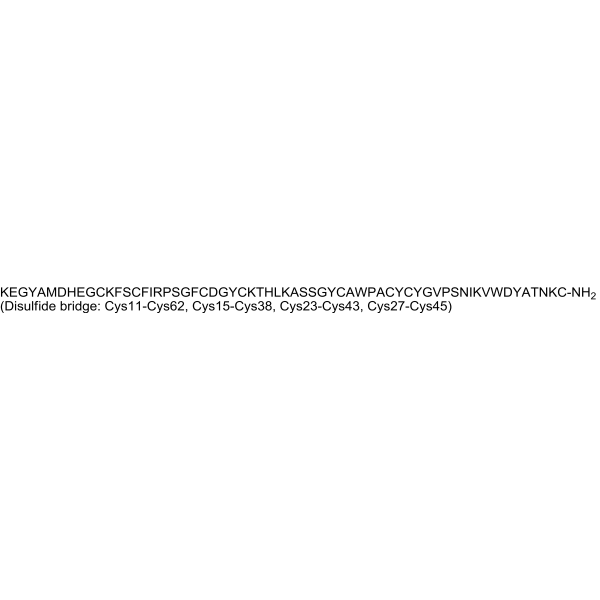
Scorpion toxin Tf2 is a selective human voltage-gated sodium channel Nav1.3 (hNav1.3) activator. Scorpion toxin Tf2 selectively shifts the channel's activation voltage to more negative values, enabling channel opening at resting membrane potentials. Scorpion toxin Tf2 can be used for the research of epilepsy, nociception (after spinal cord injury) .
loading...
    loading...
Cat. No.: HY-P5175
Target:  

mAChR

Research Areas:  

Neurological Disease

Muscarinic toxin 7 is a peptide toxin with selective and noncompetitive antagonism at the muscarinic M1 receptor .
loading...
    loading...
Cat. No.: HY-DP5354AF
Target:  

Fluorescent Dye

Research Areas:  

Others

Biotin-FRETS-VWF73 TFA is a biotin-labeled 73-amino acid peptide. FRETS-VWF73 TFA is a fluorescent substrate for ADAMTS13 detection (Ex=340 nm; Em=450 nm) .
loading...
    loading...
Cat. No.: HY-P10429
Target:  

CXCR

Research Areas:  

Infection

RCP168 is a highly selective and affinity CXCR4 receptor antagonist (IC50=5 nM). RCP168 has a stronger ability than natural chemical factors to inhibit the entry of HIV-1 (human immunodeficiency virus type 1) into host cells via CXCR4 receptors. RCP168 inhibits HIV-1 infection by blocking viral binding sites or inducing receptor internalization. RCP168 can be used to analyze the interaction between CXCR4 receptor and other chemical factor receptors .
loading...
    loading...
Cat. No.: HY-P4971
CAS No.: 1816940-05-2
Target:  

Complement System

Research Areas:  

Inflammation/Immunology

C5a Anaphylatoxin (human) is a pro-inflammatory peptide and a leukocyte chemoattractant. C5a Anaphylatoxin (human) can be used to study inflammation and immunity, such as allergic asthma .
loading...
    loading...
Cat. No.: HY-P1264F
Target:  

nAChR

Research Areas:  

Neurological Disease

FITC-labeled α-Bungarotoxin is FITC-conjugated α-Bungarotoxin (HY-P1264). α-Bungarotoxin acts as a competitive antagonist of nicotinic acetylcholine receptors (nAChRs) .
loading...
    loading...

