1. Search Result
Search Result
Results for "

CoREST complex

" in MedChemExpress (MCE) Product Catalog:

12

Inhibitors & Agonists

1

Click Chemistry

Cat. No. Product Name Target Research Areas Chemical Structure
  • HY-153358

    HDAC Cancer
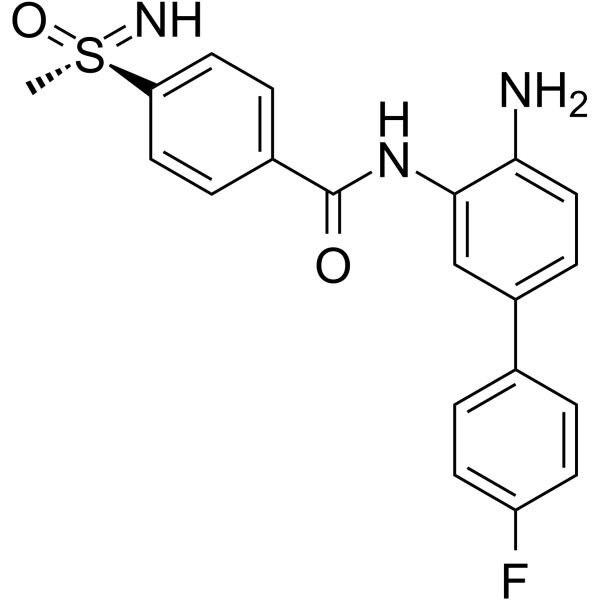
    TNG260 is a selective, orally effective inhibitor of HDAC1 and CoREST complex, with a 10-fold selectivity for HDAC1 over HDAC3 and a 500-fold selectivity for CoREST complex over NuRD and Sin3 complex. TNG260 reshapes the tumor immune microenvironment, reduces immunosuppressive neutrophil infiltration, promotes effector T cell recruitment, and reverses anti-PD-1 resistance caused by STK11 deficiency by inhibiting the activity of the CoREST-HDAC1 complex. TNG260 induces durable tumor regression in combination with α-PD1 in MC38 tumor-bearing mice with STK11 mutations, and has lower toxicity to bone marrow cells than non-selective HDAC inhibitors .
    TNG260
  • HY-172762

    HDAC Molecular Glues Histone Demethylase Cancer
    S234984 is a molecular glue degrader. S234984 forms a stable ternary complex with wild-type KBTBD4 E3 ligase and HDAC2 to drive neomorphic ubiquitination and degradation of CoREST1 and LSD1. S234984 can be used for the research of medulloblastoma .
    S234984
  • HY-175184

    Histone Demethylase Infection
    LSD1-IN-44 (Compound 19) is a LSD1 inhibitor with an IC50 of 0.02  μM for LSD1-CoREST enzymatic complex. LSD1-IN-44 has significant antischistosomal activity against transformed schistosomula (NTS) and Schistosoma mansoni adult worms while showing a delayed onset of action towards juvenile forms. LSD1-IN-44 has no significant toxicity to human cells. LSD1-IN-44 can be used for schistosomiasis research .
    LSD1-IN-44
  • HY-176866

    HDAC Neurological Disease
    Rodin-A is an orally active, brain-penetrant and selective histone deacetylase (HDAC)-co-repressor of repressor element-1 silencing transcription factor (CoREST) complex inhibitor with an IC50 value of 1.80 μM for the CoREST complex, 0.15 μM for HDAC1, and 0.43 μM for HDAC2. Rodin-A increases the acetylation level of histone H3K9, upregulates the expression of neuron-related genes, thereby promoting the increase in dendritic spine density, the colocalization of synaptic proteins (SV2A and PSD95), and the improvement of hippocampal long-term potentiation (LTP), exerting synaptic protection and repair activity. Rodin-A is promising for research of neurodegenerative diseases related to synaptic dysfunction, especially Alzheimer’s disease .
    Rodin-A
  • HY-176868

    HDAC Neurological Disease
    Rodin-C is a selective HDAC inhibitor with IC50s of 0.059, 0.18   and 5.39 μM for HDAC1, HDAC2 and HDAC11, respectively, over HDAC3-10. Rodin-C significantly inhibits the HDAC-CoREST complex with low hematological toxicity. Rodin-C can be used for neurologic disorders such as Alzheimer’s disease research .
    Rodin-C
  • HY-161848

    Histone Demethylase Cancer
    TCP-MP-CA (compound 11a) is an inhibitor of LSD1 demethylation enzymatic via binding to LSD1/CoREST complex. TCP-MP-CA exhibits an inhibitory effect on osteoclastogenesis, with an IC50 value of 0.14 µM .
    TCP-MP-CA
  • HY-175185

    Histone Demethylase Infection
    MC3935 is a LSD1 inhibitor with an IC50 of 0.52  μM for LSD1-CoREST enzymatic complex. MC3935 has significant antischistosomal activity against transformed schistosomula (NTS) and Schistosoma mansoni adult worms while showing a delayed onset of action towards juvenile forms. MC3935 has no significant toxicity to human cells. MC3935 can be used for schistosomiasis research .
    MC3935
  • HY-161849

    Histone Demethylase Metabolic Disease
    LSD1-IN-31 (compound 11e) can directly bind to LSD1/CoREST complex to reduce LSD1 demethylation enzymatic activity. LSD1-IN-31 inhibits LSD1 demethylation activity and influences its downstream IκB/NF-κB signaling pathway. LSD1-IN-31 inhibits osteoclastic bone loss in vitro and in vivo. LSD1-IN-31 can be used for osteoporosis research .
    LSD1-IN-31
  • HY-176867

    HDAC Neurological Disease
    Rodin-B is a selective histone deacetylase (HDAC)-co-repressor of repressor element-1 silencing transcription factor (CoREST) complex inhibitor with an IC50 value of 0.50 μM for the CoREST complex, 0.27 μM for HDAC1, and 0.28 μM for HDAC2. Rodin-B increases the acetylation level of histone H3K9, upregulates the expression of neuron-related genes, thereby promoting the increase in dendritic spine density, the colocalization of synaptic proteins (SV2A and PSD95), and the improvement of hippocampal long-term potentiation (LTP), exerting synaptic protection and repair activity. Rodin-B is promising for research of neurodegenerative diseases related to synaptic dysfunction, especially Alzheimer’s disease .
    Rodin-B
  • HY-182891

    Histone Demethylase Cancer
    MC4455 is a LSD1/PRMT5 dual inhibitor. MC4455 inhibits the LSD1/CoREST and PRMT5/MEP50 complex with IC50 values of 0.104 μM and 0.014 μM. MC4455 covalently binds to LSD1’s FAD cofactor, stabilizes the LSD1/CoREST complex. MC4455 induces myeloid differentiation, alters transcriptomic profiles, drives alternative splicing changes, and impairs leukemic cell viability in AML cells. MC4455 can be used for the research of acute myeloid leukemia .
    MC4455
  • HY-182892

    Histone Demethylase Histone Methyltransferase Cancer
    MC4491 is a selective LSD1/PRMT5 inhibitor, with an IC50 of 0.152 μM against the LSD1/CoREST complex and an IC50 of 0.043 μM against the PRMT5/MEP50 complex. MC4491 induces transcriptomic changes and splicing alterations in AML cells. MC4491 is applicable for the research of acute myeloid leukemia .
    MC4491
  • HY-183105

    Histone Demethylase Apoptosis Cancer
    DC551040 is an orally active and selective lysine demethylase 1 (LSD1) inhibitor with a human IC50 of 2.14 nM. DC551040 binds to LSD1 via π-π stacking with Trp552, polar interactions with Phe538, and covalent adduct formation with FAD, and disrupts the LSD1-GFI1B-CoREST complex. DC551040 induces H3K4me2 accumulation, apoptosis, and cell differentiation, activates STAT5, NF-κB, AKT, and IL6-STAT3 pathways, and upregulates IL6 expression. DC551040 can be used for the research of acute myeloid leukemia .
    DC551040

Inquiry Online

Your information is safe with us. * Required Fields.

Salutation


Country or Region *

Applicant Name *


Organization Name *

Department *


Email Address *


Product Name *

Cat. No.


Requested quantity *

Phone Number *


Remarks

Inquiry Online

Inquiry Information

Product Name:
Cat. No.:
Quantity:
MCE Japan Authorized Agent:

