7 Results for "

Dual-modality

" in MedChemExpress (MCE) Product Catalog:
Products (7)

7 Results for "Dual-modality" in MCE Product Catalog:

Cat. No.: HY-P1997
CAS No.: 34787-28-5
Synonyms: Desferrichrome; DFC; N-Desferriferrichrome
Target:  

JNK Apoptosis

Research Areas:  

Infection Cancer

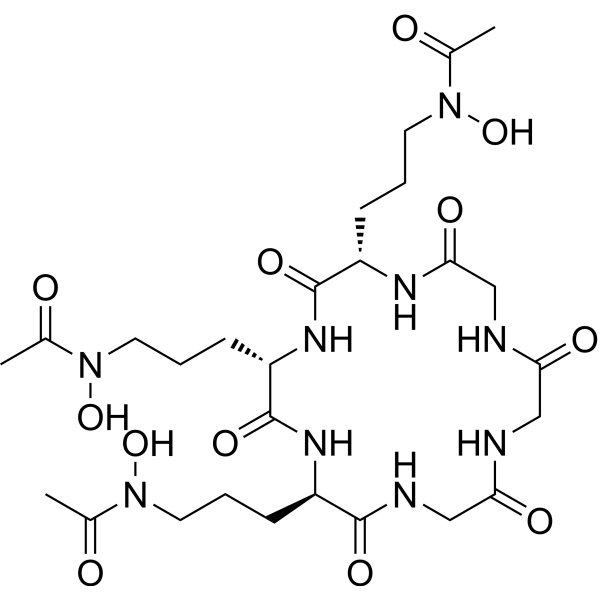
Ferrichrome Iron-free (Desferrichrome; DFC; N-Desferriferrichrome) is the ligand form of iron-loaded Ferrichrome when it is not bound to Fe 3+. Ferrichrome Iron-free induces apoptosis in gastric cancer cells by activating the JNK-DDIT3 apoptotic axis. As an iron chelator, Ferrichrome Iron-free enables dual-modal imaging of HER2 via conjugation with SiR and Trastuzumab (HY-P9907). Ferrichrome Iron-free can be used in the research of gastric cancer and HER2-overexpressing cancers .
loading...
    loading...
Cat. No.: HY-P11339A
Target:  

Integrin

Research Areas:  

Cancer

c-RGD-SH TFA is an Integrin αvβ3 ligand. c-RGD-SH TFA conjugated with core-crosslinked polymeric micelles (CCPM) can be used for synthesis a dual modality nanoparticle probe, and this probe labeled with both Cy7 and 111In can be used for SPECT and NIRF imaging of tumor .
loading...
    loading...
Cat. No.: HY-D3000
NIR-RED ROS-H2O2 Probe is a near-infrared fluorescent probe used for detecting hydrogen peroxide (H₂O₂) and featuring dual-modal fluorescence/photoacoustic imaging capabilities. NIR-RED ROS-H2O2 Probe successfully detects the upregulated fluorescence signal of H₂O₂ in HepG2 cells and a mouse liver injury model. NIR-RED ROS-H2O2 Probe can be used as a biomarker detection tool for drug-induced liver injury (DILI) .
loading...
    loading...
Cat. No.: HY-D3065
CAS No.: 2587588-33-6
Target:  

Fluorescent Dye

Research Areas:  

Neurological Disease Cancer

BODIPY-DOH is a reversible near-infrared photoacoustic/fluorescence dual-modal redox probe. BODIPY-DOH undergoes conversion of its catechol group to o-quinone upon oxidation by O2 •-, causing a red shift of the absorption peak from 680 nm to 750 nm, and can be reduced and restored by L-Glutathione reduced (GSH) (HY-D0187), thereby achieving a reversible response of the PA750/PA680 ratiometric signal (fluorescence Ex = 633 nm; photoacoustic dual-channel at 680/750 nm). BODIPY-DOH is applicable for research in tumor oxidative microenvironment imaging, spinal cord injury, and other oxidative stress-related disease fields .
loading...
    loading...
Cat. No.: HY-D3118
CAS No.: 2989973-69-3
Target:  

Fluorescent Dye

Research Areas:  

Others

Biotin-V is a fluorescent probe targeting the biotin receptor (BiR), which can be used to detect changes in intracellular viscosity in cancer cells and tumor tissues. Biotin-V consists of a viscosity-responsive TICT (twisted internal charge transfer) fluorophore and a biotin-targeting moiety. In a high-viscosity environment, intramolecular rotation is restricted, which reduces non-radiative transitions and enhances fluorescence intensity and fluorescence lifetime. Biotin-V enters BiR-positive cancer cells via biotin receptor-mediated uptake, and mainly localizes to mitochondria, enabling dual-modal viscosity imaging (fluorescence intensity imaging and fluorescence lifetime imaging) (Ex/Em = 540/608 nm; cell imaging Ex/Em = 561/570-620 nm) .
loading...
    loading...
Cat. No.: HY-D3428
CAS No.: 2863678-02-6
LJ-2P is an NIR-II small-molecule fluorescent probe with fibrin/fibrinogen affinity. LJ-2P can bind coagulation-related proteins and restrict dye molecular motion, thereby enhancing local fluorescence for high-contrast imaging of bleeding and blood clots in vivo. LJ-2P can also co-precipitate with Ca 2+ to form LJ-2P nanoparticles, significantly enhancing NIR-II luminescence through the precipitation-enhanced emission (PEE) mechanism. LJ-2P can be used for research on bleeding disorders and breast cancer. LJ-2P exhibits dual-modal emission properties (Ex/Em ≈740/945 nm or 740/1066 nm) .
loading...
    loading...
Cat. No.: HY-D3133
CAS No.: 2410296-16-9
Target:  

Fluorescent Dye

Research Areas:  

Others

HS-CyBz is a Fluorescent probe for H₂S detection, enabling ratiometric optical/photoacoustic dual-modality in/ex vivo imaging. Its detection mechanism relies on nucleophilic substitution of its benzoic ester group by HS⁻, which releases an enolic meso-hydroxyltricarboheptamethine cyanine that then undergoes keto-enol tautomerization to form Cy-ketone; this tautomerization causes distinct shifts in absorption and emission spectra, producing a ratiometric response that reduces interferences from tissue scattering, autofluorescence, and probe concentration. In its initial state, HS-CyBz has an excitation wavelength of 595 nm, with emission bands centered at 805 nm (main) and 630 nm (minor); upon reaction with H₂S, the 805 nm emission band decreases while the 630 nm band drastically increases, and its absorption spectrum shows a sharp band at 775 nm and a shoulder band at 708 nm, which decrease upon H₂S reaction with a minor increase at 850 nm and an isosbestic point at 825 nm. For in vivo optical imaging, excitation at 560 nm is used with emission channels at 620 nm and 790 nm, while in vivo photoacoustic imaging uses excitation at 775 nm and 825 nm. The detection limit of HS-CyBz for H₂S is 0.5 μM, and it shows high selectivity, with only H₂S inducing a distinct enhancement of the emission ratio F₆₃₀/F₈₀₅ and PA ratio PA₈₂₅/PA₇₇₅, while other biochemical species including cations, anions, reactive oxygen species, biothiols, and carboxylesterase trigger only minor changes and do not interfere with H₂S sensing. Tail intravenous injection of HS-CyBz leads to accumulation in the liver of mice, and it can be used to verify endogenous H₂S upregulation triggered by S-adenosyl-L-methionine via ratiometric optical/photoacoustic imaging .
loading...
    loading...

