7 Results for "

FGF2 signaling

" in MedChemExpress (MCE) Product Catalog:
Products (7)

7 Results for "FGF2 signaling" in MCE Product Catalog:

4
4 Cited Publications
Cat. No.: HY-P1408
CAS No.: 404882-00-4
Target:  

Integrin VEGFR

Research Areas:  

Cancer

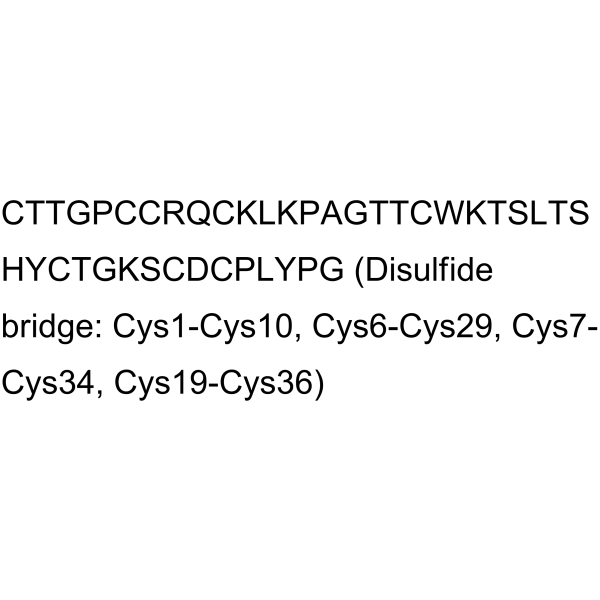
Obtustatin is a non-RGD disintegrin consisting of 41 residues. Obtustatin inhibits the adhesion of α1β1 integrin to type IV Collagen (HY-NP003), blocks α1β1 integrin signaling in endothelial cells, and suppresses FGF2-induced angiogenesis. Obtustatin inhibits tumor progression in mouse models and upregulates VEGF expression in sarcoma-bearing mice. Obtustatin can be used in research related to Lewis lung carcinoma and S-180 sarcoma .
loading...
    loading...
2
2 Cited Publications
Cat. No.: HY-122704A
CAS No.: 5424-37-3
Synonyms: Aminoquinuride dihydrochloride
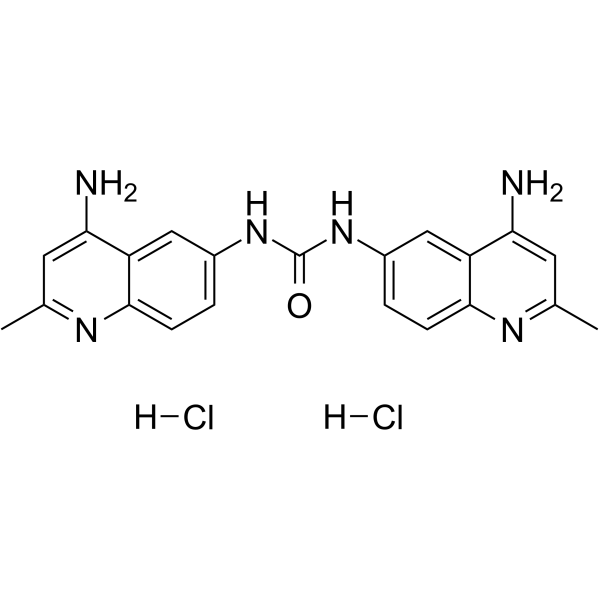
Surfen dihydrochloride is a potent heparan sulfate antagonist. Surfen inhibits FGF2 binding and signal transduction. Surfen binds to glycosaminoglycans and reduces tau hyperphosphorylation. Surfen dihydrochloride inhibits the activity of recombinant uronyl 2-O-sulfotransferase with an IC50 of approximately 2 μM. Surfen dihydrochloride inhibits HSV-1 viral infection. Surfen dihydrochloride inhibits neural differentiation, delays remyelination, and alleviates EAE .
loading...
    loading...
Cat. No.: HY-122704
CAS No.: 3811-56-1
Synonyms: Aminoquinuride
Surfen is a potent heparan sulfate antagonist. Surfen inhibits FGF2 binding and signal transduction. Surfen binds to glycosaminoglycans and reduces tau hyperphosphorylation. Surfen inhibits the activity of recombinant uronyl 2-O-sulfotransferase with an IC50 of approximately 2 μM. Surfen inhibits HSV-1 viral infection. Surfen inhibits neural differentiation, delays remyelination, and alleviates EAE .
loading...
    loading...
Cat. No.: HY-118184
CAS No.: 1195786-61-8
Target:  

PGE synthase

Research Areas:  

Cancer

AF3485 is a human mPGES-1 inhibitor that exhibits antitumor activity in vitro and in vivo. AF3485 inhibits tumor-associated angiogenesis by reducing PGE2 production, inhibiting EGFR signaling, and decreasing VEGF and FGF-2 expression. AF3485 reduced tumor growth in mice bearing human A431 xenograft tumors by subchronic administration.
loading...
    loading...
Cat. No.: HY-118792
CAS No.: 352346-46-4
Target:  

Endogenous Metabolite

Research Areas:  

Cancer

AHR activator 1 is an aryl hydrocarbon receptor activator with activity regulating fibroblast growth factor-2 (FGF2)-induced branching morphogenesis. AHR activator 1 prevents the formation of cellular branches by inhibiting AHR signaling. AHR activator 1 also associates with adhesion of dissociated linkers, suggesting the importance of dissociated linkers in the inhibition of branching by AHR agonists. Studies of AHR activator 1 reveal its functional role in mammary gland morphogenesis and play a role in inhibiting FGF-induced invasion .
loading...
    loading...
Cat. No.: HY-P992201
Synonyms: CL1-R2
Anti-CD160 Antibody (MAT 302) (CL1-R2) is a human monoclonal antibody targeting CD160. Anti-CD160 Antibody (MAT 302) blocks the CD160-HVEM protein interaction, inhibits FGF2-mediated renal tubular vascular growth, and induces endothelial cell apoptosis. Anti-CD160 Antibody (MAT 302) targets CD160 on neovascularization to exert anti-angiogenic and vascular normalization effects, trigger the production of IFN-γ, TNF and IL-6 by NK cells, and enhance glucose metabolism of NK cells through the AKT/mTOR/s6k signaling pathway. Anti-CD160 Antibody (MAT 302) reduces vascular density, normalizes remaining tumor blood vessels, and inhibits tumor growth in melanoma-bearing mice. Anti-CD160 Antibody (MAT 302) can be used in research related to neovascularization, proliferative diabetic retinopathy, and melanoma .
loading...
    loading...
Cat. No.: HY-10321G
CAS No.: 219580-11-7
PD173074 GMP is PD173074 (HY-10321) produced by using GMP guidelines. GMP small molecules works appropriately as an auxiliary reagent for cell therapy manufacture. PD173074 is an orally active FGFR inhibitor that targets the transphosphorylation of FGFR1 and FGFR2 and blocks the FGF signaling pathway. By reducing the phosphorylation level of SMAD2 and altering the expression of Nodal/Activin target genes, PD173074 eliminates endothelial differentiation potential, thereby inhibiting the formation of capillary-like structures. PD173074 blocks the proliferation and colony formation of tumor cells and increases intratumoral cell apoptosis. PD173074 successfully reverses FGF-2-induced chemoresistance to enhance the effect of cisplatin (HY-17394) in small cell lung cancer models. PD173074 can be applied to research related to critical limb ischemia and small cell lung cancer .
loading...
    loading...

