9 Results for "

G-protein binding site

" in MedChemExpress (MCE) Product Catalog:
Products (9)

9 Results for "G-protein binding site" in MCE Product Catalog:

Cat. No.: HY-W013706
CAS No.: 35908-31-7
Synonyms: ITP trisodium salt; Inosine triphosphate trisodium salt
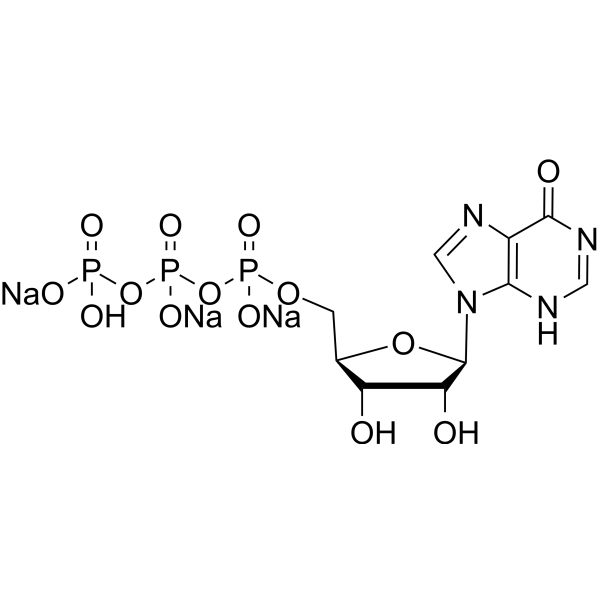
Inosine-5'-triphosphate trisodium salt is a nucleotide analogue that acts on multiple G proteins and is widely used in G protein-related research. It can bind to the α -subunit of G proteins and participate in G protein-mediated signal transduction as a substitute for GTP. Its mechanism of action is to interact with the nucleotide-binding site of the G protein α -subunit, affecting the activity and function of G proteins. In the research field, it is mainly used to explore the role of the G protein signaling pathway in cellular physiological and pathological processes. For example, in HL-60 leukemia cells, its impact on G protein-mediated signal transduction can be studied .
loading...
    loading...
Cat. No.: HY-162505
CAS No.: 1255915-27-5
Target:  

CCR CXCR

Research Areas:  

Inflammation/Immunology Cancer

SQA1, a squaramide (SQA) derivative, is a CCR6 antagonist with a Kd of 250 nM. SQA1 is also a CXCR2 inhibitor. The intracellular pocket occupied by SQA1 overlaps with the G protein binding site and stabilizes the closed conformation of the intracellular pocket .
loading...
    loading...
Cat. No.: HY-129274
CAS No.: 911114-85-7
Target:  

mGluR

Research Areas:  

Neurological Disease

RO4988546 is a negative allosteric modulator (NAM) that targets metabotropic glutamate receptors 2 and 3 (mGlu2, mGlu3). RO4988546 can reduce the binding of [ 3h]-LY354740 at the positive binding site, while affecting the receptor's G protein coupling and intracellular signaling. RO4988546 can be used in the development of antidepressants and cognitive enhancers .
loading...
    loading...
Cat. No.: HY-159920
PSB-22269 is a GPR17 antagonist with a Ki value of 8.91 nM. PSB-22269 further demonstrated significant inhibitory effects in cAMP and G protein activation assays. Molecular docking studies revealed that the binding site of PSB-22269 contains positively charged arginine residues and a hydrophobic pocket. PSB-22269 provides a strategy to promote remyelination and holds promise for research in the field of multiple sclerosis .
loading...
    loading...
Cat. No.: HY-150172A
CAS No.: 3056945-75-3
Synonyms: ITP lithium salt; Inosine triphosphate lithium salt
Target:  

Endogenous Metabolite

Research Areas:  

Metabolic Disease

Inosine-5'-triphosphate (ITP) lithium salt is a nucleotide analogue that acts on multiple G proteins. Inosine-5'-triphosphate lithium salt can bind to the α -subunit of G proteins and participate in G protein-mediated signal transduction as a substitute for GTP. Inosine-5'-triphosphate lithium salt interacts with the nucleotide-binding site of the G protein α -subunit, affecting the activity and function of G proteins. Inosine-5'-triphosphate lithium salt is used to explore the role of the G protein signaling pathway in cellular physiological and pathological processes .
loading...
    loading...
Cat. No.: HY-121837
CAS No.: 2088234-50-6
β2AR-IN-15 is a selective β2-adrenergic receptor (β2AR) antagonist with a Kd of 1.7 μM. β2AR-IN-15 binds to an intracellular β2AR region overlapping the G-protein binding site, enhancing orthosteric inverse agonist binding while negatively modulating binding of orthosteric agonists with EC50 values of 1.9 and 0.48 μM. β2AR-IN-15 shows inhibitory effect on cAMP production and β-arrestin recruitment to activated β2AR. β2AR-IN-15 can be used for the research of cardiovascular and pulmonary diseases .
loading...
    loading...
Cat. No.: HY-W013706R
CAS No.: 35908-31-7
Synonyms: ITP trisodium salt (Standard); Inosine triphosphate trisodium salt (Standard)
Inosine-5'-triphosphate (trisodium salt) (Standard) is the analytical standard of Inosine-5'-triphosphate (trisodium salt) (HY-W013706). This product is intended for research and analytical applications. Inosine-5'-triphosphate trisodium salt is a nucleotide analogue that acts on multiple G proteins and is widely used in G protein-related research. It can bind to the α -subunit of G proteins and participate in G protein-mediated signal transduction as a substitute for GTP. Its mechanism of action is to interact with the nucleotide-binding site of the G protein α -subunit, affecting the activity and function of G proteins. In the research field, it is mainly used to explore the role of the G protein signaling pathway in cellular physiological and pathological processes. For example, in HL-60 leukemia cells, its impact on G protein-mediated signal transduction can be studied .
loading...
    loading...
Cat. No.: HY-L928
7,106 compounds

G protein-coupled receptors (GPCRs) are membrane proteins in humans and one of the most important targets in drug discovery. Approximately 35% of launched drugs are targeted GPCRs, making them a crucial class of targets in drug discovery.

The orthosteric site of a GPCR is its endogenous ligand’s (such as neurotransmitters or hormones) binding site. This site plays a central role in signal transduction. Small molecules binding to this site typically contain a protonatable amino group, enabling the formation of salt bridges or hydrogen bonds with acidic residues in the binding pocket. In contrast, the allosteric site does not directly initiate signaling but modulates the signal intensity of the GPCR by altering or stabilizing the conformation of the orthosteric site. Small molecules binding to the allosteric site often contain multiple aromatic rings to occupy hydrophobic pockets and achieve their functional effects.

MCE has collected over 7,106 reported bioactive molecules targeting GPCRs, covering Class A, B, and C GPCRs. These small molecules were subjected to AI representation to extract 2D and 3D features. Subsequently, we do screening by AI score based on similarity to identify molecules in diversity library highly similar to the reported bioactive molecules in both 2D and 3D, with a threshold greater than 0.7. Further screening based on cLogP was applied to select molecules with good lipophilicity, which facilitates the binding of small molecules to GPCRs. This diversity library can be widely applied to the discovery of compounds targeting GPCR proteins.

Cat. No.: HY-L062
2,593 compounds

Neurotransmitter (NT) receptors, also known as neuroreceptors, are a broadly diverse group of membrane proteins that bind neurotransmitters for neuronal signaling. There are two major types of neurotransmitter receptors: ionotropic and metabotropic. Ionotropic receptors are ligand-gated ion channels, meaning that the receptor protein includes both a neurotransmitter binding site and an ion channel. The binding of a neurotransmitter molecule (the ligand) to the binding site induces a conformational change in the receptor structure, which opens, or gates, the ion channel. The term “metabotropic receptors” is typically used to refer to transmembrane G-protein-coupled receptors. Metabotropic receptors trigger second messenger-mediated effects within cells after neurotransmitter binding.

In some neurological diseases, the neurotransmitter receptor itself appears to be the target of the disease process. Many neuroactive drugs act by modifying neurotransmitter receptors. A better understanding of neurotransmitter receptor changes in disease may lead to improvements in therapy.

MCE designs a unique collection of 2,593 compounds targeting a variety of neurotransmitter receptors. MCE Neurotransmitter Receptor Compound Library is a useful tool for neurological diseases drug discovery.

