1. Search Result
Search Result
Results for "

H292

" in MedChemExpress (MCE) Product Catalog:

16

Inhibitors & Agonists

1

Peptides

6

Natural
Products

1

Isotope-Labeled Compounds

1

Click Chemistry

Cat. No. Product Name Target Research Areas Chemical Structure
  • HY-138253

    dFdU; 2',2'-Difluoro-2'-deoxyuridine

    Drug Metabolite Apoptosis Cancer
    2’,2’-Difluorodeoxyuridine (dFdU) is the main metabolite of Gemcitabine (HY-17026). 2’,2’-Difluorodeoxyuridine causes a concentration- and schedule- dependent radiosensitising effect in vitro. 2’,2’-Difluorodeoxyuridine arrests cell cycle at the early S phase and induces apoptosis in cancer cells .
    2′,2′-Difluorodeoxyuridine
  • HY-B1320
    Meclofenamic acid sodium
    Maximum Cited Publications
    8 Publications Verification

    Meclofenamate sodium

    Gap Junction Protein Endogenous Metabolite Fat Mass and Obesity-associated Protein (FTO) Inflammation/Immunology Cancer
    Meclofenamic acid (Meclofenamate) sodium is a non-steroidal anti-inflammatory agent (NSAID). Meclofenamic acid sodium is a non-selective gap-junction blocker and a highly selective inhibitor of fat - and obesity-related enzyme (FTO). Meclofenamic acid sodium has anti-inflammatory and antitumor activities .
    Meclofenamic acid sodium
  • HY-50868
    Bafetinib
    Maximum Cited Publications
    14 Publications Verification

    INNO-406; NS-187

    Bcr-Abl Src Apoptosis Cancer
    Bafetinib is an orally active Lyn/Bcr-Abl tyrosine kinase inhibitor. Bafetinib enhances the activity of several pro-apoptotic Bcl-2 homology (BH) 3-pure proteins (Bim, Bad, Bmf, and Bik) through intrinsic apoptotic pathways regulated by the Bcl-2 family, and induces apoptosis of Ph + leukemia cells. Bafetinib has antitumor activity .
    Bafetinib
  • HY-N2609
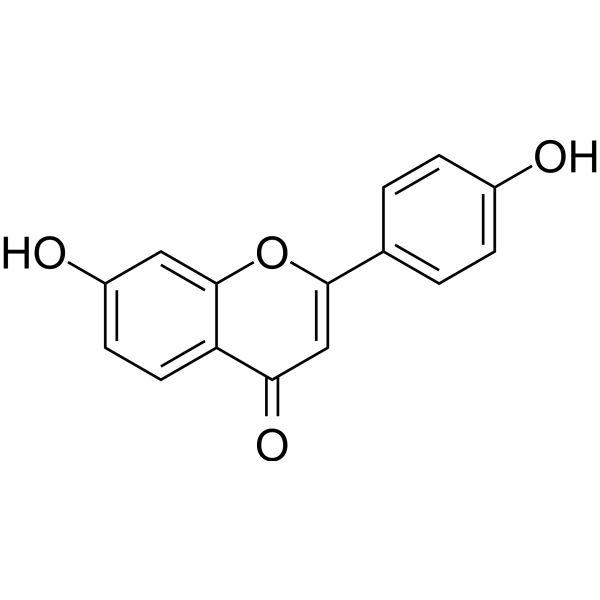
    7,4'-Dihydroxyflavone
    4 Publications Verification

    COX CCR NF-κB Inflammation/Immunology Endocrinology
    7,4'-Dihydroxyflavone (7,4'-DHF) is a flavonoid, which can be isolated from Glycyrrhiza uralensis. 7,4'-Dihydroxyflavone is eotaxin/CCL11 inhibitor and CBR1 inhibitor (IC50=0.28 μM). 7,4'-Dihydroxyflavone has the ability to consistently suppress eotaxin production and prevent dexamethasone (Dex)‐paradoxical adverse effects on eotaxin production . 7,4'-Dihydroxyflavone (7,4'-DHF) inhibits MUC5AC gene expression, mucus production and secretion via regulation of NF-κB, STAT6 and HDAC2.7,4'-Dihydroxyflavone (7,4'-DHF) decreases phorbol 12-myristate 13-acetate (PMA) stimulated NCI-H292 human airway epithelial cell MUC5AC gene expression and mucus production with IC50 value of 1.4 µM .
    7,4'-Dihydroxyflavone
  • HY-N10549
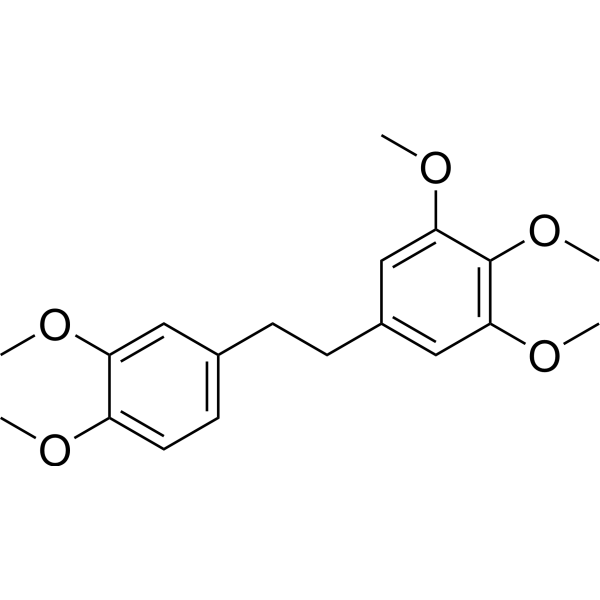
    Gigantol
    1 Publications Verification

    Ferroptosis c-Myc Glutathione Peroxidase JNK Reactive Oxygen Species (ROS) GSK-3 Infection Metabolic Disease Cancer
    Gigantol is an orally active bibenzyl compound. Gigantol targets MYC to promote its ubiquitin-proteasomal degradation and inhibit the growth of lung cancer cells. Gigantol exerts anti-lung cancer activity by inducing ferroptosis (Ferroptosis) via the SLC7A11-GPX4 axis. Gigantol restores the sensitivity of mcr-harboring multidrug-resistant bacteria to colistin. Gigantol ameliorates carbon tetrachloride-induced liver injury by inhibiting the activation of the JNK/cPLA2/12-LOX inflammatory pathway. Gigantol promotes cholesterol metabolism and progesterone biosynthesis in Leydig cells. Gigantol can be used in studies related to diseases such as lung cancer, multidrug-resistant Gram-negative bacterial infections, and acute liver injury .
    Gigantol
  • HY-138253S

    dFdU-13C,15N2; 2',2'-Difluoro-2'-deoxyuridine-13C,15N2

    Isotope-Labeled Compounds Drug Metabolite Apoptosis Others
    2′,2′-Difluorodeoxyuridine- 13C, 15N2 (dFdU- 13C, 15N2) is a 13C- and 15N-labeled compound. 2’,2’-Difluorodeoxyuridine (dFdU) is the main metabolite of Gemcitabine (HY-17026). 2’,2’-Difluorodeoxyuridine causes a concentration- and schedule- dependent radiosensitising effect in vitro. 2’,2’-Difluorodeoxyuridine arrests cell cycle at the early S phase and induces apoptosis in cancer cells .
    2′,2′-Difluorodeoxyuridine-13C,15N2
  • HY-138253R

    dFdU (Standard); 2',2'-Difluoro-2'-deoxyuridine (Standard)

    Drug Metabolite Reference Standards Apoptosis Cancer
    2′,2′-Difluorodeoxyuridine (Standard) is the analytical standard of 2′,2′-Difluorodeoxyuridine. This product is intended for research and analytical applications. 2’,2’-Difluorodeoxyuridine (dFdU) is the main metabolite of Gemcitabine (HY-17026). 2’,2’-Difluorodeoxyuridine causes a concentration- and schedule- dependent radiosensitising effect in vitro. 2’,2’-Difluorodeoxyuridine arrests cell cycle at the early S phase and induces apoptosis in cancer cells.
    2′,2′-Difluorodeoxyuridine (Standard)
  • HY-N2609R

    COX Reference Standards CCR NF-κB Inflammation/Immunology Endocrinology
    7,4'-Dihydroxyflavone (7,4'-DHF) is a flavonoid, which can be isolated from Glycyrrhiza uralensis. 7,4'-Dihydroxyflavone is eotaxin/CCL11 inhibitor and CBR1 inhibitor (IC50=0.28 μM). 7,4'-Dihydroxyflavone has the ability to consistently suppress eotaxin production and prevent dexamethasone (Dex)‐paradoxical adverse effects on eotaxin production . 7,4'-Dihydroxyflavone (7,4'-DHF) inhibits MUC5AC gene expression, mucus production and secretion via regulation of NF-κB, STAT6 and HDAC2.7,4'-Dihydroxyflavone (7,4'-DHF) decreases phorbol 12-myristate 13-acetate (PMA) stimulated NCI-H292 human airway epithelial cell MUC5AC gene expression and mucus production with IC50 value of 1.4 µM .
    7,4'-Dihydroxyflavone (Standard)
  • HY-122552

    Integrin Cancer
    Chrysotobibenzyl can be isolated from stem of Dendrobium pulchellum. Chrysotobibenzyl inhibits lung cancer cell (H460 and H292) migration, invasion, filopodia formation via Cav-1, integrins β1, β3, and αν, and EMT suppressions. Chrysotobibenzyl also sensitizes lung cancer cell death mediated by Cisplatin (HY-17394) .
    Chrysotobibenzyl
  • HY-153259

    TNK1 PARP Cancer
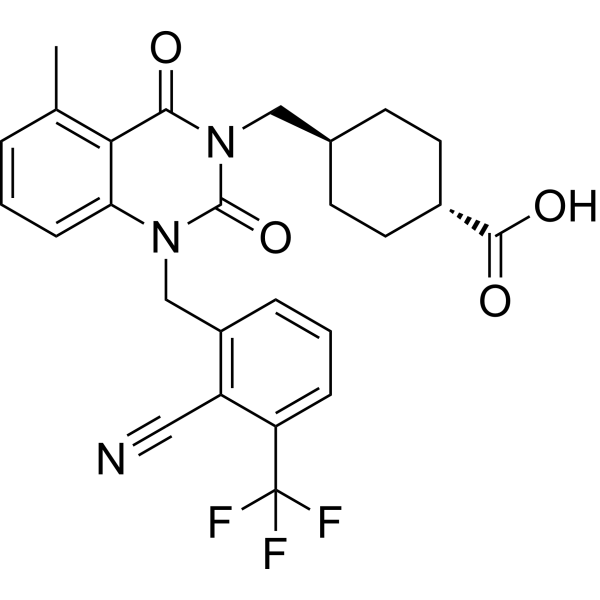
    TNKS1/2-IN-2 (Compound 21) is a potent and selective tankyrases inhibitor. TNKS1/2-IN-2 exhibits IC50 values of 4 nM and 63 nM against TNK1 and TNK2 in the enzymatic assay, respectively. TNKS1/2-IN-2 inhibits proliferation of A549 and H292 cell lines with IC50 values of 39.5 nM and 12.8 nM, respectively. TNKS1/2-IN-2 can be used for the research of cancer .
    TNKS1/2-IN-2
  • HY-176435

    mTOR Cancer
    mTOR inhibitor-28 (SM-3) is a potent mTOR inhibitor. mTOR inhibitor-28 inhibits A549, H292, and H460 cells with IC50s of 72.74, 67.66, and 43.24 μM, respectively .
    mTOR inhibitor-28
  • HY-174314

    Ligands for Target Protein for PROTAC Anaplastic lymphoma kinase (ALK) Cancer
    WZH-15-125 is a potent ALK inhibitor. WZH-15-125 can effectively overcome drug resistance, especially compound ALK mutations. WZH-15-125 has an IC50 of 101.7 nM for the highly refractory G1202R/L1196M mutation that is resistant to Lorlatinib (HY-12215). WZH-15-125 can be used as a PROTAC target protein ligand to synthesize PROTAC WZH-17-002 (HY-174315). WZH-15-125 can be used in the research of non-small cell lung cancer .
    WZH-15-125
  • HY-B1320R

    Meclofenamate sodium (Standard)

    Reference Standards Gap Junction Protein Endogenous Metabolite Fat Mass and Obesity-associated Protein (FTO) Inflammation/Immunology Cancer
    Meclofenamic acid (sodium) (Standard) is the analytical standard of Meclofenamic acid (sodium). This product is intended for research and analytical applications. Meclofenamic acid (Meclofenamate) sodium is a non-steroidal anti-inflammatory agent (NSAID). Meclofenamic acid sodium is a non-selective gap-junction blocker and a highly selective inhibitor of fat - and obesity-related enzyme (FTO). Meclofenamic acid sodium has anti-inflammatory and antitumor activities .
    Meclofenamic acid sodium (Standard)
  • HY-50868R

    INNO-406 (Standard); NS-187 (Standard)

    Bcr-Abl Src Apoptosis Reference Standards Cancer
    Bafetinib (Standard) is the analytical standard of Bafetinib. This product is intended for research and analytical applications. Bafetinib is an orally active Lyn/Bcr-Abl tyrosine kinase inhibitor. Bafetinib enhances the activity of several pro-apoptotic Bcl-2 homology (BH) 3-pure proteins (Bim, Bad, Bmf, and Bik) through intrinsic apoptotic pathways regulated by the Bcl-2 family, and induces apoptosis of Ph+ leukemia cells. Bafetinib has antitumor activity .
    Bafetinib (Standard)
  • HY-P99789

    CX-2009; CD166

    Antibody-Drug Conjugates (ADCs) Cancer
    Praluzatamab ravtansine (CX-2009) is an anti-CD166 antibody drug conjugate (ADC) with an Kd value of 25.15 nM. Praluzatamab ravtansine contains an anti-CD166 monoclonal antibody Praluzatamab (HY-P99788) conjugated to the microtubule inhibitor DM4 (HY-12454). Praluzatamab ravtansine shows tumor targeting and can be used for the study of lung cancer and breast cancer .
    Praluzatamab ravtansine
  • HY-153605

    EGFR Cancer
    EGFR-IN-77 (Compound 4a) is a selective EGFR T790M/L858R inhibitor, with an IC50 of 0.101 μM against EGFR T790M/L858R, 0.477 μM against EGFR L858R, and 1.771 μM against wild-type EGFR. EGFR-IN-77 exerts selective antiproliferative effects on EGFR T790M/L858R non-small cell lung cancer. EGFR-IN-77 can be used for the research of EGFR L858R/T790M double-mutant non-small cell lung cancer .
    EGFR-IN-77

Inquiry Online

Your information is safe with us. * Required Fields.

Salutation


Country or Region *

Applicant Name *


Organization Name *

Department *


Email Address *


Product Name *

Cat. No.


Requested quantity *

Phone Number *


Remarks

Inquiry Online

Inquiry Information

Product Name:
Cat. No.:
Quantity:
MCE Japan Authorized Agent:

