1. Search Result
Search Result
Results for "

HMC3

" in MedChemExpress (MCE) Product Catalog:

19

Inhibitors & Agonists

2

Biochemical Assay Reagents

8

Peptides

Cat. No. Product Name Target Research Areas Chemical Structure
  • HY-W042416
    N,N-Dimethylacetamide
    1 Publications Verification

    DMAc

    NF-κB Neurological Disease Metabolic Disease Inflammation/Immunology
    N,N-Dimethylacetamide (DMAc) is an organic solvent with blood-brain transmissibility and an FDA-approved drug excipient. N, N-dimethylacetamide exerts anti-inflammatory activity by inhibiting the NF-κB signaling pathway. N, N-dimethylacetamide can be used in studies of weight gain caused by a high-fat diet and neuroinflammation in Alzheimer's disease [3].
    N,N-Dimethylacetamide
  • HY-W009123

    cis-13-Docosenamide

    Endogenous Metabolite Bacterial Infection Neurological Disease
    Erucamide is an orally active, blood-brain barrier-permeable TMEM19 ligand and T3SS inhibitor. Erucamide exerts retinal neuroprotective effects in mouse models of retinal degeneration. Erucamide attenuates depression- and anxiety-like behaviors in mice.\n\nErucamide binds to the conserved hydrophobic pocket in HrcC, disrupts its outer membrane localization, and blocks T3SS-mediated effector protein secretion in Gram-negative pathogenic bacteria. Erucamide enhances the antimicrobial immunity of plants against pathogenic bacteria. Erucamide can be used in research related to retinitis pigmentosa, anxiety and depression, bacterial wilt, and bacterial blight [3] .
    Erucamide
  • HY-B0678

    AHR438; NSC170959

    NF-κB PGC-1α Neurological Disease Inflammation/Immunology
    Metaxalone (AHR438; NSC170959) is an FDA-approved muscle relaxant. Metaxalone acts mainly on the central nervous system and achieves muscle relaxation by inhibiting polysynaptic reflex arcs. In addition, Metaxalone is an inhibitor of MAO-A, which has anti-inflammatory and antioxidant effects. Metaxalone inhibits IL-1β-induced inflammatory phenotype, modulates NF-κB and other related signaling pathways, and decreases MAO-A expression and activity in IL-1β-treated microglia .
    Metaxalone
  • HY-174369

    TREM receptor Syk Neurological Disease
    TREM2 agonist-3 (Compound 4i) is a TREM2 agonist with a KD value of 19.0 µM. The KD value of TREM2 agonist-3 for TREM1 is 39.8 µM. TREM2 agonist-3 induces an increase in phosphorylated SYK levels. TREM2 agonist-3 can be used in the research of neurodegenerative diseases and other diseases associated with TREM2 dysfunction .
    TREM2 agonist-3
  • HY-P1217

    Melanocortin Receptor Inflammation/Immunology
    [D-Trp8]-γ-MSH is a potent and selective agonist of melanocortin 3 (MC3) receptor, with IC50s of 6.7 nM, 600 nM and 340 nM for hMC3, hMC4 and hMC5, respectively in CHO cells. [D-Trp8]-γ-MSH could provide protection against multiple inflammatory disorders such as rheumatoid arthritis and colitis .
    [D-Trp8]-γ-MSH
  • HY-P1208

    Melanocortin Receptor Inflammation/Immunology
    PG-931, an analog of SHU 9119 (HY-P0227), is a potent melanocortin 4 (MC4) receptor (IC50=0.58 nM) agonist and is more selective than for the hMC3R (IC50=55 nM) or the hMC5R (IC50=2.4 nM). PG-931 can reverse haemorrhagic shock and prevent multiple organ damage in vivo .
    PG-931
  • HY-P1209A

    Melanocortin Receptor Metabolic Disease
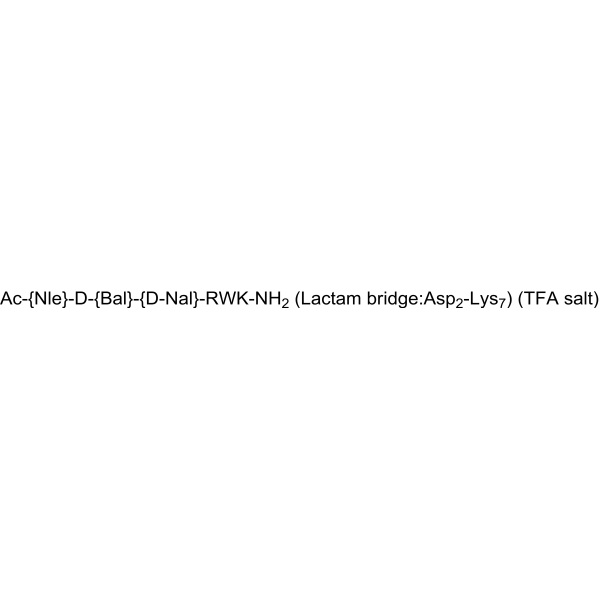
    PG106 TFA is a potent and selective human melanocortin 3 (hMC3) receptor antagonist (IC50= 210 nM) and has noactivity at hMC4 receptors (EC50=9900 nM) and hMC5 receptor .
    PG106 TFA
  • HY-120717

    mGluR Cytochrome P450 Neurological Disease
    VU6001966 is a brain-penetrant and selective mGlu2 receptor inhibitor. VU6001966 blocks mGlu2 receptor activity, counteracts LY379268 (HY-103558)-mediated blood-brain barrier protection and inflammatory cytokine dampening in microglia under inflammatory conditions. VU6001966 enhances antidepressant effects when combined with Scopolamine (HY-N0296). VU6001966 can be used for the research of major depressive disorder [3] .
    VU6001966
  • HY-P1209

    Melanocortin Receptor Inflammation/Immunology
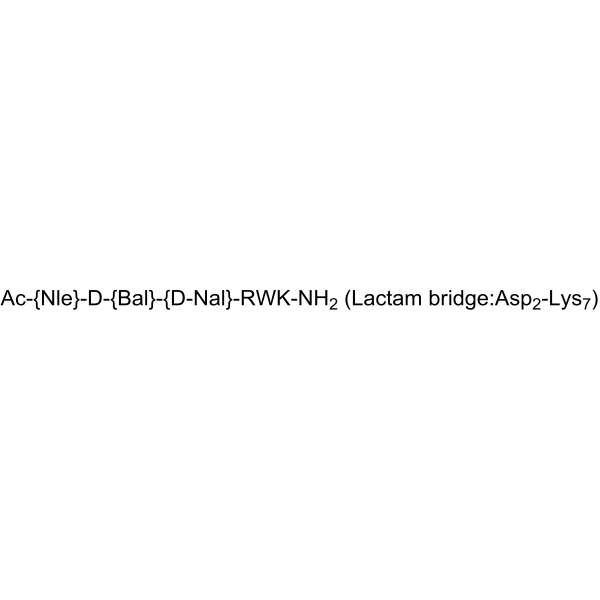
    PG106 is a potent and selective human melanocortin 3 (hMC3) receptor antagonist (IC50=210 nM) and has noactivity at hMC4 receptors (EC50=9900 nM) and hMC5 receptor .
    PG106
  • HY-P1217A

    Melanocortin Receptor Inflammation/Immunology
    [D-Trp8]-γ-MSH TFA is a potent and selective agonist of melanocortin 3 (MC3) receptor, with IC50s of 6.7 nM, 600 nM and 340 nM for hMC3, hMC4 and hMC5, respectively in CHO cells. [D-Trp8]-γ-MSH TFA could provide protection against multiple inflammatory disorders such as rheumatoid arthritis and colitis .
    [D-Trp8]-γ-MSH TFA
  • HY-P11469

    Melanocortin Receptor Interleukin Related Neurological Disease Metabolic Disease Inflammation/Immunology
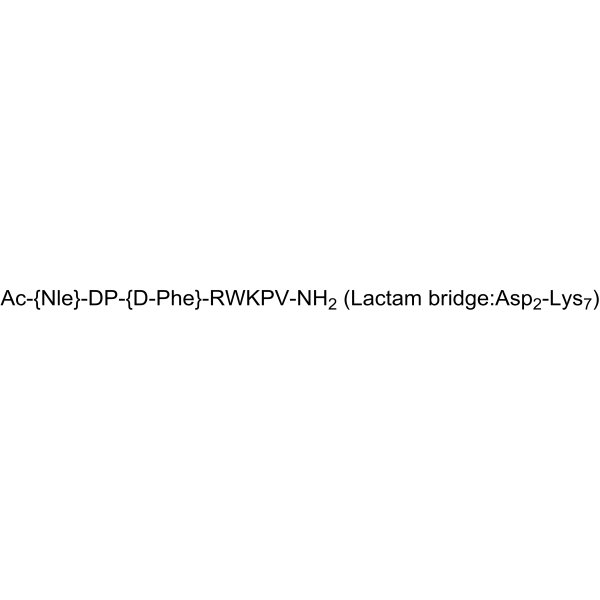
    PG-901 is a full, selective MC5R agonist (EC50 = 0.072 nM for hMC5R). PG-901 is also a full antagonist at the hMC3R and the hMC4R (Kb: 1.0 nM and 0.53 nM, respectively). PG-901 significantly diminishes Cytokines (IL-1α, IL-1β, IL-6). PG-901 increases glucose tolerance, reduces blood glucose, decreases retinal damage [3].
    PG-901
  • HY-159146

    PPAR STING Reactive Oxygen Species (ROS) Neurological Disease Inflammation/Immunology
    PPARα agonist 4 (compound BH400) is a PPARα agonist (EC50= 1.2 μM). PPARα agonist 4 also inhibits STING (IC50: 8.1 μM). PPARα agonist 4 reduces the CoCl2-induced production of ROS and LPS-induced secretion of IL-6. The PPARα agonist 4 restores the decreased expression of PCG1α induced by LPS .
    PPARα agonist 4
  • HY-P1208A

    Melanocortin Receptor Inflammation/Immunology
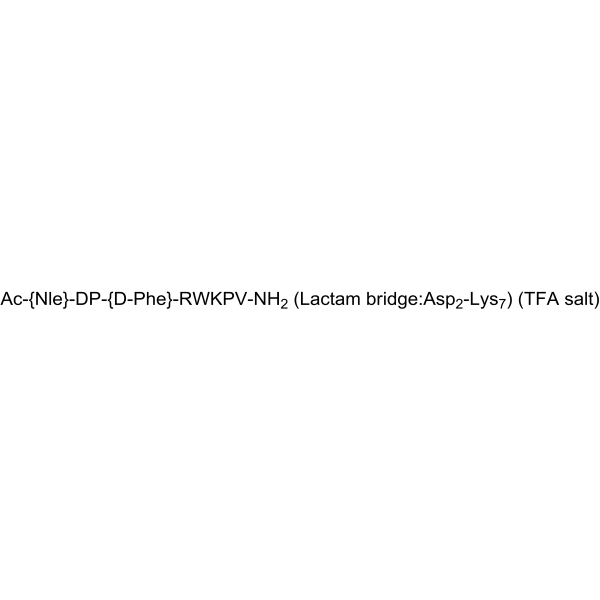
    PG-931 TFA, an analog of SHU 9119 (HY-P0227), is a potent melanocortin 4 (MC4) receptor (IC50=0.58 nM) agonist and is more selective than for the hMC3R (IC50=55 nM) or the hMC5R(IC50=2.4 nM). PG-931 TFA can reverse haemorrhagic shock and prevent multiple organ damage in vivo .
    PG-931 TFA
  • HY-159085

    P-glycoprotein Cancer
    P-gp inhibitor 24 (Compound 10) is an inhibitor for P-glycoprotein (P-gp)), that inhibits the P-gp mediated fluorescent dye efflux. P-gp inhibitor 24 exhibits multidrug resistance (MDR) reversal effect, enhances the cytotoxicity of Vincristine (HY-N0488) and Etoposide (HY-13629) in cancer cells .
    P-gp inhibitor 24
  • HY-W042416R

    DMAc (Standard)

    Reference Standards NF-κB Neurological Disease Metabolic Disease Inflammation/Immunology
    N,N-Dimethylacetamide (Standard) is the analytical standard of N,N-Dimethylacetamide. This product is intended for research and analytical applications. N,N-Dimethylacetamide (DMAc) is an organic solvent with blood-brain transmissibility and an FDA-approved drug excipient. N, N-dimethylacetamide exerts anti-inflammatory activity by inhibiting the NF-κB signaling pathway. N, N-dimethylacetamide can be used in studies of weight gain caused by a high-fat diet and neuroinflammation in Alzheimer's disease [3].
    N,N-Dimethylacetamide (Standard)
  • HY-P11432

    Melanocortin Receptor Neurological Disease
    PG-911 is a full MC5R agonist (EC50 = 0.031 nM for hMC5R). PG-911 is also a full antagonist at the hMC3R and the hMC4R (Kb: 0.38 nM and 0.17 nM, respectively). PG-911 can be used in the research of neurological disorders .
    PG-911
  • HY-182702

    TREM receptor Syk Neurological Disease
    As48 is a selective TREM2 agonist with a KD value of 12.48 μM in TRIC binding assay. As48 binds near the TREM2 cleavage region, forms hydrogen bonds with Gly68, reduces conformational flexibility in regions 58-102, restricts protease accessibility to the cleavage site. As48 activates SYK phosphorylation, enhances microglial phagocytosis, and induces downstream calcium signaling in TREM2-expressing cells. As48 inhibits TREM2 ectodomain shedding without affecting ADAM10/17 protease activities. As48 can be used for the research of Alzheimer's disease .
    As48
  • HY-183593

    Phosphatase Akt Interleukin Related Neurological Disease
    SHIP1-IN-1 is an orally active, blood-brain barrier-permeable SHIP1 ligand. SHIP1-IN-1 exhibits IC50 values of 384 μM and 177 μM against human SHIP1, and an IC50 value of 379 μM against murine SHIP1. SHIP1-IN-1 alters the binding state of SHIP1 to phosphatidylinositol membranes, and regulates phosphoinositide pools and phosphorylated AKT levels. SHIP1-IN-1 enhances the uptake of myelin/membrane fragments and amyloid proteins by microglia, alters gene expression and reduces IL-1β levels. SHIP1-IN-1 can be used in studies related to Alzheimer's disease .
    SHIP1-IN-1
  • HY-183798

    Cholinesterase (ChE) Monoamine Oxidase Interleukin Related Neurological Disease
    BChE/MAO-B-IN-6 is a dual inhibitor with inhibitory activity against both butyrylcholinesterase (BChE) and monoamine oxidase B (MAO B), with an IC50 of 557 nM against BChE and an IC50 of 142 nM against MAO B. BChE/MAO-B-IN-6 reduces IL-6 release from stimulated microglia and antagonizes 6-hydroxydopamine (HY-B1081) toxicity in neuroblastoma cells. BChE/MAO-B-IN-6 can be used in the research of neurodegenerative diseases .
    BChE/MAO-B-IN-6

Inquiry Online

Your information is safe with us. * Required Fields.

Salutation


Country or Region *

Applicant Name *


Organization Name *

Department *


Email Address *


Product Name *

Cat. No.


Requested quantity *

Phone Number *


Remarks

Inquiry Online

Inquiry Information

Product Name:
Cat. No.:
Quantity:
MCE Japan Authorized Agent: