Search Result
| Isoforms Recommended: |
HSV-1
|
Results for "
HSV 1
" in MedChemExpress (MCE) Product Catalog:
2
Biochemical Assay Reagents
33
Isotope-Labeled Compounds
| Cat. No. |
Product Name |
Target |
Research Areas |
Chemical Structure |
-
- HY-16592
-
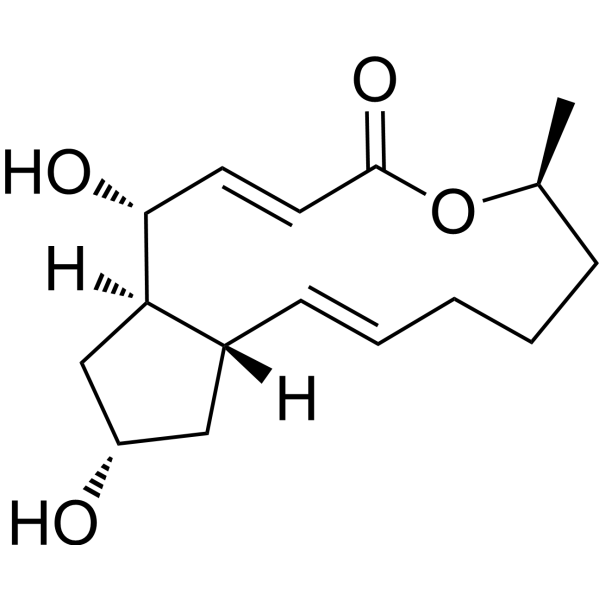
Brefeldin A
Maximum Cited Publications
153 Publications Verification
BFA; Cyanein; Decumbin
|
Autophagy
Mitophagy
HSV
Antibiotic
Bacterial
|
Infection
Cancer
|
|
Brefeldin A (BFA) is a lactone antibiotic and a specific inhibitor of protein trafficking. Brefeldin A blocks the transport of secreted and membrane proteins from endoplasmic reticulum to Golgi apparatus . Brefeldin A is also an autophagy and mitophagy inhibitor . Brefeldin A inhibits HSV-1 and has anti-cancer activity .
|
-
-
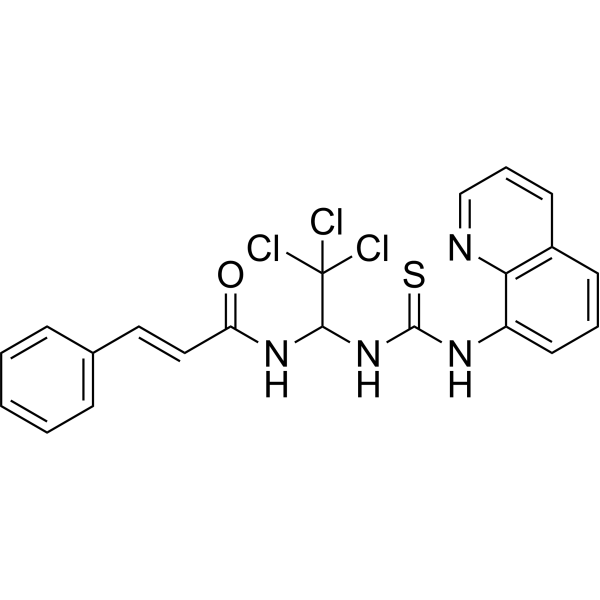
- HY-A0181
-
-
-
- HY-17422
-
|
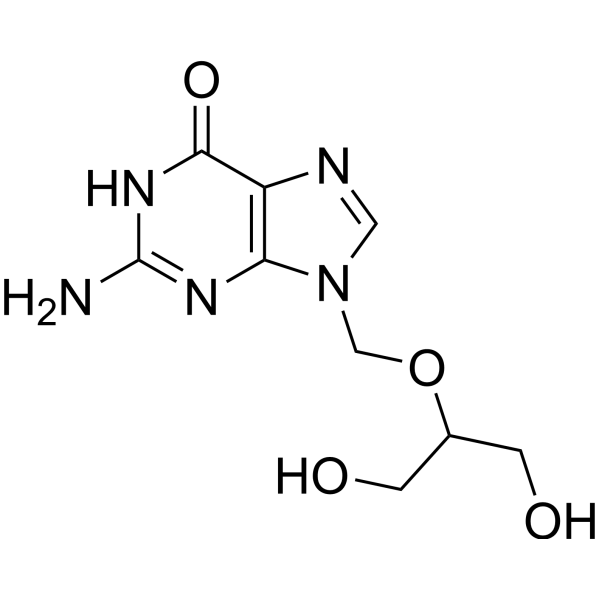
Aciclovir; Acycloguanosine
|
HSV
Apoptosis
Antibiotic
Bacterial
|
Infection
Cancer
|
|
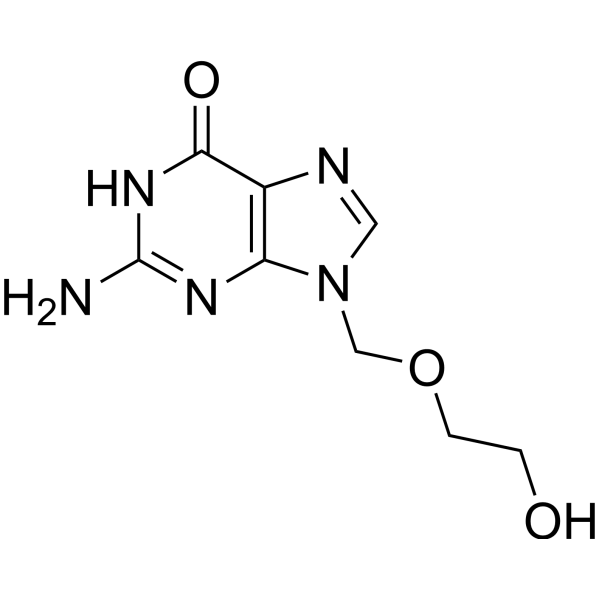
Acyclovir (Aciclovir) is a potent, orally active antiviral agent. Acyclovir has antiherpetic activity with IC50 values of 0.85 μM and 0.86 μM for HSV-1 and HSV-2, respectively. Acyclovir induces cell cycle perturbation and apoptosis. Acyclovir prevents bacterial infections during induction therapy for acute leukaemia .
|
-
-
- HY-N1067
-
|
|
COX
Acyltransferase
Apoptosis
HSV
CMV
Influenza Virus
|
Infection
Cancer
|
|
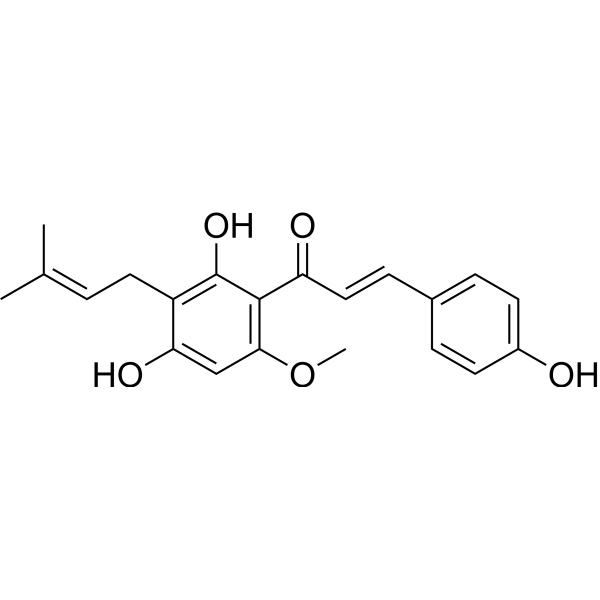
Xanthohumol is one of the principal flavonoids isolated from hops, the inhibitor of diacylglycerol acetyltransferase (DGAT), COX-1 and COX-2, and shows anti-cancer and anti-angiogenic activities. Xanthohumol also has antiviral activity against bovine viral diarrhea virus (BVDV), rhinovirus, HSV-1, HSV-2 and cytomegalovirus (CMV).
|
-
-
- HY-15486
-
|
|
Phosphatase
HSV
Autophagy
Apoptosis
|
Infection
Inflammation/Immunology
Cancer
|
|
Salubrinal is a cell-permeable and selective inhibitor of eIF2α dephosphorylation . Salubrinal acts as a dual-specificity phosphatase 2 (Dusp2) inhibitor and suppresses inflammation in anti-collagen antibody-induced arthritis . Salubrinal has antiviral activity against HSV-1 and inhibits dephosphorylation of eIF2α mediated by the HSV-1 protein ICP34.5 .
|
-
-
- HY-118122
-
|
FIAU; DRG-0098; NSC 678514
|
HSV
HBV
DNA/RNA Synthesis
Orthopoxvirus
Nucleoside Antimetabolite/Analog
|
Infection
|
|
Fialuridine (FIAU), a nucleoside analog, is a HSV-1 and HSV-2 inhibitor with Kis of 0.14 μM and 0.95 μM, respectively. Fialuridine shows anti-orthopoxvirus and anti-hepatitis B virus (HBV) activities. Fialuridine inhibits duck HBV DNA replication with IC50 values of 0.075 μM and 156 μM in human hepatoma cells and in chicken liver cells, respectively .
|
-
-
- HY-17425A
-
|
Valaciclovir hydrochloride
|
HSV
Antibiotic
Bacterial
|
Infection
Cancer
|
|
Valacyclovir hydrochloride (Valaciclovir hydrochloride) is an orally active antiviral agent for herpes simplex, herpes zoster, and herpes B. Valacyclovir hydrochloride inhibits HSV-1 W (50=2.9 μg/ml). Valacyclovir hydrochloride is a proagent of Aciclovir (HY-17422) .
|
-
-
- HY-N1430
-
|
trans-Oxyresveratrol
|
Tyrosinase
HSV
Autophagy
|
Others
|
|
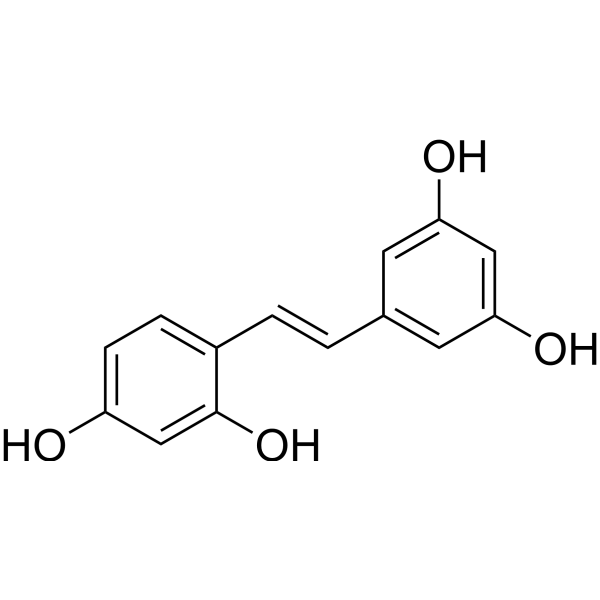
Oxyresveratrol (trans-Oxyresveratrol) is a potent naturally occurring antioxidant and free radical scavenger (IC50 of 28.9 µM against DPPH free radicals). Oxyresveratrol is potent and noncompetitive tyrosinase inhibitor with an IC50 value of 1.2 µM for mushroom tyrosinase. Oxyresveratrol is effective against HSV-1, HSV-2 and varicella-zoster virus, and has neuroprotective effects .
|
-
-
- HY-15303
-
|
AIC316; BAY 57-1293
|
DNA/RNA Synthesis
HSV
|
Infection
|
|
Pritelivir (AIC316), an inhibitor of the viral helicase-primase complex, exhibits antiviral activity in vitro and in animal models of herpes simplex virus (HSV) infection. Pritelivir is active against herpes simplex virus types 1 and 2 (HSV-1 and HSV-2) with the IC50 of 0.02 μM against HSV1-2 .
|
-
-
- HY-N1451
-
|
Betunolic acid; Liquidambaric acid; (+)-Betulonic acid
|
Parasite
HSV
|
Infection
Inflammation/Immunology
Cancer
|
|
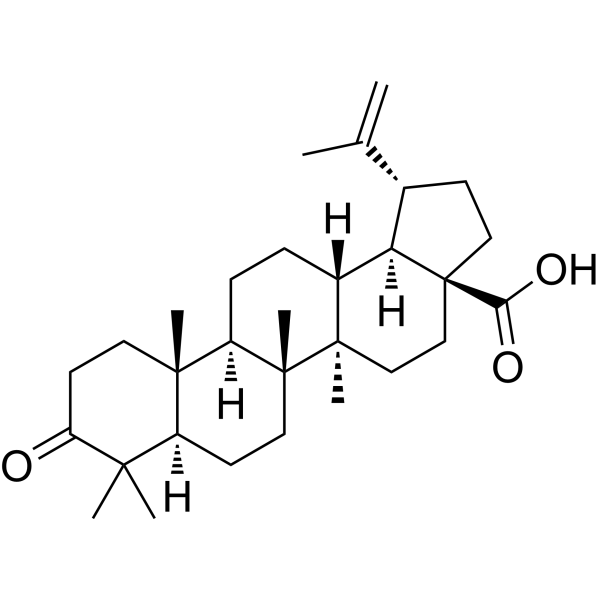
Betulonic acid (Betunolic acid), a naturally occurring triterpene, is found in many plants. Betulonic acid has anti-tumor, anti-inflammatory, antiparasitic and anti-viral (HSV-1) activities .
|
-
-
- HY-W141881
-
|
|
Environmental Pollutants
Biochemical Assay Reagents
HSV
|
Infection
|
|
N-lauroylsarcosine is an anionic surfactant. N-lauroylsarcosine has antiviral activity against HSV-2 strain 333 and HSV-1 strain F. N-lauroylsarcosine synergistically increases skin permeability with 25-50% ethanol. N-lauroylsarcosine can be used to study HSV-2 infection .
|
-
-
- HY-N2011
-
|
n-Octyl gallate; Stabilizer GA 8
|
VSV
Bacterial
HSV
Influenza Virus
Reactive Oxygen Species (ROS)
|
Infection
|
|
Octyl gallate (Progallin O) is widely used as a food additive, with antimicrobial and antioxidant activity . Octyl gallate (Progallin O) shows selective and sensitive fluorescent property . Octyl gallate shows a marked antiviral effect against HSV-1, vesicular stomatitis virus (VSV) and poliovirus .
|
-
-
- HY-A0181A
-
-
-
- HY-W342664
-
|
FIRU
|
Nucleoside Antimetabolite/Analog
HSV
|
Cancer
|
|
2'-Deoxy-2'-fluoro-5-iodouridine (FIRU) is a nucleoside analog. When labeled with 123I, 2'-Deoxy-2'-fluoro-5-iodouridine accumulates highly selectively in tumors expressing the HSV1-tk gene. Radiolabeled 2'-Deoxy-2'-fluoro-5-iodouridine enables imaging of adenovirus-mediated HSV1-tk suicide gene transfer .
|
-
-
- HY-N2004
-
|
(±)-Isoborneol
|
Environmental Pollutants
HSV
|
Infection
Neurological Disease
|
|
Isoborneol ((±)-Isoborneol) is a monoterpenoid alcohol present in the essential oils of numerous medicinal plants and has antioxidant and antiviral properties. Isoborneol is a potent inhibitor of herpes simplex virus type 1 (HSV-1) .
|
-
-
- HY-17424
-
|
BRL 39123; VSA 671
|
HSV
|
Infection
|
|
Penciclovir (VSA 671) is a potent and selective anti-herpesvirus agent with EC50 values of 0.5, 0.8 μg/ml for HSV-1 (HFEM), HSV-2 (MS), respectively. Penciclovir shows anti-herpesvirus activity with no-toxic. Penciclovir preventes mortality in mouse .
|
-
-
- HY-131606B
-
|
|
Drug Metabolite
DNA/RNA Synthesis
|
Infection
|
|
Cidofovir diphosphate tri triethylamine is an active intracellular metabolite of Cidofovir. Cidofovir diphosphate tri triethylamine is a selective inhibitor of viral DNA polymerases with Ki values of 6.6, 0.86 and 1.4 μM for HCMV, HSV-1 and HSV-2 DNA polymerase, respectively .
|
-
-
- HY-Y0136
-
|
|
Endogenous Metabolite
Influenza Virus
HSV
VSV
|
Infection
|
|
3-Indoleacetonitrile is an indole derivative with anti-influenza activity. 3-Indoleacetonitrile is a plant hormone produced by cruxiferous vegetables. 3-Indoleacetonitrile exerts profound antiviral activity against a broad spectrum of influenza A viruses, HSV-1 and VSV viruses in vitro. 3-Indoleacetonitrile diminishes lung virus titers and alleviates lung lesions in vivo. 3-Indoleacetonitrile induces an increase in mitochondrial antiviral-signaling (MAVS) protein levels. 3-Indoleacetonitrile can be used in research for combating viral infections including COVID-19, HSV-1, and VSV .
|
-
-
- HY-17425
-
|
Valaciclovir
|
HSV
Antibiotic
Bacterial
|
Infection
Cancer
|
|
Valacyclovir (Valaciclovir) is an orally active antiviral agent for herpes simplex, herpes zoster, and herpes B. Valacyclovir inhibits HSV-1 W (50=2.9 μg/ml). Valacyclovir is a proagent of Aciclovir (HY-17422) .
|
-
-
- HY-17422A
-
|
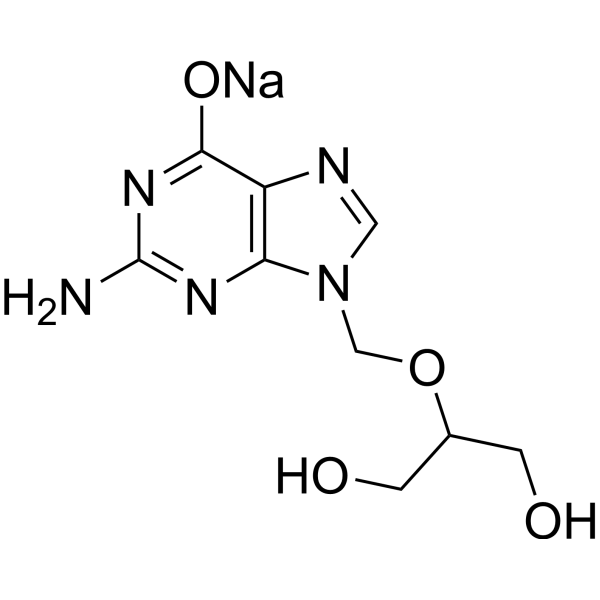
Aciclovir sodium; Acycloguanosine sodium
|
HSV
Apoptosis
Antibiotic
Bacterial
|
Infection
Cancer
|
|
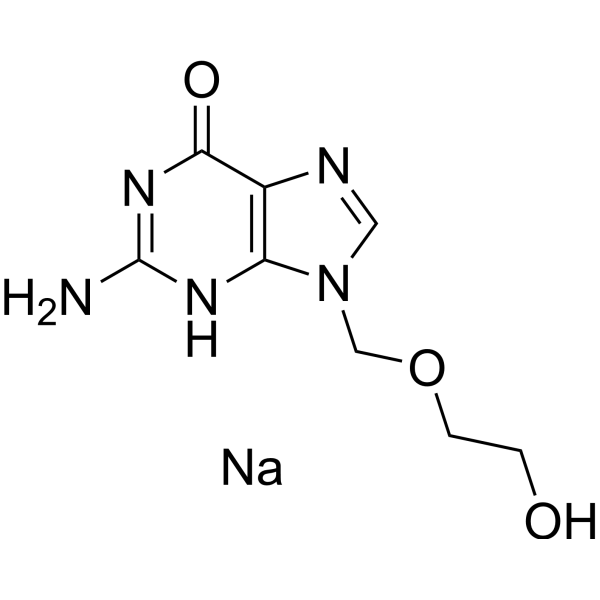
Acyclovir (Aciclovir) sodium is a potent, orally active antiviral agent. Acyclovir sodium has antiherpetic activity with IC50 values of 0.85 μM and 0.86 μM for HSV-1 and HSV-2, respectively. Acyclovir sodium induces cell cycle perturbation and apoptosis. Acyclovir sodium prevents bacterial infections during induction therapy for acute leukaemia .
|
-
-
- HY-A0181S1
-
-
-
- HY-A0181R
-
|
AMP (Standard)
|
Reference Standards
Endogenous Metabolite
Adenosine Receptor
HSV
|
Infection
Metabolic Disease
|
|
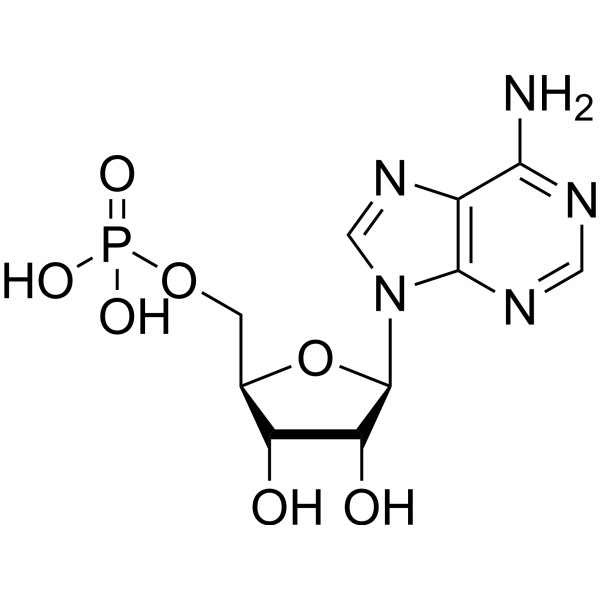
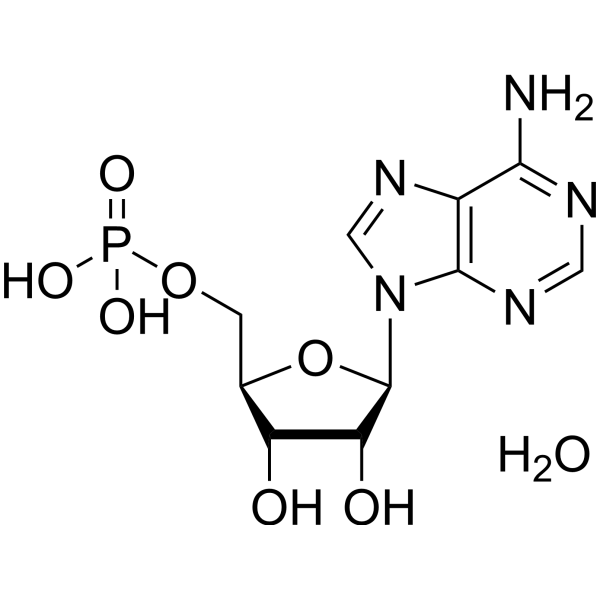
Adenosine monophosphate (Standard) is the analytical standard of Adenosine monophosphate (HY-A0181). This product is intended for research and analytical applications. Adenosine monophosphate is an adenosine A1 receptor agonist. Adenosine monophosphate has significant antiviral activity against HSV-1 and HSV-2. Adenosine monophosphate is a key cellular metabolite regulating energy homeostasis and signal transduction .
|
-
-
- HY-160222
-
|
|
HSV
STING
IFNAR
NF-κB
|
Infection
|
|
HSV-60mer sodium is a 60 bp double-stranded DNA oligonucleotide derived from the HSV-1 genome, and also an IFNβ inducer. HSV-60mer sodium colocalizes with endogenous cytoplasmic IFI16 in immune cells. HSV-60mer sodium activates the transcription factors IRF3 and NF-κB, induces the production of proinflammatory cytokines, and inhibits HSV-1 replication in immune cells. HSV-60mer sodium can be used in studies related to herpes simplex virus type 1 infection .
|
-
-
- HY-18684
-
|
5'-Isobutylthioadenosine; 5'-Deoxy-5'-isobutylthioadenosine
|
Nucleoside Antimetabolite/Analog
HSV
Parasite
|
Infection
Metabolic Disease
Cancer
|
|
SIBA (5'-Isobutylthioadenosine) is a transmethylation inhibitor (SAH (HY-19528) analogue), with potent anti-proliferative activity. SIBA reversibly inhibits the production of HSV-1 by blocking methylation, specifically by blocking the 5' end-capping of viral mRNA. SIBA also inhibits the growth of tumour cells in vitro and metastatic spread in vivo. SIBA can be used in cancer, HSV-1 infection and anti-malaria studies .
|
-
-
- HY-113135
-
-
-
- HY-150306
-
|
IM-250
|
DNA/RNA Synthesis
HSV
|
Infection
|
|
Adibelivir (IM-250) is an orally active helicase-primase inhibitor. Adibelivir is effective against HSV infection and reduces reactivation of latent HSV. Adibelivir inhibits HSV-1 infection in Vero cells (IC50: ~20 nM). Adibelivir can be used for the study of recurrent herpes disease[1][2].
|
-
-
- HY-17422R
-
|
Aciclovir (Standard); Acycloguanosine (Standard)
|
Reference Standards
HSV
Apoptosis
Antibiotic
Bacterial
|
Infection
Cancer
|
|
Acyclovir (Standard) is the analytical standard of Acyclovir. This product is intended for research and analytical applications. Acyclovir (Aciclovir) is a potent, orally active antiviral agent. Acyclovir has antiherpetic activity with IC50 values of 0.85 μM and 0.86 μM for HSV-1 and HSV-2, respectively. Acyclovir induces cell cycle perturbation and apoptosis. Acyclovir prevents bacterial infections during induction therapy for acute leukaemia .
|
-
-
- HY-18944
-
|
|
CDK
HSV
CMV
DNA/RNA Synthesis
|
Infection
|
|
FIT-039 is a selective, ATP-competitive and orally active CDK9 inhibitor with an IC50 of 5.8 μM for CKD9/cyclin T1. FIT-039 does not inhibit other CDKs and other kinases. FIT-039 inhibits replication of HSV-1 (IC50 of 0.69 μM), HSV-2, human adenovirus, and human CMV. FIT-039 is a promising antiviral agent for inhibiting drug-resistant HSVs and other DNA viruses.
|
-
-
- HY-U00124B
-
|
|
HSV
|
Infection
|
|
Tromantadine hydrochloride, an Amantadine derivative with antiherpetic activity, inhibits herpes simplex virus type 1 (HSV-1) and HSV-2 replication .
|
-
-
- HY-P1958
-
|
|
HSV
|
Infection
|
|
Histone H4 (2-21) is the core histones associated with chromatinization of herpes simplex virus 1 (HSV-1) genomes .
|
-
-
- HY-P5997
-
|
|
Autophagy
Cyclic GMP-AMP Synthase
|
Inflammation/Immunology
|
|
XQ2B is a specific cGAS inhibitor targeting protein-DNA interaction and phase separation. XQ2B markedly reduces ISD-induced Autophagy. XQ2B inhibits herpes simplex virus 1 (HSV-1)-induced antiviral immune responses and enhances HSV-1 infection .
|
-
-
- HY-N1060
-
|
|
HSV
Apoptosis
|
Infection
Cancer
|
|
Yatein is a lignan isolated from A. chilensis, with antiproliferative activity . Yatein suppresses herpes simplex virus type 1 (HSV-1 ) replication by interruption the immediate-early gene expression .
|
-
-
- HY-N3395
-
|
|
HSV
|
Infection
|
|
Leachianone G is an antiviral flavonoid from the root bark of Morus alba L. Leachianone G shows potent antiviral activity against herpes simplex type 1 virus (HSV-1) with an IC50 value of 1.6 μg/mL .
|
-
-
- HY-113135R
-
-
-
- HY-17425AR
-
|
Valaciclovir hydrochloride (Standard)
|
Reference Standards
HSV
Antibiotic
Bacterial
|
Infection
Cancer
|
|
Valacyclovir (hydrochloride) (Standard) is the analytical standard of Valacyclovir (hydrochloride). This product is intended for research and analytical applications. Valacyclovir hydrochloride (Valaciclovir hydrochloride) is an orally active antiviral agent for herpes simplex, herpes zoster, and herpes B. Valacyclovir hydrochloride inhibits HSV-1 W (50=2.9 μg/ml). Valacyclovir hydrochloride is a proagent of Aciclovir (HY-17422) .
|
-
-
- HY-15303A
-
|
AIC316 mesylate; BAY 57-1293 mesylate
|
DNA/RNA Synthesis
HSV
|
Infection
|
|
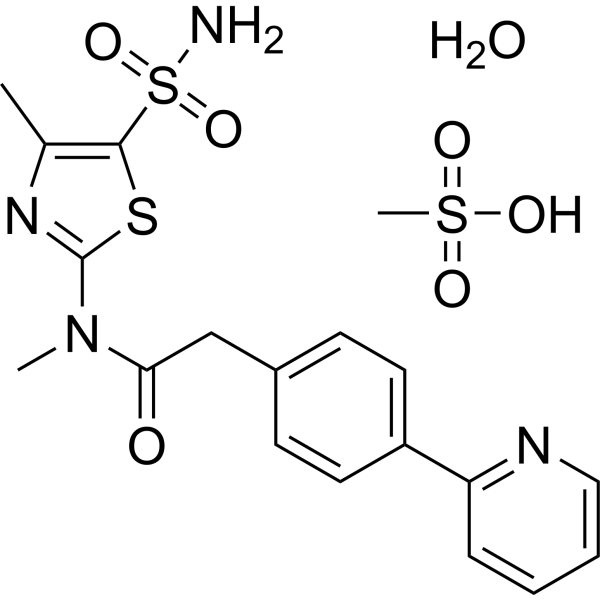
Pritelivir mesylate (BAY 57-1293 mesylate), an inhibitor of the viral helicase-primase complex, exhibits antiviral activity in vitro and in animal models of herpes simplex virus (HSV) infection. Pritelivir mesylate is active against herpes simplex virus types 1 and 2 (HSV-1 and HSV-2) with the IC50 of 0.02 μM against HSV1-2 .
|
-
-
- HY-50735
-
|
NSC 382097; FIAC; FOAC
|
HSV
EBV
DNA/RNA Synthesis
|
Infection
|
|
Fiacitabine (NSC 382097; FIAC; FOAC) is a potent and highly selective anti-herpesvirus agent. Fiacitabine acts as an inhibitor of HSV DNA polymerase, with a Ki of 0.26 μM for HSV-1 and 0.42 μM for HSV-2, respectively. Fiacitabine can be efficiently phosphorylated by thymidine kinase encoded by the virus itself to generate FIACTP, an active triphosphate metabolite. Fiacitabine is applicable to research related to herpesvirus infections .
|
-
-
- HY-A0181S3
-
|
AMP-13C10 dilithium
|
Isotope-Labeled Compounds
Endogenous Metabolite
Adenosine Receptor
HSV
|
Infection
Metabolic Disease
|
|
Adenosine monophosphate- 13C10 (AMP- 13C10) dilithium is 13C-labeled Adenosine monophosphate (HY-A0181). Adenosine monophosphate is an adenosine A1 receptor agonist. Adenosine monophosphate has significant antiviral activity against HSV-1 and HSV-2. Adenosine monophosphate is a key cellular metabolite regulating energy homeostasis and signal transduction .
|
-
-
- HY-122920
-
|
|
HSV
CMV
Influenza Virus
HIV
NOD-like Receptor (NLR)
YB-1
|
Infection
Inflammation/Immunology
|
|
Soyasaponin II is a saponin with antiviral activity. Soyasaponin II inhibits the replication of HSV-1, HCMV, influenza virus, and HIV-1. Soyasaponin II shows potent inhibition on HSV-1 replication. Soyasaponin II serves as a inhibitor for YB-1 phosphorylation and NLRP3 inflammasome priming and could protect mice against LPS/GalN induced acute liver failure .
|
-
-
- HY-W002008
-
-
-
- HY-131606
-
|
|
HSV
CMV
DNA/RNA Synthesis
|
Infection
|
|
Cidofovir diphosphate is an active intracellular metabolite of Cidofovir. Cidofovir diphosphate is a selective inhibitor of viral DNA polymerases with Ki values of 6.6, 0.86 and 1.4 μM for HCMV, HSV-1 and HSV-2 DNA polymerase, respectively .
|
-
-
- HY-P4773
-
|
|
HSV
|
Infection
|
|
HSV-1 Protease substrate is a peptide substrate for HSV-1 (Herpes Simplex Virus Type 1) protease, and the specificity constant (kcat/Km) at pH 7.5 for cleavage is 5.2 M -1 s -1 .
|
-
-
- HY-129861
-
|
|
HSV
|
Infection
Cancer
|
|
5'-Ethynyl-2'-deoxycytidine is an inhibitor for HSV, that inhibits the cytopathic effect of HSV-1 in primary rabbit kidney cell with a MIC of 0.2 μg/mL. 5'-Ethynyl-2'-deoxycytidine inhibits the proliferation of leukemia L1210 cell with an IC50 of 64.5 μg/mL .
|
-
-
- HY-N11097
-
|
|
Apoptosis
HSV
HIV
|
Infection
Cancer
|
|
FK-3000 is a potent anti-tumor agent that inhibits the growth of carcinoma cells through apoptosis and induction cell cycle arrest. FK-3000 also exhibit antiviral effects against HSV-1 and HIV-1 .
|
-
-
- HY-17424R
-
|
BRL 39123 (Standard); VSA 671 (Standard)
|
Reference Standards
HSV
|
Infection
|
|
Penciclovir (Standard) is the analytical standard of Penciclovir. This product is intended for research and analytical applications. Penciclovir (VSA 671) is a potent and selective anti-herpesvirus agent with EC50 values of 0.5, 0.8 µg/ml for HSV-1 (HFEM), HSV-2 (MS), respectively. Penciclovir shows anti-herpesvirus activity with no-toxic. Penciclovir preventes mortality in mouse .
|
-
-
- HY-Y0136S1
-
|
|
Isotope-Labeled Compounds
Endogenous Metabolite
Influenza Virus
HSV
VSV
|
Infection
|
|
3-Indoleacetonitrile-d4 is deuterium labeled 3-Indoleacetonitrile (HY-Y0136). 3-Indoleacetonitrile is an indole derivative with anti-influenza activity. 3-Indoleacetonitrile is a plant hormone produced by cruxiferous vegetables. 3-Indoleacetonitrile exerts profound antiviral activity against a broad spectrum of influenza A viruses, HSV-1 and VSV viruses in vitro. 3-Indoleacetonitrile diminishes lung virus titers and alleviates lung lesions in vivo. 3-Indoleacetonitrile induces an increase in mitochondrial antiviral-signaling (MAVS) protein levels. 3-Indoleacetonitrile can be used in research for combating viral infections including COVID-19, HSV-1, and VSV.
|
-
-
- HY-A0181S2
-
|
AMP-d12 dilithium
|
Isotope-Labeled Compounds
Endogenous Metabolite
Adenosine Receptor
HSV
|
Infection
Metabolic Disease
|
|
Adenosine monophosphate-d12 (AMP-d12) dilithium is deuterium labeled Adenosine monophosphate (HY-A0181). Adenosine monophosphate is an adenosine A1 receptor agonist. Adenosine monophosphate has significant antiviral activity against HSV-1 and HSV-2. Adenosine monophosphate is a key cellular metabolite regulating energy homeostasis and signal transduction .
|
-
-
- HY-16592R
-
|
BFA (Standard); Cyanein (Standard); Decumbin (Standard)
|
Reference Standards
Autophagy
Mitophagy
HSV
Antibiotic
Bacterial
|
Infection
Cancer
|
|
Brefeldin A (Standard) (BFA (Standard)) is the analytical standard of Rutin. This product is intended for research and analytical applications. Brefeldin A (BFA) is a lactone antibiotic and a specific inhibitor of protein trafficking. Brefeldin A blocks the transport of secreted and membrane proteins from endoplasmic reticulum to Golgi apparatus. Brefeldin A is also an autophagy and mitophagy inhibitor. Brefeldin A inhibits HSV-1 and has anti-cancer activity.
|
-
-
- HY-149022
-
|
|
HSV
Orthopoxvirus
|
Infection
|
|
HSV-1/HSV-2-IN-1 (compound 7d) is a HSV-1 and HSV-2 inhibitor, with EC50s of 7.6, 7.6, 4, and 12 μM for HSV-1 (KOS), HSV-2 (G), HSV-1 TK - KOS ACV r and vaccinia virus in human embryonic lung fibroblast cell cultures .
|
-
-
- HY-149023
-
|
|
HSV
|
Infection
|
|
HSV-1/HSV-2-IN-2 is a HSV-1, HSV-2 and VV inhibitor with EC50 values of 6.8, 8.9 and 8.9 µM, respectively. HSV-1/HSV-2-IN-2 shows antiviral activity .
|
-
- HY-100272
-
|
|
HSV
CMV
|
Infection
Cancer
|
|
B220 is an antiviral agent which can inhibit the growth of HSV-1, HSV-2 and human cytomegalovirus (CMV).
|
-
- HY-15303B
-
|
AIC316 mesylate hydrate; BAY 57-1293 mesylate hydrate
|
DNA/RNA Synthesis
HSV
|
Infection
|
|
Pritelivir mesylate hydrate (BAY 57-1293 mesylate hydrate), an inhibitor of the viral helicase-primase complex, exhibits antiviral activity in vitro and in animal models of herpes simplex virus (HSV) infection. Pritelivir mesylate hydrate is active against herpes simplex virus types 1 and 2 (HSV-1 and HSV-2) with the IC50 of 0.02 μM against HSV1-2 .
|
-
- HY-174252
-
|
|
DNA/RNA Synthesis
HSV
|
Infection
|
|
HSV-1/HSV-2-IN-3 inhibits the herpes-simplex-virus (HSV) helicase-primase complex, blocking the coordinated DNA-unwinding and primer-synthesis steps required for viral genome replication. HSV-1/HSV-2-IN-3 exhibits an EC50 of 7.0 nM against HSV-2 in a gD-immunofluorescence cell assay containing 2 % FBS and 57.5 nM when 10 % human serum is present. HSV-1/HSV-2-IN-3 achieves an EC50 of 1.1 nM in a qPCR replication assay. HSV-1/HSV-2-IN-3 shows strong selectivity over human carbonic-anhydrase off-targets (IC50 ≈ 2.9 µM for hCA II and > 35 µM for hCA I). HSV-1/HSV-2-IN-3 can be studied in anti-HSV research .
|
-
- HY-N8082
-
|
|
HSV
|
Infection
|
|
Stearyl gallate is an alkyl gallate with a long alkyl chain (carbon number of 18). Stearyl gallate has an antioxidant activity, and a weak antiviral activity against HSV-1 .
|
-
- HY-170547
-
|
|
DNA/RNA Synthesis
HSV
EBV
CMV
|
Infection
|
|
DNA polymerase-IN-6 is an antiviral agent and a DNA polymerase inhibitor. DNA polymerase-IN-6 inhibits the replication of HCMV, HSV-1, HSV-2 and EBV. DNA polymerase-IN-6 exhibits low cytotoxicity in mammalian cells. DNA polymerase-IN-6 can be used in research related to viral infections .
|
-
- HY-Y0136R
-
|
|
Reference Standards
Endogenous Metabolite
Influenza Virus
HSV
VSV
|
Metabolic Disease
|
|
3-Indoleacetonitrile (Standard) is the analytical standard of 3-Indoleacetonitrile. This product is intended for research and analytical applications. 3-Indoleacetonitrile is an indole derivative with anti-influenza activity. 3-Indoleacetonitrile is a plant hormone produced by cruxiferous vegetables. 3-Indoleacetonitrile exerts profound antiviral activity against a broad spectrum of influenza A viruses, HSV-1 and VSV viruses in vitro. 3-Indoleacetonitrile diminishes lung virus titers and alleviates lung lesions in vivo. 3-Indoleacetonitrile induces an increase in mitochondrial antiviral-signaling (MAVS) protein levels. 3-Indoleacetonitrile can be used in research for combating viral infections including COVID-19, HSV-1, and VSV .
|
-
- HY-A0181S6
-
|
AMP-13C10,15N5
|
Isotope-Labeled Compounds
Endogenous Metabolite
Adenosine Receptor
HSV
|
Infection
|
|
Adenosine monophosphate- 13C10, 15N5 (AMP- 13C10, 15N5) is the 13C- and 15N-labeled Adenosine monophosphate (HY-A0181). Adenosine monophosphate is an adenosine A1 receptor agonist. Adenosine monophosphate has significant antiviral activity against HSV-1 and HSV-2. Adenosine monophosphate is a key cellular metabolite regulating energy homeostasis and signal transduction .
|
-
- HY-176163
-
|
|
HSV
|
Infection
|
|
HSV-1-IN-2 (compound 5i) is a potent Herpes simplex virus type 1 (HSV-1) inhibitor with an EC50 of 1.95 μM. HSV-1-IN-2 inhibits apoptosis and improves herpes encephalitis model mouse survival .
|
-
- HY-U00124
-
|
|
HSV
|
Infection
|
|
Tromantadine hydrochloride, an Amantadine derivative with antiherpetic activity, inhibits herpes simplex virus type 1 (HSV-1) and HSV-2 replication .
|
-
- HY-15303AR
-
|
AIC316 mesylate (Standard); BAY 57-1293 mesylate (Standard)
|
HSV
Reference Standards
|
Infection
|
|
Pritelivir (mesylate) (Standard) is the analytical standard of Pritelivir (mesylate). This product is intended for research and analytical applications. Pritelivir mesylate (BAY 57-1293 mesylate), an inhibitor of the viral helicase-primase complex, exhibits antiviral activity in vitro and in animal models of herpes simplex virus (HSV) infection. Pritelivir mesylate is active against herpes simplex virus types 1 and 2 (HSV-1 and HSV-2) with the IC50 of 0.02 μM against HSV1-2 .
|
-
- HY-15303R
-
|
AIC316 (Standard); BAY 57-1293 (Standard)
|
HSV
Reference Standards
|
Infection
|
|
Pritelivir (Standard) is the analytical standard of Pritelivir. This product is intended for research and analytical applications. Pritelivir (AIC316), an inhibitor of the viral helicase-primase complex, exhibits antiviral activity in vitro and in animal models of herpes simplex virus (HSV) infection. Pritelivir is active against herpes simplex virus types 1 and 2 (HSV-1 and HSV-2) with the IC50 of 0.02 μM against HSV1-2 .
|
-
- HY-U00224
-
|
|
EBV
VZV
HSV
|
Infection
|
|
BRL44385 is a potent and selective inhibitor of the replication of herpes simplex virus types 1 and 2 (HSV-1 and HSV2), varicella zoster virus (VZV) and Epstein-Barr virus (EBV).
|
-
- HY-177638
-
|
|
HSV
|
Infection
|
|
ISIS 1082 is an antisense oligonucleotide targeted to the translation initiation codon of herpes simplex virus (HSV) type 1 and 2 virion capsid protein. It has been shown to inhibit HSV-1 replication in vitro
|
-
- HY-15486R
-
|
|
Phosphatase
HSV
Autophagy
Apoptosis
|
Infection
Inflammation/Immunology
Cancer
|
|
Salubrinal (Standard) is the analytical standard of Salubrinal. This product is intended for research and analytical applications. Salubrinal is a cell-permeable and selective inhibitor of eIF2α dephosphorylation . Salubrinal acts as a dual-specificity phosphatase 2 (Dusp2) inhibitor and suppresses inflammation in anti-collagen antibody-induced arthritis . Salubrinal has antiviral activity against HSV-1 and inhibits dephosphorylation of eIF2α mediated by the HSV-1 protein ICP34.5 .
|
-
- HY-123211
-
|
|
HSV
|
Infection
|
|
WAY-150138 inhibits replication of herpes simplex virus type 1 (HSV-1) that acts by preventing the incorporation of DNA-packaging proteins into capsids as they are assembled
|
-
- HY-163546
-
|
|
HSV
|
Infection
|
|
HSV-1-IN-1 (compound 1b) is a drug candidate for herpes simplex virus HSV-1(IC50=0.5 nM) and HSV-2(IC50=16 nM) infection. HSV-1-IN-1 inhibits the helicase-primase complex to prevent viral replication, thereby inhibiting HSV infection .
|
-
- HY-19288
-
|
ABT 606; MIV 606; A 174606.0
|
HSV
VZV
|
Infection
|
|
Valomaciclovir stearate (ABT 606), a nucleoside analog, is the Omaciclovir (HY-116174) prodrug. Valomaciclovir stearate has antiviral activity against HSV-1 and varicella zoster virus (VZV) .
|
-
- HY-174429
-
|
|
HSV
|
Infection
|
|
HSV-1-IN-3 (Compound A50) is a HSV inhibitor. HSV-1-IN-3 shows good antiviral efficacy against both Acyclovir (HY-17422) -sensitive and -resistant HSV strains .
|
-
- HY-N1067R
-
|
|
Reference Standards
COX
Acyltransferase
Apoptosis
HSV
CMV
Influenza Virus
|
Infection
Cancer
|
|
Xanthohumol (Standard) is the analytical standard of Xanthohumol. This product is intended for research and analytical applications. Xanthohumol is one of the principal flavonoids isolated from hops, the inhibitor of diacylglycerol acetyltransferase (DGAT), COX-1 and COX-2, and shows anti-cancer and anti-angiogenic activities. Xanthohumol also has antiviral activity against bovine viral diarrhea virus (BVDV), rhinovirus, HSV-1, HSV-2 and cytomegalovirus (CMV).
|
-
- HY-W011079
-
|
|
Nucleoside Antimetabolite/Analog
|
Infection
Cancer
|
|
5-Iodouridine is an iodine-containing pyrimidine nucleoside analog. 5-Iodouridine inhibits dihydroorotase with a Ki value of 340 µM. 5-Iodouridine significantly enhances the cell-killing effect of gamma irradiation. 5-Iodouridine can be used in the research of HSV-1 infection and leukemia .
|
-
- HY-17425AS
-
|
|
HSV
Antibiotic
|
Infection
|
|
Valacyclovir-d8 (hydrochloride) is the deuterium labeled Valacyclovir hydrochloride. Valacyclovir hydrochloride (Valaciclovir hydrochloride) is an orally active antiviral agent for herpes simplex, herpes zoster, and herpes B. Valacyclovir hydrochloride inhibits HSV-1 W (50=2.9 μg/ml). Valacyclovir hydrochloride is a proagent of Aciclovir (HY-17422) .
|
-
- HY-17425AS1
-
|
|
Isotope-Labeled Compounds
HSV
Antibiotic
|
Infection
|
|
Valacyclovir-d4 (hydrochloride) is the deuterium labeled Valacyclovir hydrochloride. Valacyclovir hydrochloride (Valaciclovir hydrochloride) is an orally active antiviral agent for herpes simplex, herpes zoster, and herpes B. Valacyclovir hydrochloride inhibits HSV-1 W (50=2.9 μg/ml). Valacyclovir hydrochloride is a proagent of Aciclovir (HY-17422) .
|
-
- HY-P11342
-
|
|
Fungal
HSV
|
Infection
|
|
Verlamelin A is a macrocyclic depsipeptide with antifungal and antiviral activity. Verlamelin A shows
antifungal activity toward Aspergillus versicolor and Curvularia australiensis and also has antiviral activity toward
HSV-1 (IC50 = 16.7 μM). Verlamelin A is isolated from the entomopathogenic fungus Lecanicillium sp. Verlamelin A is useful for antifungal and antiviral research .
|
-
- HY-N1430R
-
|
trans-Oxyresveratrol (Standard)
|
Reference Standards
Tyrosinase
HSV
Autophagy
|
Others
|
|
Oxyresveratrol (Standard) is the analytical standard of Oxyresveratrol. This product is intended for research and analytical applications. Oxyresveratrol (trans-Oxyresveratrol) is a potent naturally occurring antioxidant and free radical scavenger (IC50 of 28.9 μM against DPPH free radicals). Oxyresveratrol is potent and noncompetitive tyrosinase inhibitor with an IC50 value of 1.2 μM for mushroom tyrosinase. Oxyresveratrol is effective against HSV-1, HSV-2 and varicella-zoster virus, and has neuroprotective effects .
|
-
- HY-118703
-
|
|
HIV
HSV
|
Infection
|
|
L-Ristosamine nucleoside is a nucleoside compound with antiviral activity against HIV and HSV-1 .
|
-
- HY-111801
-
|
|
HSV
|
Infection
|
|
Woodorien is a potent HSV-1 inhibitor. Woodorien also is a glucoside that can be isolated from Woodwardia orientalis .
|
-
- HY-118745
-
|
|
HSV
VZV
|
Infection
|
|
A-73209 is an orally active and potent antivirus agent against VZV, HSV-1, and HSV-2. A-73209 is an Oxetanocin derivative and can be utilized in antivirus research .
|
-
- HY-15303S
-
|
AIC316-d4-1; BAY 57-1293-d4-1
|
Isotope-Labeled Compounds
HSV
DNA/RNA Synthesis
|
Infection
|
|
Pritelivir-d4-1 (AIC316-d4-1) is deuterium labeled Pritelivir. Pritelivir (AIC316), an inhibitor of the viral helicase-primase complex, exhibits antiviral activity in vitro and in animal models of herpes simplex virus (HSV) infection. Pritelivir is active against herpes simplex virus types 1 and 2 (HSV-1 and HSV-2) with the IC50 of 0.02 μM against HSV1-2 .
|
-
- HY-162069
-
|
|
HSV
|
Infection
|
|
Antiviral agent 47 (Compound 26) is an antiviral agent, which inhibits HSV-1 with ID50 of 16 μM, through suppression of herpes virus replication .
|
-
- HY-N14563
-
|
|
Bacterial
HSV
|
Infection
|
|
Cycloviracin B1 has anti-herpes simplex virus Type I (HSV-1) activity and has weak anti-Gram-positive bacterial activity .
|
-
- HY-N14446
-
|
|
HSV
|
Infection
|
|
Karalicin inhibits herpes simplex virus HSV-1, HSV-2, vaccinia virus, polio virus type I with the IC50s (μg/mL) of 0.004, 0.008, 0.016 and 0.016 .
|
-
- HY-177638A
-
|
|
HSV
|
Infection
|
|
ISIS 1082 sodium is an antisense oligonucleotide targeted to the translation initiation codon of herpes simplex virus (HSV) type 1 and 2 virion capsid protein. It has been shown to inhibit HSV-1 replication in vitro
|
-
- HY-N14564
-
|
|
Antibiotic
HSV
|
Infection
|
|
Cycloviracin B2 is an antibiotic with antiviral activity. Cycloviracin B2 has a strong inhibitory activity against herpes simplex virus type 1 (HSV-1) .
|
-
- HY-104083
-
|
N-MCT
|
DNA/RNA Synthesis
HSV
|
Infection
Cancer
|
|
North-methanocarbathymidine (N-MCT) is a potent antiviral agent. North-methanocarbathymidine inhibits DNA synthesis. North-methanocarbathymidine demonstrates potent antiviral activity against HSV-1, HSV-2 and KSHV. North-methanocarbathymidine exhibits anticancer activity against colon adenocarcinoma expressing HSV-tk .
|
-
- HY-107739
-
|
VSA 671 sodium; BRL 39123A; BRL 39123D
|
HSV
|
Infection
|
|
Penciclovir (VSA 671) sodium is a potent and selective anti-herpesvirus agent with EC50 values of 0.5, 0.8 µg/ml for HSV-1 (HFEM), HSV-2 (MS), respectively. Penciclovir sodium shows anti-herpesvirus activity with no-toxic. Penciclovir sodium preventes mortality in mouse .
|
-
- HY-P11160
-
|
|
HSV
|
Infection
|
|
GF-17 is a polypeptide containing 17 amino acids. is the precursor peptide of GF19. GF-17 exhibits significant antiviral activity. GF-17 can be used for research on viral infections such as HSV-1 virus .
|
-
- HY-17422D
-
|
Aciclovir hydrochloride; Acycloguanosine hydrochloride
|
HSV
Apoptosis
Antibiotic
Bacterial
|
Infection
Cancer
|
|
Acyclovir (Aciclovir) hydrochloride is a potent, orally active antiviral agent. Acyclovir hydrochloride has antiherpetic activity with IC50 values of 0.85 μM and 0.86 μM for HSV-1 and HSV-2, respectively. Acyclovir hydrochloride induces cell cycle perturbation and apoptosis. Acyclovir hydrochloride prevents bacterial infections during induction therapy for acute leukaemia .
|
-
- HY-101848A
-
|
|
HSV
|
Infection
Cancer
|
|
16-epi-latrunculin B is anticancer agent, which can inhibit the growth of HeLa cells with IC50 value of 3.9 uM . 16-epi-latrunculin B has antiviral activity against HSV-1 (ED50 of 1 µg/mL) .
|
-
- HY-N1451R
-
|
Betunolic acid (Standard); Liquidambaric acid (Standard); (+)-Betulonic acid (Standard)
|
Reference Standards
Parasite
HSV
|
Infection
Inflammation/Immunology
Cancer
|
|
Betulonic acid (Standard) is the analytical standard of Betulonic acid. This product is intended for research and analytical applications. Betulonic acid (Betunolic acid), a naturally occurring triterpene, is found in many plants. Betulonic acid has anti-tumor, anti-inflammatory, antiparasitic and anti-viral (HSV-1) activities .
|
-
- HY-N2004R
-
|
(±)-Isoborneol (Standard)
|
Reference Standards
HSV
|
Infection
Neurological Disease
|
|
Isoborneol (Standard) is the analytical standard of Isoborneol. This product is intended for research and analytical applications. Isoborneol ((±)-Isoborneol) is a monoterpenoid alcohol present in the essential oils of numerous medicinal plants and has antioxidant and antiviral properties. Isoborneol is a potent inhibitor of herpes simplex virus type 1 (HSV-1) .
|
-
- HY-P5693
-
|
|
Bacterial
CMV
HSV
|
Infection
|
|
HBA(111-142), an antimicrobial peptide, is a C-terminal 32-mer fragment of alpha-hemoglobin. HBA(111-142) has antibacterial activity against the ESKAPE panel of pathogens. HBA(111-142) forms amyloid fibrils, and has antiviral activities. HBA(111-142) inhibits measles and herpes viruses (HSV-1, HSV-2, HCMV) .
|
-
- HY-164343
-
|
|
HSV
|
Infection
|
17,17-Ethylendioxyandrost-5-en-3β-ol is an HSV-1 inhibitor, with an EC50 value of 629 μM. 17,17-Ethylendioxyandrost-5-en-3β-ol can be used in research related to viral infections .
|
-
- HY-W747737
-
|
(E)-5-(2-Bromovinyl)-dUTP; BVdUTP
|
VZV
DNA/RNA Synthesis
HSV
|
Infection
|
|
BVDU 5′-Triphosphate is an antivirus agent with 5′-Triphosphate label, targeting viral DNA polymerase. BVDU 5′-Triphosphate shows excellent selectivity against varicella-zoster virus (VZV) and herpes simplex virus type 1 (HSV-1), due to a specific phosphorylation by the virus-encoded thymidine kinase.
|
-
- HY-162701
-
|
|
SARS-CoV
Influenza Virus
RSV
HSV
|
Infection
|
|
Antiviral agent 58 (Compound J1) is an orally active antiviral agent with broad-spectrum antiviral activity against enveloped viruses, including influenza A virus (IAV), respiratory syncytial virus (RSV), severe acute respiratory syndrome coronavirus 2 (SARS-CoV-2), human coronavirus OC43 (HCoV-OC43), herpes simplex virus type 1 (HSV-1), and HSV-2 .
|
-
- HY-W747737A
-
|
(E)-5-(2-Bromovinyl)-dUTP ammonium; BVdUTP ammonium
|
VZV
DNA/RNA Synthesis
HSV
|
Infection
|
|
BVDU 5′-Triphosphate ammonium is an antivirus agent with 5′-Triphosphate label, targeting viral DNA polymerase. BVDU 5′-Triphosphate ammonium shows excellent selectivity against varicella-zoster virus (VZV) and herpes simplex virus type 1 (HSV-1), due to a specific phosphorylation by the virus-encoded thymidine kinase.
|
-
- HY-W783223
-
|
|
HSV
|
Infection
|
|
C-AFG is a novel compound against herpes virus (HSV). C-AFG exhibits excellent inhibitory activity and high selectivity towards HSV-1 and HSV-2. C-AFG can be used for research on viral infections .
|
-
- HY-186203
-
|
|
HSV
|
Infection
|
|
8-Bromo-harmane is a β-carboline derivative with anti-HSV-1 activity. 8-Bromo-harmane is non-cytotoxic. 8-Bromo-harmane can be used for the research of herpes simplex virus 1 (HSV-1) infection .
|
-
- HY-170547A
-
|
|
HSV
CMV
EBV
DNA/RNA Synthesis
|
Infection
|
|
DNA polymerase-IN-6 formic is an antiviral agent and a DNA polymerase inhibitor. DNA polymerase-IN-6 formic inhibits the replication of HCMV, HSV-1, HSV-2 and EBV. DNA polymerase-IN-6 formic exhibits low cytotoxicity in mammalian cells. DNA polymerase-IN-6 formic can be used in research related to viral infections .
|
-
- HY-105111
-
|
|
Parasite
Angiotensin-converting Enzyme (ACE)
HSV
DNA/RNA Synthesis
|
Cardiovascular Disease
Metabolic Disease
|
|
P-536 is a ACE inhibitor that also inhibits herpes simplex virus HSV-1 thymidine kinase and Trypanosoma cruzi RNA polymerase. By inhibiting the renin-angiotensin system, downregulating the expression of AT1R and NOX4, and reducing oxidative stress (decreasing plasma hydrogen peroxide (H2O2) and 8-isoprostaglandin levels), P-536 effectively reduces systolic blood pressure and improves vascular reactivity. P-536 also inhibits the replication of DNA/RNA viruses such as HSV-1 by blocking nucleotide metabolism and nucleic acid synthesis, competitively inhibits RNA synthesis in Trypanosoma cruzi, and inhibits amastigote replication, thereby impeding its growth. P-536 is suitable for research on hypertension, insulin resistance, and Chagas disease .
|
-
- HY-180881
-
|
|
HSV
Tau Protein
Akt
GSK-3
|
Neurological Disease
|
|
PAV-174 is a potent antiviral agent that targets a host protein. PAV-174 prevents Herpes simplex virus (HSV-1) infection in cells (IC50 of 0.02 μM in Vero cells) and human brain organoids. PAV-174 inhibits oxidized macrophage migration inhibitory factor (oxMIF)-induced tau phosphorylation in vitro and in vivo independent of infection. PAV-174 reduces HSV-1-induced tau phosphorylation via the Akt/GSK3β signaling pathway. PAV-174 can be used for Alzheimer’s disease research .
|
-
- HY-A0181S
-
|
AMP-13C10,15N5 dilithium
|
Isotope-Labeled Compounds
Endogenous Metabolite
Adenosine Receptor
HSV
|
Infection
Metabolic Disease
|
|
Adenosine monophosphate- 13C10, 15N5(AMP- 13C10, 15N5) is the 13C-labeled and 15N-labeled Adenosine monophosphate (HY-A0181). Adenosine monophosphate is an adenosine A1 receptor agonist. Adenosine monophosphate has significant antiviral activity against HSV-1 and HSV-2. Adenosine monophosphate is a key cellular metabolite regulating energy homeostasis and signal transduction .
|
-
- HY-A0181S5
-
|
AMP-15N5,d12 dilithium
|
Isotope-Labeled Compounds
Endogenous Metabolite
Adenosine Receptor
HSV
|
Infection
Metabolic Disease
|
|
Adenosine monophosphate- 15N5,d12 (AMP- 15N5,d12) dilithium is deuterium and 15N labeled Adenosine monophosphate (HY-A0181). Adenosine monophosphate is an adenosine A1 receptor agonist. Adenosine monophosphate has significant antiviral activity against HSV-1 and HSV-2. Adenosine monophosphate is a key cellular metabolite regulating energy homeostasis and signal transduction .
|
-
- HY-N2011R
-
|
n-Octyl gallate (Standard); Stabilizer GA 8 (Standard)
|
VSV
Reference Standards
Bacterial
HSV
Influenza Virus
Reactive Oxygen Species (ROS)
|
Infection
|
|
Octyl gallate (Standard) is the analytical standard of Octyl gallate. This product is intended for research and analytical applications. Octyl gallate (Progallin O) is widely used as a food additive, with antimicrobial and antioxidant activity . Octyl gallate (Progallin O) shows selective and sensitive fluorescent property . Octyl gallate shows a marked antiviral effect against HSV-1, vesicular stomatitis virus (VSV) and poliovirus .
|
-
- HY-122704
-
|
Aminoquinuride
|
FGFR
HSV
Tau Protein
|
Infection
Neurological Disease
Inflammation/Immunology
|
|
Surfen is a potent heparan sulfate antagonist. Surfen inhibits FGF2 binding and signal transduction. Surfen binds to glycosaminoglycans and reduces tau hyperphosphorylation. Surfen inhibits the activity of recombinant uronyl 2-O-sulfotransferase with an IC50 of approximately 2 μM. Surfen inhibits HSV-1 viral infection. Surfen inhibits neural differentiation, delays remyelination, and alleviates EAE .
|
-
- HY-122704A
-
|
Aminoquinuride dihydrochloride
|
FGFR
HSV
Tau Protein
|
Infection
Neurological Disease
Inflammation/Immunology
|
|
Surfen dihydrochloride is a potent heparan sulfate antagonist. Surfen inhibits FGF2 binding and signal transduction. Surfen binds to glycosaminoglycans and reduces tau hyperphosphorylation. Surfen dihydrochloride inhibits the activity of recombinant uronyl 2-O-sulfotransferase with an IC50 of approximately 2 μM. Surfen dihydrochloride inhibits HSV-1 viral infection. Surfen dihydrochloride inhibits neural differentiation, delays remyelination, and alleviates EAE .
|
-
- HY-17422S1
-
|
Aciclovir-d4; Acycloguanosine-d4
|
Isotope-Labeled Compounds
HSV
Bacterial
Apoptosis
Antibiotic
|
Infection
Cancer
|
|
Acyclovir-d4 is the deuterium labeled Acyclovir. Acyclovir (Aciclovir) is a guanosine analogue and an orally active antiviral agent. Acyclovir inhibits HSV-1 (IC50 of 0.85 μM), HSV-2 (IC50 of 0.86 μM) and varicella-zoster virus. Acyclovir can be phosphorylated by viral thymidine kinase (TK), and Acyclovir triphosphate interferes with viral DNA polymerization through competitive inhibition with guanosine triphosphate and obligatory chain termination . Acyclovir prevents bacterial infections during induction therapy for acute leukaemia .
|
-
- HY-170483
-
|
|
HSV
HIV
|
Infection
Cancer
|
|
Antitumor agent-191 (Compound 7) exhibits antiviral activity against HSV-1 and HIV with EC50 of 0.03 μM and 0.81 μM. Antitumor agent-191 exhibits potential antitumor efficacy, that inhibits cancer cell HepG2, WI-38, Vero and MCF-7, with IC50s of 19.6, 39.3, 18.3 and 28 μM, respectively .
|
-
- HY-117025A
-
|
Keramamine A hydrochloride
|
GSK-3
CDK
Parasite
Proton Pump
HSV
Autophagy
|
Infection
Neurological Disease
Cancer
|
|
Manzamine A hydrochloride, an orally active beta-carboline alkaloid, inhibits specifically GSK-3β and CDK-5 with IC50s of 10.2 μM and 1.5 μM, respectively. Manzamine A hydrochloride targets vacuolar ATPases and inhibits autophagy in pancreatic cancer cells. Manzamine A hydrochloride has antimalarial and anticancer activities. Manzamine A hydrochloride also shows potent activity against HSV-1 .
|
-
- HY-117025
-
|
Keramamine A
|
GSK-3
CDK
Parasite
Proton Pump
HSV
Autophagy
|
Infection
Neurological Disease
Cancer
|
|
Manzamine A, an orally active beta-carboline alkaloid, inhibits specifically GSK-3β and CDK-5 with IC50s of 10.2 μM and 1.5 μM, respectively. Manzamine A targets vacuolar ATPases and inhibits autophagy in pancreatic cancer cells. Manzamine A has antimalarial and anticancer activities. Manzamine A also shows potent activity against HSV-1 .
|
-
- HY-18944R
-
|
|
CDK
HSV
CMV
DNA/RNA Synthesis
|
Infection
|
|
FIT-039 (Standard) is the analytical standard of FIT-039. This product is intended for research and analytical applications. FIT-039 is a selective, ATP-competitive and orally active CDK9 inhibitor with an IC50 of 5.8 μM for CKD9/cyclin T1. FIT-039 does not inhibit other CDKs and other kinases. FIT-039 inhibits replication of HSV-1 (IC50 of 0.69 μM), HSV-2, human adenovirus, and human CMV. FIT-039 is a promising antiviral agent for inhibiting drug-resistant HSVs and other DNA viruses.
|
-
- HY-A0181S4
-
|
AMP-13C10,15N5,d12 dilithium
|
Isotope-Labeled Compounds
Endogenous Metabolite
Adenosine Receptor
HSV
|
Infection
Metabolic Disease
|
|
Adenosine monophosphate- 13C10, 15N5,d12 (AMP- 13C10, 15N5,d12) dilithium is 13C and 15N-labeled Adenosine monophosphate (HY-A0181). Adenosine monophosphate is an adenosine A1 receptor agonist. Adenosine monophosphate has significant antiviral activity against HSV-1 and HSV-2. Adenosine monophosphate is a key cellular metabolite regulating energy homeostasis and signal transduction .
|
-
- HY-W035144
-
|
|
HSV
Drug Intermediate
|
Infection
|
|
5-(4-Carboxyphenyl)-10,15,20-triphenylporphyrin is a porphyrin compound. 5-(4-Carboxyphenyl)-10,15,20-triphenylporphyrin exhibits virucidal effects of 85% and 60% against HSV-1 and HSV-2, respectively. 5-(4-Carboxyphenyl)-10,15,20-triphenylporphyrin has a maximum noncytotoxic studied concentration of 5 μg/mL on Vero cells. 5-(4-Carboxyphenyl)-10,15,20-triphenylporphyrin can be used for the synthesis of compounds with stronger antiviral activity .
|
-
- HY-131944
-
|
|
Apoptosis
HSV
|
Infection
Cancer
|
|
S-Acetylglutathione is a derivative of Glutathione (HY-D0187). S-Acetylglutathione is stable in blood, and can be converted to glutathione by intracellular thioesterases. S-Acetylglutathione restores the intracellular glutathione content in glutathione synthetase deficient fibroblasts. S-Acetylglutathione exhibits antiviral efficacy in HSV-1 infected model through inhibition of viral replication. S-Acetylglutathione induces apoptosis in cancer cells MOLT4 and UKF-NB-3 .
|
-
- HY-113289
-
|
|
Akt
Androgen Receptor
Bacterial
Drug Metabolite
HSV
|
Infection
Cardiovascular Disease
Neurological Disease
Cancer
|
|
Brassicasterol is a metabolite of Ergosterol and has cardiovascular protective effects. Brassicasterol exerts anticancer effects in prostate cancer through dual targeting of AKT and androgen receptor signaling pathways. Brassicasterol inhibits HSV-1 (IC50=1.2 μM) and Mycobacterium tuberculosis. Brassicasterol also inhibits sterol δ 24-reductase, slowing the progression of atherosclerosis. Brassicasterol is also a cerebrospinal fluid biomarker for Alzheimer's disease .
|
-
- HY-113041
-
|
PGA2; Medullin
|
Apoptosis
Caspase
PARP
ERK
MDM-2/p53
JNK
HSV
|
Infection
Cancer
|
|
Prostaglandin A2 (PGA2) is a Cyclopentenone prostaglandin. Prostaglandin A2 induces Caspase-dependent Apoptosis, activates p53. Prostaglandin A2 activates ERK2 and JNK1/SAPK. Prostaglandin A2 shows antiviral activity against HSV-1. Prostaglandin A2 has anti-tumor effects. Prostaglandin A2 can be used for the research of colorectal cancer, colorectal carcinoma, breast carcinoma, and herpetic keratitis .
|
-
- HY-N15215
-
|
|
Enterovirus
Influenza Virus
RSV
HSV
|
Infection
Cancer
|
|
Antiviral agent 64 (Compound 12) is a diarylheptanoid that can be isolated from Alpinia officinarum. Antiviral agent 64 exhibits cytotoxicity in human neuroblastoma cell IMR-32 with an IC50 of 0.23 μM. Antiviral agent 64 exhibits antiviral efficacy, that inhibits RSV, poliovirus, measles virus, HSV-1, and influenza virus H1N1, with EC50 of 13.3, 3.7, 6.3, 5.7, and <10 μg/mL, respectively .
|
-
- HY-120427
-
|
NSC 658586
|
CCR
CXCR
HIV
HSV
|
Infection
Inflammation/Immunology
|
|
Cosalane (NSC 658586) is a CCR7 (IC50 = 2.43 μM) and CXCR2 antagonist (IC50 = 0.66 μM). Cosalane is an inhibitor of HIV replication with a wide range of activity against HIV-1 isolates, HIV-2, Rauscher murine leukemia virus, HSV-1, HSV-2 and human cytomegalovirus. Cosalane inhibits both attachment of gp120 to CD4. Cosalane inhibits human and murine CCR7 in response to both CCL19 and CCL21 agonists. Cosalane can be studied in research for HIV or attenuating acute graft-versus-host disease (aGVHD) in allogeneic hematopoietic stem cell transplantation (HSCT) .
|
-
- HY-P2310
-
|
|
Bacterial
Parasite
Apoptosis
HIV
HSV
CMV
TNF Receptor
NOD-like Receptor (NLR)
DNA/RNA Synthesis
Influenza Virus
|
Cardiovascular Disease
Infection
|
|
Defensin HNP-1 human is a type of human neutrophil peptide (HNPs). Defensin HNP-1 human possesses immunomodulatory functions and can delay the apoptosis of neutrophils. Defensin HNP-1 human inhibits DNA/RNA/protein synthesis and interferes with metabolic pathways, thus exhibiting broad antibacterial activity. Defensin HNP-1 human has direct inactivation effects on HIV, HSV-1, HSV-2, CMV, influenza virus, etc. Defensin HNP-1 human has antileishmanial activity. Defensin HNP-1 human is involved in endothelial cell dysfunction during the early development of atherosclerosis .
|
-
- HY-P2310A
-
|
|
Bacterial
Parasite
Apoptosis
HIV
HSV
CMV
TNF Receptor
Interleukin Related
NOD-like Receptor (NLR)
DNA/RNA Synthesis
Influenza Virus
|
Cardiovascular Disease
Infection
|
|
Defensin HNP-1 human TFA is a type of human neutrophil peptide (HNPs). Defensin HNP-1 human TFA possesses immunomodulatory functions and can delay the apoptosis of neutrophils. Defensin HNP-1 human TFA inhibits DNA/RNA/protein synthesis and interferes with metabolic pathways, thus exhibiting broad antibacterial activity. Defensin HNP-1 human TFA has direct inactivation effects on HIV, HSV-1, HSV-2, CMV, influenza virus, etc. Defensin HNP-1 human TFA has antileishmanial activity. Defensin HNP-1 human TFA is involved in endothelial cell dysfunction during the early development of atherosclerosis .
|
-
- HY-W353804
-
|
|
Nucleoside Antimetabolite/Analog
|
Infection
|
|
2'-Deoxy-β-L-uridine is a nucledside analogue and a specific substrate for the viral enzyme, shows no stereospecificity against herpes simplex 1 (HSV1) thymidine kinase (TK). 2′-Deoxy-β-L-uridine exerts antiviral activity via the interation of 5'-triphosphates with the viral DNA polymerase .
|
-
- HY-107009
-
|
|
VZV
HSV
VSV
|
Infection
|
|
CTC 96 is an antiviral agent, showing inhibitory effects particularly on herpes viruses and adenoviruses. CTC 96 directly blocks the fusion process between the viral envelope and the cell membrane, preventing the entry of viral nucleic acids and proteins into the cells. CTC 96 can completely block the penetration and intercellular transmission of HSV-1, preventing the synthesis of viral proteins and mRNA. CTC 96 exhibits significant anti-adenovirus activity in rabbit eye models. CTC 96 is also effective against varicella-zoster virus (VZV) and vesicular stomatitis virus (VSV). CTC 96 can be used for broad-spectrum antiviral research .
|
-
- HY-N10177
-
|
|
HSV
|
Infection
|
|
Peniterphenyl A is a natural product obtained from a deep-sea-derived Penicillium sp. Peniterphenyl A inhibits HSV-1/2 virus entry into cells and may block HSV-1/2 infection through direct interaction with virus envelope glycoprotein D to interfere with virus adsorption and membrane fusion. Peniterphenyl A is a promising lead compound against HSV-1/2 .
|
-
- HY-P10371
-
|
txCD47
|
Reactive Oxygen Species (ROS)
Thrombopoietin Receptor
Mitochondrial Metabolism
HSP
HSV
CD47
|
Infection
Inflammation/Immunology
Cancer
|
|
PKHB1 (txCD47) is a CD47 agonist and Thrombospondin-1 peptide mimetic. PKHB1 activates CD47 and triggers Caspase-independent, calcium-dependent cell death via mitochondrial alterations, ROS production, endoplasmic reticulum morphological changes, and dissipation of mitochondrial membrane potential. PKHB1 induces the exposure of Calreticulin, HSP70, and HSP90, thereby driving immunogenic cell death. PKHB1 promotes intratumoral CD8 + T cell infiltration and inhibits breast tumorigenesis. PKHB1 reduces HSV-1 levels and alleviates the severity of herpes simplex keratitis. PKHB1 can be used in research related to breast cancer, herpes simplex keratitis, and T-cell acute lymphoblastic leukemia .
|
-
- HY-156786
-
|
|
Reactive Oxygen Species (ROS)
Influenza Virus
SARS-CoV
HSV
|
Infection
|
|
TLD-1433 is the fourth-generation ruthenium (II) based photodynamic compound (PDC). TLD-1433 is activated by green light (525 ± 25 nm) and efficiently generates ROS to achieve pathogen inactivation. After photoinactivation, TLD-1433 significantly induces lipid peroxidation of the cell membrane, which can directly damage the integrity of the viral envelope. TLD-1433 has ID50 for enveloped viruses (such as H1N1 influenza virus, coronavirus OC43, HSV-1, Zika virus) is as low as nanomolar level; for non-enveloped viruses (such as adenovirus Ad5, mammalian rotavirus MRV), a concentration of micro-molar level is required for inactivation. TLD-1433 has antigen retention property and can be used for the preparation of inactivated vaccines .
|
-
- HY-P99147
-
|
|
CD3
|
Infection
Inflammation/Immunology
|
|
Anti-Mouse TCR V gamma 2 Antibody (UC3-10A6) is an Armenian Hamster-derived IgG antibody inhibitor, targeting to mouse TCR V gamma 2. Anti-Mouse TCR V gamma 2 Antibody (UC3-10A6) reacts with an epitope on the delta chain of the mouse Vγ2 TCR (V gamma 2 T cell receptor). Anti-Mouse TCR V gamma 2 Antibody (UC3-10A6) can deplete γδ T cell. Anti-Mouse TCR V gamma 2 Antibody (UC3-10A6) can be used for the researches of infection and immunology, such as herpes simplex virus-1 (HSV-1) infection .
|
-
- HY-137985
-
|
Stachybotrydial; F 1839M; Stachybotrydial
|
HSV
Virus Protease
|
Infection
|
|
Mer-NF5003F (Stachybotrydial; F 1839M), a sesquiterpene isolated from Stachybotrys, inhibits avian medulloblastoma virus (AMV) protease (IC50=7.8 μM). Mer-NF5003F inhibits sialyltransferase 6N (ST6N), ST3O, and ST3N (IC50=0.61, 6.7, and 10 μg/mL, respectively), and fucosyltransferase (IC50=11.3 μg/mL). Mer-NF5003F has in vitro activity against herpes simplex virus HSV-1 (IC50=4.32 μg/mL) and multidrug-resistant Plasmodium falciparum K1 strain (IC50=0.85 μg/mL).
|
-
- HY-N0772
-
|
|
VEGFR
NOD-like Receptor (NLR)
NF-κB
Bacterial
AMPK
Acetyl-CoA Carboxylase
Apoptosis
Reactive Oxygen Species (ROS)
HSV
Drug Derivative
|
Infection
Metabolic Disease
Inflammation/Immunology
Cancer
|
|
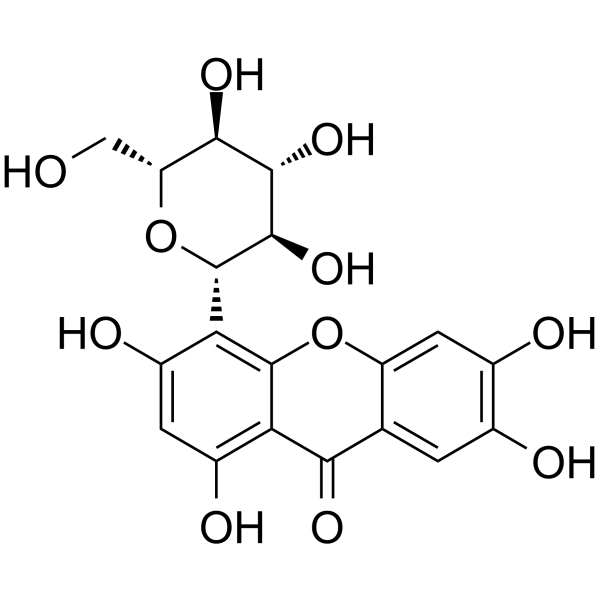
Isomangiferin is an orally active xanthone C-glucoside, and its chemical structure is similar to Mangiferin (HY-N0290). Isomangiferin is an effective VEGFR-2 kinase inhibitor, which can induces cell apoptosis, inhibit the growth, metastasis and angiogenesis of breast cancer. Isomangiferin exerts anti-inflammatory effects by inhibiting the HMGB1/NLRP3/NF-κB signaling pathway, thereby improving the renal function indicators of diabetic mice. Isomangiferin exhibits inhibitory effects on various bacteria and herpes simplex virus type 1 (HSV-1). Isomangiferin promotes the migration and osteogenic differentiation of bone marrow mesenchymal stem cells (BMSCs) and reduces cell apoptosis and the production of ROS by activating the AMPK/ACC pathway, thereby facilitating fracture healing .
|
-
- HY-N0772R
-
|
|
Reference Standards
VEGFR
NF-κB
NOD-like Receptor (NLR)
AMPK
Acetyl-CoA Carboxylase
Apoptosis
Reactive Oxygen Species (ROS)
HSV
Drug Derivative
|
Infection
Metabolic Disease
Inflammation/Immunology
Cancer
|
|
Isomangiferin (Standard) is the analytical standard of Isomangiferin (HY-N0772). This product is intended for research and analytical applications. Isomangiferin is an orally active xanthone C-glucoside, and its chemical structure is similar to Mangiferin (HY-N0290). Isomangiferin is an effective VEGFR-2 kinase inhibitor, which can induces cell apoptosis, inhibit the growth, metastasis and angiogenesis of breast cancer. Isomangiferin exerts anti-inflammatory effects by inhibiting the HMGB1/NLRP3/NF-κB signaling pathway, thereby improving the renal function indicators of diabetic mice. Isomangiferin exhibits inhibitory effects on various bacteria and herpes simplex virus type 1 (HSV-1). Isomangiferin promotes the migration and osteogenic differentiation of bone marrow mesenchymal stem cells (BMSCs) and reduces cell apoptosis and the production of ROS by activating the AMPK/ACC pathway, thereby facilitating fracture healing.
|
-
- HY-P11102
-
|
|
Bacterial
Fungal
HIV
Parasite
|
Infection
Cancer
|
|
Temporin-Sha is an antibacterial peptide with extensive biological activity. Temporin-Sha exhibits broad-spectrum antibacterial activity (e.g., against L. ivanovii, MIC = 6.25 μM), and is effective against Gram-negative bacteria (such as Escherichia coli, MIC = 10 μM), including drug-resistant strains (such as Methicillin (HY-121544)-resistant Staphylococcus aureus). Temporin-Sha also has inhibitory effects on Candida albicans (MIC = 25 μM), Saccharomyces cerevisiae (MIC = 12 μM), the pre-flagellated and non-flagellated forms of Leishmania infantum (IC50 = 5-20 μM), and Trypanosoma cruzi (IC50 = 17 μM). Temporin-Sha exhibits antiviral activity against HSV-1 and has anti-cancer effects (cytotoxicity against breast cancer cells MCF-7 and lung cancer cells H460, etc.) .
|
-
- HY-P1862
-
|
|
HSV
|
Infection
|
|
HSV-gB2 (498-505) is an immunodominant epitope from herpes simplex virus (HSV) glycoprotein B residues 498-505, acts as H-2Kb-restricted and HSV-1/2-cross-reactive cytotoxic T-lymphocyte (CTL) recognition epitope .
|
-
- HY-N8156
-
|
|
HSV
|
Infection
|
|
Soyasapogenol C is an oleanane-type triterpenoid. Soyasapogenol C exhibits anti-HSV-1 activity, with an IC50 of 18.9 μM .
|
-
- HY-B0222
-
|
Behenyl alcohol
|
Environmental Pollutants
HSV
|
Infection
|
|
1-Docosanol (Behenyl alcohol) is a saturated fatty alcohol with reported inhibitory activity against lipid-enveloped viruses, including herpes simplex virus (HSV) .
|
-
- HY-13666S
-
|
(-)-Tetramisole-d5 hydrochloride
|
Isotope-Labeled Compounds
Parasite
HSV
|
Infection
Neurological Disease
|
|
Levamisole-d5 (hydrochloride) is the deuterium labeled Levamisole hydrochloride. Levamisole ((-)-Tetramisole) hydrochloride is an anthelmintic and immunomodulator belonging to a class of synthetic imidazothiazole derivatives. Levamisole hydrochloride has antiviral effects against HSV .
|
-
- HY-173679
-
|
|
PROTACs
PARP
Interleukin Related
STAT
Integrin
HSV
VSV
|
Infection
Cancer
|
|
RBN012811 is a highly selective PROTAC-based PARP14 degrader. RBN012811 forms a ternary complex with cereblon by binding to the NAD + site of PARP14, and mediates the specific degradation of PARP14 via the ubiquitin-proteasome pathway (IC50=10 nM). RBN012811 effectively depletes endogenous PARP14 in various cell lines and primary human macrophages, thereby downregulating IL-10 production and IFN-β mRNA levels, increasing phosphorylated STAT1 levels to enhance inflammatory signaling, and inhibiting interferon-induced ADPr condensate formation. RBN012811 also modulates viral replication, exhibiting increased HSV1 replication while reducing VSV replication. RBN012811 has important application value in research related to cancer and viral infections .
|
-
- HY-N12191
-
|
|
HSV
|
Others
|
|
Cangorinine E-1 (compound 11) is a dihydroagarofuran derivative of the sesquiterpenoid family. Cangorinine E-1 exhibits weak inhibitory effects on herpes simplex virus type II (HSV) .
|
-
- HY-N0415S
-
|
Trigonelline-d3 hydrochloride
|
Isotope-Labeled Compounds
HSV
Bacterial
Fungal
|
Infection
Metabolic Disease
Cancer
|
|
Trigonelline-d3 (chloride) is the deuterium labeled Trigonelline chloride. Trigonelline chloride, an alkaloid with potential antidiabetic activity, is present in considerable amounts in coffee. Trigonelline chloride has anti-HSV-1 , antibacterial, and antifungal activities.
|
-
- HY-N18293
-
|
|
HSV
|
Infection
|
|
Makisterone A 2-acetate is a steroid compound that can be isolated from the 75% ethanol extract of Cyanotis arachnoidea. Experimental tests show that Makisterone A 2-acetate has no anti-HSV-1 activity .
|
-
- HY-B1773A
-
|
|
Environmental Pollutants
Apoptosis
Endogenous Metabolite
Bacterial
Autophagy
HSV
PPAR
NF-κB
COX
NO Synthase
|
Infection
Neurological Disease
Inflammation/Immunology
Cancer
|
|
Sodium propionate is an orally active short-chain fatty acid. Sodium propionate can be produced by intestinal bacteria from the metabolism of dietary fiber. Sodium propionate increases PPAR-γ, inhibits NF-κB activation, and reduces COX-2 expression and NO production. Sodium propionate also induces Apoptosis and Autophagy. Sodium propionate reduces HSV-1-induced keratitis. Sodium propionate has anticancer effects against glioblastoma. Sodium propionate exhibits neuroprotective, antioxidant, and anti-inflammatory activities. Sodium propionate can be used in the research of spinal cord injury and Alzheimer's disease .
|
-
- HY-N6073
-
-
- HY-113471
-
|
|
Apoptosis
HSV
|
Infection
Inflammation/Immunology
Cancer
|
|
Perillic acid is the metabolite of Perillyl alcohol (HY-N7000). Perillic acid induces lung cancer cell cycle arrest and apoptosis. Perillic acid shows anti-HSV-1 and immunomodulatory activities .
|
-
- HY-148169
-
|
|
Nucleoside Antimetabolite/Analog
|
Infection
|
|
2'-Deoxy-L-guanosine selectively inhibits D-Thymidine phosphorylation catalyzed by HSV 1 thymidine kinase. 2'-Deoxy-L-guanosine is the L-configuration of 2'-Deoxyguanosine (HY-17563) .
|
-
- HY-B1773AS5
-
|
|
Isotope-Labeled Compounds
Apoptosis
NF-κB
Bacterial
PPAR
COX
NO Synthase
Autophagy
HSV
Endogenous Metabolite
|
Infection
Neurological Disease
Inflammation/Immunology
Cancer
|
|
Sodium propionate-d3 is the deuterium labeled Propionate sodium (HY-B1773A). Sodium propionate is an orally active short-chain fatty acid. Sodium propionate can be produced by intestinal bacteria from the metabolism of dietary fiber. Sodium propionate increases PPAR-γ, inhibits NF-κB activation, and reduces COX-2 expression and NO production. Sodium propionate also induces Apoptosis and Autophagy. Sodium propionate reduces HSV-1-induced keratitis. Sodium propionate has anticancer effects against glioblastoma. Sodium propionate exhibits neuroprotective, antioxidant, and anti-inflammatory activities. Sodium propionate can be used in the research of spinal cord injury and Alzheimer's disease .
|
-
- HY-B1773AS4
-
|
|
Isotope-Labeled Compounds
Apoptosis
NF-κB
Bacterial
PPAR
COX
NO Synthase
Autophagy
HSV
Endogenous Metabolite
|
Infection
Neurological Disease
Inflammation/Immunology
Cancer
|
|
Sodium propionate-d5 is the deuterium labeled Propionate sodium (HY-B1773A). Sodium propionate is an orally active short-chain fatty acid. Sodium propionate can be produced by intestinal bacteria from the metabolism of dietary fiber. Sodium propionate increases PPAR-γ, inhibits NF-κB activation, and reduces COX-2 expression and NO production. Sodium propionate also induces Apoptosis and Autophagy. Sodium propionate reduces HSV-1-induced keratitis. Sodium propionate has anticancer effects against glioblastoma. Sodium propionate exhibits neuroprotective, antioxidant, and anti-inflammatory activities. Sodium propionate can be used in the research of spinal cord injury and Alzheimer's disease .
|
-
- HY-B1773AS
-
|
|
Isotope-Labeled Compounds
Apoptosis
NF-κB
Bacterial
PPAR
COX
NO Synthase
Autophagy
HSV
Endogenous Metabolite
|
Infection
Neurological Disease
Inflammation/Immunology
Cancer
|
|
Sodium propionate- 13C is the 13C labeled Propionate sodium (HY-B1773A). Sodium propionate is an orally active short-chain fatty acid. Sodium propionate can be produced by intestinal bacteria from the metabolism of dietary fiber. Sodium propionate increases PPAR-γ, inhibits NF-κB activation, and reduces COX-2 expression and NO production. Sodium propionate also induces Apoptosis and Autophagy. Sodium propionate reduces HSV-1-induced keratitis. Sodium propionate has anticancer effects against glioblastoma. Sodium propionate exhibits neuroprotective, antioxidant, and anti-inflammatory activities. Sodium propionate can be used in the research of spinal cord injury and Alzheimer's disease .
|
-
- HY-B1773AR
-
|
|
Reference Standards
Apoptosis
NF-κB
Bacterial
PPAR
COX
NO Synthase
Autophagy
HSV
Endogenous Metabolite
|
Infection
Neurological Disease
Inflammation/Immunology
Cancer
|
|
Sodium propionate (Standard) is the analytical standard of Sodium propionate. This product is intended for research and analytical applications. Sodium propionate is an orally active short-chain fatty acid. Sodium propionate can be produced by intestinal bacteria from the metabolism of dietary fiber. Sodium propionate increases PPAR-γ, inhibits NF-κB activation, and reduces COX-2 expression and NO production. Sodium propionate also induces Apoptosis and Autophagy. Sodium propionate reduces HSV-1-induced keratitis. Sodium propionate has anticancer effects against glioblastoma. Sodium propionate exhibits neuroprotective, antioxidant, and anti-inflammatory activities. Sodium propionate can be used in the research of spinal cord injury and Alzheimer's disease .
|
-
- HY-W017522
-
-
- HY-13605S
-
-
- HY-B1773AS1
-
|
|
Isotope-Labeled Compounds
Apoptosis
NF-κB
Bacterial
PPAR
COX
NO Synthase
Autophagy
HSV
Endogenous Metabolite
|
Infection
Neurological Disease
Inflammation/Immunology
Cancer
|
|
Sodium propionate- 13C-1 is the 13C-labeled Propionate sodium (HY-B1773A). Sodium propionate is an orally active short-chain fatty acid. Sodium propionate can be produced by intestinal bacteria from the metabolism of dietary fiber. Sodium propionate increases PPAR-γ, inhibits NF-κB activation, and reduces COX-2 expression and NO production. Sodium propionate also induces Apoptosis and Autophagy. Sodium propionate reduces HSV-1-induced keratitis. Sodium propionate has anticancer effects against glioblastoma. Sodium propionate exhibits neuroprotective, antioxidant, and anti-inflammatory activities. Sodium propionate can be used in the research of spinal cord injury and Alzheimer's disease .
|
-
- HY-W780208
-
|
|
Isotope-Labeled Compounds
Endogenous Metabolite
Bacterial
PPAR
NF-κB
COX
NO Synthase
Apoptosis
Autophagy
HSV
|
Infection
Neurological Disease
Inflammation/Immunology
Cancer
|
|
Propanoic acid- 13C3 is the 13C-labeled Propanoic acid (HY-W020017). Propanoic acid is an orally active short-chain fatty acid. Propanoic acid can be produced by intestinal bacteria from the metabolism of dietary fiber. Propanoic acid increases PPAR-γ, inhibits NF-κB activation, and reduces COX-2 expression and NO production. Propanoic acid also induces Apoptosis and Autophagy. Propanoic acid reduces HSV-1-induced keratitis. Propanoic acid has anticancer effects against glioblastoma. Propanoic acid exhibits neuroprotective, antioxidant, and anti-inflammatory activities. Propanoic acid can be used in the research of spinal cord injury and Alzheimer's disease .
|
-
- HY-B1773AS3
-
|
|
Isotope-Labeled Compounds
Apoptosis
NF-κB
Bacterial
PPAR
COX
NO Synthase
Autophagy
HSV
Endogenous Metabolite
|
Infection
Neurological Disease
Inflammation/Immunology
Cancer
|
|
Sodium propionate- 13C-3 is the 13C-labeled Propionate sodium (HY-B1773A). Sodium propionate is an orally active short-chain fatty acid. Sodium propionate can be produced by intestinal bacteria from the metabolism of dietary fiber. Sodium propionate increases PPAR-γ, inhibits NF-κB activation, and reduces COX-2 expression and NO production. Sodium propionate also induces Apoptosis and Autophagy. Sodium propionate reduces HSV-1-induced keratitis. Sodium propionate has anticancer effects against glioblastoma. Sodium propionate exhibits neuroprotective, antioxidant, and anti-inflammatory activities. Sodium propionate can be used in the research of spinal cord injury and Alzheimer's disease .
|
-
- HY-B0222R
-
|
Behenyl alcohol (Standard)
|
Reference Standards
HSV
|
Infection
|
|
1-Docosanol (Standard) is the analytical standard of 1-Docosanol. This product is intended for research and analytical applications. 1-Docosanol (Behenyl alcohol) is a saturated fatty alcohol with reported inhibitory activity against lipid-enveloped viruses, including herpes simplex virus (HSV) .
|
-
- HY-B0275
-
|
|
Environmental Pollutants
Antibiotic
Endogenous Metabolite
Bacterial
HSV
|
Infection
|
|
Oxytetracycline is an antibiotic belonging to the tetracycline class. Oxytetracycline potent inhibits Gram-negative and Gram-positive bacteria. Oxytetracycline is a protein synthesis inhibitor and prevents the binding from aminoacil-tRNA to the complex m-ribosomal RNA. Oxytetracycline also possesses anti-HSV-1 activity .
|
-
- HY-B0275A
-
|
|
Environmental Pollutants
Antibiotic
Endogenous Metabolite
Bacterial
HSV
|
Infection
|
|
Oxytetracycline hydrochloride is an antibiotic belonging to the tetracycline class. Oxytetracycline hydrochloride potent inhibits Gram-negative and Gram-positive bacteria. Oxytetracycline hydrochloride is a protein synthesis inhibitor and prevents the binding from aminoacil-tRNA to the complex m-ribosomal RNA. Oxytetracycline hydrochloride also possesses anti-HSV-1 activity .
|
-
- HY-110354
-
UCM05
2 Publications Verification
G28UCM
|
Fatty Acid Synthase (FASN)
Bacterial
|
Infection
|
|
UCM05 (G28UCM) is a fatty acid synthase (FASN) and filamentous temperature-sensitive protein Z (Ftsz) inhibitor. UCM05 inhibits fatty acid synthesis, viral replication, and Gram-positive bacterial growth. UCM05 binds to FtsZ GTP-binding sites, inhibits GTPase activity, and disrupts Z-ring localization. UCM05 can be used for the research of HSV-1/2 infection, HIV-1 infection, and Gram-positive bacterial infections[1][2][3].
|
-
- HY-B0275C
-
|
|
Bacterial
HSV
Antibiotic
Endogenous Metabolite
|
Infection
|
|
Oxytetracycline calcium is an antibiotic belonging to the tetracycline class. Oxytetracycline calcium potently inhibits Gram-negative and Gram-positive bacteria. Oxytetracycline calcium is a protein synthesis inhibitor and prevents the binding from aminoacil-tRNA to the complex m-ribosomal RNA. Oxytetracycline calcium also possesses anti-HSV-1 activity .
|
-
- HY-N6073R
-
|
|
Reference Standards
Apoptosis
HSV
|
Infection
Metabolic Disease
Inflammation/Immunology
Cancer
|
|
Soyasapogenol A (Standard) is the analytical standard of Soyasapogenol A (HY-N6073). This product is intended for research and analytical applications. Soyasapogenol A is a triterpenoid aglycone of soyasaponins. Soyasapogenol A has activities such as anti-inflammation, anti-cancer, hepatoprotection and anti-HSV-1. Soyasapogenol A can be used in the research of tumors and immune inflammatory diseases .
|
-
- HY-B0275B
-
|
|
Bacterial
HSV
Antibiotic
Endogenous Metabolite
|
Infection
|
|
Oxytetracycline dihydrate is an antibiotic belonging to the tetracycline class. Oxytetracycline dihydrate potent inhibits Gram-negative and Gram-positive bacteria. Oxytetracycline dihydrate is a protein synthesis inhibitor and prevents the binding from aminoacil-tRNA to the complex m-ribosomal RNA. Oxytetracycline dihydrate also possesses anti-HSV-1 activity .
|
-
- HY-N0414
-
|
Trigenolline
|
Endogenous Metabolite
Ferroptosis
Apoptosis
HIV
Bacterial
Fungal
|
Metabolic Disease
Cancer
|
|
Trigonelline is an alkaloid with potential antidiabetic activity that can be isolated from Trigonella foenum-graecum L or Leonurus artemisia. Trigonelline is a potent Nrf2 inhibitor that blocks Nrf2-dependent proteasome activity, thereby enhancing apoptosis in pancreatic cancer cells. Trigonelline also has anti-HSV-1, antibacterial, and antifungal activity and induces ferroptosis.
|
-
- HY-B0275S
-
|
|
Isotope-Labeled Compounds
Antibiotic
Bacterial
Endogenous Metabolite
HSV
|
Infection
|
|
Oxytetracycline-d6 is deuterium labeled Oxytetracycline. Oxytetracycline is an antibiotic belonging to the tetracycline class. Oxytetracycline potent inhibits Gram-negative and Gram-positive bacteria. Oxytetracycline is a protein synthesis inhibitor and prevents the binding from aminoacil-tRNA to the complex m-ribosomal RNA. Oxytetracycline also possesses anti-HSV-1 activity .
|
-
- HY-N0415
-
|
Trigonelline hydrochloride
|
Endogenous Metabolite
Ferroptosis
Apoptosis
HIV
Bacterial
Fungal
|
Infection
Metabolic Disease
Cancer
|
|
Trigonelline chloride is an alkaloid with potential antidiabetic activity that can be isolated from Trigonella foenum-graecum L or Leonurus artemisia. Trigonelline chloride is a potent Nrf2 inhibitor that blocks Nrf2-dependent proteasome activity, thereby enhancing apoptosis in pancreatic cancer cells. Trigonelline chloride also has anti-HSV-1, antibacterial, and antifungal activity, and induces ferroptosis.
|
-
- HY-P5642
-
-
- HY-W017522S3
-
|
Hexanedioic acid-13C
|
Isotope-Labeled Compounds
Endogenous Metabolite
HSV
|
Infection
Metabolic Disease
|
|
Adipic acid- 13C (Hexanedioic acid- 13C) is the 13C labeled Adipic acid (HY-W017522). Adipic acid (Hexanedioic acid) is an orally active compound with anti-HSV-1 activity. Adipic acid has low toxicity and can be used as a food additive and a gelling agent. Adipic acid can also be used in the synthesis of lubricants, artificial resins, plastics, etc .
|
-
- HY-B0275AR
-
|
|
Reference Standards
Bacterial
HSV
Antibiotic
Endogenous Metabolite
|
Infection
|
|
Oxytetracycline (hydrochloride) (Standard) is the analytical standard of Oxytetracycline (hydrochloride). This product is intended for research and analytical applications. Oxytetracycline hydrochloride is an antibiotic belonging to the tetracycline class. Oxytetracycline hydrochloride potent inhibits Gram-negative and Gram-positive bacteria. Oxytetracycline hydrochloride is a protein synthesis inhibitor and prevents the binding from aminoacil-tRNA to the complex m-ribosomal RNA. Oxytetracycline hydrochloride also possesses anti-HSV-1 activity .
|
-
- HY-W017522R
-
|
Hexanedioic acid (Standard)
|
Reference Standards
Endogenous Metabolite
HSV
|
Infection
Metabolic Disease
|
|
Adipic acid (Standard) (Hexanedioic acid (Standard)) is the analytical standard of Adipic acid (HY-W017522). This product is intended for research and analytical applications. Adipic acid (Hexanedioic acid) is an orally active compound with anti-HSV-1 activity. Adipic acid has low toxicity and can be used as a food additive and a gelling agent. Adipic acid can also be used in the synthesis of lubricants, artificial resins, plastics, etc .
|
-
- HY-B0275R
-
|
|
Reference Standards
Bacterial
HSV
Endogenous Metabolite
Antibiotic
|
Infection
|
|
Oxytetracycline (Standard) is the analytical standard of Oxytetracycline. This product is intended for research and analytical applications. Oxytetracycline is an antibiotic belonging to the tetracycline class. Oxytetracycline potent inhibits Gram-negative and Gram-positive bacteria. Oxytetracycline is a protein synthesis inhibitor and prevents the binding from aminoacil-tRNA to the complex m-ribosomal RNA. Oxytetracycline also possesses anti-HSV-1 activity .
|
-
- HY-110354R
-
|
G28UCM (Standard)
|
Reference Standards
Fatty Acid Synthase (FASN)
Bacterial
|
Infection
|
|
UCM05 (Standard) is the analytical standard of Lysipressin. This product is intended for research and analytical applications. UCM05 (G28UCM) is a fatty acid synthase (FASN) and filamentous temperature-sensitive protein Z (Ftsz) inhibitor. UCM05 inhibits fatty acid synthesis, viral replication, and Gram-positive bacterial growth. UCM05 binds to FtsZ GTP-binding sites, inhibits GTPase activity, and disrupts Z-ring localization. UCM05 can be used for the research of HSV-1/2 infection, HIV-1 infection, and Gram-positive bacterial infections [1][2][3].
|
-
- HY-B0275S1
-
|
|
Isotope-Labeled Compounds
Endogenous Metabolite
Bacterial
Antibiotic
HSV
|
Infection
|
|
Oxytetracycline-d3 is the deuterium labeled Oxytetracycline (HY-B0275). Oxytetracycline is an antibiotic belonging to the tetracycline class. Oxytetracycline potent inhibits Gram-negative and Gram-positive bacteria. Oxytetracycline is a protein synthesis inhibitor and prevents the binding from aminoacil-tRNA to the complex m-ribosomal RNA. Oxytetracycline also possesses anti-HSV-1 activity .
|
-
- HY-W017522S
-
|
Hexanedioic acid-d10
|
Isotope-Labeled Compounds
Endogenous Metabolite
HSV
|
Infection
Metabolic Disease
|
|
Adipic acid-d10 (Hexanedioic acid-d10) is the deuterium labeled Adipic acid (HY-W017522). Adipic acid (Hexanedioic acid) is an orally active compound with anti-HSV-1 activity. Adipic acid has low toxicity and can be used as a food additive and a gelling agent. Adipic acid can also be used in the synthesis of lubricants, artificial resins, plastics, etc .
|
-
- HY-W017522S6
-
|
Hexanedioic acid-13C2
|
Isotope-Labeled Compounds
Endogenous Metabolite
HSV
|
Infection
Metabolic Disease
|
|
Adipic acid- 13C2 (Hexanedioic acid- 13C2) is 13C labeled Adipic acid (HY-W017522). Adipic acid (Hexanedioic acid) is an orally active compound with anti-HSV-1 activity. Adipic acid has low toxicity and can be used as a food additive and a gelling agent. Adipic acid can also be used in the synthesis of lubricants, artificial resins, plastics, etc .
|
-
- HY-W017522S2
-
|
Hexanedioic acid-d4
|
Isotope-Labeled Compounds
Endogenous Metabolite
HSV
|
Infection
Metabolic Disease
|
|
Adipic acid-d4 (Hexanedioic acid-d4) is the deuterium labeled Adipic acid (HY-W017522). Adipic acid (Hexanedioic acid) is an orally active compound with anti-HSV-1 activity. Adipic acid has low toxicity and can be used as a food additive and a gelling agent. Adipic acid can also be used in the synthesis of lubricants, artificial resins, plastics, etc .
|
-
- HY-W017522S1
-
|
Hexanedioic acid-13C6
|
Isotope-Labeled Compounds
Endogenous Metabolite
HSV
|
Infection
Metabolic Disease
|
|
Adipic acid- 13C6 (Hexanedioic acid- 13C6) is the 13C labeled Adipic acid (HY-W017522). Adipic acid (Hexanedioic acid) is an orally active compound with anti-HSV-1 activity. Adipic acid has low toxicity and can be used as a food additive and a gelling agent. Adipic acid can also be used in the synthesis of lubricants, artificial resins, plastics, etc .
|
-
- HY-W755036
-
|
|
Isotope-Labeled Compounds
Bacterial
HSV
Antibiotic
|
Infection
|
|
Oxytetracycline-13C,d3 hydrochloride is the 13C- and deuterium labeled Oxytetracycline hydrochloride (HY-B0275A). Oxytetracycline hydrochloride is an antibiotic that exhibits board-spectrum antibacterial activity. Oxytetracycline hydrochloride is a protein synthesis inhibitor and prevents the binding from aminoacil-tRNA to the complex m-ribosomal RNA. Oxytetracycline hydrochloride also possesses anti-HSV-1 activity .
|
-
- HY-W017522S4
-
|
Hexanedioic acid-d8
|
Isotope-Labeled Compounds
Endogenous Metabolite
HSV
|
Infection
Metabolic Disease
|
|
Adipic acid-d8 (Hexanedioic acid-d8) is the deuterium labeled Adipic acid (HY-W017522). Adipic acid (Hexanedioic acid) is an orally active compound with anti-HSV-1 activity. Adipic acid has low toxicity and can be used as a food additive and a gelling agent. Adipic acid can also be used in the synthesis of lubricants, artificial resins, plastics, etc .
|
-
- HY-W017522S5
-
|
Hexanedioic acid-d4-1
|
Isotope-Labeled Compounds
Endogenous Metabolite
HSV
|
Infection
Metabolic Disease
|
|
Adipic acid-d4-1 (Hexanedioic acid-d4-1) is the deuterium labeled Adipic acid (HY-W017522). Adipic acid (Hexanedioic acid) is an orally active compound with anti-HSV-1 activity. Adipic acid has low toxicity and can be used as a food additive and a gelling agent. Adipic acid can also be used in the synthesis of lubricants, artificial resins, plastics, etc .
|
-
- HY-B0275BR
-
|
|
Reference Standards
Bacterial
HSV
Antibiotic
Endogenous Metabolite
|
Infection
|
|
Oxytetracycline (dihydrate) (Standard) is the analytical standard of Oxytetracycline (dihydrate). This product is intended for research and analytical applications. Oxytetracycline dihydrate is an antibiotic belonging to the tetracycline class. Oxytetracycline dihydrate potent inhibits Gram-negative and Gram-positive bacteria. Oxytetracycline dihydrate is a protein synthesis inhibitor and prevents the binding from aminoacil-tRNA to the complex m-ribosomal RNA. Oxytetracycline dihydrate also possesses anti-HSV-1 activity .
|
-
- HY-N0414R
-
|
Trigenolline (Standard)
|
Endogenous Metabolite
Ferroptosis
Apoptosis
HIV
Bacterial
Fungal
Reference Standards
|
Metabolic Disease
Cancer
|
|
Trigonelline (Standard) is the analytical standard of Trigonelline. This product is intended for research and analytical applications. Trigonelline is an alkaloid with potential antidiabetic activity that can be isolated from Trigonella foenum-graecum L or Leonurus artemisia. Trigonelline is a potent Nrf2 inhibitor that blocks Nrf2-dependent proteasome activity, thereby enhancing apoptosis in pancreatic cancer cells. Trigonelline also has anti-HSV-1, antibacterial, and antifungal activity and induces ferroptosis.
|
-
- HY-N0415R
-
|
Trigonelline hydrochloride (Standard)
|
Endogenous Metabolite
Ferroptosis
Apoptosis
HIV
Bacterial
Fungal
Reference Standards
|
Infection
Metabolic Disease
Cancer
|
|
Trigonelline (chloride) (Standard) is the analytical standard of Trigonelline (chloride). This product is intended for research and analytical applications. Trigonelline chloride is an alkaloid with potential antidiabetic activity that can be isolated from Trigonella foenum-graecum L or Leonurus artemisia. Trigonelline chloride is a potent Nrf2 inhibitor that blocks Nrf2-dependent proteasome activity, thereby enhancing apoptosis in pancreatic cancer cells. Trigonelline chloride also has anti-HSV-1, antibacterial, and antifungal activity, and induces ferroptosis.
|
-
- HY-P5642A
-
|
RC-101 TFA
|
HIV
SARS-CoV
Influenza Virus
Flavivirus
HSV
Bacterial
Fungal
Toll-like Receptor (TLR)
Ser/Thr Protease
|
Infection
Inflammation/Immunology
|
|
Retrocyclin-101 (RC-101) TFA is an artificially synthesized, cyclic-structured θ-defensin, a broad-spectrum agent with antimicrobial (covering viruses, bacteria, and fungi) activity and anti-inflammatory activity. Retrocyclin-101 TFA can inhibit the serine protease activity of ZIKV NS2B-NS3, with an IC50 of 7.20 μM. Retrocyclin-101 TFA has significant inhibitory activity against HIV, SARS-CoV-2, flaviviruses, influenza viruses, HSV-1/2, Staphylococcus aureus, etc. Retrocyclin-101 TFA inhibits the signal transduction mediated by TLR4 and TLR2, reducing the expression of pro-inflammatory cytokines .
|
-
- HY-W004486
-
|
|
HSV
MMP
ERK
p38 MAPK
JNK
|
Infection
|
|
Gallic aldehyde (3,4,5-Trihydroxybenzaldehyde) is a phenolic aldehyde. Gallic aldehyde can be isolated from Geum japonicum. Gallic aldehyde inhibits the gelatinolytic activity and expression of MMP-9. Gallic aldehyde also inhibits ERK1/2, p38, and JNK. Gallic aldehyde has potent anti-HSV-1 and antioxidant activities. Gallic aldehyde also exhibits antibacterial activity against Oenococcus oeni VF .
|
-
- HY-N0415S1
-
|
Trigonelline-d3-1 hydrochloride
|
Isotope-Labeled Compounds
Fungal
Apoptosis
Bacterial
HIV
Ferroptosis
Endogenous Metabolite
|
Infection
Metabolic Disease
Cancer
|
|
Trigonelline-d3-1 chloride (Trigonelline-d3-1 hydrochloride) is the deuterium labeled Trigonelline chloride (HY-N0415). Trigonelline chloride is an alkaloid with potential antidiabetic activity that can be isolated from Trigonella foenum-graecum L or Leonurus artemisia. Trigonelline chloride is a potent Nrf2 inhibitor that blocks Nrf2-dependent proteasome activity, thereby enhancing apoptosis in pancreatic cancer cells. Trigonelline chloride also has anti-HSV-1, antibacterial, and antifungal activity, and induces ferroptosis.
|
-
- HY-13637B
-
|
BW-759 hydrate; 2'-Nor-2'-deoxyguanosine hydrate
|
CMV
HSV
Antibiotic
Nucleoside Antimetabolite/Analog
|
Infection
Cancer
|
|
Ganciclovir (BW 759) hydrate, a nucleoside analogue, is an orally active antiviral agent with activity against CMV. Ganciclovir hydrate also has activity in vitro against members of the herpes group and some other DNA viruses. Ganciclovir hydrate inhibits the in vitro replication of human herpes viruses (HSV 1 and 2, CMV) and adenovirus serotypes 1, 2, 4, 6, 8, 10, 19, 22 and 28. Ganciclovir hydrate has an IC50 of 5.2 μM for feline herpesvirus type-1 (FHV-1) and can diffuse into the brain .
|
-
- HY-13637
-
|
BW 759; 2'-Nor-2'-deoxyguanosine
|
CMV
HSV
Antibiotic
Nucleoside Antimetabolite/Analog
|
Infection
Cancer
|
|
Ganciclovir (BW 759), a nucleoside analogue, is an orally active antiviral agent with activity against CMV. Ganciclovir also has activity in vitro against members of the herpes group and some other DNA viruses. Ganciclovir inhibits the in vitro replication of human herpes viruses (HSV 1 and 2, CMV) and adenovirus serotypes 1, 2, 4, 6, 8, 10, 19, 22 and 28. Ganciclovir has an IC50 of 5.2 μM for feline herpesvirus type-1 (FHV-1) and can diffuse into the brain .
|
-
- HY-13637A
-
|
BW 759 sodium; 2'-Nor-2'-deoxyguanosine sodium
|
CMV
HSV
Antibiotic
Nucleoside Antimetabolite/Analog
|
Infection
Cancer
|
|
Ganciclovir (BW 759) sodium, a nucleoside analogue, is an orally active antiviral agent with activity against CMV. Ganciclovir sodium also has activity in vitro against members of the herpes group and some other DNA viruses. Ganciclovir sodium inhibits the in vitro replication of human herpes viruses (HSV 1 and 2, CMV) and adenovirus serotypes 1, 2, 4, 6, 8, 10, 19, 22 and 28. Ganciclovir sodium has an IC50 of 5.2 μM for feline herpesvirus type-1 (FHV-1) and can diffuse into the brain .
|
-
- HY-13637S
-
|
BW 759-d5; 2'-Nor-2'-deoxyguanosine-d5
|
Isotope-Labeled Compounds
CMV
HSV
Antibiotic
Nucleoside Antimetabolite/Analog
|
Infection
|
|
Ganciclovir-d5 is the deuterium labeled Ganciclovir. Ganciclovir (BW 759), a nucleoside analogue, is an orally active antiviral agent with activity against CMV. Ganciclovir also has activity in vitro against members of the herpes group and some other DNA viruses. Ganciclovir inhibits the in vitro replication of human herpes viruses (HSV 1 and 2, CMV) and adenovirus serotypes 1, 2, 4, 6, 8, 10, 19, 22 and 28. Ganciclovir has an IC50 of 5.2 μM for feline herpesvirus type-1 (FHV-1) .
|
-
- HY-170940
-
|
|
DYRK
Enterovirus
|
Infection
|
|
Dyrk1A-IN-12 (compound S43) is a Dyrk (Dual specificity tyrosine phosphorylation regulated kinase 1A inhibitor. Dyrk1A-IN-12 inhibits Dyrk1A with a IC50 of 95 nM. Dyrk1A-IN-12 shows anti-EV-A71 activity with an EC50 of 4.4 μM, CC50 of 12.8 μM and SI of 2.9. Dyrk1A-IN-12 shows potent inhibition against herpes simplex virus (HSV) .
|
-
- HY-13637R
-
|
BW 759 (Standard); 2'-Nor-2'-deoxyguanosine (Standard)
|
Reference Standards
CMV
HSV
Antibiotic
Nucleoside Antimetabolite/Analog
|
Infection
Cancer
|
|
Ganciclovir (Standard) is the analytical standard of Ganciclovir. This product is intended for research and analytical applications. Ganciclovir (BW 759), a nucleoside analogue, is an orally active antiviral agent with activity against CMV. Ganciclovir also has activity in vitro against members of the herpes group and some other DNA viruses. Ganciclovir inhibits the in vitro replication of human herpes viruses (HSV 1 and 2, CMV) and adenovirus serotypes 1, 2, 4, 6, 8, 10, 19, 22 and 28. Ganciclovir has an IC50 of 5.2 μM for feline herpesvirus type-1 (FHV-1) and can diffuse into the brain .
|
-
- HY-13637AR
-
|
BW 759 sodium (Standard); 2'-Nor-2'-deoxyguanosine sodium (Standard)
|
Reference Standards
CMV
HSV
Antibiotic
Nucleoside Antimetabolite/Analog
|
Infection
Cancer
|
|
Ganciclovir (sodium) (Standard) is the analytical standard of Ganciclovir (sodium). This product is intended for research and analytical applications. Ganciclovir (BW 759) sodium, a nucleoside analogue, is an orally active antiviral agent with activity against CMV. Ganciclovir sodium also has activity in vitro against members of the herpes group and some other DNA viruses. Ganciclovir sodium inhibits the in vitro replication of human herpes viruses (HSV 1 and 2, CMV) and adenovirus serotypes 1, 2, 4, 6, 8, 10, 19, 22 and 28. Ganciclovir sodium has an IC50 of 5.2 μM for feline herpesvirus type-1 (FHV-1) and can diffuse into the brain[1][2][3].
|
-
- HY-W004486R
-
|
|
Reference Standards
HSV
MMP
ERK
p38 MAPK
JNK
|
Infection
|
|
Gallic aldehyde (Standard) is an analytical standard of Gallic aldehyde (HY-W004486). This product is intended for research and analytical applications. Gallic aldehyde (3,4,5-Trihydroxybenzaldehyde) is a phenolic aldehyde. Gallic aldehyde can be isolated from Geum japonicum. Gallic aldehyde inhibits the gelatinolytic activity and expression of MMP-9. Gallic aldehyde also inhibits ERK1/2, p38, and JNK. Gallic aldehyde has potent anti-HSV-1 and antioxidant activities. Gallic aldehyde also exhibits antibacterial activity against Oenococcus oeni VF .
|
-
- HY-N2110
-
|
|
Akt
Sirtuin
Integrin
STAT
PI3K
Apoptosis
ERK
PPAR
PKC
Toll-like Receptor (TLR)
HIV
|
Inflammation/Immunology
|
|
Phellopterin, an orally active furocoumarin with multiple biological activities. Phellopterin is a partial agonist of the central benzodiazepine receptors. Phellopterin exerts anti-inflammatory effects by upregulating SIRT1, downregulating ICAM-1 (reducing chronic inflammation, aiding diabetic ulcer healing), inhibiting STAT3 phosphorylation (easing atopic dermatitis inflammation), regulating Akt/PKC pathways (lowering TNF-α-induced VCAM-1 to block monocyte adhesion), and inhibiting TLR4/NF-κB pathway and macrophage M2 polarization (alleviating colitis-related cancers). Phellopterin suppresses ovarian cancer progression via inhibiting the PU.1/CLEC5A/PI3K-AKT loop (inducing cell cycle arrest, apoptosis, DNA damage). Phellopterin alleviates murine diabetes by promoting adipocyte differentiation and increasing PPARγ. Phellopterin also has anti-HSV-1 activity. Phellopterin can be used for studying anti-inflammation, anti-cancer (e.g., ovarian cancer, colitis cancer), blood glucose lowering, anti-diabetes, and anti-virus .
|
-
- HY-N2110R
-
|
|
Reference Standards
Akt
Sirtuin
Integrin
STAT
PI3K
Apoptosis
ERK
PPAR
PKC
Toll-like Receptor (TLR)
HIV
|
Infection
Cardiovascular Disease
Neurological Disease
Metabolic Disease
Inflammation/Immunology
Cancer
|
|
Phellopterin (Standard) is the analytical standard of Phellopterin. Phellopterin, an orally active furocoumarin with multiple biological activities. Phellopterin is a partial agonist of the central benzodiazepine receptors. Phellopterin exerts anti-inflammatory effects by upregulating SIRT1, downregulating ICAM-1 (reducing chronic inflammation, aiding diabetic ulcer healing), inhibiting STAT3 phosphorylation (easing atopic dermatitis inflammation), regulating Akt/PKC pathways (lowering TNF-α-induced VCAM-1 to block monocyte adhesion), and inhibiting TLR4/NF-κB pathway and macrophage M2 polarization (alleviating colitis-related cancers). Phellopterin suppresses ovarian cancer progression via inhibiting the PU.1/CLEC5A/PI3K-AKT loop (inducing cell cycle arrest, apoptosis, DNA damage). Phellopterin alleviates murine diabetes by promoting adipocyte differentiation and increasing PPARγ. Phellopterin also has anti-HSV-1 activity. Phellopterin can be used for studying anti-inflammation, anti-cancer (e.g., ovarian cancer, colitis cancer), blood glucose lowering, anti-diabetes, and anti-virus.
|
-
| Cat. No. |
Product Name |
Type |
-
- HY-B1773A
-
|
|
Biochemical Assay Reagents
|
|
Sodium propionate is an orally active short-chain fatty acid. Sodium propionate can be produced by intestinal bacteria from the metabolism of dietary fiber. Sodium propionate increases PPAR-γ, inhibits NF-κB activation, and reduces COX-2 expression and NO production. Sodium propionate also induces Apoptosis and Autophagy. Sodium propionate reduces HSV-1-induced keratitis. Sodium propionate has anticancer effects against glioblastoma. Sodium propionate exhibits neuroprotective, antioxidant, and anti-inflammatory activities. Sodium propionate can be used in the research of spinal cord injury and Alzheimer's disease .
|
-
- HY-B1773AR
-
|
|
Biochemical Assay Reagents
|
|
Sodium propionate (Standard) is the analytical standard of Sodium propionate. This product is intended for research and analytical applications. Sodium propionate is an orally active short-chain fatty acid. Sodium propionate can be produced by intestinal bacteria from the metabolism of dietary fiber. Sodium propionate increases PPAR-γ, inhibits NF-κB activation, and reduces COX-2 expression and NO production. Sodium propionate also induces Apoptosis and Autophagy. Sodium propionate reduces HSV-1-induced keratitis. Sodium propionate has anticancer effects against glioblastoma. Sodium propionate exhibits neuroprotective, antioxidant, and anti-inflammatory activities. Sodium propionate can be used in the research of spinal cord injury and Alzheimer's disease .
|
| Cat. No. |
Product Name |
Target |
Research Area |
-
- HY-P2310
-
|
|
Bacterial
Parasite
Apoptosis
HIV
HSV
CMV
TNF Receptor
NOD-like Receptor (NLR)
DNA/RNA Synthesis
Influenza Virus
|
Cardiovascular Disease
Infection
|
|
Defensin HNP-1 human is a type of human neutrophil peptide (HNPs). Defensin HNP-1 human possesses immunomodulatory functions and can delay the apoptosis of neutrophils. Defensin HNP-1 human inhibits DNA/RNA/protein synthesis and interferes with metabolic pathways, thus exhibiting broad antibacterial activity. Defensin HNP-1 human has direct inactivation effects on HIV, HSV-1, HSV-2, CMV, influenza virus, etc. Defensin HNP-1 human has antileishmanial activity. Defensin HNP-1 human is involved in endothelial cell dysfunction during the early development of atherosclerosis .
|
-
- HY-W141881
-
|
|
Environmental Pollutants
Biochemical Assay Reagents
HSV
|
Infection
|
|
N-lauroylsarcosine is an anionic surfactant. N-lauroylsarcosine has antiviral activity against HSV-2 strain 333 and HSV-1 strain F. N-lauroylsarcosine synergistically increases skin permeability with 25-50% ethanol. N-lauroylsarcosine can be used to study HSV-2 infection .
|
-
- HY-P2310A
-
|
|
Bacterial
Parasite
Apoptosis
HIV
HSV
CMV
TNF Receptor
Interleukin Related
NOD-like Receptor (NLR)
DNA/RNA Synthesis
Influenza Virus
|
Cardiovascular Disease
Infection
|
|
Defensin HNP-1 human TFA is a type of human neutrophil peptide (HNPs). Defensin HNP-1 human TFA possesses immunomodulatory functions and can delay the apoptosis of neutrophils. Defensin HNP-1 human TFA inhibits DNA/RNA/protein synthesis and interferes with metabolic pathways, thus exhibiting broad antibacterial activity. Defensin HNP-1 human TFA has direct inactivation effects on HIV, HSV-1, HSV-2, CMV, influenza virus, etc. Defensin HNP-1 human TFA has antileishmanial activity. Defensin HNP-1 human TFA is involved in endothelial cell dysfunction during the early development of atherosclerosis .
|
-
- HY-P1958
-
|
|
HSV
|
Infection
|
|
Histone H4 (2-21) is the core histones associated with chromatinization of herpes simplex virus 1 (HSV-1) genomes .
|
-
- HY-P5997
-
|
|
Autophagy
Cyclic GMP-AMP Synthase
|
Inflammation/Immunology
|
|
XQ2B is a specific cGAS inhibitor targeting protein-DNA interaction and phase separation. XQ2B markedly reduces ISD-induced Autophagy. XQ2B inhibits herpes simplex virus 1 (HSV-1)-induced antiviral immune responses and enhances HSV-1 infection .
|
-
- HY-P4773
-
|
|
HSV
|
Infection
|
|
HSV-1 Protease substrate is a peptide substrate for HSV-1 (Herpes Simplex Virus Type 1) protease, and the specificity constant (kcat/Km) at pH 7.5 for cleavage is 5.2 M -1 s -1 .
|
-
- HY-P11342
-
|
|
Fungal
HSV
|
Infection
|
|
Verlamelin A is a macrocyclic depsipeptide with antifungal and antiviral activity. Verlamelin A shows
antifungal activity toward Aspergillus versicolor and Curvularia australiensis and also has antiviral activity toward
HSV-1 (IC50 = 16.7 μM). Verlamelin A is isolated from the entomopathogenic fungus Lecanicillium sp. Verlamelin A is useful for antifungal and antiviral research .
|
-
- HY-P10371
-
|
txCD47
|
Reactive Oxygen Species (ROS)
Thrombopoietin Receptor
Mitochondrial Metabolism
HSP
HSV
CD47
|
Infection
Inflammation/Immunology
Cancer
|
|
PKHB1 (txCD47) is a CD47 agonist and Thrombospondin-1 peptide mimetic. PKHB1 activates CD47 and triggers Caspase-independent, calcium-dependent cell death via mitochondrial alterations, ROS production, endoplasmic reticulum morphological changes, and dissipation of mitochondrial membrane potential. PKHB1 induces the exposure of Calreticulin, HSP70, and HSP90, thereby driving immunogenic cell death. PKHB1 promotes intratumoral CD8 + T cell infiltration and inhibits breast tumorigenesis. PKHB1 reduces HSV-1 levels and alleviates the severity of herpes simplex keratitis. PKHB1 can be used in research related to breast cancer, herpes simplex keratitis, and T-cell acute lymphoblastic leukemia .
|
-
- HY-P11102
-
|
|
Bacterial
Fungal
HIV
Parasite
|
Infection
Cancer
|
|
Temporin-Sha is an antibacterial peptide with extensive biological activity. Temporin-Sha exhibits broad-spectrum antibacterial activity (e.g., against L. ivanovii, MIC = 6.25 μM), and is effective against Gram-negative bacteria (such as Escherichia coli, MIC = 10 μM), including drug-resistant strains (such as Methicillin (HY-121544)-resistant Staphylococcus aureus). Temporin-Sha also has inhibitory effects on Candida albicans (MIC = 25 μM), Saccharomyces cerevisiae (MIC = 12 μM), the pre-flagellated and non-flagellated forms of Leishmania infantum (IC50 = 5-20 μM), and Trypanosoma cruzi (IC50 = 17 μM). Temporin-Sha exhibits antiviral activity against HSV-1 and has anti-cancer effects (cytotoxicity against breast cancer cells MCF-7 and lung cancer cells H460, etc.) .
|
-
- HY-P5642
-
-
- HY-P11160
-
|
|
HSV
|
Infection
|
|
GF-17 is a polypeptide containing 17 amino acids. is the precursor peptide of GF19. GF-17 exhibits significant antiviral activity. GF-17 can be used for research on viral infections such as HSV-1 virus .
|
-
- HY-P5693
-
|
|
Bacterial
CMV
HSV
|
Infection
|
|
HBA(111-142), an antimicrobial peptide, is a C-terminal 32-mer fragment of alpha-hemoglobin. HBA(111-142) has antibacterial activity against the ESKAPE panel of pathogens. HBA(111-142) forms amyloid fibrils, and has antiviral activities. HBA(111-142) inhibits measles and herpes viruses (HSV-1, HSV-2, HCMV) .
|
-
- HY-P1862
-
|
|
HSV
|
Infection
|
|
HSV-gB2 (498-505) is an immunodominant epitope from herpes simplex virus (HSV) glycoprotein B residues 498-505, acts as H-2Kb-restricted and HSV-1/2-cross-reactive cytotoxic T-lymphocyte (CTL) recognition epitope .
|
-
- HY-P5642A
-
|
RC-101 TFA
|
HIV
SARS-CoV
Influenza Virus
Flavivirus
HSV
Bacterial
Fungal
Toll-like Receptor (TLR)
Ser/Thr Protease
|
Infection
Inflammation/Immunology
|
|
Retrocyclin-101 (RC-101) TFA is an artificially synthesized, cyclic-structured θ-defensin, a broad-spectrum agent with antimicrobial (covering viruses, bacteria, and fungi) activity and anti-inflammatory activity. Retrocyclin-101 TFA can inhibit the serine protease activity of ZIKV NS2B-NS3, with an IC50 of 7.20 μM. Retrocyclin-101 TFA has significant inhibitory activity against HIV, SARS-CoV-2, flaviviruses, influenza viruses, HSV-1/2, Staphylococcus aureus, etc. Retrocyclin-101 TFA inhibits the signal transduction mediated by TLR4 and TLR2, reducing the expression of pro-inflammatory cytokines .
|
| Cat. No. |
Product Name |
Target |
Research Area |
Image |
-
- HY-P99147
-
|
|
CD3
|
Infection
Inflammation/Immunology
|
|
Anti-Mouse TCR V gamma 2 Antibody (UC3-10A6) is an Armenian Hamster-derived IgG antibody inhibitor, targeting to mouse TCR V gamma 2. Anti-Mouse TCR V gamma 2 Antibody (UC3-10A6) reacts with an epitope on the delta chain of the mouse Vγ2 TCR (V gamma 2 T cell receptor). Anti-Mouse TCR V gamma 2 Antibody (UC3-10A6) can deplete γδ T cell. Anti-Mouse TCR V gamma 2 Antibody (UC3-10A6) can be used for the researches of infection and immunology, such as herpes simplex virus-1 (HSV-1) infection .
|
-
(5)
| Cat. No. |
Product Name |
Category |
Target |
Chemical Structure |
-
- HY-16592
-
-
-
- HY-A0181
-
-
-
- HY-N1067
-
-
-
- HY-N0415
-
-
-
- HY-N0414
-
-
-
- HY-B0275
-
-
-
- HY-17425A
-
-
-
- HY-N1430
-
-
-
- HY-113289
-
-
-
- HY-B0275A
-
-
-
- HY-W017522
-
-
-
- HY-N1451
-
-
-
- HY-N2011
-
-
-
- HY-A0181A
-
-
-
- HY-N2004
-
-
-
- HY-Y0136
-
-
-
- HY-A0181R
-
-
-
- HY-N0772
-
-
-
- HY-B0222
-
-
-
- HY-N6073
-
-
-
- HY-B0275B
-
-
-
- HY-113135
-
-
-
- HY-N2110
-
|
|
Structural Classification
Classification of Application Fields
Coumarins
Phenylpropanoids
Umbelliferae
Helogyne apaloidea Nutt.
Plants
Inflammation/Immunology
Disease Research Fields
Source Classification
|
Akt
Sirtuin
Integrin
STAT
PI3K
Apoptosis
ERK
PPAR
PKC
Toll-like Receptor (TLR)
HIV
|
|
Phellopterin, an orally active furocoumarin with multiple biological activities. Phellopterin is a partial agonist of the central benzodiazepine receptors. Phellopterin exerts anti-inflammatory effects by upregulating SIRT1, downregulating ICAM-1 (reducing chronic inflammation, aiding diabetic ulcer healing), inhibiting STAT3 phosphorylation (easing atopic dermatitis inflammation), regulating Akt/PKC pathways (lowering TNF-α-induced VCAM-1 to block monocyte adhesion), and inhibiting TLR4/NF-κB pathway and macrophage M2 polarization (alleviating colitis-related cancers). Phellopterin suppresses ovarian cancer progression via inhibiting the PU.1/CLEC5A/PI3K-AKT loop (inducing cell cycle arrest, apoptosis, DNA damage). Phellopterin alleviates murine diabetes by promoting adipocyte differentiation and increasing PPARγ. Phellopterin also has anti-HSV-1 activity. Phellopterin can be used for studying anti-inflammation, anti-cancer (e.g., ovarian cancer, colitis cancer), blood glucose lowering, anti-diabetes, and anti-virus .
|
-
-
- HY-B0275AR
-
-
-
- HY-N1060
-
-
-
- HY-N3395
-
-
-
- HY-113135R
-
-
-
- HY-117025A
-
-
-
- HY-117025
-
-
-
- HY-N2011R
-
-
-
- HY-122920
-
-
-
- HY-N0414R
-
-
-
- HY-N11097
-
-
-
- HY-16592R
-
-
-
- HY-N8156
-
-
-
- HY-Y0136R
-
|
|
Structural Classification
Natural Products
Microorganisms
Endogenous metabolite
Source Classification
|
Reference Standards
Endogenous Metabolite
Influenza Virus
HSV
VSV
|
|
3-Indoleacetonitrile (Standard) is the analytical standard of 3-Indoleacetonitrile. This product is intended for research and analytical applications. 3-Indoleacetonitrile is an indole derivative with anti-influenza activity. 3-Indoleacetonitrile is a plant hormone produced by cruxiferous vegetables. 3-Indoleacetonitrile exerts profound antiviral activity against a broad spectrum of influenza A viruses, HSV-1 and VSV viruses in vitro. 3-Indoleacetonitrile diminishes lung virus titers and alleviates lung lesions in vivo. 3-Indoleacetonitrile induces an increase in mitochondrial antiviral-signaling (MAVS) protein levels. 3-Indoleacetonitrile can be used in research for combating viral infections including COVID-19, HSV-1, and VSV .
|
-
-
- HY-N1067R
-
-
-
- HY-P11342
-
|
|
Structural Classification
Natural Products
Microorganisms
Source Classification
|
Fungal
HSV
|
|
Verlamelin A is a macrocyclic depsipeptide with antifungal and antiviral activity. Verlamelin A shows
antifungal activity toward Aspergillus versicolor and Curvularia australiensis and also has antiviral activity toward
HSV-1 (IC50 = 16.7 μM). Verlamelin A is isolated from the entomopathogenic fungus Lecanicillium sp. Verlamelin A is useful for antifungal and antiviral research .
|
-
-
- HY-N1430R
-
|
trans-Oxyresveratrol (Standard)
|
Structural Classification
other families
Stilbenes
Phenols
Polyphenols
Plants
Source Classification
|
Reference Standards
Tyrosinase
HSV
Autophagy
|
|
Oxyresveratrol (Standard) is the analytical standard of Oxyresveratrol. This product is intended for research and analytical applications. Oxyresveratrol (trans-Oxyresveratrol) is a potent naturally occurring antioxidant and free radical scavenger (IC50 of 28.9 μM against DPPH free radicals). Oxyresveratrol is potent and noncompetitive tyrosinase inhibitor with an IC50 value of 1.2 μM for mushroom tyrosinase. Oxyresveratrol is effective against HSV-1, HSV-2 and varicella-zoster virus, and has neuroprotective effects .
|
-
-
- HY-N15215
-
|
|
Structural Classification
Monophenols
Phenols
Alpinia officinarum Hance
Plants
Source Classification
Zingiberaceae
|
Enterovirus
Influenza Virus
RSV
HSV
|
|
Antiviral agent 64 (Compound 12) is a diarylheptanoid that can be isolated from Alpinia officinarum. Antiviral agent 64 exhibits cytotoxicity in human neuroblastoma cell IMR-32 with an IC50 of 0.23 μM. Antiviral agent 64 exhibits antiviral efficacy, that inhibits RSV, poliovirus, measles virus, HSV-1, and influenza virus H1N1, with EC50 of 13.3, 3.7, 6.3, 5.7, and <10 μg/mL, respectively .
|
-
-
- HY-B0275C
-
-
-
- HY-W017522R
-
-
-
- HY-B0275R
-
-
-
- HY-111801
-
-
-
- HY-N0415R
-
-
-
- HY-N14563
-
-
-
- HY-N14446
-
-
-
- HY-N14564
-
-
-
- HY-N1451R
-
-
-
- HY-N2004R
-
-
- HY-N2110R
-
|
|
Structural Classification
Coumarins
Phenylpropanoids
Umbelliferae
Helogyne apaloidea Nutt.
Plants
Source Classification
|
Reference Standards
Akt
Sirtuin
Integrin
STAT
PI3K
Apoptosis
ERK
PPAR
PKC
Toll-like Receptor (TLR)
HIV
|
|
Phellopterin (Standard) is the analytical standard of Phellopterin. Phellopterin, an orally active furocoumarin with multiple biological activities. Phellopterin is a partial agonist of the central benzodiazepine receptors. Phellopterin exerts anti-inflammatory effects by upregulating SIRT1, downregulating ICAM-1 (reducing chronic inflammation, aiding diabetic ulcer healing), inhibiting STAT3 phosphorylation (easing atopic dermatitis inflammation), regulating Akt/PKC pathways (lowering TNF-α-induced VCAM-1 to block monocyte adhesion), and inhibiting TLR4/NF-κB pathway and macrophage M2 polarization (alleviating colitis-related cancers). Phellopterin suppresses ovarian cancer progression via inhibiting the PU.1/CLEC5A/PI3K-AKT loop (inducing cell cycle arrest, apoptosis, DNA damage). Phellopterin alleviates murine diabetes by promoting adipocyte differentiation and increasing PPARγ. Phellopterin also has anti-HSV-1 activity. Phellopterin can be used for studying anti-inflammation, anti-cancer (e.g., ovarian cancer, colitis cancer), blood glucose lowering, anti-diabetes, and anti-virus.
|
-
- HY-N10177
-
-
- HY-N0772R
-
-
- HY-N12191
-
-
- HY-B0222R
-
-
- HY-N6073R
-
-
- HY-B0275BR
-
-
- HY-N18293
-
-
| Cat. No. |
Compare |
Product Name |
Species |
Source |
Image |
Compare Products
|
| Products |
|
| Cat. No. |
|
| Species |
|
| Source |
|
| Tag |
|
| Accession |
|
| Gene ID |
|
| Molecular Weight |
|
| Purity |
|
| Endotoxin Level |
|
| Biological Activity |
|
| Appearance |
|
| Formulation |
|
| Storage & Stability |
|
| Shipping |
|
| Free Sample |
Yes
No
|
| Size |
* This product has been "discontinued".
Optimized version of product available:
|
| Cat. No. |
Product Name |
Chemical Structure |
-
- HY-B1773AS3
-
|
|
|
Sodium propionate- 13C-3 is the 13C-labeled Propionate sodium (HY-B1773A). Sodium propionate is an orally active short-chain fatty acid. Sodium propionate can be produced by intestinal bacteria from the metabolism of dietary fiber. Sodium propionate increases PPAR-γ, inhibits NF-κB activation, and reduces COX-2 expression and NO production. Sodium propionate also induces Apoptosis and Autophagy. Sodium propionate reduces HSV-1-induced keratitis. Sodium propionate has anticancer effects against glioblastoma. Sodium propionate exhibits neuroprotective, antioxidant, and anti-inflammatory activities. Sodium propionate can be used in the research of spinal cord injury and Alzheimer's disease .
|
-
-
- HY-A0181S1
-
|
|
|
Adenosine monophosphate- 15N5 dilithium is the 15N labeled Adenosine monophosphate (HY-A0181). Adenosine monophosphate is an adenosine A1 receptor agonist. Adenosine monophosphate has significant antiviral activity against HSV-1 and HSV-2. Adenosine monophosphate is a key cellular metabolite regulating energy homeostasis and signal transduction .
|
-
-
- HY-A0181S
-
|
|
|
Adenosine monophosphate- 13C10, 15N5(AMP- 13C10, 15N5) is the 13C-labeled and 15N-labeled Adenosine monophosphate (HY-A0181). Adenosine monophosphate is an adenosine A1 receptor agonist. Adenosine monophosphate has significant antiviral activity against HSV-1 and HSV-2. Adenosine monophosphate is a key cellular metabolite regulating energy homeostasis and signal transduction .
|
-
-
- HY-17422S1
-
|
|
|
Acyclovir-d4 is the deuterium labeled Acyclovir. Acyclovir (Aciclovir) is a guanosine analogue and an orally active antiviral agent. Acyclovir inhibits HSV-1 (IC50 of 0.85 μM), HSV-2 (IC50 of 0.86 μM) and varicella-zoster virus. Acyclovir can be phosphorylated by viral thymidine kinase (TK), and Acyclovir triphosphate interferes with viral DNA polymerization through competitive inhibition with guanosine triphosphate and obligatory chain termination . Acyclovir prevents bacterial infections during induction therapy for acute leukaemia .
|
-
-
- HY-13666S
-
|
|
|
Levamisole-d5 (hydrochloride) is the deuterium labeled Levamisole hydrochloride. Levamisole ((-)-Tetramisole) hydrochloride is an anthelmintic and immunomodulator belonging to a class of synthetic imidazothiazole derivatives. Levamisole hydrochloride has antiviral effects against HSV .
|
-
-
- HY-W017522S4
-
|
|
|
Adipic acid-d8 (Hexanedioic acid-d8) is the deuterium labeled Adipic acid (HY-W017522). Adipic acid (Hexanedioic acid) is an orally active compound with anti-HSV-1 activity. Adipic acid has low toxicity and can be used as a food additive and a gelling agent. Adipic acid can also be used in the synthesis of lubricants, artificial resins, plastics, etc .
|
-
-
- HY-A0181S3
-
|
|
|
Adenosine monophosphate- 13C10 (AMP- 13C10) dilithium is 13C-labeled Adenosine monophosphate (HY-A0181). Adenosine monophosphate is an adenosine A1 receptor agonist. Adenosine monophosphate has significant antiviral activity against HSV-1 and HSV-2. Adenosine monophosphate is a key cellular metabolite regulating energy homeostasis and signal transduction .
|
-
-
- HY-N0415S
-
|
|
|
Trigonelline-d3 (chloride) is the deuterium labeled Trigonelline chloride. Trigonelline chloride, an alkaloid with potential antidiabetic activity, is present in considerable amounts in coffee. Trigonelline chloride has anti-HSV-1 , antibacterial, and antifungal activities.
|
-
-
- HY-B1773AS4
-
|
|
|
Sodium propionate-d5 is the deuterium labeled Propionate sodium (HY-B1773A). Sodium propionate is an orally active short-chain fatty acid. Sodium propionate can be produced by intestinal bacteria from the metabolism of dietary fiber. Sodium propionate increases PPAR-γ, inhibits NF-κB activation, and reduces COX-2 expression and NO production. Sodium propionate also induces Apoptosis and Autophagy. Sodium propionate reduces HSV-1-induced keratitis. Sodium propionate has anticancer effects against glioblastoma. Sodium propionate exhibits neuroprotective, antioxidant, and anti-inflammatory activities. Sodium propionate can be used in the research of spinal cord injury and Alzheimer's disease .
|
-
-
- HY-B1773AS
-
|
|
|
Sodium propionate- 13C is the 13C labeled Propionate sodium (HY-B1773A). Sodium propionate is an orally active short-chain fatty acid. Sodium propionate can be produced by intestinal bacteria from the metabolism of dietary fiber. Sodium propionate increases PPAR-γ, inhibits NF-κB activation, and reduces COX-2 expression and NO production. Sodium propionate also induces Apoptosis and Autophagy. Sodium propionate reduces HSV-1-induced keratitis. Sodium propionate has anticancer effects against glioblastoma. Sodium propionate exhibits neuroprotective, antioxidant, and anti-inflammatory activities. Sodium propionate can be used in the research of spinal cord injury and Alzheimer's disease .
|
-
-
- HY-B0275S
-
|
|
|
Oxytetracycline-d6 is deuterium labeled Oxytetracycline. Oxytetracycline is an antibiotic belonging to the tetracycline class. Oxytetracycline potent inhibits Gram-negative and Gram-positive bacteria. Oxytetracycline is a protein synthesis inhibitor and prevents the binding from aminoacil-tRNA to the complex m-ribosomal RNA. Oxytetracycline also possesses anti-HSV-1 activity .
|
-
-
- HY-W017522S3
-
|
|
|
Adipic acid- 13C (Hexanedioic acid- 13C) is the 13C labeled Adipic acid (HY-W017522). Adipic acid (Hexanedioic acid) is an orally active compound with anti-HSV-1 activity. Adipic acid has low toxicity and can be used as a food additive and a gelling agent. Adipic acid can also be used in the synthesis of lubricants, artificial resins, plastics, etc .
|
-
-
- HY-13637S
-
|
|
|
Ganciclovir-d5 is the deuterium labeled Ganciclovir. Ganciclovir (BW 759), a nucleoside analogue, is an orally active antiviral agent with activity against CMV. Ganciclovir also has activity in vitro against members of the herpes group and some other DNA viruses. Ganciclovir inhibits the in vitro replication of human herpes viruses (HSV 1 and 2, CMV) and adenovirus serotypes 1, 2, 4, 6, 8, 10, 19, 22 and 28. Ganciclovir has an IC50 of 5.2 μM for feline herpesvirus type-1 (FHV-1) .
|
-
-
- HY-Y0136S1
-
|
|
|
3-Indoleacetonitrile-d4 is deuterium labeled 3-Indoleacetonitrile (HY-Y0136). 3-Indoleacetonitrile is an indole derivative with anti-influenza activity. 3-Indoleacetonitrile is a plant hormone produced by cruxiferous vegetables. 3-Indoleacetonitrile exerts profound antiviral activity against a broad spectrum of influenza A viruses, HSV-1 and VSV viruses in vitro. 3-Indoleacetonitrile diminishes lung virus titers and alleviates lung lesions in vivo. 3-Indoleacetonitrile induces an increase in mitochondrial antiviral-signaling (MAVS) protein levels. 3-Indoleacetonitrile can be used in research for combating viral infections including COVID-19, HSV-1, and VSV.
|
-
-
- HY-A0181S2
-
|
|
|
Adenosine monophosphate-d12 (AMP-d12) dilithium is deuterium labeled Adenosine monophosphate (HY-A0181). Adenosine monophosphate is an adenosine A1 receptor agonist. Adenosine monophosphate has significant antiviral activity against HSV-1 and HSV-2. Adenosine monophosphate is a key cellular metabolite regulating energy homeostasis and signal transduction .
|
-
-
- HY-W780208
-
|
|
|
Propanoic acid- 13C3 is the 13C-labeled Propanoic acid (HY-W020017). Propanoic acid is an orally active short-chain fatty acid. Propanoic acid can be produced by intestinal bacteria from the metabolism of dietary fiber. Propanoic acid increases PPAR-γ, inhibits NF-κB activation, and reduces COX-2 expression and NO production. Propanoic acid also induces Apoptosis and Autophagy. Propanoic acid reduces HSV-1-induced keratitis. Propanoic acid has anticancer effects against glioblastoma. Propanoic acid exhibits neuroprotective, antioxidant, and anti-inflammatory activities. Propanoic acid can be used in the research of spinal cord injury and Alzheimer's disease .
|
-
-
- HY-W017522S
-
|
|
|
Adipic acid-d10 (Hexanedioic acid-d10) is the deuterium labeled Adipic acid (HY-W017522). Adipic acid (Hexanedioic acid) is an orally active compound with anti-HSV-1 activity. Adipic acid has low toxicity and can be used as a food additive and a gelling agent. Adipic acid can also be used in the synthesis of lubricants, artificial resins, plastics, etc .
|
-
-
- HY-W017522S1
-
|
|
|
Adipic acid- 13C6 (Hexanedioic acid- 13C6) is the 13C labeled Adipic acid (HY-W017522). Adipic acid (Hexanedioic acid) is an orally active compound with anti-HSV-1 activity. Adipic acid has low toxicity and can be used as a food additive and a gelling agent. Adipic acid can also be used in the synthesis of lubricants, artificial resins, plastics, etc .
|
-
-
- HY-B0275S1
-
|
|
|
Oxytetracycline-d3 is the deuterium labeled Oxytetracycline (HY-B0275). Oxytetracycline is an antibiotic belonging to the tetracycline class. Oxytetracycline potent inhibits Gram-negative and Gram-positive bacteria. Oxytetracycline is a protein synthesis inhibitor and prevents the binding from aminoacil-tRNA to the complex m-ribosomal RNA. Oxytetracycline also possesses anti-HSV-1 activity .
|
-
-
- HY-A0181S6
-
|
|
|
Adenosine monophosphate- 13C10, 15N5 (AMP- 13C10, 15N5) is the 13C- and 15N-labeled Adenosine monophosphate (HY-A0181). Adenosine monophosphate is an adenosine A1 receptor agonist. Adenosine monophosphate has significant antiviral activity against HSV-1 and HSV-2. Adenosine monophosphate is a key cellular metabolite regulating energy homeostasis and signal transduction .
|
-
-
- HY-A0181S4
-
|
|
|
Adenosine monophosphate- 13C10, 15N5,d12 (AMP- 13C10, 15N5,d12) dilithium is 13C and 15N-labeled Adenosine monophosphate (HY-A0181). Adenosine monophosphate is an adenosine A1 receptor agonist. Adenosine monophosphate has significant antiviral activity against HSV-1 and HSV-2. Adenosine monophosphate is a key cellular metabolite regulating energy homeostasis and signal transduction .
|
-
-
- HY-B1773AS5
-
|
|
|
Sodium propionate-d3 is the deuterium labeled Propionate sodium (HY-B1773A). Sodium propionate is an orally active short-chain fatty acid. Sodium propionate can be produced by intestinal bacteria from the metabolism of dietary fiber. Sodium propionate increases PPAR-γ, inhibits NF-κB activation, and reduces COX-2 expression and NO production. Sodium propionate also induces Apoptosis and Autophagy. Sodium propionate reduces HSV-1-induced keratitis. Sodium propionate has anticancer effects against glioblastoma. Sodium propionate exhibits neuroprotective, antioxidant, and anti-inflammatory activities. Sodium propionate can be used in the research of spinal cord injury and Alzheimer's disease .
|
-
-
- HY-W017522S2
-
|
|
|
Adipic acid-d4 (Hexanedioic acid-d4) is the deuterium labeled Adipic acid (HY-W017522). Adipic acid (Hexanedioic acid) is an orally active compound with anti-HSV-1 activity. Adipic acid has low toxicity and can be used as a food additive and a gelling agent. Adipic acid can also be used in the synthesis of lubricants, artificial resins, plastics, etc .
|
-
-
- HY-17425AS
-
|
|
|
Valacyclovir-d8 (hydrochloride) is the deuterium labeled Valacyclovir hydrochloride. Valacyclovir hydrochloride (Valaciclovir hydrochloride) is an orally active antiviral agent for herpes simplex, herpes zoster, and herpes B. Valacyclovir hydrochloride inhibits HSV-1 W (50=2.9 μg/ml). Valacyclovir hydrochloride is a proagent of Aciclovir (HY-17422) .
|
-
-
- HY-17425AS1
-
|
|
|
Valacyclovir-d4 (hydrochloride) is the deuterium labeled Valacyclovir hydrochloride. Valacyclovir hydrochloride (Valaciclovir hydrochloride) is an orally active antiviral agent for herpes simplex, herpes zoster, and herpes B. Valacyclovir hydrochloride inhibits HSV-1 W (50=2.9 μg/ml). Valacyclovir hydrochloride is a proagent of Aciclovir (HY-17422) .
|
-
-
- HY-W755036
-
|
|
|
Oxytetracycline-13C,d3 hydrochloride is the 13C- and deuterium labeled Oxytetracycline hydrochloride (HY-B0275A). Oxytetracycline hydrochloride is an antibiotic that exhibits board-spectrum antibacterial activity. Oxytetracycline hydrochloride is a protein synthesis inhibitor and prevents the binding from aminoacil-tRNA to the complex m-ribosomal RNA. Oxytetracycline hydrochloride also possesses anti-HSV-1 activity .
|
-
-
- HY-15303S
-
|
|
|
Pritelivir-d4-1 (AIC316-d4-1) is deuterium labeled Pritelivir. Pritelivir (AIC316), an inhibitor of the viral helicase-primase complex, exhibits antiviral activity in vitro and in animal models of herpes simplex virus (HSV) infection. Pritelivir is active against herpes simplex virus types 1 and 2 (HSV-1 and HSV-2) with the IC50 of 0.02 μM against HSV1-2 .
|
-
-
- HY-A0181S5
-
|
|
|
Adenosine monophosphate- 15N5,d12 (AMP- 15N5,d12) dilithium is deuterium and 15N labeled Adenosine monophosphate (HY-A0181). Adenosine monophosphate is an adenosine A1 receptor agonist. Adenosine monophosphate has significant antiviral activity against HSV-1 and HSV-2. Adenosine monophosphate is a key cellular metabolite regulating energy homeostasis and signal transduction .
|
-
-
- HY-13605S
-
|
|
|
Cytarabine-d2 is the deuterium labeled Cytarabine. Cytarabine, a nucleoside analog, causes S phase cell cycle arrest and inhibits DNA polymerase. Cytarabine inhibits DNA synthesis with an IC50 of 16 nM. Cytarabine has antiviral effects against HSV .
|
-
-
- HY-B1773AS1
-
|
|
|
Sodium propionate- 13C-1 is the 13C-labeled Propionate sodium (HY-B1773A). Sodium propionate is an orally active short-chain fatty acid. Sodium propionate can be produced by intestinal bacteria from the metabolism of dietary fiber. Sodium propionate increases PPAR-γ, inhibits NF-κB activation, and reduces COX-2 expression and NO production. Sodium propionate also induces Apoptosis and Autophagy. Sodium propionate reduces HSV-1-induced keratitis. Sodium propionate has anticancer effects against glioblastoma. Sodium propionate exhibits neuroprotective, antioxidant, and anti-inflammatory activities. Sodium propionate can be used in the research of spinal cord injury and Alzheimer's disease .
|
-
-
- HY-W017522S6
-
|
|
|
Adipic acid- 13C2 (Hexanedioic acid- 13C2) is 13C labeled Adipic acid (HY-W017522). Adipic acid (Hexanedioic acid) is an orally active compound with anti-HSV-1 activity. Adipic acid has low toxicity and can be used as a food additive and a gelling agent. Adipic acid can also be used in the synthesis of lubricants, artificial resins, plastics, etc .
|
-
-
- HY-W017522S5
-
|
|
|
Adipic acid-d4-1 (Hexanedioic acid-d4-1) is the deuterium labeled Adipic acid (HY-W017522). Adipic acid (Hexanedioic acid) is an orally active compound with anti-HSV-1 activity. Adipic acid has low toxicity and can be used as a food additive and a gelling agent. Adipic acid can also be used in the synthesis of lubricants, artificial resins, plastics, etc .
|
-
-
- HY-N0415S1
-
|
|
|
Trigonelline-d3-1 chloride (Trigonelline-d3-1 hydrochloride) is the deuterium labeled Trigonelline chloride (HY-N0415). Trigonelline chloride is an alkaloid with potential antidiabetic activity that can be isolated from Trigonella foenum-graecum L or Leonurus artemisia. Trigonelline chloride is a potent Nrf2 inhibitor that blocks Nrf2-dependent proteasome activity, thereby enhancing apoptosis in pancreatic cancer cells. Trigonelline chloride also has anti-HSV-1, antibacterial, and antifungal activity, and induces ferroptosis.
|
-
| Cat. No. |
Product Name |
|
Classification |
-
- HY-129861
-
|
|
|
Alkynes
|
|
5'-Ethynyl-2'-deoxycytidine is an inhibitor for HSV, that inhibits the cytopathic effect of HSV-1 in primary rabbit kidney cell with a MIC of 0.2 μg/mL. 5'-Ethynyl-2'-deoxycytidine inhibits the proliferation of leukemia L1210 cell with an IC50 of 64.5 μg/mL .
|
| Cat. No. |
Product Name |
|
Classification |
-
- HY-113289
-
|
|
|
Cholesterol
|
|
Brassicasterol is a metabolite of Ergosterol and has cardiovascular protective effects. Brassicasterol exerts anticancer effects in prostate cancer through dual targeting of AKT and androgen receptor signaling pathways. Brassicasterol inhibits HSV-1 (IC50=1.2 μM) and Mycobacterium tuberculosis. Brassicasterol also inhibits sterol δ 24-reductase, slowing the progression of atherosclerosis. Brassicasterol is also a cerebrospinal fluid biomarker for Alzheimer's disease .
|
-
- HY-W342664
-
|
FIRU
|
|
Nucleoside Analogs
Uridine
|
|
2'-Deoxy-2'-fluoro-5-iodouridine (FIRU) is a nucleoside analog. When labeled with 123I, 2'-Deoxy-2'-fluoro-5-iodouridine accumulates highly selectively in tumors expressing the HSV1-tk gene. Radiolabeled 2'-Deoxy-2'-fluoro-5-iodouridine enables imaging of adenovirus-mediated HSV1-tk suicide gene transfer .
|
-
- HY-113135
-
|
|
|
Nucleoside Analogs
Cytidine
|
|
5-Methylcytidine is a nucleoside compound. 5-Methylcytidine has antiviral activity, and its IC50 against HSV-1 is 0.06 μM .
|
-
- HY-W353804
-
|
|
|
Nucleoside Analogs
Uridine
|
|
2'-Deoxy-β-L-uridine is a nucledside analogue and a specific substrate for the viral enzyme, shows no stereospecificity against herpes simplex 1 (HSV1) thymidine kinase (TK). 2′-Deoxy-β-L-uridine exerts antiviral activity via the interation of 5'-triphosphates with the viral DNA polymerase .
|
-
- HY-148169
-
|
|
|
Nucleoside Analogs
Guanosine
|
|
2'-Deoxy-L-guanosine selectively inhibits D-Thymidine phosphorylation catalyzed by HSV 1 thymidine kinase. 2'-Deoxy-L-guanosine is the L-configuration of 2'-Deoxyguanosine (HY-17563) .
|
-
- HY-177638
-
|
|
|
Antisense Oligonucleotides
|
|
ISIS 1082 is an antisense oligonucleotide targeted to the translation initiation codon of herpes simplex virus (HSV) type 1 and 2 virion capsid protein. It has been shown to inhibit HSV-1 replication in vitro
|
-
- HY-W011079
-
|
|
|
Nucleoside Analogs
Uridine
|
|
5-Iodouridine is an iodine-containing pyrimidine nucleoside analog. 5-Iodouridine inhibits dihydroorotase with a Ki value of 340 µM. 5-Iodouridine significantly enhances the cell-killing effect of gamma irradiation. 5-Iodouridine can be used in the research of HSV-1 infection and leukemia .
|
-
- HY-177638A
-
|
|
|
Antisense Oligonucleotides
|
|
ISIS 1082 sodium is an antisense oligonucleotide targeted to the translation initiation codon of herpes simplex virus (HSV) type 1 and 2 virion capsid protein. It has been shown to inhibit HSV-1 replication in vitro
|
Your information is safe with us. * Required Fields.
Inquiry Information
- Product Name:
- Cat. No.:
- Quantity:
- MCE Japan Authorized Agent:

