9 Results for "

Hsp90 inhibition

" in MedChemExpress (MCE) Product Catalog:
Products (9)

9 Results for "Hsp90 inhibition" in MCE Product Catalog:

48
48 Publications Verification
Cat. No.: HY-15205
CAS No.: 888216-25-9
Purity:  99.94%
Synonyms: STA-9090
Target:  

HSP Apoptosis

Research Areas:  

Cancer

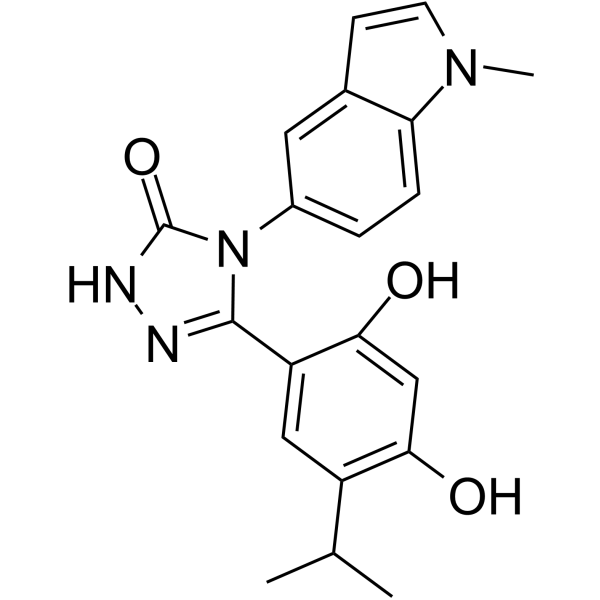
Ganetespib (STA-9090) is a heat shock protein 90 (HSP90) inhibitor which exhibits potent cytotoxicity in a wide variety of hematological and solid tumor cell lines. Ganetespib has antiangiogenic effects in colorectal cancer mediated through inhibition of HIF-1α and STAT3 .
loading...
    loading...
4
4 Cited Publications
Cat. No.: HY-N6769
CAS No.: 12772-57-5
Synonyms: Monorden
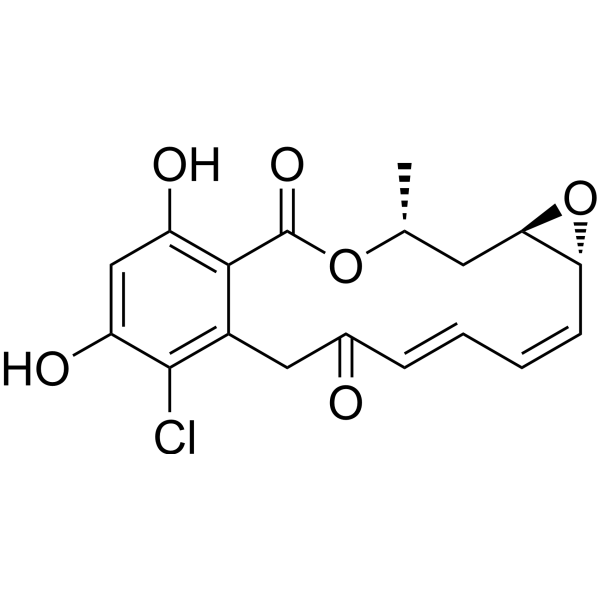
Radicicol is an inhibitor of Hsp90 with an IC50 value < 1 μM, and leads to proteasomal degradation . Radicicol exhibits inhibition on PDK with IC50s of 230 μM (PDK1) and 400 μM (PDK3). Radicicol is an antifungal and antimalarial antibiotic, impairs mitochondrial replication by targeting P. falciparum topoisomerase VIB . Radicicol is also an inhibitor of fat mass and obesity-associated protein (FTO), with an IC50 value of 16.04 μM .
loading...
    loading...
1
1 Cited Publications
Cat. No.: HY-115781
CAS No.: 2135749-60-7
Purity:  98.64%
Synonyms: Panvotinib-401; Pan-401
Target:  

HSP

Research Areas:  

Cancer

DN401 is a potent TRAP1 inhibitor with an IC50 of 79 nM. DN401 shows a weak inhibition of Hsp90 (IC50 of 698 nM). DN401 inactivates mitochondrial TRAP1 and has potent anticancer activities .
loading...
    loading...
Cat. No.: HY-145102
CAS No.: 2411429-33-7
Purity:  99.63%
Target:  

HSP Apoptosis

Research Areas:  

Cancer

NCT-58 is a potent inhibitor of C-terminal HSP90. NCT-58 does not induce the heat shock response (HSR) due to its targeting of the C-terminal region and elicits anti-tumor activity via the simultaneous downregulation of HER family members as well as inhibition of Akt phosphorylation. NCT-58 kills Trastuzumab-resistant breast cancer stem-like cells. NCT-58 induces apoptosis in HER2-positive breast cancer cells .
loading...
    loading...
Cat. No.: HY-151335
CAS No.: 1160952-43-1
Target:  

HSP

Research Areas:  

Cancer

KU-177 is a potent inhibitor of Hsp90 ATPase homologue 1 (Aha1), ablates Aha1-driven enhancement of Hsp90-dependent tau aggregation. KU-177 also disrupts Aha1/Hsp90 interactions (IC50=4.08 μM) without inhibition of Hsp90’s ATPase activity. KU-177 can be used for tauopathies research .
loading...
    loading...
Cat. No.: HY-151137
CAS No.: 3033543-67-5
Target:  

mTOR HSP Apoptosis Autophagy

Research Areas:  

Cancer

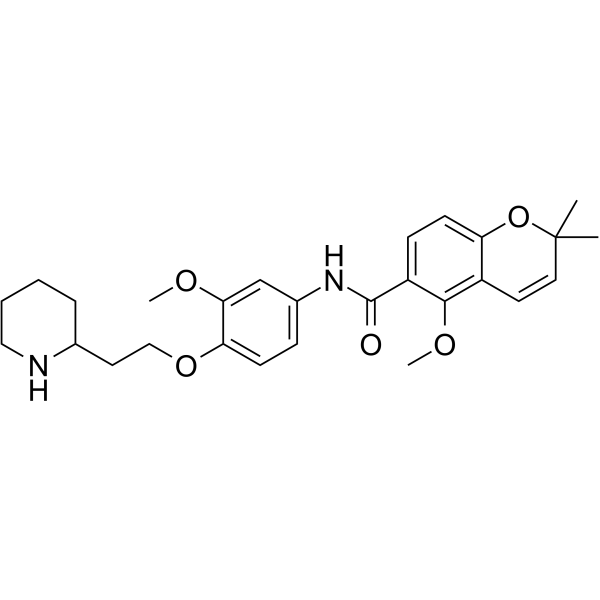
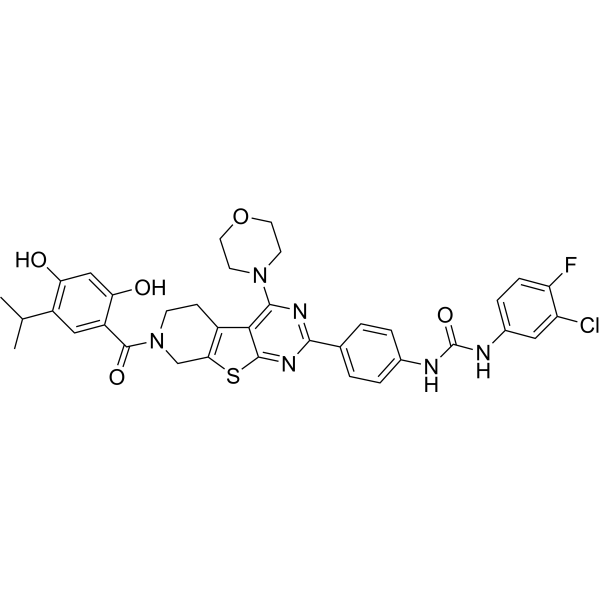
HSP90/mTOR-IN-1 is a potent and orally active Hsp90 and mTOR inhibitor with IC50 values of 69 nM and 29 nM, respectively. HSP90/mTOR-IN-1 suppresses the proliferation of SW780 cells through the over-activation of the PI3K/AKT/mTOR pathway. HSP90/mTOR-IN-1 induces apoptosis and autophagy via selective Hsp90 and mTOR inhibition. HSP90/mTOR-IN-1 also has considerable in vivo anti-tumor activity. HSP90/mTOR-IN-1 can be used for researching bladder cancer .
loading...
    loading...
Cat. No.: HY-15205R
CAS No.: 888216-25-9
Synonyms: STA-9090 (Standard)
Research Areas:  

Cancer

Ganetespib (Standard) is the analytical standard of Ganetespib. This product is intended for research and analytical applications. Ganetespib (STA-9090) is a heat shock protein 90 (HSP90) inhibitor which exhibits potent cytotoxicity in a wide variety of hematological and solid tumor cell lines. Ganetespib has antiangiogenic effects in colorectal cancer mediated through inhibition of HIF-1α and STAT3 .
loading...
    loading...
Cat. No.: HY-176404
CAS No.: 2640292-52-8
Target:  

HSP

Research Areas:  

Cancer

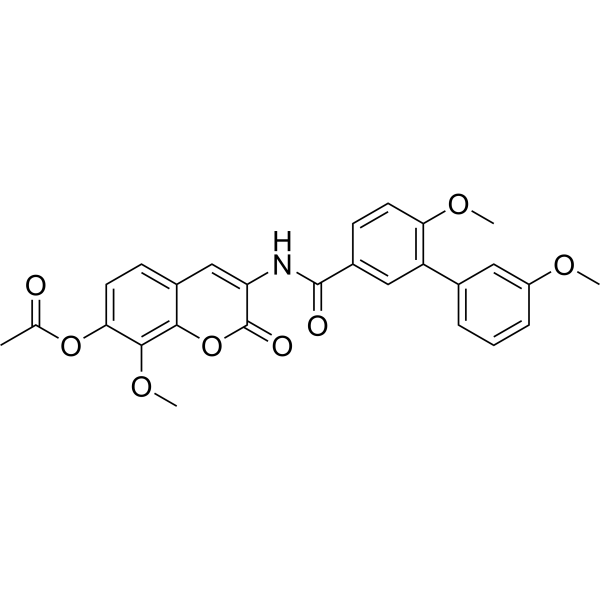
DDO-6691 is a heat shock protein 90 (HSP90) inhibitor. DDO-6691 has antiproliferative effects on a variety of tumor cells, with HCT-116 colon cancer cells being the most sensitive (IC50: 1.08 μM). DDO-6691 exhibits potent tumor growth inhibition in the HCT-116 xenograft mouse model .
loading...
    loading...
Cat. No.: HY-181907
Target:  

HyT Keap1-Nrf2 HSP

Research Areas:  

Inflammation/Immunology

NBE5 is an orally active hydrophobic tag-targeting (Hyt) degrader (HyTTD) that targets Keap1. NBE5 mimics protein misfolding and recruits the molecular chaperone Hsp90, while achieving targeted degradation of Keap1 through both the ubiquitin-proteasome system and the autophagy-lysosome system. Consequently, NBE5 relieves the inhibition of the transcription factor Nrf2 by Keap1, potently activates the Nrf2-mediated endogenous antioxidant pathway, and upregulates the expression of downstream antioxidant proteins such as HO-1 and GCLM. NBE5 effectively alleviates oxidative stress and inflammatory damage, and exhibits excellent in vivo activity in a mouse model of acute colitis induced by DSS (HY-116282C) .
NBE5 consists of a hydrophobic tag (HY-W022007), a Keap1-Nrf2 ligand (HY-14909), and a linker (HY-W014831).
loading...
    loading...

