





15 Results for "

LL-37, human

" in MedChemExpress (MCE) Product Catalog:
Products (15)

15 Results for "LL-37, human" in MCE Product Catalog:

6
6 Publications Verification
Cat. No.: HY-P1222
CAS No.: 154947-66-7
Target:  

Bacterial

Research Areas:  

Infection

LL-37, human is a 37-residue, amphipathic, cathelicidin-derived antimicrobial peptide, which exhibits a broad spectrum of antimicrobial activity. LL-37, human could help protect the cornea from infection and modulates wound healing .
loading...
    loading...
6
6 Publications Verification
Cat. No.: HY-P1222A
Target:  

Bacterial

Research Areas:  

Infection

LL-37, human TFA is a 37-residue, amphipathic, cathelicidin-derived antimicrobial peptide, which exhibits a broad spectrum of antimicrobial activity. LL-37, human TFA could help protect the cornea from infection and modulates wound healing .
loading...
    loading...
6
6 Publications Verification
Cat. No.: HY-P1222B
Target:  

Bacterial

Research Areas:  

Infection Inflammation/Immunology

LL-37, human acetate is a 37-residue, amphipathic, cathelicidin-derived antimicrobial peptide, which exhibits a broad spectrum of antimicrobial activity. LL-37, human acetate could help protect the cornea from infection and modulates wound healing .
loading...
    loading...
3
3 Cited Publications
Cat. No.: HY-32350
CAS No.: 60133-18-8
Synonyms: 1α,25-Dihydroxy Vitamin D2
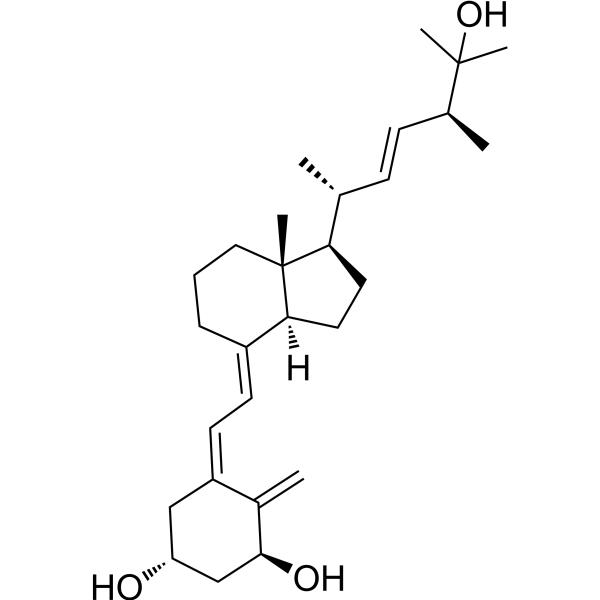
Ercalcitriol (1α,25-Dihydroxy Vitamin D2) is a vitamin D receptor (VDR) agonist with high binding affinity. After binding to VDR, Ercalcitriol forms a complex with retinoid X receptor (RXR) to regulate target gene transcription. For example, Ercalcitriol induces human gingival/oral epithelial cells to produce human cat antimicrobial peptide (hCAP-18/LL-37), which has antimicrobial activity against periodontal pathogens such as Porphyromonas gingivalis. Ercalcitriol enhances the innate immune defense of the oral mucosa by promoting the expression of antimicrobial peptides, and is mainly used in the study of periodontal diseases and immune-related oral diseases .
loading...
    loading...
Cat. No.: HY-P10257
CAS No.: 1218951-51-9
Target:  

Bacterial

Research Areas:  

Infection

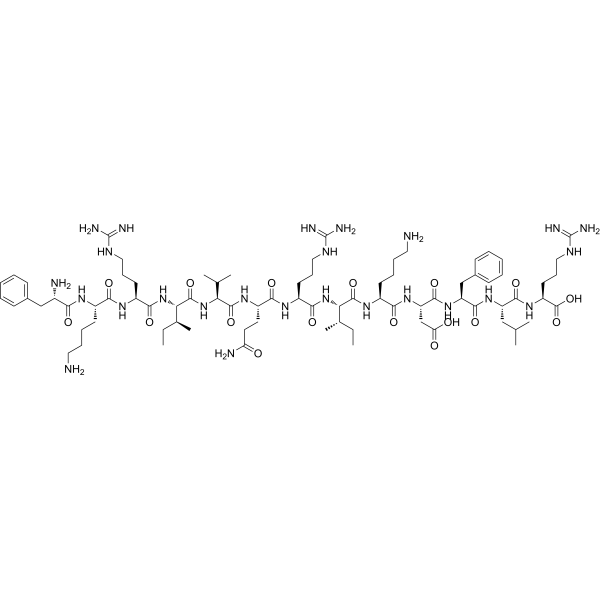
KR-12 (human) is an active segment of LL-37 (HY-P4744). KR-12 (human) exhibits antimicrobial activity against gram-negative bacteria. KR-12 (human) inhibits E. coli K-12 with a MIC of 66 μM. KR-12 human can be used for the research of infection, such as E. coli infection .
loading...
    loading...
Cat. No.: HY-P1884
Target:  

Bacterial

Research Areas:  

Infection

LL-37, acetylated, amidated is a cathelicidin peptide LL-37 acetylated on the N-terminus and amidated on the C-terminus. The single human cathelicidin peptide LL-37 has antimicrobial and anti-biofilm activity against multiple Gram-positive and Gram-negative human pathogens, and has wound-healing effects on the host .
loading...
    loading...
Cat. No.: HY-P4836A
Target:  

Parasite

Research Areas:  

Infection

LL-37 FK-13 TFA is the TFA salt form of LL-37 FK-13 (HY-P4836). LL-37 FK-13 TFA is an antimicrobial agent, that inhibits Trichomonas vaginalis. LL-37 FK-13 TFA exhibits minimal hemolytic effects on human erythrocytes and low cytotoxicity to human fibroblasts .
loading...
    loading...
Cat. No.: HY-116863
CAS No.: 865285-47-8
Purity:  95.70%
Target:  

Bacterial

Research Areas:  

Infection

KKL-40 is a small molecule inhibitor that targets the trans-transcription process and is effective against methicillin-sensitive and -resistant Staphylococcus aureus (S. aureus) as well as other Gram-positive pathogens including vancomycin-resistant Enterococcus faecium, Bacillus subtilis, and Streptococcus pyogenes. KKL-40 synergizes with the human antimicrobial peptide LL-37 to inhibit S. aureus, but does not synergize with other antibiotics such as daptomycin, kanamycin, or erythromycin. Trans-transcription is an extreme form of recoding, and KKL-40 inhibits trans-transcription but is nontoxic to HeLa cells .
loading...
    loading...
Cat. No.: HY-P4836
CAS No.: 717919-68-1
Target:  

Parasite

Research Areas:  

Infection

LL-37 FK-13 is an antimicrobial agent, that inhibits Trichomonas vaginalis. LL-37 FK-13 exhibits slight hemolytic effects on human erythrocytes and low cytotoxicity to human fibroblasts .
loading...
    loading...
Cat. No.: HY-P5057
CAS No.: 2243219-81-8
Research Areas:  

Others

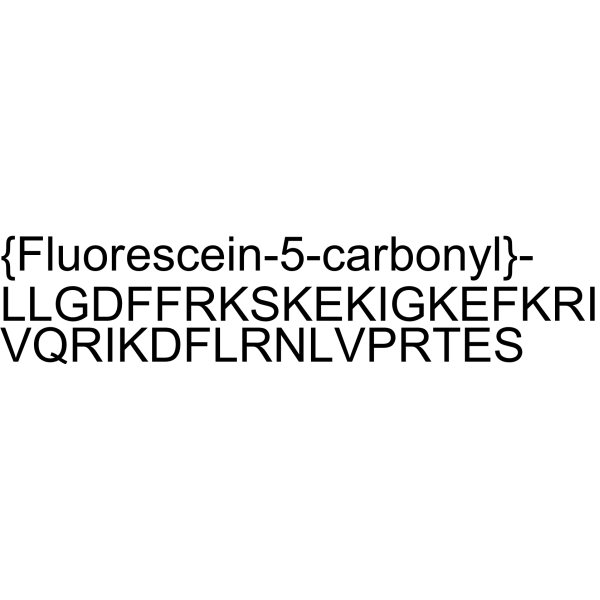
5-FAM-LL-37 is afluorescent labeled LL-37, human (HY-P1222).
loading...
    loading...
Cat. No.: HY-P5057B
Research Areas:  

Infection

5-FAM-Ahx-LL-37 TFA is a 5-FAM (HY-66022) labeled LL-37, human (HY-P1222). The carboxyfluorescein group is attached via a 6-carbon spacer, 6-Aminohexanoic acid (Ahx, HY-B0236). LL-37, human is a 37-residue, amphipathic, cathelicidin-derived antimicrobial peptide, which exhibits a broad spectrum of antimicrobial activity .
loading...
    loading...
Cat. No.: HY-P5836
Citrullinated LL-37 1cit is a citrullinated LL-37 (HY-P1222) peptide. Citrullinated LL-37 1cit does not alter the antiviral effect of LL-37 toward human rhinovirus. Citrullinated LL-37 1cit shows antibacterial activity toward S. aureus. Citrullinated LL-37 1cit causes a reduction in the levels of IL-8, CCL5, and IL-6 mRNA induced by RV1B .
loading...
    loading...
Cat. No.: HY-P5842
Research Areas:  

Infection

Citrullinated LL-37 3cit is a host defense peptide (HDP) with broad immunomodulatory and antimicrobial activities. Citrullinated LL-37 3cit exhibits direct antiviral effects against human rhinoviruses (HRV) .
loading...
    loading...
Cat. No.: HY-P5829A
Target:  

Bacterial

Research Areas:  

Infection

CRAMP (140-173) (mouse) TFA is a ortholog of human LL-37 antimicrobial peptide. CRAMP (140-173) (mouse) TFA inhibits LPS (HY-D1056)-induced responses, and can not colocalized with TLR3 in BEAS-2B cells .
loading...
    loading...
Cat. No.: HY-32350S1
CAS No.: 1261254-46-9
Synonyms: 1α,25-Dihydroxy Vitamin D2-d3
Ercalcitriol-d3 (1α,25-Dihydroxy Vitamin D2-d3) is the deuterium labeled Ercalcitriol (HY-32350). Ercalcitriol (1α,25-Dihydroxy Vitamin D2) is a vitamin D receptor (VDR) agonist with high binding affinity. After binding to VDR, Ercalcitriol forms a complex with retinoid X receptor (RXR) to regulate target gene transcription. For example, Ercalcitriol induces human gingival/oral epithelial cells to produce human cat antimicrobial peptide (hCAP-18/LL-37), which has antimicrobial activity against periodontal pathogens such as Porphyromonas gingivalis. Ercalcitriol enhances the innate immune defense of the oral mucosa by promoting the expression of antimicrobial peptides, and is mainly used in the study of periodontal diseases and immune-related oral diseases .
loading...
    loading...
  • 1

