1. Search Result
Search Result
Results for "

LX2

" in MedChemExpress (MCE) Product Catalog:

13

Inhibitors & Agonists

1

Fluorescent Dye

4

Peptides

Cat. No. Product Name Target Research Areas Chemical Structure
  • HY-129389
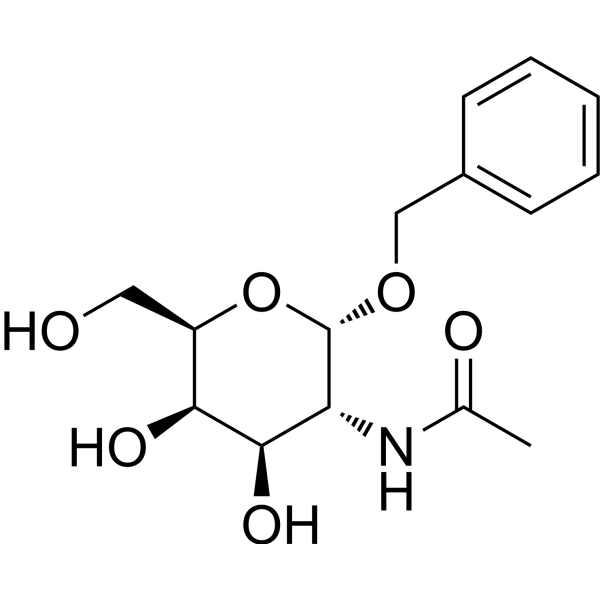
    Benzyl-α-GalNAc
    5+ Cited Publications

    Glycosyltransferase Cancer
    Benzyl-α-GalNAc is a potent O-glycosylation inhibitor. Benzyl-α-GalNAc effectively inhibits the proliferation and activation of LX-2 cells and suppresses the expression of collagen I/III, which has good potential for investigation in liver fibrosis. Benzyl-α-GalNAc also significantly enhances the anti-tumour activity of 5-Fluorouracil (HY-90006) (e.g. pancreatic cancer) by inhibiting O-glycosylation [2] .
    Benzyl-α-GalNAc
  • HY-110210

    BODIPY FL,SE

    Fluorescent Dye Others
    BODIPY FL NHS ester (BODIPY FL, SE) is a cell membranes-penatrable amine-reactive fluorescent probe. The maximum excitation/emission wavelength of the BODIPY-FL NHS ester are 502/511 nm, respectively. BODIPY-FL NHS ester has high stability and is insensitive to the polarity, pH and type of solvent, and can maintain stable fluorescence properties under different environmental conditions. BODIPY-FL NHS ester can be used for the synthesis of protease substrates, live cell imaging, protein labeling and immunoassay [2].
    BODIPY-FL NHS ester
  • HY-168906

    Bradykinin Receptor PI3K Akt TNF Receptor ERK Neurological Disease Inflammation/Immunology
    BI-113823 is an orally active, blood-brain barrier-permeable bradykinin B1 receptor antagonist, with a Ki value of 5.3 nM for human receptors and 13.3 nM for rat receptors. BI-113823 reduces inflammation-induced mechanical hyperalgesia, as well as the mechanical sensitivity of peripheral afferent nerves and spinal nociceptive-specific neurons. BI-113823 alleviates liver fibrosis and portal hypertension, and improves survival in chronic liver disease models. BI-113823 inhibits the activities of monocytes, neutrophils and hepatic stellate cells, as well as the PI3K/Akt signaling pathway. BI-113823 can be used in research related to inflammatory pain, liver fibrosis and portal hypertension [2].
    BI-113823
  • HY-156523

    MAP4K Cancer
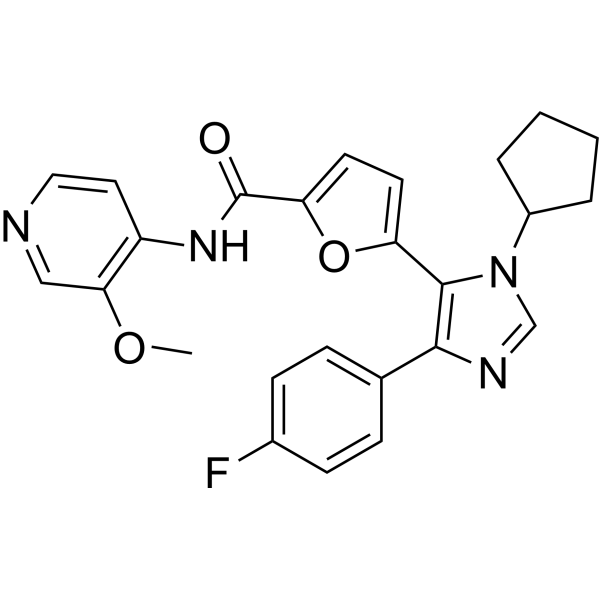
    TNIK&MAP4K4-IN-1 (compound A-39) is a dual inhibitor of TNIK and MAP4K4/HGK with IC50s of 1.29 nM and <10 nM,respectively,in human hepaticstellate cell LX-2. TNIK&MAP4K4-IN-1 can be used for cancer and fibrosis inhibition .
    TNIK&MAP4K4-IN-1
  • HY-179410

    Galectin Others
    Galectin-3-IN-7 is a selective Galectin-3 inhibitor with a Kd of 5.7 nM and shows 390-fold selectivity over Gal-1. Galectin-3-IN-7 can downregulate profibrotic signaling such as ACTA2, COL1A2, and FN1 in TGFβ-stimulated LX2 hepatic stellate cells. Galectin-3-IN-7 can be used for the research of fibrosis .
    Galectin-3-IN-7
  • HY-176274

    Fatty Acid Synthase (FASN) Stearoyl-CoA Desaturase (SCD) Reactive Oxygen Species (ROS) Interleukin Related TNF Receptor SOD LDLR Glutathione Peroxidase Metabolic Disease Inflammation/Immunology
    FASN/SCD-IN-1 is a Silybin (HY-N0779A) derivative, an orally active inhibitor of Fatty Acid Synthase (FASN)/Stearoyl-CoA Desaturase (SCD). FASN/SCD-IN-1 has shown in vitro activity in inhibiting lipid deposition, reducing FASN and SCD transcriptional levels, and exhibiting antioxidant, anti-inflammatory, and anti-fibrotic activities. FASN/SCD-IN-1 has demonstrated significant hepatoprotective effects in a rat model of acute liver injury. FASN/SCD-IN-1 ameliorates the pathological features of MASH liver, including steatosis, inflammation, and fibrosis in a mouse model of myeloproliferative steatohepatitis (MASH). FASN/SCD-IN-1 can be used to study MASH .
    FASN/SCD-IN-1
  • HY-149816

    Interleukin Related TNF Receptor NF-κB Inflammation/Immunology
    Anti-inflammatory agent 41 (13a) significantly inhibit lipopolysaccharide (LPS)-induced expression of the proinflammatory cytokines IL-6 and TNF-α on J774A.1, THP-1 and LX-2 cells, and inhibits the activation of the NF-κB pathway .
    Anti-inflammatory agent 41
  • HY-169927

    Ferroptosis Inflammation/Immunology
    Ferroptosis-IN-16 (Compound 13l) is a specific inhibitor for ferroptosis with an EC50 of 0.7 nM and 0.9 nM in ES-2 cell and LX-2 cell. Ferroptosis-IN-16 ameliorates Acetaminophen (HY-66005)-induced acute liver injury in mouse model, and exhibits good metabolic stability in mouse liver microsomes .
    Ferroptosis-IN-16
  • HY-170543

    Galectin EGFR Apoptosis Inflammation/Immunology
    Dual Galectin-3/EGFR-IN-1 (Compound 29) is the dual inhibitor for Galectin-3 and EGFR with the KD of 52.29 μM and 3.31 μM. Dual Galectin-3/EGFR-IN-1 inhibits TGF-β-induced hepatic stellate cell (HSCs) activation, induces apoptosis in LX-2 cell, and exhibits anti-liver fibrotic efficacy .
    Dual Galectin-3/EGFR-IN-1
  • HY-149205

    PI3K ERK Inflammation/Immunology
    CXJ-2 is a cyclic peptide, and exhibits moderate affinity toward elastin derived peptides (EDPs). CXJ-2 exhibits potent activities to inhibit the PI3K/ERK pathway and decrease hepatic stellate cell proliferation and migration. CXJ-2 possesses potent antifibrotic efficacy .
    CXJ-2
  • HY-P6177

    Dipeptidyl Peptidase Inflammation/Immunology
    SGP8 (IAVPGEVA) is an octapeptide produced by hydrolysis of soybean 11S globulin, which has the effects of regulating lipid metabolism, inflammation and fibrosis. SGP8 (IAVPGEVA) exhibits inhibitory activity against DPP4 and inhibits the JNK-c-Jun signaling pathway, and has the ability to inhibit non-alcoholic steatohepatitis (NASH) .
    SGP8
  • HY-P11826

    Collagen Metabolic Disease
    T2 peptide-1 is a linear peptide derived from Lumican degradation. T2 peptide-1 exhibits activity against endometrial adhesion progression and ability to inhibit the LumicanCollagen I interaction. T2 peptide-1 can be used for the research of liver fibrosis .
    T2 peptide-1
  • HY-P11827

    Collagen ERK TGF-beta/Smad Metabolic Disease
    C11 peptide-1 is an antifibrotic agent that binds directly to Collagen I. C11 peptide-1 physically disrupts Collagen I interaction with Lumican. C11 peptide-1 reduces inflammatory infiltration and inhibits the ERK1/2 and Smad2/3 signaling pathways. C11 peptide-1 can be used for the research of liver fibrosis .
    C11 peptide-1

Inquiry Online

Your information is safe with us. * Required Fields.

Salutation


Country or Region *

Applicant Name *


Organization Name *

Department *


Email Address *


Product Name *

Cat. No.


Requested quantity *

Phone Number *


Remarks

Inquiry Online

Inquiry Information

Product Name:
Cat. No.:
Quantity:
MCE Japan Authorized Agent:

