8 Results for "

MTDL

" in MedChemExpress (MCE) Product Catalog:
Products (8)

8 Results for "MTDL" in MCE Product Catalog:

Cat. No.: HY-160481
CAS No.: 2567913-75-9
Target:  

Tau Protein MicroRNA

Research Areas:  

Neurological Disease

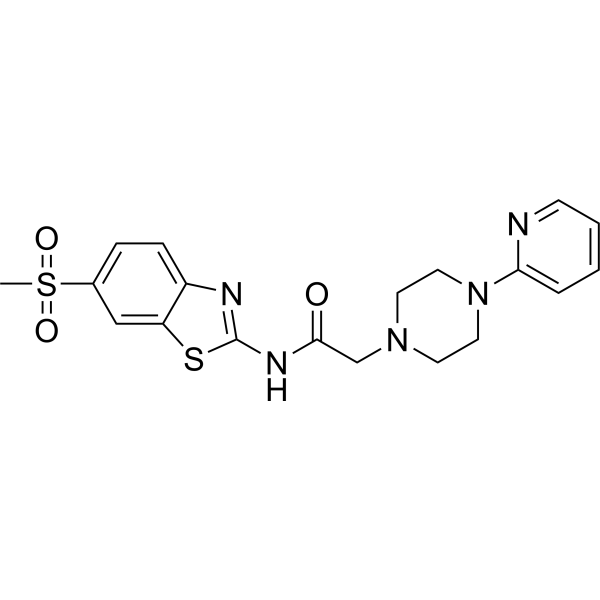
MG-1102 is first-in-class dual binder of monomeric tau and pre-miRNA-146a. MG-1102 shows specific inhibition of miRNA146a with IC50s of 0.21 mM and 0.36 mM specific inhibition of doublelabeled pre-miRNA146a and mono-labeled pre-miRNA146a, respectively. MG-1102 interacts with tau monomers with a Kd of 3.21 mM by surface plasmon resonance (SPR). MG-1102 is a potential multi-target-directed ligands (MTDLs) for Alzheimer’s disease (AD) .
loading...
    loading...
Cat. No.: HY-161466
Research Areas:  

Neurological Disease

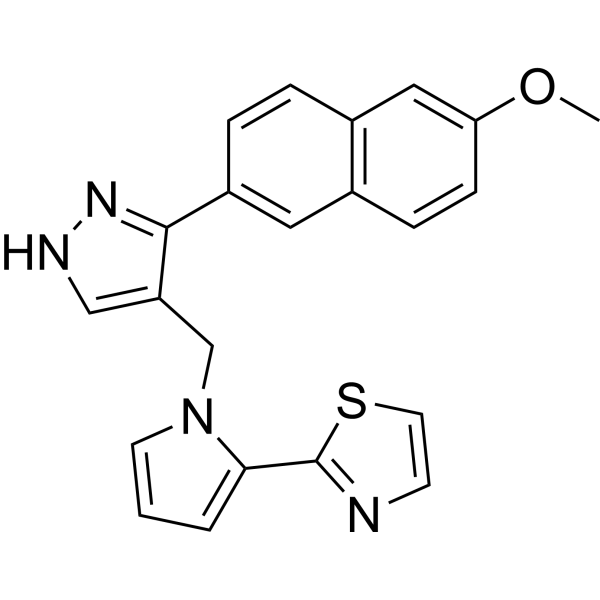
AChE-IN-62 (Compound 1) is an effective mixed and selective acetylcholinesterase (AChE) inhibitor with an IC50 value of 0.421 μM. AChE-IN-62 exhibits excellent blood-brain barrier permeability and neuroprotective effects. Additionally, AChE-IN-62 can inhibit the aggregation of 1-42 with an IC50 value of 44.64 μM. AChE-IN-62 is also an effective multi-target-directed ligand (MTDL) that can be utilized in the research of Alzheimer's disease .
loading...
    loading...
Cat. No.: HY-149287
Target:  

Cholinesterase (ChE)

Research Areas:  

Neurological Disease

hAChE/hBACE-1-IN-1 (compounds 5d) is an orally active inhibitor of hAChE with blood-brain permeability. hAChE/hBACE-1-IN-1 inhibits hAChE and hBACE-1 with IC50 values of 0.076 and 0.23 μM, respectively. hAChE/hBACE-1-IN-1 inhibits Aβ1-42 aggregation and improves mouse learning and memory ability. hAChE/hBACE-1-IN-1 can be used to research in Alzheimer's disease .
loading...
    loading...
Cat. No.: HY-149288
hAChE/hBACE-1-IN-2 is a potent, orally active, blood-brain barrier transboundary triple inhibitor of hAChE, hBChE, and HACE-1 with IC50s of 0.113 μM, 1.48 μM and 0.38 μM, respectively. hAChE/hBACE-1-IN-2 has antioxidant activity. hAChE/hBACE-1-IN-2 also inhibits Aβ11-42 aggregation. hAChE/hBACE-1-IN-2 can be used to study Alzheimer's disease .
loading...
    loading...
Cat. No.: HY-162606
CAS No.: 315210-31-2
MAO-A/B-IN-3 (Compound 12) stands out as a key dual MAO-AChE inhibitor, displaying excellent multi-target efficacy against MAO-A, MAO-B, and AChE with IC50 values of 67 nM, 29 nM, and 1370 nM respectively. MAO-A/B-IN-3 is adept at altering the A site (hydrophobic ring) and C site (semicarbazone chain) within ketone amine-based MTDLs to bolster the inhibitory potential against MAO-A/B while notably diminishing activity against AChE. MAO-A/B-IN-3 is poised for research applications in the field of neurodegenerative diseases .
loading...
    loading...
Cat. No.: HY-163514
Research Areas:  

Neurological Disease

hAChE-IN-8 (Compound S-12) is a orally effective and selective inhibitor of hAChE (IC50=0.486 μM). hAChE-IN-8 also inhibits BACE-1 (IC50=0.542 μM), and does not inhibit Dyrk1A (IC50>10 μM). hAChE-IN-8 can reduce Aβ aggregation, has good blood-brain barrier penetration. hAChE-IN-8 is mainly used in Alzheimer's disease research .
loading...
    loading...
Cat. No.: HY-180891
Multitarget AD-IN-4 (compound IIIj) is a multitarget-directed ligand (MTDL), with the ability to simultaneously inhibit ChE enzymes (EeAChE IC50 = 0.157 μM, eqBuChE IC50 = 0.147 μM, hAChE IC50 = 1.551 μM, hBuChE IC50 = 2.152 μM), exhibit antioxidant activity, provide neuroprotection, and inhibit calcium channels (Ca 2+ channel blockade: IC50 = 30.59 μM). Multitarget AD-IN-4 reverses Scopolamine (HY-N0296)-induced amnesia in a mouse model. Multitarget AD-IN-4 can be used for Alzheimer’s disease (AD) research .
loading...
    loading...
Cat. No.: HY-180892
Multi-kinase-IN-10 (Compound IIIk) is a multi-kinase inhibitor. Multi-kinase-IN-10 exhibits significant calcium channel blocking activity, with its IC50 being 26.67 μM. Multi-kinase-IN-10 is a potent dual cholinesterase inhibitor, with its IC50 values for hAChE and hBuChE being 0.304 μM and 1.033 μM respectively. Multi-kinase-IN-10 has antioxidant and neuroprotective activities, and shows significant anti-amnesia activity. Multi-kinase-IN-10 can be used for research on Alzheimer's disease .
loading...
    loading...

