8 Results for "

PARylation

" in MedChemExpress (MCE) Product Catalog:
Products (8)

8 Results for "PARylation" in MCE Product Catalog:

2
2 Cited Publications
Cat. No.: HY-128760
CAS No.: 906439-72-3
Purity:  99.92%
Research Areas:  

Cancer

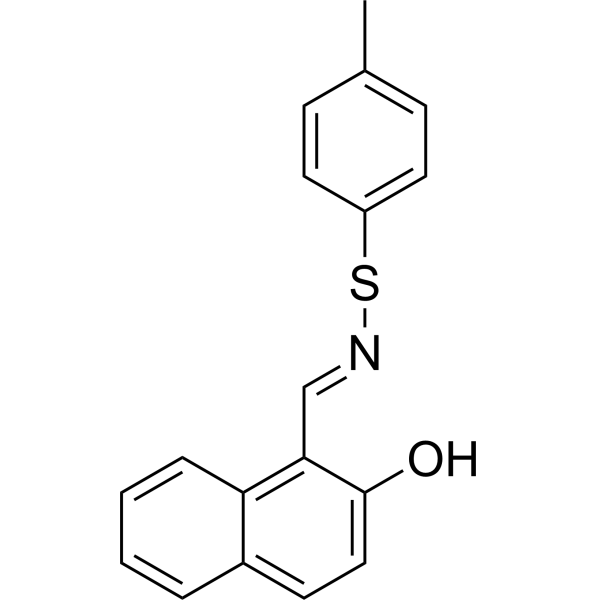
COH34 is a potent and specific poly(ADP-ribose) glycohydrolase (PARG) inhibitor with an IC50 of 0.37 nM. COH34 binds to the catalytic domain of PARG (Kd=0.547 μM), thereby prolonging PARylation at DNA lesions and trapping DNA repair factors .
loading...
    loading...
1
1 Cited Publications
Cat. No.: HY-170620
Target:  

PROTACs PARP

Research Areas:  

Cancer

PARP1 PROTAC 180055 is a PARP1 PROTAC degrader that recruits VHL, with DC50 values of 180 nM and 240 nM in T47D and MDA-MB-231 cells, respectively. PARP1 PROTAC 180055 selectively kills BRCA-mutant tumor cells by inducing PARP1 ubiquitination and proteasomal degradation, thereby blocking PARylation, NAD + depletion and DNA trapping. PARP1 PROTAC 180055 can be used in the research of breast cancer, ovarian cancer, colorectal cancer, acute T-lymphoblastic leukemia, prostate cancer and osteosarcoma .
loading...
    loading...
Cat. No.: HY-E70238
CAS No.: 126609-61-8
Synonyms: Nicotinamide 2-azidoadenine dinucleotide
Research Areas:  

Others

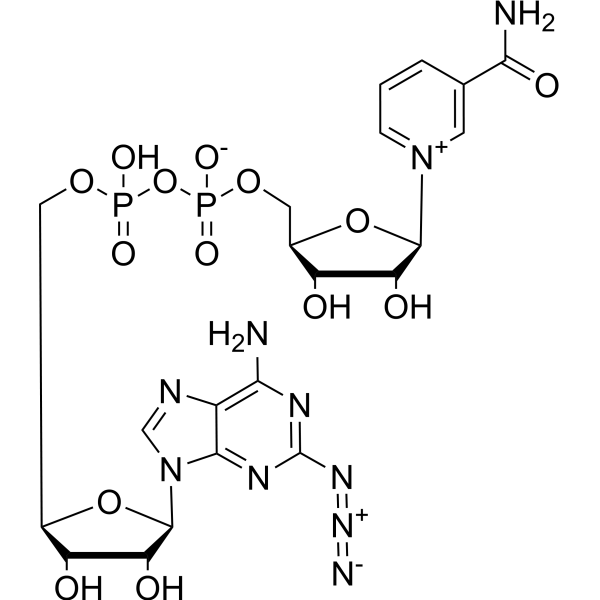
2-Azido-NAD is a NAD + analog that can be used for visualization of intracellular Poly(ADP ribos)ylation (PARylation) processes .
loading...
    loading...
Cat. No.: HY-178032
PARP1-IN-44, an Olaparib (HY-10162) derivative, is an orally active PARP1 inhibitor (IC50 = 0.6 nM), and also inhibits PARP2 (IC50 = 1.0 nM) and PARP7 (IC50 = 7.5 nM). PARP1-IN-44 has selective antiproliferative activity against BRCA-deficient cancer cells with minimal toxicity to normal cells. PARP1-IN-44 induces G2/M phase arrest, promotes apoptosis, elevates ROS levels, disrupts mitochondrial membrane potential. PARP1-IN-44 suppresses PARylation while increasing γH2AX accumulation. PARP1-IN-44 activates the cGAS-STING pathway, upregulating IFN-β and CXCL10 expression. PARP1-IN-44 enhancing CD8+ T cell infiltration in a CT26 tumor mouse model, demonstrating robust in vivo antitumor efficacy .
loading...
    loading...
Cat. No.: HY-14687
CAS No.: 1207454-56-5
Synonyms: (rac)-BMN-673; (rac)-LT-673
Target:  

PARP

Research Areas:  

Cancer

(rac)-Talazoparib ((rac)-BMN-673) (Compound 47) is the orally active inhibitor for PARP1/2 with Ki of 1.2 nM and 0.87 nM. (rac)-Talazoparib inhibits cellular PARylation with an EC50 of 2.51 nM. (rac)-Talazoparib causes the accumulation of DNA damage, inhibits proliferation of BRCA1/2-mutated MX-1 cell and Capan-1 cell with IC50 of 0.3 nM and 5 nM. (rac)-Talazoparib exhibits antitumor efficacy in mouse models .
loading...
    loading...
Cat. No.: HY-136263
CAS No.: 146385-37-7
Target:  

PARP

Research Areas:  

Cancer

Biotin-NAD + is a PARylation donor and also a substrate of poly (ADP-ribose) polymerase-1 (PARP1). Under the mediation of PARP1, Biotin-NAD + undergoes poly (ADP-ribosyl) ation to generate biotinylated poly (ADP-ribose) polymers. Biotin-NAD + can be used for pull-down assays of PARylated proteins in renal epithelial cells. Biotin-NAD + is applicable to cancer-related research .
loading...
    loading...
Cat. No.: HY-189005
Target:  

PARP

Research Areas:  

Cancer

PARP1-IN-60 is an orally active PARP1 inhibitor with a human IC50 of 2.4 nM. PARP1-IN-60 selectively inhibits PARP1-mediated poly (ADP-ribosylation) (PARylation) compared with PARP2. PARP1-IN-60 induces DNA damage, G2/M phase arrest and antiproliferative activity in BRCA-deficient cells. PARP1-IN-60 can be used in the research of BRCA-mutant cancers and colorectal cancer .
loading...
    loading...
Cat. No.: HY-185459
Research Areas:  

Cancer

PCIP-1 is a PARP2 inhibitor. PCIP-1 recruits BET proteins to PARP2 to inhibit DNA repair, acts via event-driven pharmacology, and does not inhibit PARP-catalyzed PARylation. PCIP-1 inhibits DNA repair, thereby inducing synthetic lethality in homologous recombination-deficient cancer cells and increasing the sensitivity of PARP1-knockout cells. PCIP-1 can be used in the research of homologous recombination-deficient cancers, T-cell acute lymphoblastic leukemia, and BRCA-mutant cancers .
loading...
    loading...

