7 Results for "

Premature termination codons

" in MedChemExpress (MCE) Product Catalog:
Products (7)

7 Results for "Premature termination codons" in MCE Product Catalog:

1
1 Cited Publications
Cat. No.: HY-150090
CAS No.: 1613509-49-1
Purity:  99.68%
Target:  

CFTR

Research Areas:  

Inflammation/Immunology

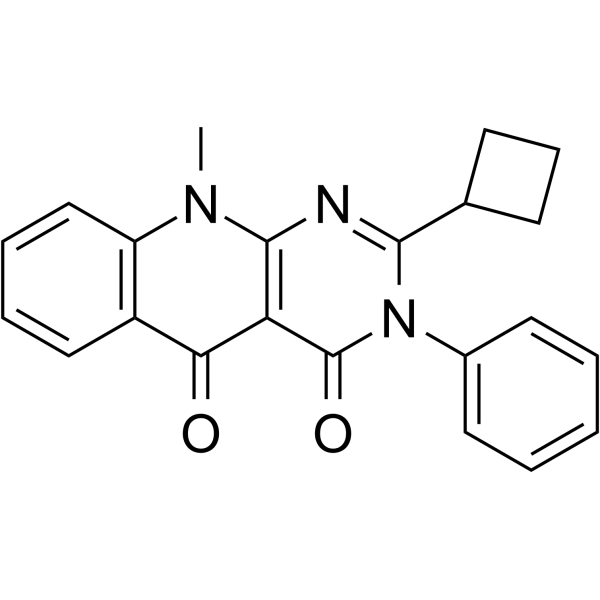
SRI-41315 induces a prolonged pause at stop codons and suppresses PTCs (premature termination codons) associated with cystic fibrosis in immortalized and primary human bronchial epithelial cells, restoring CFTR (cystic fibrosis transmembrane conductance regulator) expression and function. SRI-41315 suppresses PTCs by reducing the abundance of the termination factor eRF1. SRI-41315 also potentiates aminoglycoside-mediated readthrough, leading to synergistic increases in CFTR activity .
loading...
    loading...
Cat. No.: HY-150089
CAS No.: 883956-47-6
Purity:  99.21%
Target:  

CFTR

Research Areas:  

Inflammation/Immunology

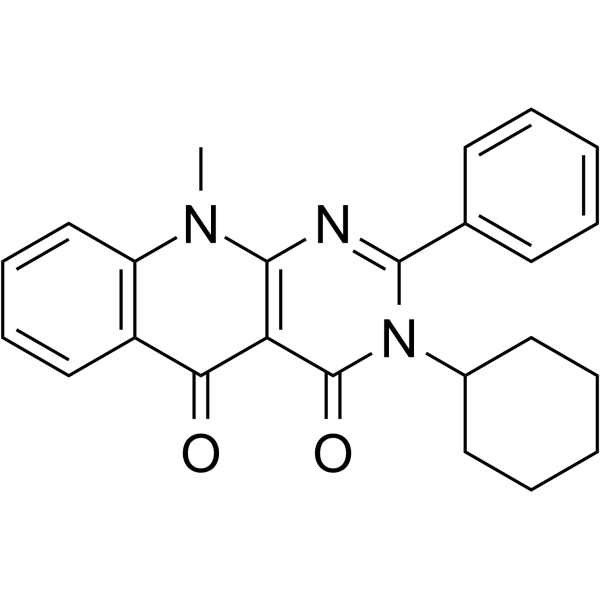
SRI-37240 is a potent premature termination codons (PTCs) inhibitor. SRI-37240 suppresses CFTR nonsense mutations. SRI-37240 alters cellular translation termination at PTCs in HEK293T cells. SRI-37240 can also restore CFTR function in primary bronchial epithelial cells when combination with G418 .
loading...
    loading...
Cat. No.: HY-156650
CAS No.: 2407849-89-0
Purity:  99.51%
Synonyms: PTC518
Target:  

Huntingtin

Research Areas:  

Neurological Disease

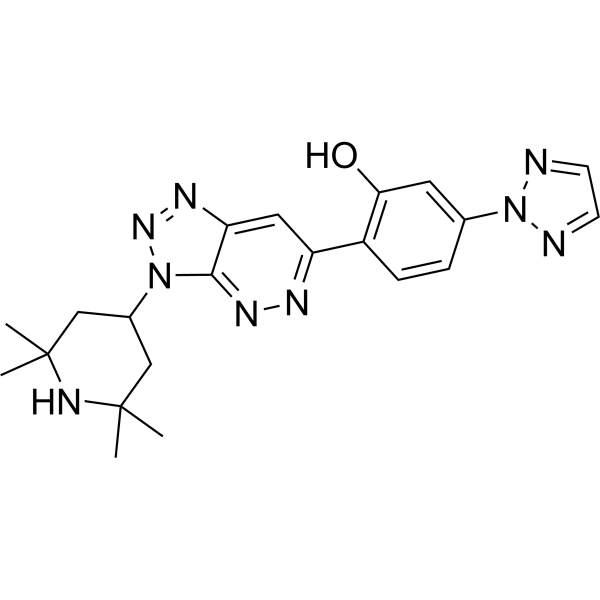
Votoplam (PTC518) is a blood-brain barrier-permeable HTT pre-mRNA inhibitor with an IC50 ≤ 0.1 μM. Votoplam modulates the splicing process of HTT pre-mRNA to include a pseudo-exon carrying a premature translation termination codon, thereby triggering HTT mRNA degradation. Votoplam is applicable to research related to Huntington's disease .
loading...
    loading...
Cat. No.: HY-143792
CAS No.: 2254502-89-9
Research Areas:  

Neurological Disease

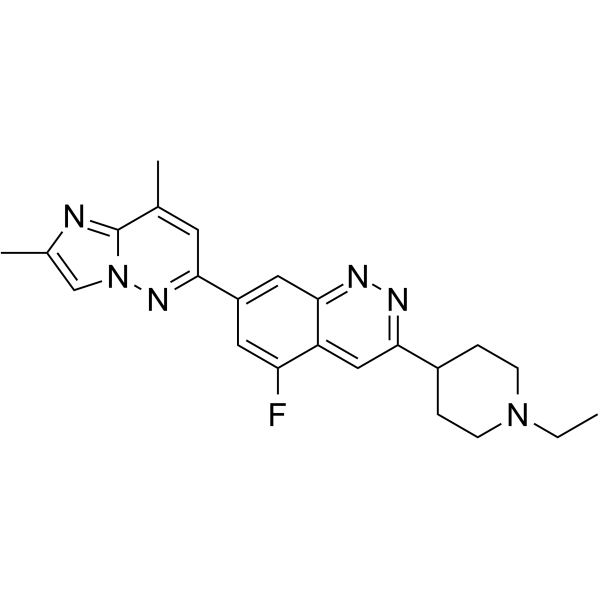
HTT-D3 is an orally active, blood-brain barrier penetrant splicing modulator of huntingtin (HTT). HTT-D3 promotes the inclusion of a pseudo-exon containing a premature termination codon into HTT pre-mRNA, triggers nonsense-mediated mRNA degradation and reduces HTT protein levels. HTT-D3 induces dose-dependent, comparable reductions in mutant HTT protein in both the brain and peripheral tissues of transgenic mouse models. HTT-D3 can be used for the research of Huntington's disease .
loading...
    loading...
Cat. No.: HY-177569
Research Areas:  

Others

NVS1.1 is a potent, orally active and brain-penetrant readthrough promoter. NVS1.1 triggers the degradation of eRF1 by activating the ribosome-related quality control pathways (involving GCN1, RNF14, and RNF25), thereby facilitating the reading through of premature termination codons. NVS1.1 can be used for the research of genetic diseases caused by nonsense mutations .
loading...
    loading...
Cat. No.: HY-177963
CAS No.: 2341941-41-9
Target:  

DNA Methyltransferase

Research Areas:  

Inflammation/Immunology

NV914 is an inhibitor of FTSJ1 (tryptophan tRNA-specific 2'-O-methyltransferase) that inhibits the methyltransferase activity of FTSJ1, induces translational readthrough of premature termination codons, and enables genes carrying nonsense mutations to synthesize full-length proteins. NV914 belongs to translational readthrough-inducing compounds (TRIDs). NV914 exhibits translational readthrough activity against nonsense mutations in in vitro systems, does not induce readthrough of natural termination codons, and restores CFTR protein expression. NV914 shows favorable acute oral tolerance in mice, with low health risks and good safety profiles. NV914 is applicable to research related to cystic fibrosis and Shwachman-Diamond syndrome .
loading...
    loading...
Cat. No.: HY-177757
CAS No.: 1831092-94-4
Research Areas:  

Others

NVS2.1 is a potent, orally active and brain-penetrant readthrough promoter. NVS2.1 triggers the degradation of eRF1 by activating the ribosome-related quality control pathways (involving GCN1, RNF14, and RNF25), thereby facilitating the reading through of premature termination codons. NVS2.1 can be used for the research of genetic diseases caused by nonsense mutations .
loading...
    loading...

