
17 Results for "

Wistar Albino rats

" in MedChemExpress (MCE) Product Catalog:
Products (17)

17 Results for "Wistar Albino rats" in MCE Product Catalog:

1
1 Cited Publications
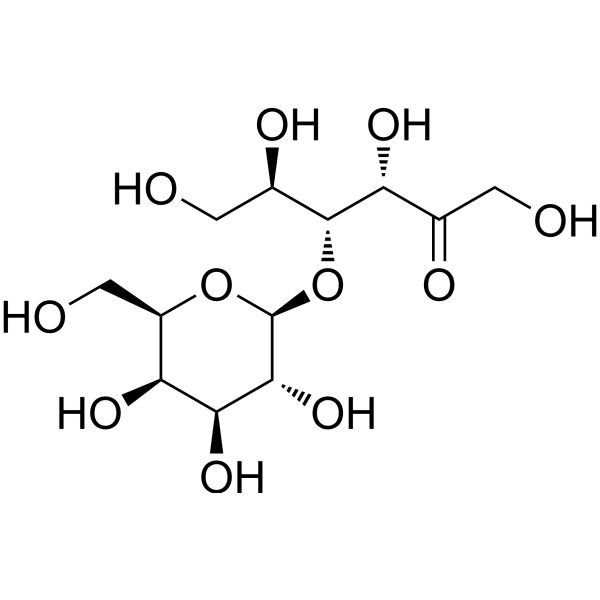
Cat. No.: HY-B1172
CAS No.: 4618-18-2
Synonyms: 4-O-β-D-Galactopyranosyl-D-fructose
Lactulose is an orally active galactose-fructose disaccharide. Lactulose suppresses upregulation of TNF-α and IL-6. Lactulose decreases the degree of DNA damage. Lactulose exhibits many of the properties of other oligosaccharides, including increasing the numbers of Bifidobacteria in feces. Lactulose restores the structure and composition of the intestinal microbiota, mitigates inflammation, and suppresses inflammatory tumorigenesis in mice with colitis-associated cancer. Lactulose can be used in the research of constipation .
loading...
    loading...
Cat. No.: HY-105174A
CAS No.: 1628202-19-6
Target:  

JAK FAK

BPC 157 acetate is an orally active peptide. BPC 157 acetate exhibits multiple activities such as promoting wound healing, tendon healing, neuroprotection, and gastrointestinal protection. BPC 157 acetate can be used in the research of tendon injury, burn, gastric ulcer, and neurological diseases .
loading...
    loading...
Cat. No.: HY-P3538
CAS No.: 9015-71-8
Synonyms: CRH (Sheep)
Target:  

Inhibitory Antibodies

Research Areas:  

Neurological Disease

Corticotropin-releasing factor (CRH) (Sheep) is a brain-penetrant hypothalamic releasing factor and a peptide hormone with analgesic and arousal-inducing activity. Corticotropin-releasing factor (Sheep) mediates stress effects, including stress-induced analgesia. Corticotropin-releasing factor (Sheep) increases wakefulness, reduces slow wave sleep, alters EEG frequency content, stimulates ACTH and β-endorphin release, activates locomotor activity. Corticotropin-releasing factor (Sheep) can be used for the research of neurological disease .
loading...
    loading...
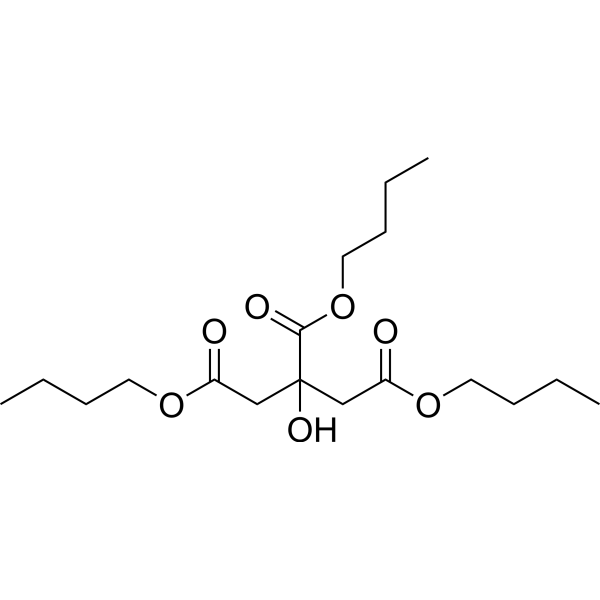
Cat. No.: HY-W013762
CAS No.: 77-94-1
Tributyl citrate is a low-toxicity and orally active citrate ester with no genotoxicity or skin sensitizing activity. Tributyl citrate also acts as a plasticizer, solvent, FDA-approved indirect food additive, and topical anesthetic, among other uses. Tributyl citrate induces a needle-prick insensitivity response that lasts for more than 2 hours, and a 5% suspension of it temporarily eliminates the corneal reflex in rabbits. Tributyl citrate causes no significant systemic toxicity in rats and cats at most tested doses, and only may cause growth retardation and gastrointestinal reactions such as diarrhea and nausea at high doses or with repeated oral administration .
loading...
    loading...
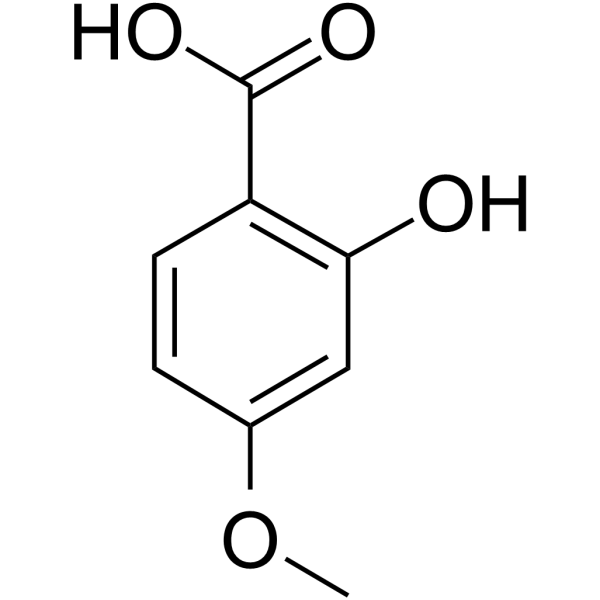
Cat. No.: HY-75625
CAS No.: 2237-36-7
Synonyms: 4-Methoxysalicylic Acid
2-Hydroxy-4-methoxybenzoic acid is an orally active inhibitor of MCT-1 and MCT-4, as well as a plant biomarker. 2-Hydroxy-4-methoxybenzoic acid can be isolated from roots. 2-Hydroxy-4-methoxybenzoic acid induces Apoptosis and loss of mitochondrial membrane potential. 2-Hydroxy-4-methoxybenzoic acid exhibits anticancer activity against breast cancer. 2-Hydroxy-4-methoxybenzoic acid normalizes lactic acid levels. 2-Hydroxy-4-methoxybenzoic acid neutralizes viper venom and attenuates its lethal, hemorrhagic, coagulant and anticoagulant activities in male albino mice. 2-Hydroxy-4-methoxybenzoic acid possesses antihyperlipidemic, antidiabetic and hepatoprotective activities .
loading...
    loading...
Cat. No.: HY-W088011B
CAS No.: 2836-32-0
Synonyms: Sodium hydroxyacetate, 98%
Sodium glycolate, 98% (Sodium hydroxyacetate, 98%) is an orally active, versatile organic salt . Sodium glycolate, 98% acts as an enzyme activity regulator that increases the activities of glycolate oxidase (GAO) and lactate dehydrogenase (LDH), while reducing the activity of glycolate dehydrogenase (GAD). Sodium glycolate, 98% induces oxalate biosynthesis and causes hyperoxaluria in rats. Sodium glycolate, 98% reduces urinary calcium excretion in male albino rats. Sodium glycolate, 98% can be used in studies related to calcium oxalate urolithiasis and hyperoxaluria .
loading...
    loading...
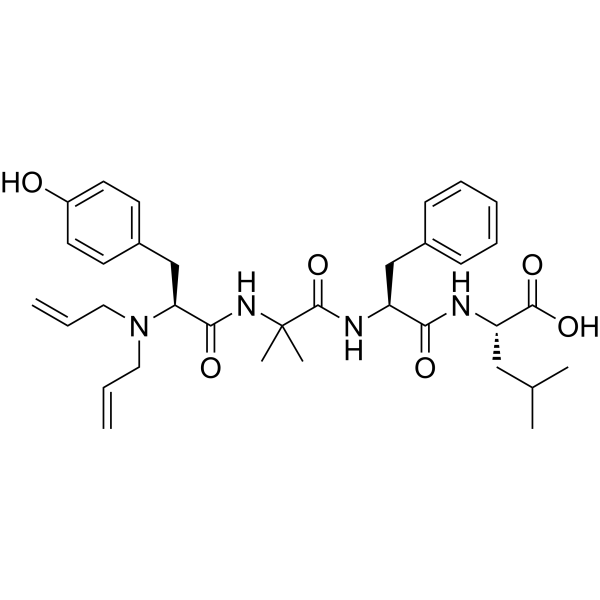
Cat. No.: HY-101230
CAS No.: 89352-67-0
Purity:  99.97%
Target:  

Opioid Receptor

Research Areas:  

Neurological Disease

ICI 174864 is a selective and brain-penetrant δ-opioid receptor antagonist with Ke values of 22.0 nM to 30.6 nM at δ-opioid receptor in mouse vas deferens. ICI 174864 selectively blocks biological effects mediated by the δ-opioid receptor agonist DPDPE (HY-P1334) after central administration. ICI 174864 reverses hypotension in rats with endotoxic shock and inhibits acetic acid-induced writhing in mice. ICI 174864 can be used for the research of opioid receptor subtypes, endotoxic hypotension and analgesic pathways .
loading...
    loading...
Cat. No.: HY-W741145
Dibenzepine-d3 is the deuterated-labeled Dibenzepine (HY-12391). Dibenzepine is a blood-brain barrier permeable ligand of the histamine H1 receptor (Histamine H1 Receptor), with a Ki value of 0.02 μM. Dibenzepine exhibits varying degrees of affinity for multiple serotonin receptors and dopamine receptors. Dibenzepine can be used in research related to depression, schizophrenia, dementia, and non-specific agitation .
loading...
    loading...
Cat. No.: HY-W795548
CAS No.: 713-05-3
Target:  

Endogenous Metabolite

Research Areas:  

Others

N-Methyl-4-oxo-4-(pyridin-3-yl) butanamide is a urinary metabolite of (±)-Cotinine in rats and an intermediate in the bacterial catabolism of Nicotine. N-Methyl-4-oxo-4-(pyridin-3-yl) butanamide serves as a tool molecule for studies on Nicotine metabolism.
loading...
    loading...
Cat. No.: HY-181235
Target:  

COX Cytochrome P450

Research Areas:  

Inflammation/Immunology Cancer

COX-2/Aromatase-IN-1 is a potent dual inhibitor of COX-2 and aromatase. COX-2/Aromatase-IN-1 can simultaneously inhibit COX-2 and aromatase, significantly suppress inflammation and induce proliferation inhibition of breast cancer cells. COX-2/Aromatase-IN-1 exerts anti-breast cancer and anti-inflammatory effects in the MCF-7 breast cancer cell and carrageenan-induced rat paw edema model. COX-2/Aromatase-IN-1 can be used for the study of inflammation and breast cancer .
loading...
    loading...
Cat. No.: HY-W982689
CAS No.: 6723-40-6
Research Areas:  

Metabolic Disease

Fluindarol is a phenylindandione derivative and an orally active anticoagulant. Fluindarol acts as a toxicant that induces organ and tissue haemorrhages and liver parenchymal necrosis in rats. Fluindarol exhibits acute and cumulative preclinical toxicity in rats, rabbits, and dogs, with higher toxicity in female rats than male rats. Fluindarol lacks analgesic action, produces only minor blood pressure effects, and does not alter circulation, respiration, CNS, or cardiac activity. Fluindarol is considered too toxic for clinical use based on preclinical data .
loading...
    loading...
Cat. No.: HY-P11822
Research Areas:  

Infection

Py-FGGK is a gelatinase-responsive short peptide. Py-FGGK can specifically target MRSA, cause leakage of cellular components, generate ROS in situ, and kill biofilm-encapsulated MRSA cells. Py-FGGK can promote cell migration to aid wound healing, and accelerates wound healing in MRSA-infected rat models. Py-FGGK can be used in studies related to MRSA infection .
loading...
    loading...
Cat. No.: HY-N18387
trans-Psoralenoside is the trans isomer of Psoralenoside (HY-N7503). trans-Psoralenoside is present in the aerial parts of Ficus palmata. trans-Psoralenoside can be used in studies of liver diseases, kidney diseases and peptic ulcers .
loading...
    loading...
Cat. No.: HY-114341
CAS No.: 34157-80-7
Synonyms: Kaempferol 5-O-β-D-glucopyranoside
Kaempferol 5-glucoside (Kaempferol 5-O-β-D-glucopyranoside) is an orally active flavonol glycoside and immunomodulator. Kaempferol 5-glucoside is isolated from the aerial parts of Indigofera aspalathoides Vahl ex DC. Kaempferol 5-glucoside enhances delayed-type hypersensitivity in rats. Kaempferol 5-glucoside increases humoral antibody titers. Kaempferol 5-glucoside is used for the research of autoimmune diseases .
loading...
    loading...
Cat. No.: HY-12391
CAS No.: 4498-32-2
Target:  

Histamine Receptor

Research Areas:  

Neurological Disease

Dibenzepine is a blood-brain barrier permeable ligand of the histamine H1 receptor (Histamine H1 Receptor), with a Ki value of 0.02 μM. Dibenzepine exhibits varying degrees of affinity for multiple serotonin receptors and dopamine receptors. Dibenzepine can be used in research related to depression, schizophrenia, dementia, and non-specific agitation .
loading...
    loading...
Cat. No.: HY-12391A
CAS No.: 315-80-0
Target:  

Histamine Receptor

Research Areas:  

Neurological Disease

Dibenzepine hydrochloride is a blood-brain barrier permeable ligand of the histamine H1 receptor (Histamine H1 Receptor), with a Ki value of 0.02 μM. Dibenzepine hydrochloride exhibits varying degrees of affinity for multiple serotonin receptors and dopamine receptors. Dibenzepine hydrochloride can be used in research related to depression, schizophrenia, dementia, and non-specific agitation .
loading...
    loading...
Cat. No.: HY-183540
CAS No.: 57558-44-8
Target:  

mAChR

Secoverine is a muscarinic cholinergic receptor (mAChR) antagonist and antispasmodic with blood-brain barrier permeability. Secoverine binds competitively to muscarinic receptors, blocks central cholinergic effects, and inhibits cholinergically induced gastrointestinal motility, intestinal smooth muscle contraction, and acetylcholine-mediated neurotransmitter release. Secoverine exerts direct antispasmodic activity on intestinal smooth muscle independent of receptor blockade, and exhibits characteristics such as reversible smooth muscle activity and long duration of action. Secoverine can be used in studies related to hyperintestinal motility, diverticular disease, and colonic spasm .
loading...
    loading...
  • 1

