27 Results for "

Xylan

" in MedChemExpress (MCE) Product Catalog:
Products (27)

27 Results for "Xylan" in MCE Product Catalog:

2
2 Cited Publications
Cat. No.: HY-107846
CAS No.: 9014-63-5
Purity:  ≥95.0%
Xylan represents the main hemicellulose component in the secondary plant cell walls of flowering plants. Xylan is a polysaccharide made from units of xylose and contains predominantly β-D-xylose units linked as in cellulose .
loading...
    loading...
1
1 Cited Publications
Cat. No.: HY-N6831
CAS No.: 49694-21-5
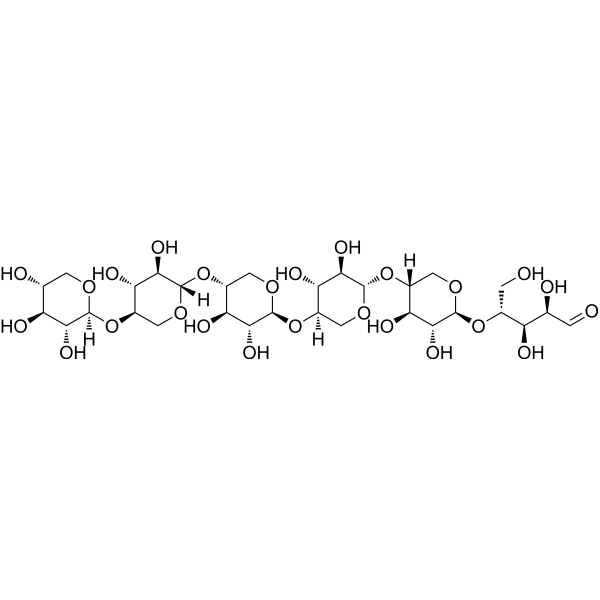
Xylohexaose is a xylooligosaccharide composed of six xylose residues. Xylohexaose can be produced by hydrolysis of beechwood xylan by AfXynA. Xylohexaose serves as a substrate for the determination of xylan hydrolysis activity .
loading...
    loading...
1
1 Cited Publications
Cat. No.: HY-N1887
CAS No.: 1126-61-0
Synonyms: Hydroxychavicol; 4-Allylpyrocatechol
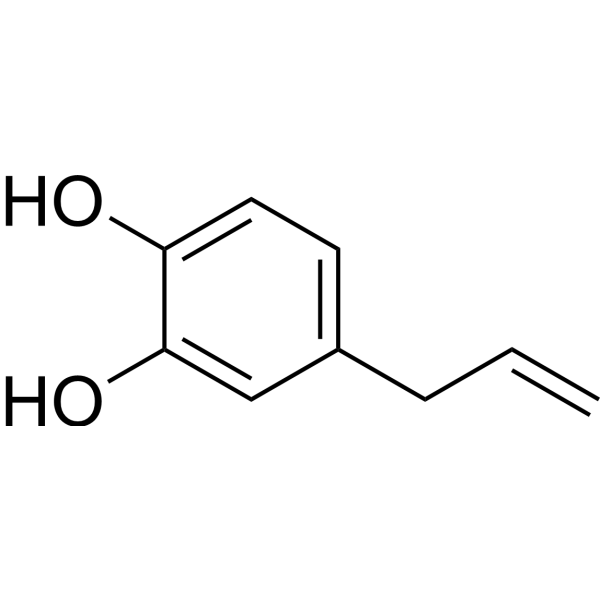
4-Allylcatechol (4-Allylpyrocatechol) is a xylan which has oral activity and can be isolated from the root of Piper taiwanense. 4-Allylcatechol has a strong inhibitory activity against collagen-induced platelet aggregation (IC50 = 5.3 μM). In addition, 4-Allylcatechol has anti-tuberculosis activity against Mycobacterium tuberculosis H37Rv (MIC = 27.6 μg/mL) .
loading...
    loading...
Cat. No.: HY-N6840
CAS No.: 22416-58-6
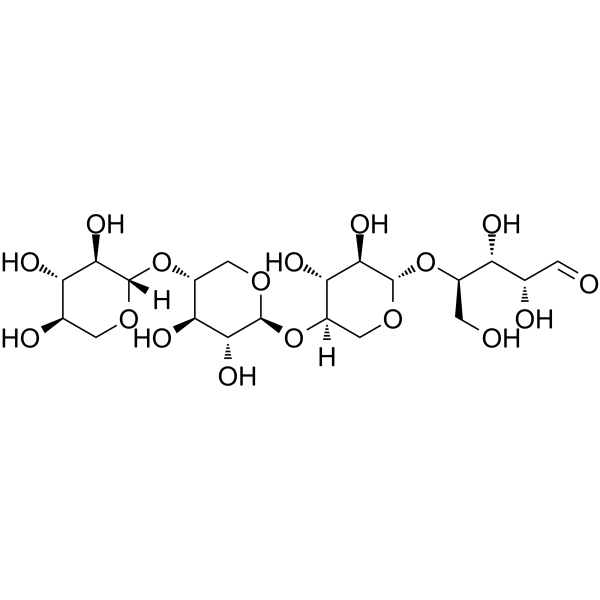
Xylotetraose is a xylo-oligosaccharide and a substrate of Taxy11. Xylotetraose serves as a substrate for the endo-xylanase Taxy11, and is hydrolyzed by it into xylobiose and xylotriose .
loading...
    loading...
Cat. No.: HY-P2875
CAS No.: 9025-56-3
Research Areas:  

Others

Hemicellulase is a hemicellulose-targeting hydrolase that breaks down the binding of glucose and polymers to water molecules present in plant fibers. Hemicellulase specifically degrades hemicellulose (such as xylan and mannan) in plant cell walls by hydrolyzing β-1,4-xylosidic bonds and ester bonds (such as acetyl and ferulic acid ester bonds). Hemicellulase relies on the synergistic action of the glycoside hydrolase (GH) and carbohydrate esterase (CE) families to achieve efficient hydrolysis through acid-base catalysis (such as Glu/Asp residues) and substrate binding pockets. Hemicellulase can be used in the food industry (such as improving bread texture), biofuel production (lignocellulose pretreatment) and paper industry (biobleaching) .
loading...
    loading...
Cat. No.: HY-P2816
CAS No.: 37278-89-0
Research Areas:  

Others

Xylanase is an enzyme targeting 1,4-β-D-xylan that randomly cleaves the β-1,4 backbone of xylan, a complex polysaccharide in plant cell walls. Xylanase finds applications in the food, feed and industrial sectors, including pulp and paper processing, baking, animal feed improvement, and biotransformation of waste .
loading...
    loading...
Cat. No.: HY-P3187
CAS No.: 9025-53-0
Target:  

DNA/RNA Synthesis

Research Areas:  

Others

Exo-1,4-β-xylosidase is an exonuclease that specifically acts on the β-1,4 glycosidic bonds at the non-reducing ends of xylan and xylooligosaccharides. Exo-1,4-β-xylosidase is Ca 2+-dependent and reversibly binds to metal ions to catalyze the hydrolysis of β-1,4 glycosidic bonds, thereby degrading xylan to produce xylose. Exo-1,4-β-xylosidase can be used in research fields such as lignocellulose bioconversion, bioethanol production, and optimization of xylan saccharification processes .
loading...
    loading...
Cat. No.: HY-P3187A
CAS No.: 9025-53-0
Target:  

DNA/RNA Synthesis

Research Areas:  

Others

exo-β-1,4-xylosidase,Clostridium stercorarium (EC.3.2.1.37) is an exonuclease that specifically acts on the β-1,4 glycosidic bonds at the non-reducing ends of xylan and xylooligosaccharides. exo-β-1,4-xylosidase is Ca 2+-dependent and reversibly binds to metal ions to catalyze the hydrolysis of β-1,4 glycosidic bonds, thereby degrading xylan to produce xylose. exo-β-1,4-xylosidase can be used in research fields such as lignocellulose bioconversion, bioethanol production, and optimization of xylan saccharification processes .
loading...
    loading...
Cat. No.: HY-P3187B
CAS No.: 9025-53-0
Target:  

DNA/RNA Synthesis

Research Areas:  

Others

exo-β-1,4-xylosidase, Bacteroides ovatus (EC.3.2.1.37) is an exonuclease that specifically acts on the β-1,4 glycosidic bonds at the non-reducing ends of xylan and xylooligosaccharides. exo-β-1,4-xylosidase is Ca 2+-dependent and reversibly binds to metal ions to catalyze the hydrolysis of β-1,4 glycosidic bonds, thereby degrading xylan to produce xylose. exo-β-1,4-xylosidase can be used in research fields such as lignocellulose bioconversion, bioethanol production, and optimization of xylan saccharification processes .
loading...
    loading...
Cat. No.: HY-W145701
CAS No.: 9062-57-1
Synonyms: 4-O-methylglucuronoXylan
4-O-Methyl-α-D-glucurono-β-D-xylan is a biochemical reagent that can be used as a biological material or organic compound for life science related research.
loading...
    loading...
Cat. No.: HY-W802197
CAS No.: 30571-56-3
Synonyms: Xylose tetraacetate
Research Areas:  

Others

D-Xylose 2,3,4,5-tetraacetate (Xylose tetraacetate) is a synthetic, fully acetylated xylose derivative. D-Xylose 2,3,4,5-tetraacetate serves as a substrate substitute for acetyl xylan esterase (AXE) to detect the enzyme's hydrolytic activity toward acetyl ester bonds .
loading...
    loading...
Cat. No.: HY-E70100A
Research Areas:  

Others

Acetyl xylan esterase, Cellvibrio japonicus (EC 3.1.1.72) is an enzyme that catalyzes a chemical reaction, the deacetylation of xylans and xylo-oligosaccharides. Acetyl xylan esterase, Cellvibrio japonicus (EC 3.1.1.72) belongs to the family of hydrolases, specifically those acting on carboxylic ester bonds.
loading...
    loading...
Cat. No.: HY-E70100B
Research Areas:  

Others

Acetyl xylan esterase, Clostridium thermocellum (EC 3.1.1.72) is an enzyme that catalyzes a chemical reaction, the deacetylation of xylans and xylo-oligosaccharides. Acetyl xylan esterase, Clostridium thermocellum (EC 3.1.1.72) belongs to the family of hydrolases, specifically those acting on carboxylic ester bonds.
loading...
    loading...
Cat. No.: HY-E72069
Research Areas:  

Others

Acetyl xylan esterase from bacillus subtilis (Recombinant) (EC 3.1.1.72) is a hydrolase that can catalyze deacetylation of xylans and xylo-oligosaccharides.
loading...
    loading...
Cat. No.: HY-E72069A
Research Areas:  

Others

Acetyl xylan esterase from ruminococcus flavefaciens (Recombinant) (EC 3.1.1.72) is a hydrolase that can catalyze deacetylation of xylans and xylo-oligosaccharides.
loading...
    loading...
Cat. No.: HY-E72069B
Research Areas:  

Others

Acetyl xylan esterase from thermotoga maritima (Recombinant) (EC 3.1.1.72) is a hydrolase that can catalyze deacetylation of xylans and xylo-oligosaccharides.
loading...
    loading...
Cat. No.: HY-E71162
Research Areas:  

Others

1,4-β-D-Xylan synthase (EC 2.4.2.24) belongs to the family of glycosyltransferases, specifically the pentosyltransferases. 1,4-β-D-Xylan synthase (EC 2.4.2.24) participates in starch and sucrose metabolism and nucleotide sugars metabolism.
loading...
    loading...
Cat. No.: HY-P2816A
Research Areas:  

Metabolic Disease

Xylanase, Trichoderma viride (EC 3.2.1.8) is the name given to a class of enzymes which degrade the linear polysaccharide beta-1,4-xylan into xylose, thus breaking down hemicellulose, one of the major components of plant cell walls.
loading...
    loading...
Cat. No.: HY-E70897
Research Areas:  

Metabolic Disease

Xylanase 10A, Cellvibrio japonicus (EC 3.2.1.8) is the name given to a class of enzymes which degrade the linear polysaccharide beta-1,4-xylan into xylose, thus breaking down hemicellulose, one of the major components of plant cell walls.
loading...
    loading...
Cat. No.: HY-P3017A
Research Areas:  

Others

Endo-1,4-β-Xylanase, Trichoderma longibrachiatum (EC 3.2.1.8) is the name given to a class of enzymes which degrade the linear polysaccharide beta-1,4-xylan into xylose, thus breaking down hemicellulose, one of the major components of plant cell walls.
loading...
    loading...

