1. Search Result
Search Result
Results for "

Zeaxanthin

" in MedChemExpress (MCE) Product Catalog:

8

Inhibitors & Agonists

6

Natural
Products

Cat. No. Product Name Target Research Areas Chemical Structure
  • HY-120318
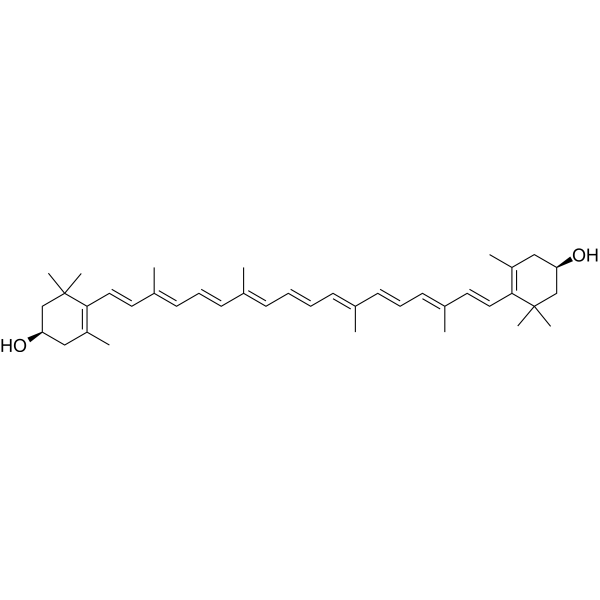
    Zeaxanthin
    2 Publications Verification

    Endogenous Metabolite Inflammation/Immunology Cancer
    Zeaxanthin, a diet-obtained carotenoid, presents in the macula region of the eye. Zeaxanthin shows antioxidant effects .
    Zeaxanthin
  • HY-N9182

    Physalien

    Adiponectin Receptor P2X Receptor Autophagy Inflammation/Immunology
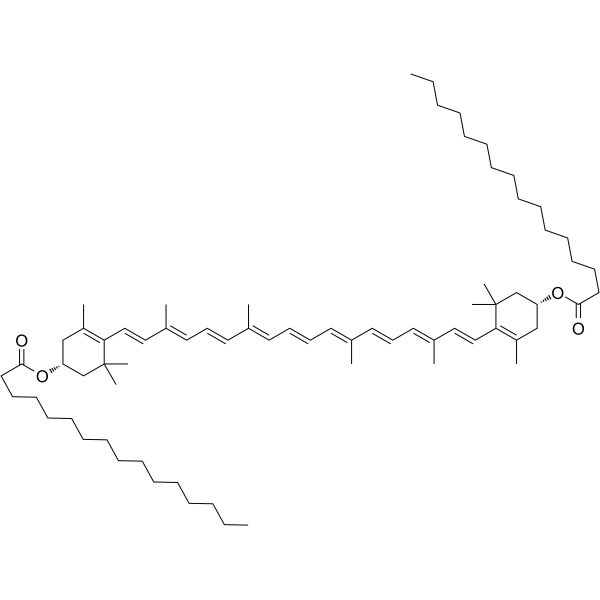
    Zeaxanthin dipalmitate (Physalien) is a wolfberry-derived carotenoid, has anti-inflammatory and anti-oxidative stress effects. Zeaxanthin dipalmitate directly interact with p2X7 receptor (Kd=81.2 nM) and adiponectin receptor 1 (AdipoR1; Kd=533 nM) in a positive dose-dependent manner. Zeaxanthin dipalmitate restores mitochondrial autophagy functions suppressed by ethanol intoxication. Zeaxanthin dipalmitate can be used in the research of alcoholic fatty liver disease (AFLD) and retinitis pigmentosa (RP) .
    Zeaxanthin dipalmitate
  • HY-107425A

    PROTACs Epigenetic Reader Domain Cancer
    cis-MZ 1 is a cis isomer of meso-zeaxanthin, a xanthophyll carotenoid component of total zeaxanthin measured in serum and egg yolks.cis-MZ 1 is a triphenyltin benzoate that adopts either a tetrahedral monomeric structure (I) or a trans-SnR3O2 polymeric structure (III), with structure determined by a balance of steric and electronic factors .
    cis-MZ 1
  • HY-N10991

    Drug Derivative Others
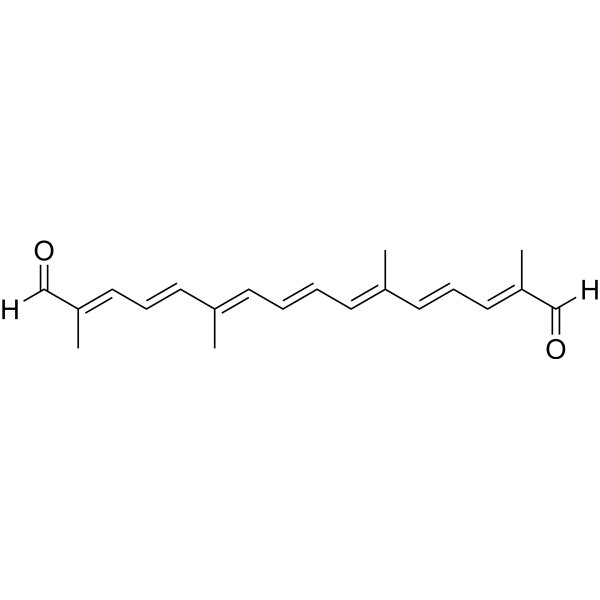
    Crocetin dialdehyde is a non-volatile apocarotenoid obtained by the action of the plastidic enzyme CCD2 over the carotenoid zeaxanthin in saffron. Crocetin dialdehyde can be converted into Crocetin (HY-N2072) by aldehyde dehydrogenases (ALDHs). Crocetin dialdehyde has no effect on the liver in mice .
    Crocetin dialdehyde
  • HY-N9625

    Photosystem II Others
    Violaxanthin is a lipophilic epoxy carotenoid and a light energy scavenger with biological activities such as antioxidation and anti-inflammation. Violaxanthin exists in photosynthetic eukaryotes including higher plants and participates in the xanthophyll cycle. As a component of the xanthophyll cycle, violaxanthin can be synthesized from zeaxanthin under the catalysis of epoxidase and scavenge excess light energy in photosynthetic eukaryotes .
    Violaxanthin
  • HY-167632

    (3R,3′S)-Zeaxanthin

    Reactive Oxygen Species (ROS) Inflammation/Immunology
    meso-Zeaxanthin accumulates in the central retina and forms macular pigment together with lutein and zeaxanthin, which has the function of light filtering. meso-Zeaxanthin can quench ROS and exert antioxidant function .
    meso-Zeaxanthin
  • HY-W720042A

    Biochemical Assay Reagents Others
    (rac)-Zeaxanthin dimethyl ether is the racemate of Zeaxanthin dimethyl ester. Zeaxanthin is a type of xanthophyll. (rac)-Zeaxanthin dimethyl ether has applications as pharmaceuticals and nutraceuticals and in the food industry .
    (rac)-Zeaxanthin dimethyl ether
  • HY-N18644

    Bacterial Inflammation/Immunology Cancer
    The main active ingredients of calendula extract are lutein and zeaxanthin. It has anti-aging, anti-inflammatory and antibacterial effects. It also has a certain moisturizing effect, thus can be used as a good functional cosmetics raw material.
    Calendula extract

Inquiry Online

Your information is safe with us. * Required Fields.

Salutation


Country or Region *

Applicant Name *


Organization Name *

Department *


Email Address *


Product Name *

Cat. No.


Requested quantity *

Phone Number *


Remarks

Inquiry Online

Inquiry Information

Product Name:
Cat. No.:
Quantity:
MCE Japan Authorized Agent:

