1. Search Result
Search Result
Results for "

advanced prostate cancer

" in MedChemExpress (MCE) Product Catalog:

12

Inhibitors & Agonists

1

Biochemical Assay Reagents

1

Inhibitory Antibodies

Targets Recommended:
Cat. No. Product Name Target Research Areas Chemical Structure
  • HY-158101
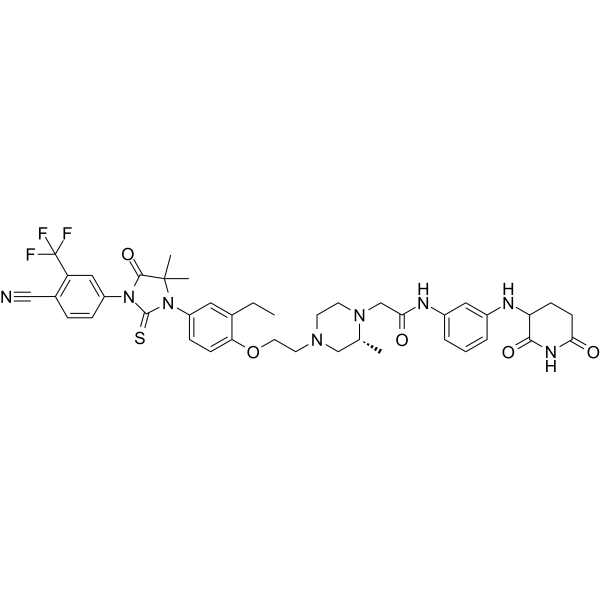
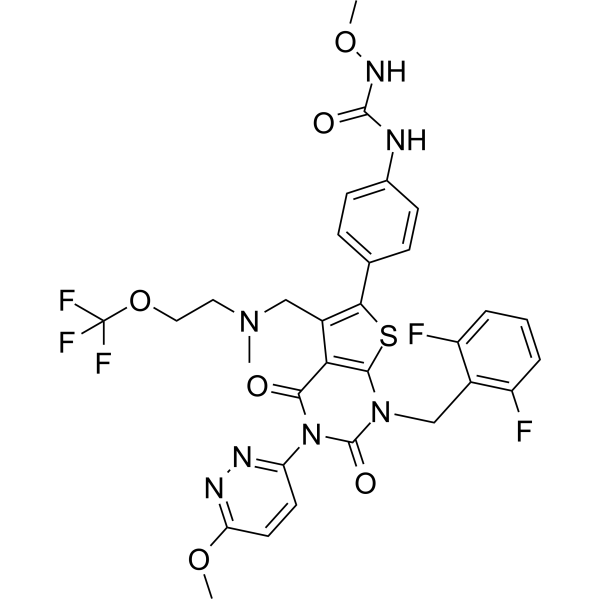
    BMS-986365
    1 Publications Verification

    CC-94676

    PROTACs Androgen Receptor Cancer
    BMS-986365 (CC-94676) is an orally active and selective targeted androgen receptor (AR) PROTAC degrader (DC50 of 10-40 nM). BMS-986365 is capable of inducing cereblon (CRBN) E3 ligase-dependent ubiquitination and degradation of the androgen receptor (AR), as well as various AR mutants. BMS-986365 shows no degradation of the close AR family members estrogen receptor (ER), progesterone receptor (PR), and glucocorticoid receptor (GR). BMS-986365 shows significant in vivo potency, degrading AR, inhibiting AR signaling, and restricting tumor growth in animal models of advanced prostate cancer. BMS-986365 can be used for the study of metastatic castration-resistant prostate cancer (mCRPC) .
    BMS-986365
  • HY-125399
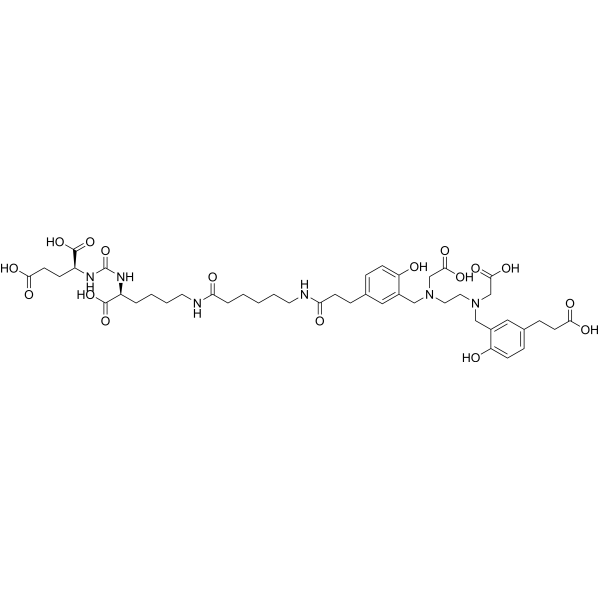
    PSMA-11
    1 Publications Verification

    HBED-CC-PSMA

    PSMA Radionuclide-Drug Conjugates (RDCs) Cancer
    PSMA-11 is a small molecule ligand that targets prostate-specific membrane antigen (PSMA) and has the ability to inhibit PSMA activity. PSMA-11 can be used to synthesize 68Ga-PSMA-11, a positron emission tomography (PET) tracer that can be used to image advanced prostate cancer .
    PSMA-11
  • HY-P991577

    DS-8895A

    Ephrin Receptor Cancer
    DS-8895(DS-8895A) is an anti-EphA2 monoclonal antibody with specific binding to EphA2 receptors and EphA2-expressing cells. DS-8895, when conjugated with 89Zr, 111In, or 125I, supports molecular imaging of EphA2 expression in xenograft models. DS-8895 allows noninvasive measurement of EphA2 expresssion in tumors in vivo. .
    DS-8895
  • HY-158498

    FA2 N-linked oligosaccharide; F(6)A2 glycan

    Biochemical Assay Reagents Cancer
    FA2 glycan (G0F) (FA2 N-linked oligosaccharide; F(6)A2 glycan) is a core-fucosylated biantennary N-linked oligosaccharide that serves as a prostate cancer biomarker. The level of FA2 glycan (G0F) is higher in prostate cancer than in benign prostatic hyperplasia, and it is further elevated in advanced prostate cancer with a Gleason score ≥8 compared with both benign prostatic hyperplasia and low-/intermediate-risk prostate cancer. FA2 glycan (G0F) can be used in prostate cancer research .
    FA2 glycan (G0F)
  • HY-Y0943

    Drug Metabolite Cancer
    Aldehyde Dehydrogenase Isobutyramide is an orally active liver alcohol dehydrogenase (LADH2) inhibitor. Isobutyramide inhibits ethanol metabolism and enhances differentiation-related gene expression, inducing cell cycle arrest and significantly reducing the growth rate of prostate cancer cells (LNCaP). Isobutyramide is promising for research of advanced prostate cancer .
    Isobutyramide
  • HY-151247

    GnRH Receptor Cancer
    GnRH-R antagonist 1 (compound 21a) is an orally safe and membrane-permeable GnRH-R antagonist with high binding affinity (IC50=0.57 nM) and potent in vitro antagonistic activity (IC50=2.18 nM). GnRH-R antagonist 1 can be used in studies of advanced prostate cancer and premature LH peaks preventing .
    GnRH-R antagonist 1
  • HY-174908

    Histone Methyltransferase 11β-HSD Androgen Receptor Cancer
    SJL2-1 is a PRMT5 inhibitor, with an IC50 of 1.56 μM. SJL2-1 suppresses proliferation, migration, and invasion in prostate cancer cells. SJL2-1 promotes apoptosis and blocks the cell cycle at the G0/G1 phase. SJL2-1 can target the binding of PRMT5 in cells and inhibit the methylation and expression of the androgen receptor. SJL2-1 can be used for the study of early androgen-sensitive prostate cancer and advanced castration-resistant prostate cancer (CRPC) .
    SJL2-1
  • HY-175000

    Ferroptosis Polo-like Kinase (PLK) MDM-2/p53 Endocrinology Cancer
    L14-8 is a potent ferroptosis inducer. L14-8 promotes PLK1 degradation via ubiquitination, increasing TP53 phosphorylation to enhance SAT1 transcription, thereby triggering ferroptosis and cancer cell death. L14-8 can be used for the study of advanced prostate cancer .
    L14-8
  • HY-175826

    Deubiquitinase Ferroptosis Reactive Oxygen Species (ROS) Glutathione Peroxidase Cancer
    USP30-IN-20 is an orally active USP30 inhibitor (Kd = 1.61 μM, IC50 = 12.8 μM). USP30-IN-20 induces ferroptosis by promoting ubiquitination-mediated degradation of GPX4. USP30-IN-20 inhibits the proliferation, migration, invasion, and stemness of prostate cancer cells. USP30-IN-20 induces G0/G1 cell cycle arrest and ROS levels in prostate cancer cells. USP30-IN-20 exhibits significant anti-tumor efficacy in PC3 cell subcutaneous xenografts in mice. USP30-IN-20 can be used for the study of advanced prostate cancer .
    USP30-IN-20
  • HY-118487A

    Endogenous Metabolite Cancer
    OB-24 free base is a compound that potently and selectively inhibits heme oxygenase 1 (HO-1) and has the potential to inhibit advanced prostate cancer. OB-24 significantly reduces protein carbonylation and the formation of reactive oxygen species by selectively inhibiting HO-1 activity in prostate cancer cells. OB-24 significantly inhibited cell proliferation in vitro and inhibited tumor growth and lymph node and lung metastasis in vivo. OB-24 exhibits powerful synergy when used in combination with Taxol .
    OB-24 free base
  • HY-123664

    LY133314

    Estrogen Receptor/ERR Cancer
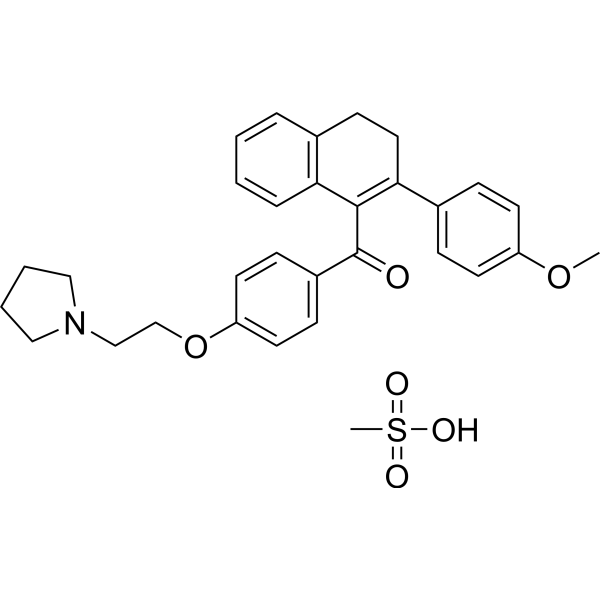
    Trioxifene mesylate (LY133314) is an orally active and selective estrogen receptor (ER) modulator with human ERα IC50 of 203.49 nM and Ki of 20.84 nM. Trioxifene mesylate binds estradiol receptors, inhibits ERα-mediated gene expression, reduces circulating gonadotrophin levels. Trioxifene mesylate can be used for the research of advanced breast cancer and androgen-independent, metastatic prostatic adenocarcinoma .
    Trioxifene mesylate
  • HY-135529

    LY133314 free base

    Estrogen Receptor/ERR Cancer
    Trioxifene (LY133314 free base) is an orally active and selective estrogen receptor (ER) modulator with human ERα IC50 of 203.49 nM and Ki of 20.84 nM. Trioxifene binds estradiol receptors, inhibits ERα-mediated gene expression, reduces circulating gonadotrophin levels. Trioxifene can be used for the research of advanced breast cancer and androgen-independent, metastatic prostatic adenocarcinoma .
    Trioxifene

Inquiry Online

Your information is safe with us. * Required Fields.

Salutation


Country or Region *

Applicant Name *


Organization Name *

Department *


Email Address *


Product Name *

Cat. No.


Requested quantity *

Phone Number *


Remarks

Inquiry Online

Inquiry Information

Product Name:
Cat. No.:
Quantity:
MCE Japan Authorized Agent:

