18 Results for "

appressorium formation

" in MedChemExpress (MCE) Product Catalog:
Products (18)

18 Results for "appressorium formation" in MCE Product Catalog:

Cat. No.: HY-N1677
CAS No.: 530-55-2
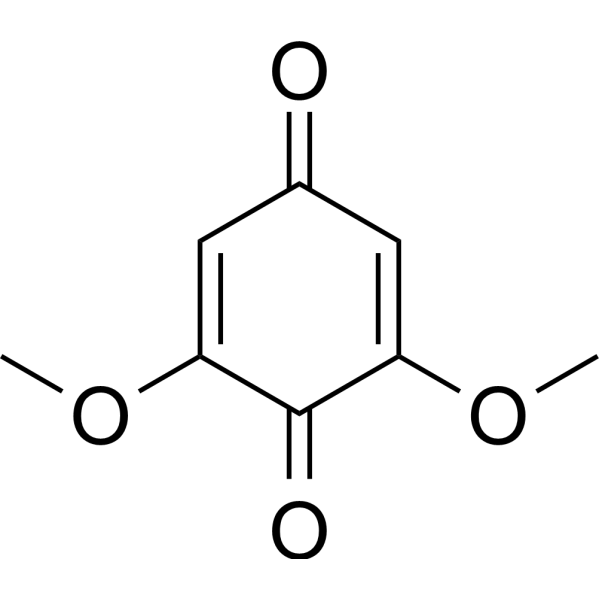
2,6-Dimethoxy-1,4-benzoquinone is a 1,4-benzoquinone derivative. 2,6-Dimethoxy-1,4-benzoquinone promotes phosphorylation of AKT, S6K, mTOR, 4E-BP1, and AMPK, and attenuates mTORC1 activity as part of the AKT/mTOR pathway. 2,6-Dimethoxy-1,4-benzoquinone stimulates myoblast differentiation, increases myotube size, elevates MHC protein expression, enhances mitochondrial biogenesis, respiration, and DNA content, and increases skeletal muscle weights, fiber size, grip strength, and treadmill performance. 2,6-Dimethoxy-1,4-benzoquinone exerts anti-cancer, anti-inflammatory, anti-adipogenic, antibacterial, and antimutagenic effects, inhibits adipogenic transcription factors, nitric oxide production, skin tumor development, Magnaporthe oryzae growth, spore germination, appressorium formation, and growth of select bacterial species, induces H2O2 generation and rice defense gene expression, and reduces rice blast lesion formation. 2,6-Dimethoxy-1,4-benzoquinone can be used for the research of obesity, skin tumorigenesis, rice blast disease, and food-borne illness .
loading...
    loading...
Cat. No.: HY-W105735
CAS No.: 7735-42-4
Synonyms: Hexadecamethylene glycol
Target:  

Fungal Mps1

Research Areas:  

Infection

1,16-Hexadecanediol (Hexadecamethylene glycol) is a diol compound derived from plant wax and an inducer of appressorium formation in Magnaporthe grisea. Its activities include reversing PepEST-mediated inhibition and promoting the accumulation of α-1,3-glucan (a-1,3-glucan) on germ tubes and appressoria. 1,16-Hexadecanediol activates the Mps1 MAP kinase pathway through Mps1p phosphorylation. 1,16-Hexadecanediol can be used for research on rice blast and anthracnose .
loading...
    loading...
Cat. No.: HY-W010203
CAS No.: 693-54-9
2-Decanone is an antifungal agent. 2-Decanone inhibits pathogen mycelial growth, spore germination, and appressorium formation. 2-Decanone downregulates spore germination-related genes (MfBmp1) and penetration structure formation genes (MfPls1), inducing reactive oxygen species (ROS) accumulation to trigger mitochondrial damage and subsequent spore apoptosis. 2-Decanone is promising for research of postharvest disease control in fruits and vegetables .
loading...
    loading...
Cat. No.: HY-N14525
CAS No.: 144376-62-5
Glisoprenin A is a cholesterol acyltransferase (ACAT) inhibitor, and it can inhibit the formation of Appressorium on the hydrophobic surface of Magnaporthegrisea .
loading...
    loading...
Cat. No.: HY-N14574
CAS No.: 205594-88-3
Glisoprenin C is a cholesterol acyltransferase (ACAT) inhibitor, and it can inhibit the formation of Appressorium on the hydrophobic surface of Magnaporthegrisea .
loading...
    loading...
Cat. No.: HY-N14813
CAS No.: 205594-89-4
Glisoprenin D is a cholesterol acyltransferase (ACAT) inhibitor, and it can inhibit the formation of Appressorium on the hydrophobic surface of Magnaporthegrisea .
loading...
    loading...
Cat. No.: HY-N14816
CAS No.: 205594-90-7
Glisoprenin E is a cholesterol acyltransferase (ACAT) inhibitor, and it can inhibit the formation of Appressorium on the hydrophobic surface of Magnaporthegrisea .
loading...
    loading...
Cat. No.: HY-N14807
CAS No.: 315209-15-5
Neobulgarone A is an anthraquinone derivative of Neobulgaria pura HA A07-97, a fungus of the ascomycetes class. Neobulgarone A can inhibit the formation of Appressorium in Magnaporthe grisea and has weak cytotoxicity without antifungal, antibacterial or phytotoxicity .
loading...
    loading...
Cat. No.: HY-N14808
CAS No.: 315209-16-6
Neobulgarone B is an anthraquinone derivative of Neobulgaria pura HA A07-97, a fungus of the ascomycetes class. Neobulgarone B can inhibit the formation of Appressorium in Magnaporthe grisea and has weak cytotoxicity without antifungal, antibacterial or phytotoxicity .
loading...
    loading...
Cat. No.: HY-N14809
CAS No.: 315209-17-7
Neobulgarone C is an anthraquinone derivative of Neobulgaria pura HA A07-97, a fungus of the ascomycetes class. Neobulgarone C can inhibit the formation of Appressorium in Magnaporthe grisea and has weak cytotoxicity without antifungal, antibacterial or phytotoxicity .
loading...
    loading...
Cat. No.: HY-N14810
CAS No.: 315209-18-8
Neobulgarone D is an anthraquinone derivative of Neobulgaria pura HA A07-97, a fungus of the ascomycetes class. Neobulgarone D can inhibit the formation of Appressorium in Magnaporthe grisea and has weak cytotoxicity without antifungal, antibacterial or phytotoxicity .
loading...
    loading...
Cat. No.: HY-N14812
CAS No.: 315209-19-9
Neobulgarone E is an anthraquinone derivative of Neobulgaria pura HA A07-97, a fungus of the ascomycetes class. Neobulgarone E can inhibit the formation of Appressorium in Magnaporthe grisea and has weak cytotoxicity without antifungal, antibacterial or phytotoxicity .
loading...
    loading...
Cat. No.: HY-173402
CAS No.: 3110357-76-8
Target:  

Fungal

Research Areas:  

Infection

TPS1-IN-1 (Compound O1) is a highly potent and broad-spectrum TPS1 inhibitor. TPS1-IN-1 with IC50s of 14.73 μM for MoTPS1 (TPS1 of M oryzae) and 59.99 μM for BcTPS1 (TPS1 of B cinerea), respectively. TPS1-IN-1 exerts a broad-spectrum fungicidal effect by interfering with spore germination, appressorium formation, and turgor pressure accumulation of fungi. TPS1-IN-1 has good safety and has the potential to be a novel fungicide candidate compound .
loading...
    loading...
Cat. No.: HY-N1677R
CAS No.: 530-55-2
2,6-Dimethoxy-1,4-benzoquinone (Standard) is the analytical standard of 2,6-Dimethoxy-1,4-benzoquinone (HY-N1677). This product is intended for research and analytical applications. 2,6-Dimethoxy-1,4-benzoquinone is a 1,4-benzoquinone derivative. 2,6-Dimethoxy-1,4-benzoquinone promotes phosphorylation of AKT, S6K, mTOR, 4E-BP1, and AMPK, and attenuates mTORC1 activity as part of the AKT/mTOR pathway. 2,6-Dimethoxy-1,4-benzoquinone stimulates myoblast differentiation, increases myotube size, elevates MHC protein expression, enhances mitochondrial biogenesis, respiration, and DNA content, and increases skeletal muscle weights, fiber size, grip strength, and treadmill performance. 2,6-Dimethoxy-1,4-benzoquinone exerts anti-cancer, anti-inflammatory, anti-adipogenic, antibacterial, and antimutagenic effects, inhibits adipogenic transcription factors, nitric oxide production, skin tumor development, Magnaporthe oryzae growth, spore germination, appressorium formation, and growth of select bacterial species, induces H2O2 generation and rice defense gene expression, and reduces rice blast lesion formation. 2,6-Dimethoxy-1,4-benzoquinone can be used for the research of obesity, skin tumorigenesis, rice blast disease, and food-borne illness.
loading...
    loading...
Cat. No.: HY-N14814
CAS No.: 315209-20-2
Neobulgarone F is an anthraquinone derivative of Neobulgaria pura HA A07-97, a fungus of the ascomycetes class. Neobulgarone F can inhibit the formation of Appressorium in Magnaporthe grisea and has weak cytotoxicity without antifungal, antibacterial or phytotoxicity .
loading...
    loading...
Cat. No.: HY-179411
CAS No.: 25847-29-4
Target:  

Fungal

Research Areas:  

Infection

Antifungal agent 139 (Compound li) is an antifungal agent that exhibits antifungal activity against Colletotrichum gloeosporioides by inhibiting CgSfu1 and CgRidA. Antifungal agent 139 completely inhibits mycelial growth, spore germination, and appressorium formation, with an EC50 of 18 μg/mL. Antifungal agent 139 can completely block the pathogen's infection of host plants (such as linden trees, cypress trees). Antifungal agent 139 can be used for research on anthrax .
loading...
    loading...
Cat. No.: HY-W010203S1
CAS No.: 55320-60-0
2-Decanone-d5-1 is the deuterium labeled 2-Decanone (HY-W010203). 2-Decanone is an antifungal agent. 2-Decanone inhibits pathogen mycelial growth, spore germination, and appressorium formation. 2-Decanone downregulates spore germination-related genes (MfBmp1) and penetration structure formation genes (MfPls1), inducing reactive oxygen species (ROS) accumulation to trigger mitochondrial damage and subsequent spore apoptosis. 2-Decanone is promising for research of postharvest disease control in fruits and vegetables .
loading...
    loading...
Cat. No.: HY-182471
CAS No.: 1531626-08-0
Target:  

Fungal

Research Areas:  

Infection

Aminopyrifen is a GWT-1 inhibitor. Aminopyrifen inhibits the inositol acylation of phosphatidylinositol, disrupting the maturation process of GPI-anchored proteins and the integrity of fungal cell walls. Aminopyrifen strongly inhibits germ tube elongation of Botrytis cinerea, delays spore germination, prevents appressorium formation, and blocks the infection of plant tissues by pathogenic fungi. Aminopyrifen is effective against field populations of eggplant gray mold and cucumber powdery mildew, and can be used for research on various plant fungal diseases such as gray mold and powdery mildew .
loading...
    loading...
  • 1

