

10 Results for "

dodecapeptide

" in MedChemExpress (MCE) Product Catalog:
Products (10)

10 Results for "dodecapeptide" in MCE Product Catalog:

1
1 Cited Publications
Cat. No.: HY-P1597
CAS No.: 86555-35-3
Target:  

PKA PKC

Research Areas:  

Cancer

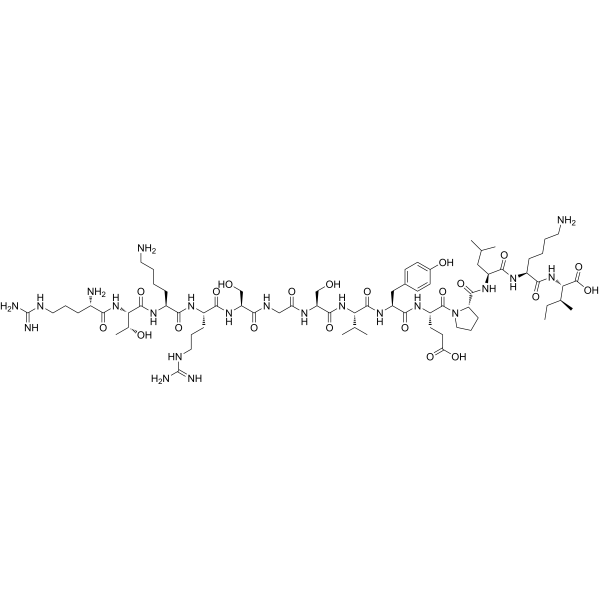
Malantide is a synthetic dodecapeptide derived from the site phosphorylated by cAMP-dependent protein kinase (PKA) on the β-subunit of phosphorylase kinase. Malantide is a highly specific substrate for PKA with a Km of 15 μM and shows protein inhibitor (PKI) inhibition >90% substrate phosphorylation in various rat tissue extracts . Malantide is also an efficient substrate for PKC with a Km of 16 μM .
loading...
    loading...
Cat. No.: HY-P1507
CAS No.: 89105-94-2
Target:  

Integrin

Research Areas:  

Cardiovascular Disease

Fibrinogen Binding Inhibitor Peptide is a dodecapeptide (HHLGGAKQAGDV, H12), which is a fibrinogen γ-chain carboxy-terminal sequence (γ400-411). Fibrinogen Binding Inhibitor Peptide is a specific binding site of the ligand for activated glycoprotein (GP) IIb/IIIa.
loading...
    loading...
Cat. No.: HY-P1508A
Synonyms: Bactenecin, bovine TFA
Bactenecin TFA (Bactenecin, bovine TFA) is a potent 12-aa looped antimicrobial peptide isolated from bovine neutrophils. Bactenecin TFA inhibits the growth of bacteria and yeast, and kills the fungus Trichophyton rubrum. Bactenecin TFA increass membrane permeability, inhibits the growth and biofilm formation of B. pseudomallei .
loading...
    loading...
Cat. No.: HY-P1508
CAS No.: 116229-36-8
Synonyms: Bactenecin, bovine
Bactenecin (Bactenecin, bovine) is a potent 12-aa looped antimicrobial peptide isolated from bovine neutrophils. Bactenecin inhibits the growth of bacteria and yeast, and kills the fungus Trichophyton rubrum. Bactenecin increass membrane permeability, inhibits the growth and biofilm formation of B. pseudomallei .
loading...
    loading...
Cat. No.: HY-P2706
CAS No.: 64704-41-2
Target:  

Histamine Receptor

Research Areas:  

Endocrinology

Granuliberin R is a new mast cell degranulating peptide comes from amphibian, can be isolated from the skin of frog Rana rugosa. Granuliberin R is a dodecapeptide, can act on rat peritoneal mast cell to liberate granules and release histamine .
loading...
    loading...
Cat. No.: HY-W089230
CAS No.: 20866-46-0
Synonyms: N,N'-Di-tert-butoxycarbonyl-L-histidine
Research Areas:  

Others

Boc-His(Boc)-OH (N,N'-Di-tert-butoxycarbonyl-L-histidine) is an amino acid derivative with an Fmoc protecting group, which can be used to synthesize the dodecapeptide α-mating factor of Saccharomyces cerevisiae .
loading...
    loading...
Cat. No.: HY-P10542
CAS No.: 1247945-70-5
Target:  

Peptides

Research Areas:  

Cancer

Dodecapeptide AR71 is an inhibitor of melanoma inhibitory activity (MIA). Dodecapeptide AR71 can reduce cell migration, reduce metastasis formation, and increase immune response. Dodecapeptide AR71 can be used in research on the treatment of malignant melanoma .
loading...
    loading...
Cat. No.: HY-P1597A
Target:  

PKA PKC

Research Areas:  

Cancer

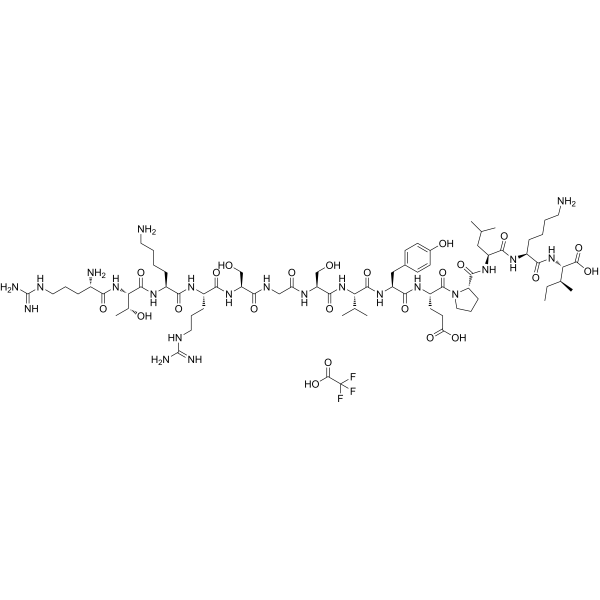
Malantide TFA is a synthetic dodecapeptide derived from the site phosphorylated by cAMP-dependent protein kinase (PKA) on the β-subunit of phosphorylase kinase. Malantide TFA is a highly specific substrate for PKA with a Km of 15 μM and shows protein inhibitor (PKI) inhibition >90% substrate phosphorylation in various rat tissue extracts . Malantide TFA is also an efficient substrate for PKC with a Km of 16 μM .
loading...
    loading...
Cat. No.: HY-P10500
CAS No.: 216682-41-6
Target:  

Peptides

Research Areas:  

Neurological Disease

NX210 is a dodecapeptide derived from the SCO-spondin protein. NX210 can increase cell survival and induce neurite outgrowth, and participate in cell-cell and cell-matrix interactions. NX210 can be used in research on spinal cord injury recovery .
loading...
    loading...
Cat. No.: HY-P11756
Target:  

ASCT

Research Areas:  

Cancer

P-LPK is a dodecapeptide that specifically targets SLC1A5, which is highly expressed on the membrane of colorectal cancer cells, with a Kd value of 1.19 μM. P-LPK has no intrinsic cell proliferation regulatory activity. Gallium-68-labeled P-LPK selectively accumulates at colorectal cancer tumor sites in xenograft mouse models. P-LPK can serve as a targeted carrier to deliver Camptothecin (HY-16560) to colorectal cancer cells, forming the conjugate P-LPK-CPT. P-LPK can be used in the research of colorectal cancer .
loading...
    loading...

