1. Search Result
Search Result
Pathways Recommended: Stem Cell/Wnt Cell Cycle/DNA Damage
Results for "

fibroblast cell lines

" in MedChemExpress (MCE) Product Catalog:

19

Inhibitors & Agonists

3

Biochemical Assay Reagents

1

Peptides

2

MCE Kits

1

Natural
Products

Cat. No. Product Name Target Research Areas Chemical Structure
  • HY-Y0850

    Environmental Pollutants Biochemical Assay Reagents Neurological Disease
    Polyvinyl alcohol (Mw 146000-186000, 99+% hydrolyzed) is a non-biodegradable, hydrophilic, odorless biomedical polymer with cell adhesion/proliferation inhibition, peripheral nerve regeneration induction, dissolution enhancement, and non-toxic, biocompatible properties .
    Polyvinyl alcohol (Mw 146000-186000, 99+% hydrolyzed)
  • HY-176798

    Lactate Dehydrogenase Reactive Oxygen Species (ROS) Apoptosis Cancer
    NCI-006 is an orally active lactate dehydrogenase (LDH) inhibitor (LDHA IC50 = 0.06 μM; LDHB IC50 = 0.03 μM). NCI-006 inhibits intratumoral LDH activity, lactate production, and tumor growth in a mouse pancreatic cancer model. NCI-006 inhibits glycolysis and induces apoptosis in vitro. NCI-006 enhances the radiosensitivity of glycolytic tumor cell lines while sparing non-glycolytic/normal cells (1522, skin fibroblasts) in combination with ionizing radiation (IR). NCI-006 exhibits synergistic antitumor effects in combination with IACS-010759 (HY-112037) against colorectal and gastric cancers. NCI-006 targets glycolysis by inhibiting lactate dehydrogenase impairs tumor growth in an Ewing sarcoma model .
    NCI-006
  • HY-W001939

    Biochemical Assay Reagents Cancer
    4-Acetylbenzoic acid is a Zn(II) complex. 4-Acetylbenzoic acid is a derivative of benzoic acid that is commonly used in chemical synthesis. 4-Acetylbenzoic acid has an IC50 of 331.3 μM in murine L929 fibroblasts and an IC50 of 176 μM in metastatic melanoma B16 F10 cell lines .
    4-Acetylbenzoic acid
  • HY-147802

    EGFR Apoptosis Cancer
    EGFR-IN-59 (Compound 8c) is a EGFR inhibitor (IC50=190 nM) and apoptosis inducer. EGFR-IN-59 exhibits cytotoxicity against non-small lung cancer cell lines (A549) and normal lung fibroblasts (WI38) with IC50s of 8.62 and 52.6 µM, respectively. EGFR-IN-59 can be used for the research of various cancers such as non-small cell lung cancer (NSCLC), head and neck cancer, breast cancer and colorectal cancer .
    EGFR-IN-59
  • HY-157404

    Pim Cancer
    Pim-1/2 kinase inhibitor 2 (compound 5b) is a competitive PIM-1 and PIM-2 kinase inhibitor with IC50s of 1.31 μM and 0.67 μM, respectively. Pim-1/2 kinase inhibitor 2 shows in-vitro low cytotoxicity against normal human lung fibroblast Wi-38 cell line and potent in-vitro anticancer activity against myeloid leukaemia (NFS-60), liver (HepG-2), prostate (PC-3), and colon (Caco-2) cancer cell lines .
    Pim-1/2 kinase inhibitor 2
  • HY-120621

    Phospholipase Inflammation/Immunology
    BMS-229724 is an orally active and tight-binding cytosolic phospholipase A2 (cPLA2) inhibitor with an IC50 of 2.8 μM. BMS-229724 can inhibit the production of arachidonic acid and eicosanoids in U937 cells, neutrophils, platelets, and other cells. BMS-229724 has anti-inflammatory activity and can be used in the research of diseases such as skin inflammation .
    BMS-229724
  • HY-W773183

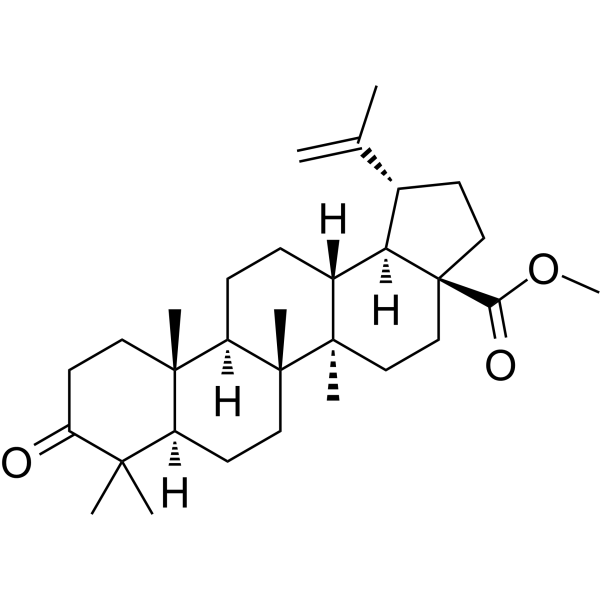
    Betulonic acid methyl ester; Methyl 3-oxolup-20(29)-en-28-oate

    Drug Intermediate Cancer
    Methyl betulonate (Betulonic acid methyl ester) is a triterpenoid. Methyl betulonate inhibits cell growth of eight tumor (including resistant) and two normal fibroblast cell lines with the IC50s >50.0 μM .
    Methyl betulonate
  • HY-123464

    Ras Cancer
    RBC10 is an anti-cancer agent. RBC10 inhibits the binding of Ral to its effector RALBP1. RBC10 also inhibits Ral-mediated cell spreading of murine embryonic fibroblasts and anchorage-independent growth of human cancer cell lines .
    RBC10
  • HY-173367

    EGFR PI3K mTOR Cancer
    Anticancer agent 271 (compound 5C) has antiproliferative activity against lung (A549), colon (Caco-2) cancer cell lines, and human lung fibroblast (WI38) with an IC50 value of 9.18 μM on A549 cells. Anticancer agent 271 downregulates PI3K and mTOR gene expression that can be used for cancer research .
    Anticancer agent 271
  • HY-W001939R

    Biochemical Assay Reagents Reference Standards Cancer
    4-Acetylbenzoic acid (Standard) is the analytical standard of 4-Acetylbenzoic acid. This product is intended for research and analytical applications. 4-Acetylbenzoic acid is a Zn(II) complex. 4-Acetylbenzoic acid is a derivative of benzoic acid that is commonly used in chemical synthesis. 4-Acetylbenzoic acid has an IC50 of 331.3 μM in murine L929 fibroblasts and an IC50 of 176 μM in metastatic melanoma B16 F10 cell lines .
    4-Acetylbenzoic acid (Standard)
  • HY-136727A

    Caspase Apoptosis Cancer
    Ac-LEVD-CHO (TFA) is an inhibitor of caspase-4. Ac-LEVD-CHO (TFA) can inhibit the expression and secretion of IL-1α expression as well as the activation of caspase-4 induced by the T. denticola periodontal pathogen surface protein Td92 in human gingival fibroblasts. Ac-LEVD-CHO (TFA) can also reduce the apoptosis due to the expression of the dominant negative adenoviral RNA-dependent protein kinase in A549 and PC3 cancer cell lines .
    Ac-LEVD-CHO TFA
  • HY-164482

    RET Cancer
    HG-6-63-01 is a type II RET tyrosine kinase inhibitor (TKI). HG-6-63-01 also inhibits REarranged during Transfection (RET) kinase and signaling in human thyroid cancer cell lines carrying oncogenic RET alleles. HG-6-63-01 impairs phosphorylation and signalling of RET oncogenic mutants. HG-6-63-01 blunts proliferation of RET/C634R and RET/M918T-transformed fibroblasts and of RET mutant thyroid cancer cells, which is promising for research of cancers harboring oncogenic activation of RET .
    HG-6-63-01
  • HY-185347

    Cholinesterase (ChE) Neurological Disease
    AChE-IN-114 is a selective AChE inhibitor and shows weak inhibitory activity for BChE. AChE-IN-114 can be used for the research of alzheimer’s disease .
    AChE-IN-114
  • HY-W053641

    Cholinesterase (ChE) Neurological Disease
    (E)-2-Nitrocinnamic acid (Compound 1k) is an Acetylcholinesterase inhibitor. (E)-2-Nitrocinnamic acid is applicable to research related to Alzheimer's disease .
    (E)-2-Nitrocinnamic acid
  • HY-W750980

    TNF Receptor Interleukin Related Inflammation/Immunology
    β-Bisabolol is a potent anti-inflammatory agent that can be found in cotton gin trash. β-Bisabolol inhibits the production of nitric oxide (NO), pGE2, TNF-α, IL-6, and IL-8 in LPS (HY-D1056)-stimulated macrophages and fibroblast cells. β-Bisabolol can be used for the research on inflammatory conditions .
    β-Bisabolol
  • HY-181269

    Bacterial Infection
    InhA-IN-11 is a Mycobacterium tuberculosis InhA inhibitor with an IC50 of 0.36 μM. InhA-IN-11 exhibits activity against Mycobacterium tuberculosis, disrupts pre-formed Mycobacterium tuberculosis biofilms, and reduces bacterial viability within biofilms. InhA-IN-11 is applicable for the research of tuberculosis .
    InhA-IN-11
  • HY-181252

    P-glycoprotein Cancer
    P-gp-IN-35 is a P-glycoprotein (P-gp) inhibitor. P-gp-IN-35 exhibits cytotoxicity against sensitive breast cancer and colorectal cancer cells, and can reverse multidrug resistance in breast cancer cells with P-gp overexpression. P-gp-IN-35 can be used in research related to multidrug-resistant breast cancer and colon cancer .
    P-gp-IN-35
  • HY-182285A

    5-HT Receptor DNA/RNA Synthesis Cancer
    FOXM1-IN-4 hydrochloride is a selective 5-HT7 receptor inhibitor with a Ki of 92 nM. FOXM1-IN-4 hydrochloride blocks 5-HT7 receptor signaling to reduce FOXM1, p-FOXM1, cyclin B1, and cdc25B levels. FOXM1-IN-4 hydrochloride acts as an antiproliferative, clonogenic inhibitor, and cell cycle inhibitor that induces G2/M arrest, reduces G0/G1 population. FOXM1-IN-4 hydrochloride can be used for the research of triple-negative breast cancer .
    FOXM1-IN-4 hydrochloride
  • HY-186120A

    Amino Acid Derivatives Cancer
    N-(Aminoiminomethyl)-N-methyl-L-alanine is an Amino acid analog. N-(Aminoiminomethyl)-N-methyl-L-alanine can be used in cancer-related research .
    N-(Aminoiminomethyl)-N-methyl-L-alanine

Inquiry Online

Your information is safe with us. * Required Fields.

Salutation


Country or Region *

Applicant Name *


Organization Name *

Department *


Email Address *


Product Name *

Cat. No.


Requested quantity *

Phone Number *


Remarks

Inquiry Online

Inquiry Information

Product Name:
Cat. No.:
Quantity:
MCE Japan Authorized Agent:

