1. Search Result
Search Result
Results for "

hair follicles

" in MedChemExpress (MCE) Product Catalog:

16

Inhibitors & Agonists

1

Biochemical Assay Reagents

4

Peptides

1

Oligonucleotides

Art. -Nr. Produktname Target Forschungsgebiete Chemical Structure
  • HY-B1445

    Potassium Channel Metabolic Disease
    Minoxidil sulfate, a potent and ATP-sensitive K + channel opener, is the sulfated metabolite of minoxidil. Minoxidil sulfate is considered as a vasodilator to promote hair growth in vivo .
    Minoxidil sulfate
  • HY-W250721A

    CBM 940

    Biochemical Assay Reagents Others
    Carbomer 940 (CBM 940) is an acrylic polymer with high viscosity, good thermal stability and histocompatibility. Carbomer 940 serves as a transdermal drug delivery carrier and an external gel matrix. Carbomer 940 has no cytotoxicity, and it can also improve blood supply in the stasis zone of burns and promote wound repair. Carbomer 940 is applicable to pharmaceutical research .
    Carbomer 940
  • HY-W129161

    Amino Acid Derivatives Metabolic Disease
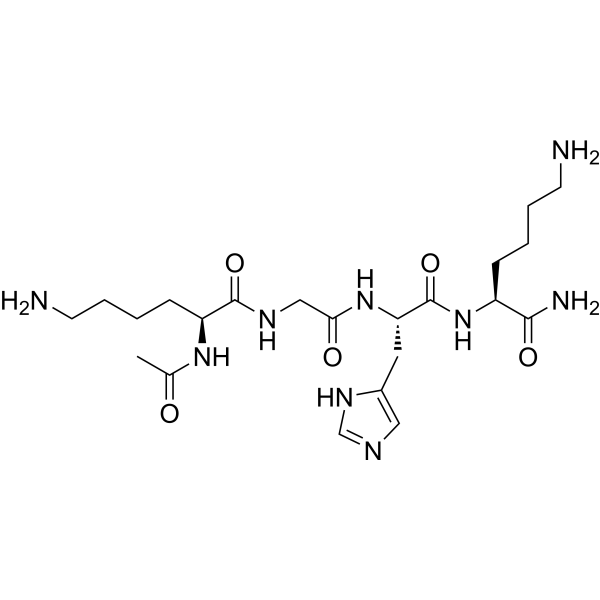
    Acetyl tetrapeptide-3 is a synthetic peptide. Acetyl tetrapeptide-3 enhances the adhesion of hair follicles to the scalp but also promotes the development of new hair follicles. Acetyl tetrapeptide-3 stimulates the synthesis of collagen III in hair follicles. Acetyl tetrapeptide-3 combined with Biochanin A (HY-14595) and ginseng extracts, can stimulate dermal papilla extracellular matrix (ECM) proteins by increasing hydroxyproline, Collagen Type 3, and laminin, yielding a significant improvement in hair follicle size and hair anchoring .
    Acetyl tetrapeptide-3
  • HY-P5243

    AHK-Cu

    Others Bcl-2 Family Others
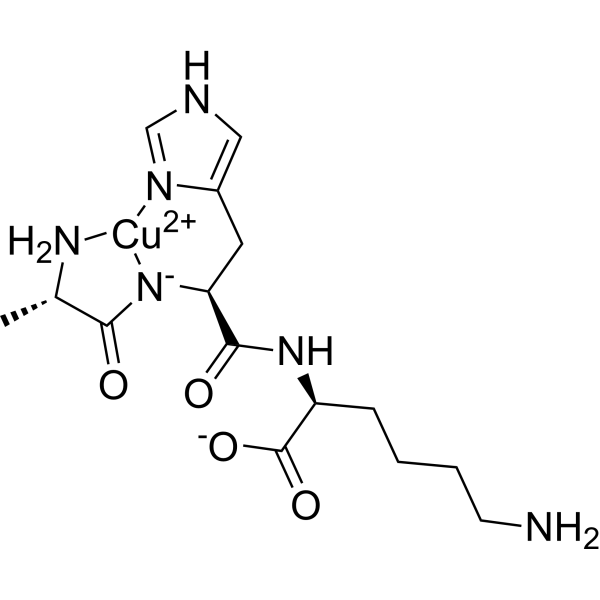
    Copper tripeptide-3 (AHK-Cu) is a bioactive peptide with promotion of hair growth effect. Copper tripeptide-3 increases dermal cell proliferation and viability while increasing the deposition of collagen to renew the extracellular matrix. Copper tripeptide-3 stimulates the elongation of human hair follicles and proliferation of dermal papilla cells .
    Copper tripeptide-3
  • HY-B1820
    Zinc sulphate
    1 Publications Verification

    Environmental Pollutants Biochemical Assay Reagents Glutathione Reductase (GR) Tyrosinase Metabolic Disease Inflammation/Immunology
    Zinc sulphate is an orally active inhibitor of tyrosinase and glutathione reductase. Zinc sulphate enhances the activity of dopachrome tautomerase. Zinc sulphate delays anagen-related eumelanin production, induces hair hypopigmentation in mice, and accelerates wound healing. Zinc sulphate can be used in research related to benign gastric ulcers. Zinc sulphate can be used in research related to rheumatoid arthritis .
    Zinc sulphate
  • HY-P5247

    PTP20

    Melanocortin Receptor Sirtuin Metabolic Disease Inflammation/Immunology
    Palmitoyl tetrapeptide-20 (PTP20) is a biomimetic peptide agonist of α-MSH. Palmitoyl tetrapeptide-20 promotes hair pigmentation and delays hair graying by activating the MC1-R pathway (AC50: 0.16 nM), enhancing catalase activity to reduce H2O2 accumulation, and upregulating SIRT1 activity. Palmitoyl tetrapeptide-20 can be used in research on preventing hair loss and improving hair graying .
    Palmitoyl tetrapeptide-20
  • HY-139783

    Environmental Pollutants Apoptosis Others
    3-Campholenyl-2-butanol, a synthetic sandalwood odorant, is a selective olfactory receptor OR2AT4 agonist. 3-Campholenyl-2-butanol prolongs human hair growth ex vivo by decreasing apoptosis and increasing production of the anagen-prolonging growth factor IGF-1 in the outer root sheath (ORS) .
    3-Campholenyl-2-butanol
  • HY-P5247A

    PTP20 TFA

    Melanocortin Receptor Sirtuin Metabolic Disease Inflammation/Immunology
    Palmitoyl tetrapeptide-20 (PTP20) TFA is a biomimetic peptide agonist of α-MSH. Palmitoyl tetrapeptide-20 TFA promotes hair pigmentation and delays hair graying by activating the MC1-R pathway (AC50: 0.16 nM), enhancing catalase activity to reduce H2O2 accumulation, and upregulating SIRT1 activity. Palmitoyl tetrapeptide-20 TFA can be used in research on preventing hair loss and improving hair graying .
    Palmitoyl tetrapeptide-20 TFA
  • HY-162831

    Mitochondrial Metabolism Others
    MPC-IN-1 (compound 4i) is a cyanocinnamate-based, mitochondrial pyruvate transporter (MPC) inhibitor, and is a derivative of UK-5099 (HY-15475). MPC inhibitors promote the development of hair follicle stem cells without affecting normal cells. MPC-IN-1 promotes cellular lactate production and promotes significant hair growth in mice, and has the potential to be used to inhibit hair loss .
    MPC-IN-1
  • HY-W129441

    N-Ac-4-S-CAP

    DNA/RNA Synthesis Tyrosinase Thymidylate Synthase Others
    N-Acetyl-4-S-mercaptoaminophenol (N-Ac-4-S-CAP) is a compound that is selectively cytotoxic to melanocytes of black mouse hair follicles. It can cause 98% depigmentation of black mouse hair follicles. N-Ac-4-S-CAP can produce visible changes in hair follicle melanocytes 4 hours after intraperitoneal injection, including aggregation of melanin granules and nuclear condensation. Electron microscopy observations showed that it caused progressive destruction of melanocytes, including swelling of membranous organelles, nuclear condensation, and cytoplasmic vacuolation, ultimately leading to complete cell necrosis. N-Ac-4-S-CAP has a specific cytotoxic effect on melanocytes that actively produce eumelanin, but may not affect precursor or dormant melanocytes. These properties suggest that N-Ac-4-S-CAP may have potential application value in the treatment of melanoma or skin whitening.
    N-Acetyl-4-S-cysteaminylphenol
  • HY-106174

    CS 891

    5 alpha Reductase Endocrinology
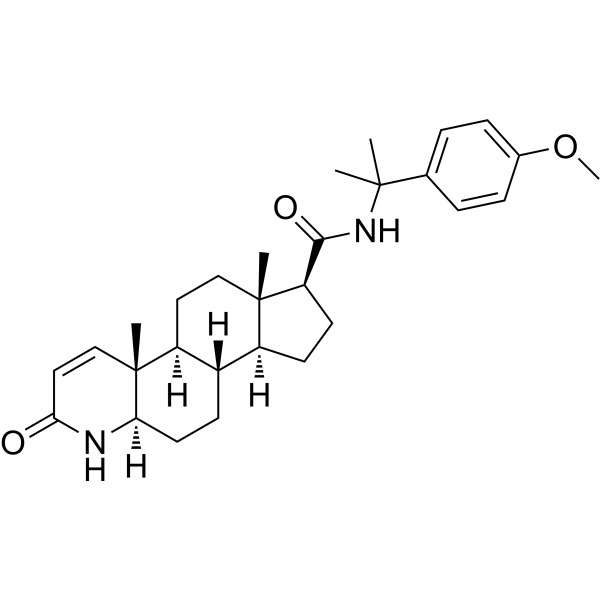
    Lapisteride (CS 891) is an orally active 5α-reductase inhibitor. Lapisteride can inhibit 5α-reductaseactivity in the hair follicles (HF). Lapisteride can be used in prostatic hyperplasia and androgenic alopecia research .
    Lapisteride
  • HY-170448

    PROTACs Androgen Receptor Endocrinology
    PROTAC AR Degrader-9 (Compound c6) is a PROTAC degrader for androgen receptor, that degrades AR in human hair follicle papilla cells (HDPCs) with a DC50 of 262.38 nM. PROTAC AR Degrader-9 promotes the expressions of paracrine factors, such as TGF-β1 and β-catenin, exhibits hair regenerating efficacy in mouse models . (Pink: ligand for target protein AR ligand-38 (HY-170450); Black: linker; Blue: ligand for E3 ligase Cereblon (HY-170449))
    PROTAC AR Degrader-9
  • HY-170449

    Ligands for E3 Ligase Others
    E3 ligase Ligand 48 is a CRBN ligand for PROTAC AR Degrader-9 (HY-170448). PROTAC AR Degrader-9 (Compound c6) is a PROTAC degrader for androgen receptor, that degrades AR in human hair follicle papilla cells (HDPCs) with a DC50 of 262.38 nM .
    E3 ligase Ligand 48
  • HY-174782

    mRNA Inflammation/Immunology
    Human ACVR2B mRNA encodes the human activin A receptor type 2B (ACVR2B) protein, a receptor that transduces the activin signal from the cell surface to the cytoplasm and is thus regulating many physiological and pathological processes including neuronal differentiation and neuronal survival, hair follicle development and cycling, FSH production by the pituitary gland, wound healing, extracellular matrix production, immunosuppression and carcinogenesis.
    Human ACVR2B mRNA
  • HY-167655

    Androgen Receptor Others
    KF-19418 is a hair follicle stimulator with hair growth promoting activity. KF-19418 stimulates proliferation of cultured hair bulb cells from newborn mice. KF-19418 accelerates hair regrowth in hair-clipped mouse alopecia model following topical application. KF-19418 can be used for the research of alopecia .
    KF-19418
  • HY-181560

    Wnt β-catenin Metabolic Disease
    SLD1121 is an agonist of the Wnt/β-catenin signaling pathway that enhances Wnt signaling by targeting LRP6 (Kd: 4.52-7.49 nM). SLD1121 interacts with the intracellular domain of LRP6, stabilizes LRP6, promotes its nuclear translocation, and facilitates its binding to β-catenin, TCF4 or LEF1 in the nucleus, thereby inducing the expression of Wnt-regulated genes and stem cell-related genes. SLD1121 induces the transition of hair follicles from telogen to anagen in the mouse hair growth cycle and promotes hair growth in mice. SLD1121 is applicable to hair loss-related research .
    SLD1121

Online-Anfrage

Your information is safe with us. * Required Fields.

Anrede


Country or Region *

Name des Antragstellers *


Name der Organisation *

Department *


E-Mail-Addresse *


Produktname *

Art. -Nr.


Requested quantity *

Telefonnummer *


Bemerkungen

Online-Anfrage

Inquiry Information

Produktname:
Art. -Nr.:
Menge:
MCE Japan Authorized Agent:

