10 Results for "

human intestinal absorption

" in MedChemExpress (MCE) Product Catalog:
Products (10)

10 Results for "human intestinal absorption" in MCE Product Catalog:

1
1 Cited Publications
Cat. No.: HY-112144
CAS No.: 1558021-37-6
Purity:  99.25%
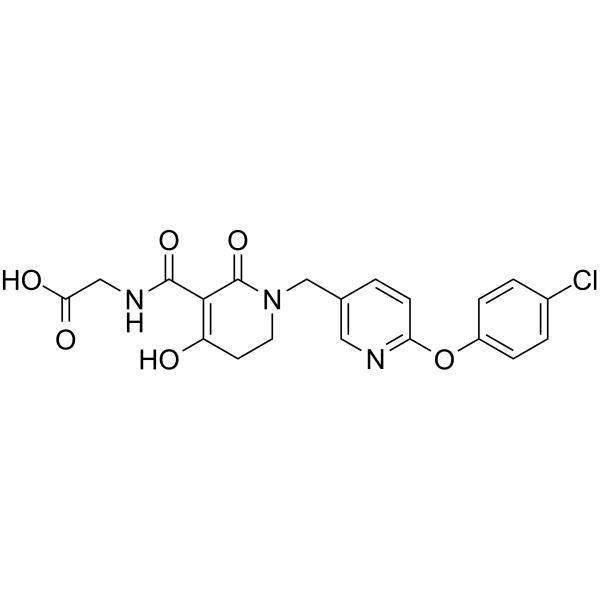
TP0463518 is an orally active, competitive pan-inhibitor of hypoxia-inducible factor prolyl hydroxylases PHD1/2/3. TP0463518 competitively inhibits human PHD1 (IC50=18 nM), PHD2 (Ki=5.3 nM), and PHD3 (IC50=63 nM), and targets monkey PHD2 with an IC50 of 22 nM. TP0463518 inhibits PHD-catalyzed hydroxylation to stabilize HIFα, thereby upregulating erythropoietin (EPO) expression and enhancing intestinal iron absorption (such as increased DMT-1 and dCYTb expression), improving anemia. TP0463518 is mainly used for the research of renal anemia and inflammatory anemia .
loading...
    loading...
Cat. No.: HY-N15135
CAS No.: 9040-27-1
Arabinoxylan Medium viscosity is an orally active Dectin-1 splice variant modulator, glucose absorption inhibitor, and chyme viscosity enhancer. Arabinoxylan Medium viscosity inhibits particulate β-glucan-induced Dectin-1A activation and mildly suppresses Dectin-1B activation. In human dendritic cells stimulated with particulate β-glucan, Arabinoxylan Medium viscosity reduces the production of IL-10 and TNF-α, and increases the production of IL-4 and IL-23. Arabinoxylan Medium viscosity also supports antifungal immune responses without activating TLR2, TLR4 or TLR5, and does not induce cytokine production when used to stimulate human dendritic cells alone. Arabinoxylan Medium viscosity increases small intestinal chyme viscosity, gets degraded in the large intestine to produce short-chain fatty acids, reduces glucose absorption and insulin response, and improves glucose homeostasis. Arabinoxylan Medium viscosity supports microbial fermentation and the growth of beneficial microbiota in the gastrointestinal tract, prevents bile acid reabsorption, and delays starch digestion. Arabinoxylan Medium viscosity can be used in research related to type 2 diabetes, impaired glucose tolerance, and metabolic syndrome .
loading...
    loading...
Cat. No.: HY-N0469R
CAS No.: 56-87-1
L-Lysine (Standard) is the analytical standard of L-Lysine. This product is intended for research and analytical applications. L-lysine is an essential amino acid for humans with orally activity. L-lysine can inhibit the occurrence of HSV infections and is used in herpes research. L-lysine increases calcium absorption, reduces diabetes-related diseases, improves gut health, and alleviates pancreatic inflammation. L-lysine can be used in research on metabolism, infection, and inflammation . IC50 & Target:L-lysine (150 mg/kg) promotes, but not initiates, bladder cancer. The administration of L-lysine to rats submitted to colovesical cystoplasty accelerates the development of transitional metaplasia of the intestinal epithelium .
L-lysine (10 mg/kg) treatment attenuates pancreatic tissue injury induced by L-arginine by inhibiting the release of the inflammatory cytokine IL-6 and enhance antioxidant activity . In Vivo:L-lysine (10?mg/kg, p.o., pre-treated or post-treated, administration duration 15 days) treatment attenuates pancreatic tissue injury induced by L-arginine by inhibiting the release of the inflammatory cytokine IL-6 and enhance antioxidant activity in acute pancreatitis mice model . L-lysine (5 or 10?mg/kg, p.o., 45 days) ameliorates sepsis-induced acute lung injury in a lipopolysaccharide (HY-D1056)-induced mouse model .
loading...
    loading...
Cat. No.: HY-101122
CAS No.: 1610954-97-6
Target:  

SGLT GLP Receptor

Research Areas:  

Metabolic Disease

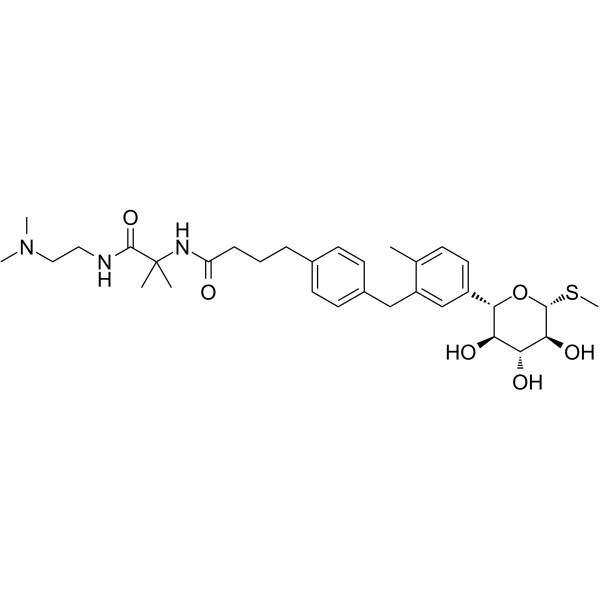
LX2761 is an orally active, dual SGLT1/SGLT2 inhibitor with IC50 values of 2.2 nM and 2.7 nM against human SGLT1 and SGLT2, respectively. LX2761 locks human SGLT1 in an outward-open conformation and blocks its putative water permeation pathway. After oral administration, LX2761 is confined exclusively to the intestinal lumen, delays intestinal glucose absorption, regulates intestinal glucose metabolism, increases cecal glucose levels, reduces cecal pH, improves glycemic control and elevates plasma total GLP-1 levels. However, LX2761 induces diarrhea in a dose-dependent manner. LX2761 can be used in diabetes-related research .
loading...
    loading...
Cat. No.: HY-174542
Target:  

mRNA

Research Areas:  

Cancer

Human PRKCB mRNA encodes the human protein kinase C beta (PRKCB) protein, a member of Protein kinase C (PKC) family. PRKCB has been reported to be involved in many different cellular functions, such as B cell activation, apoptosis induction, endothelial cell proliferation, and intestinal sugar absorption.
loading...
    loading...
Cat. No.: HY-121624
CAS No.: 69168-09-8
Anthglutin is a gamma-glutamyltransferase inhibitor isolated from Penicillium oxalicum cultures. The Ki values of Anthglutin for different enzymes are: porcine kidney enzyme 5.7 μM, human kidney enzyme 18.3 μM, human liver soluble enzyme 13.6 μM, and conjugated enzyme 10.2 μM. Anthglutin had no significant effect on intestinal absorption of methionine in rats .
loading...
    loading...
Cat. No.: HY-W269270
CAS No.: 742-01-8
1,3,5-Triphenyl-2-pyrazoline (Compound 12) is a pyrazoline derivative. 1,3,5-Triphenyl-2-pyrazoline exhibits weak cytotoxicity against K562 and Jurkat cells, with an IC50 of greater than 300 μM and 297.7 μM, respectively. 1,3,5-Triphenyl-2-pyrazoline has a predicted human intestinal absorption rate of 100% .
loading...
    loading...
Cat. No.: HY-N20703
CAS No.: 163527-00-2
Resveratrol 12-C-β-glucopyranoside is a stilbene-type natural secondary metabolite. Resveratrol 12-C-β-glucopyranoside has the potential to target TNF-α, TGF-β1, and PPAR-α. As one of the core active components of MESR, Resveratrol 12-C-β-glucopyranoside exerts hepatoprotective, anti-inflammatory, and antioxidant effects in a rat liver injury model induced by Isoniazid (HY-B0329). Resveratrol 12-C-β-glucopyranoside can be used for studies related to drug-induced liver injury .
loading...
    loading...
Cat. No.: HY-187377
Target:  

Glycosidase

α-Glucosidase-IN-121 is a yeast α-glucosidase inhibitor with an IC50 of 3.8 μM and a Ki of 12.9 μM. α-Glucosidase-IN-121 binds to the active site of the enzyme, competes with substrate binding, and forms stable interactions with Phe137, Ser308, Pro309, Arg312 and Glu350 via hydrogen bonding, π-π stacking and hydrophobic interactions. α-Glucosidase-IN-121 can be used in the research of diabetes .
loading...
    loading...
Cat. No.: HY-159978
CAS No.: 1628848-73-6
EOS789 is an orally active sodium-dependent phosphate transporter inhibitor, with IC50 values of 6.8, 1.5, and 1.7 μM against human NaPi-IIb, PiT-1, PiT-2, respectively; and IC50 values of 3.9, 1.9, and 1.7 μM against rat NaPi-IIb, PiT-1, PiT-2, respectively. EOS789 inhibits intestinal phosphate absorption, increases fecal phosphate excretion, reduces urinary phosphate excretion, and decreases the levels of serum phosphate, FGF23, and adult parathyroid hormone. EOS789 ameliorates ectopic thoracic aortic calcification, renal injury and hyperphosphatemia, and inhibits the expression of fibrosis markers. EOS789 can be used for the research of hyperphosphatemia and chronic kidney disease-mineral and bone disorder (CKD-MBD) .
loading...
    loading...

