12 Results for "

imidazole groups

" in MedChemExpress (MCE) Product Catalog:
Products (12)

12 Results for "imidazole groups" in MCE Product Catalog:

109
109 Cited Publications
Cat. No.: HY-66019
CAS No.: 3326-32-7
Synonyms: Fluorescein 5-isothiocyanate
Target:  

Fluorescent Dye

Research Areas:  

Others

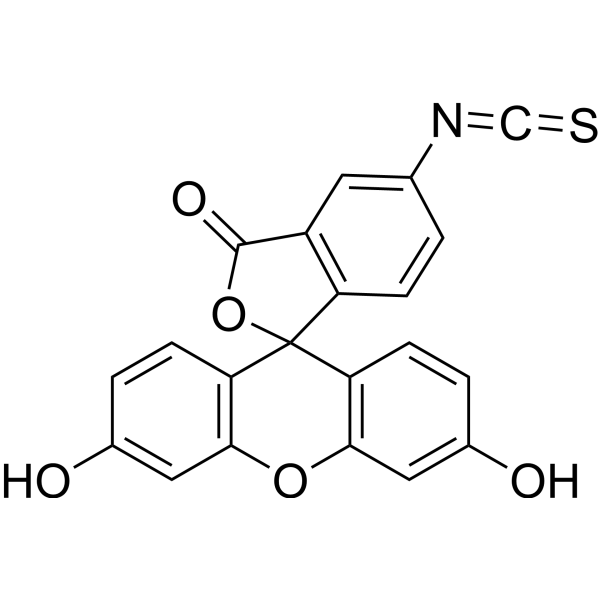
FITC (Fluorescein Isothiocyanate), is one of the green fluorescein derivatives widely used in biology. FITC has the characteristics of high absorptivity and excellent fluorescence quantum yield. The isothiocyanate group of FITC can be combined with amino, sulfhydryl, imidazole, tyrosyl, carbonyl and other groups on the protein, so as to achieve protein labeling including antibodies and lectins. In addition to its use as a protein marker, FITC can also be used as a fluorescent protein tracer to rapidly identify pathogens by labeling antibodies, or for microsequencing of proteins and peptides (HPLC). The maximum excitation wavelength of FITC is 494 nm. Once excited, it fluoresces yellow-green at a maximum emission wavelength of 520 nm. In addition, FITC is also a hapten that can induce contact hypersensitivity (CHS) and induce an atopic dermatitis model .
loading...
    loading...
2
2 Cited Publications
Cat. No.: HY-15941
CAS No.: 27072-45-3
Synonyms: Fluorescein 5(6)-isothiocyanate; Fluorescein isothiocyanate 5- and 6- isomers
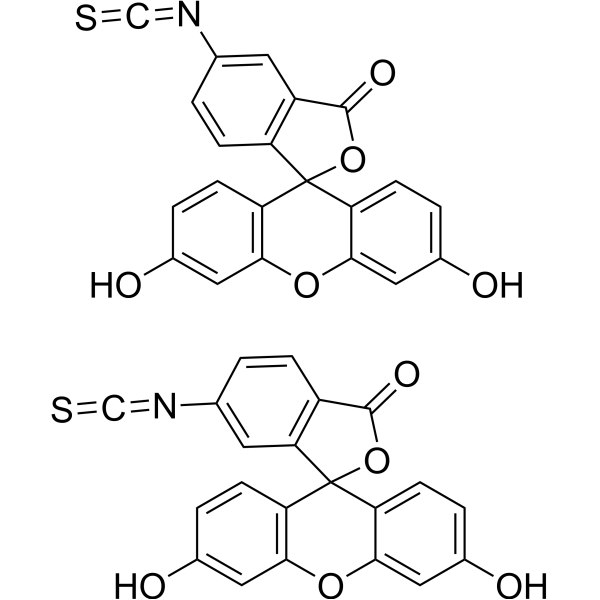
5(6)-FITC (Fluorescein 5(6)-isothiocyanate) is an amine-reactive derivative of a fluorescent dye, characterized by high absorbance and excellent fluorescence quantum yield. The isothiocyanate group of FITC can react with various functional groups on proteins, including amines, thiols, imidazoles, tyrosines and carbonyls, enabling the labeling of proteins such as antibodies and lectins. 5(6)-FITC has a wide range of applications, including flow cytometry, immunofluorescence, protease assays and conjugation. The maximum excitation/emission wavelengths are 492/518 nm .
loading...
    loading...
Cat. No.: HY-DY1007
CAS No.: 3326-32-7
Target:  

Fluorescent Dye

Research Areas:  

Inflammation/Immunology

FITC (Fluorescein Isothiocyanate) (solution) , is one of the green fluorescein derivatives widely used in biology. FITC has the characteristics of high absorptivity and excellent fluorescence quantum yield. The isothiocyanate group of FITC can be combined with amino, sulfhydryl, imidazole, tyrosyl, carbonyl and other groups on the protein, so as to achieve protein labeling including antibodies and lectins. In addition to its use as a protein marker, FITC can also be used as a fluorescent protein tracer to rapidly identify pathogens by labeling antibodies, or for microsequencing of proteins and peptides (HPLC). The maximum excitation wavelength of FITC is 494 nm. Once excited, it fluoresces yellow-green at a maximum emission wavelength of 520 nm. In addition, FITC is also a hapten that can induce contact hypersensitivity (CHS) and induce an atopic dermatitis model .
Solvent and concentration: DMSO: 20 mM
The 1 mL volume is defined as the base specification. All larger sizes correspond to incremental volumes of this base.
loading...
    loading...
Cat. No.: HY-W998680
CAS No.: 2228857-33-6
Synonyms: 5-FITC-Maleimide
Fluorescein-maleimide (5-FITC-Maleimide) is a thiol-reactive fluorescent derivatization reagent and non-specific protein labeling reagent. Fluorescein-maleimide covalently binds to protein thiol groups for protein labeling. Fluorescein-maleimide covalently binds to protein amino and imidazole groups under neutral pH conditions. Fluorescein-maleimide is used for fluorescent labeling of proteins, nucleic acids or other molecules containing one or more thiol groups (Ex/Em = 494/519 nm) .
loading...
    loading...
Cat. No.: HY-W007695
CAS No.: 1072-84-0
Synonyms: 4-imidazolecarboxylic acid
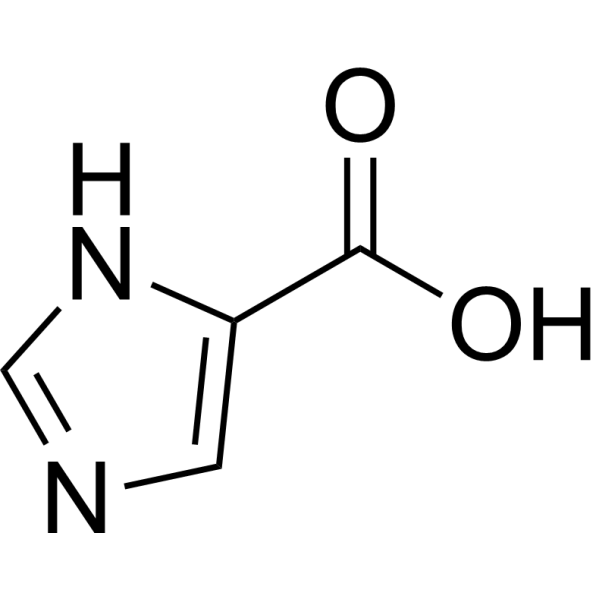
1H-Imidazole-4-carboxylic acid (4-Imidazolecarboxylic acid) is an organic compound containing an imidazole ring and a carboxyl group. 1H-Imidazole-4-carboxylic acid stabilizes specific forms of metal ions through coordination, thus influencing the progress of chemical reactions. 1H-Imidazole-4-carboxylic acid plays an important role in the hydrolysis of phosphate esters catalyzed by lanthanide metals. 1H-Imidazole-4-carboxylic acid can be used to modify dendrimers, changing the surface properties and catalytic performance of materials .
loading...
    loading...
Cat. No.: HY-W111226
CAS No.: 252049-16-4
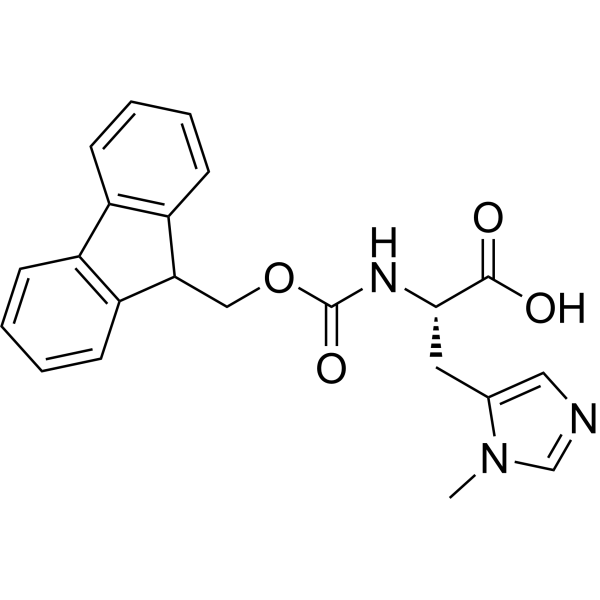
Fmoc-His (3-Me)-OH is a histidine derivative with a methylated imidazole group. Fmoc-His (3-Me)-OH can be used for the synthesis of the chemically modified tripeptide His (3-methyl)-Arg-Trp (H (3-Me)-RW). Fmoc-His (3-Me)-OH serves as a resin in Fmoc solid-phase synthesis for the generation of the His-(3-Me)-Gly-Lys peptide. Fmoc-His (3-Me)-OH is a building block for the synthesis of NAHIS02-(p-Met). Fmoc-His (3-Me)-OH can be applied in research related to Alzheimer's disease .
loading...
    loading...
Cat. No.: HY-D0181
CAS No.: 2466-76-4
Research Areas:  

Others

1-Acetylimidazole is an acetylation agent and an important intermediate for the synthesis of various bioactive molecules. 1-Acetylimidazole can be used to close the residual α-amino group remaining after coupling and to synthesize cyclic imidazole derivatives .
loading...
    loading...
Cat. No.: HY-107562A
CAS No.: 544707-19-9
Target:  

Histamine Receptor

Research Areas:  

Neurological Disease

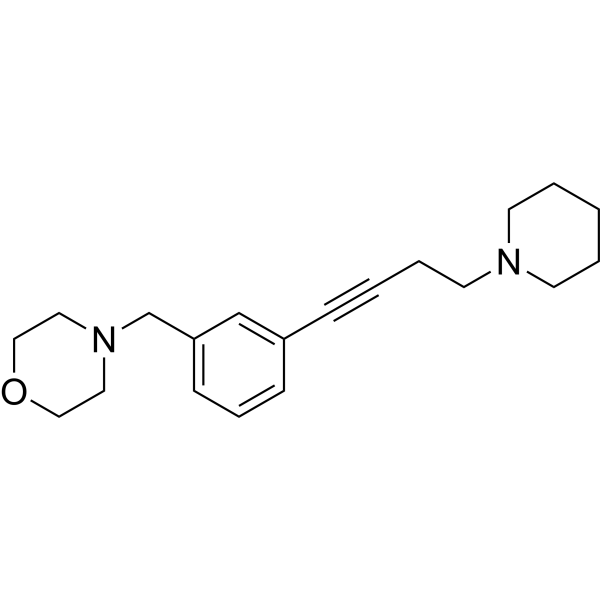
JNJ-10181457 is a selective non-imidazole histamine H3 receptor antagonist that normalizes acetylcholine neurotransmission . JNJ-10181457 is a click chemistry reagent, it contains an Alkyne group and can undergo copper-catalyzed azide-alkyne cycloaddition (CuAAc) with molecules containing Azide groups.
loading...
    loading...
Cat. No.: HY-155710
CAS No.: 2925307-53-3
Target:  

Fungal

Research Areas:  

Infection

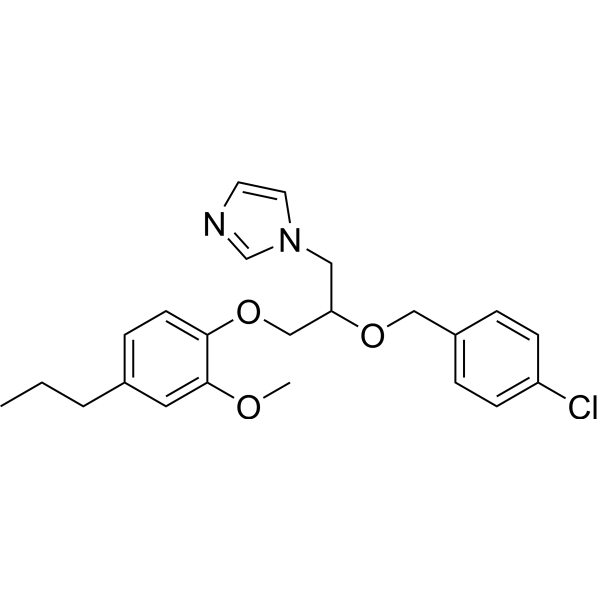
Antifungal agent 68 (compound 10) is an antifungal agent against Candida and Cryptococcus gattii. Antifungal agent 68 inhibits fungal ergosterol biosynthesis, possibly by targeting lanosterol 14α-demethylase (CYP51). There is an interaction between the imidazole ring of antifungal agent 68 and the heme group of CYP51 .
loading...
    loading...
Cat. No.: HY-118185
CAS No.: 115766-42-2
Target:  

Renin

Research Areas:  

Others

SQ 31844 is a novel renin inhibitor belonging to the imidazolidinol class. This compound, which contains an imidazole ring in its active site binding group, has potent in vitro inhibition of primate renin, but not rat, pig, or dog renin. In conscious, sodium-deprived cynomolgus monkeys, both compounds produced dose-related inhibition of plasma renin activity (PRA) over a dose range of 0.001 to 1.0 μmol/kg, administered intravenously, with complete inhibition observed at the highest dose. However, a reduction in blood pressure was only observed when 10 μmol/kg was administered intravenously or by infusion. In sodium-replete monkeys, SQ 30774 inhibited the increase in arterial blood pressure and PRA following administration of exogenous monkey renin. When the compounds were administered orally at 50 μmol/kg, only SQ 31844 significantly inhibited PRA (80%). In summary, the imidazolidinol renin inhibitors have potent inhibitory effects on renin in vitro and inhibit PRA and reduce arterial blood pressure in vivo.
loading...
    loading...
Cat. No.: HY-D3067
Target:  

Fluorescent Dye

Research Areas:  

Metabolic Disease Cancer

ASSI-Leu is a novel AIE fluorescent probe based on an asymmetric tetraaryl imidazole skeleton, which can be used for ratiometric imaging detection of endogenous leucine aminopeptidase. ASSI-Leu contains an L-leucine-based recognition group that blocks the excited-state intramolecular proton transfer (ESIPT) in its 2-(2'-hydroxyphenyl) benzothiazole (HBT) skeleton, thereby generating an enol-form emission signal at Ex/Em = 365/417 nm. ASSI-Leu undergoes cleavage of the L-leucine group mediated by LAP to form ASSI-OH, which further activates aggregation-induced emission (AIE) and ESIPT, generating a keto-form emission signal at Ex/Em = 365/554 nm and producing a ratiometric fluorescent signal. ASSI-Leu enables real-time tracking of LAP in cancer cells and zebrafish models .\n
loading...
    loading...
Cat. No.: HY-189129
Target:  

Ras

Research Areas:  

Cancer

RAS GTPase-IN-3 is a RAS GTPase inhibitor that targets multiple KRAS-Q61 mutant variants. RAS GTPase-IN-3 binds to the switch II pocket of GTP-bound KRAS-Q61R, positions its side-chain imidazole group near the GTP γ-phosphate, and accelerates GTP hydrolysis of KRAS-Q61. RAS GTPase-IN-3 inhibits Sos-catalyzed nucleotide exchange on GTP-bound KRAS. RAS GTPase-IN-3 only activates GTP hydrolysis of HRAS-Q61R/Q95H and NRAS-Q61R/L95H mutant proteins. RAS GTPase-IN-3 can be applied in research related to cancers driven by KRAS-Q61 mutations .
loading...
    loading...
  • 1

