6 Results for "

intestinal spasm

" in MedChemExpress (MCE) Product Catalog:
Products (6)

6 Results for "intestinal spasm" in MCE Product Catalog:

1
1 Cited Publications
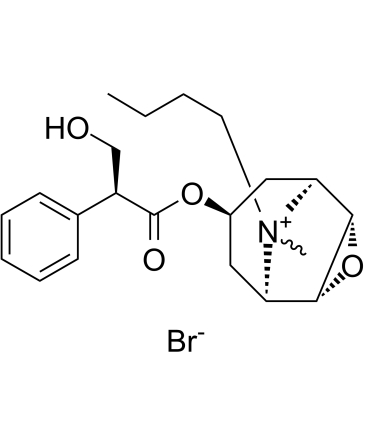
Cat. No.: HY-N0340
CAS No.: 149-64-4
Synonyms: Hyoscine butylbromide; (-)-Scopolamine butylbromide; Butylscopolamine bromide
Scopolamine butylbromide (Hyoscine butylbromide) is an orally active anticholinergic agent and spasmolytic. Scopolamine butylbromide binds with high affinity to rat cardiac M2 (Ki 83 nmol/L), hM2 (Ki 233 nmol/L), rat intestinal M3 (Ki 290 nmol/L) and hM3 (Ki 643 nmol/L) muscarinic receptors. Scopolamine butylbromide exerts a dose-dependent antagonistic effect on Carbachol-induced gastrointestinal smooth muscle spasm. Scopolamine butylbromide can be used for the research of abdominal colic and pain associated with gastrointestinal spasm, functional abdominal pain, chronic gastropathy and gastric ulcer .
loading...
    loading...
Cat. No.: HY-N15736
CAS No.: 26989-18-4
Petiline is a steroidal alkaloid found in Petilium raddeanum, acting as a selective antagonist of M cholinergic receptors. Petiline exerts anticholinergic effects (e.g., reducing vagal influence on the heart) by competitively blocking M cholinergic receptors, and also has central excitatory, cardiotonic, and spasmolytic activities. Petiline is promising for research of cholinergic system-related diseases (e.g., arrhythmia, intestinal spasm) .
loading...
    loading...
Cat. No.: HY-N0340R
CAS No.: 149-64-4
Synonyms: Hyoscine butylbromide (Standard); (-)-Scopolamine butylbromide (Standard); Butylscopolamine bromide (Standard)
Scopolamine butylbromide (Standard) is the analytical standard of Scopolamine butylbromide (HY-N0340). This product is intended for research and analytical applications. Scopolamine butylbromide (Hyoscine butylbromide) is an orally active anticholinergic agent and spasmolytic. Scopolamine butylbromide binds with high affinity to rat cardiac M2 (Ki 83 nmol/L), hM2 (Ki 233 nmol/L), rat intestinal M3 (Ki 290 nmol/L) and hM3 (Ki 643 nmol/L) muscarinic receptors. Scopolamine butylbromide exerts a dose-dependent antagonistic effect on Carbachol-induced gastrointestinal smooth muscle spasm. Scopolamine butylbromide can be used for the research of abdominal colic and pain associated with gastrointestinal spasm, functional abdominal pain, chronic gastropathy and gastric ulcer .
loading...
    loading...
Cat. No.: HY-W277805
CAS No.: 549-68-8
Octaverine is a synthetic isoquinoline alkaloid with oral activity and adrenergic lytic activity. Octaverine antagonizes the pressor effect of adrenaline, elevates the toxicity threshold of adrenaline, and reduces blood pressure. Octaverine increases respiratory depth, respiratory frequency, ventilation rate, and coronary blood flow. Octaverine inhibits spontaneous uterine contractions, antagonizes induced intestinal spasms, alleviates histamine-induced bronchospasm, and exhibits favorable biosafety. Octaverine can be used in research related to intestinal spasms and bronchospasm .
loading...
    loading...
Cat. No.: HY-183540
CAS No.: 57558-44-8
Target:  

mAChR

Secoverine is a muscarinic cholinergic receptor (mAChR) antagonist and antispasmodic with blood-brain barrier permeability. Secoverine binds competitively to muscarinic receptors, blocks central cholinergic effects, and inhibits cholinergically induced gastrointestinal motility, intestinal smooth muscle contraction, and acetylcholine-mediated neurotransmitter release. Secoverine exerts direct antispasmodic activity on intestinal smooth muscle independent of receptor blockade, and exhibits characteristics such as reversible smooth muscle activity and long duration of action. Secoverine can be used in studies related to hyperintestinal motility, diverticular disease, and colonic spasm .
loading...
    loading...
Cat. No.: HY-181755
CAS No.: 109621-29-6
Target:  

NO Synthase

Research Areas:  

Inflammation/Immunology

Phenylaminojuglone AJ-2 is a nitric oxide synthase inhibitor that interacts with soluble guanylate cyclase, β-adrenergic receptor, CaV1.2 calcium channel, KV channel and KCa channel. Phenylaminojuglone AJ-2 blocks extracellular Ca 2+ influx, regulates the activity of the NO?sGC?cGMP signaling pathway, and inhibits pharmacologic and electromechanical contractions of smooth muscle. Phenylaminojuglone AJ-2 is applicable to studies related to intestinal spasm .
loading...
    loading...

