

1. Search Result
Search Result
Results for "

intracellular Cu2 imaging

" in MedChemExpress (MCE) Product Catalog:

2599

Inhibitors & Agonists

14

Screening Libraries

672

Fluorescent Dyes

124

Biochemical Assay Reagents

239

Peptides

11

MCE Kits

28

Inhibitory Antibodies

207

Natural
Products

12

Recombinant Proteins

69

Isotope-Labeled Compounds

20

Antibodies

65

Click Chemistry

69

Oligonucleotides

6

GMP Molecules

Cat. No. Product Name Target Research Areas Chemical Structure
  • HY-111653
    CycLuc1
    2 Publications Verification

    Reactive Oxygen Species (ROS) Others
    CycLuc1 is a blood-brain barrier permeable luciferase substrate that displays near-infrared (NIR) emission with a peak luminescence wavelength of 599 nm. CycLuc1 can be used for in vivo bioluminescence imaging [2].
    CycLuc1
  • HY-143589

    JAB-21822; KRAS G12C inhibitor 36

    Ras Cancer
    Glecirasib (Compound 1-2; JAB-21822) is an orally active and potent inhibitor of KRAS G12C. The Ras family of proteins is an important intracellular signaling molecule that plays an important role in growth and development. Glecirasib has the potential for the research of KRAS G12C-mediated cancer [2] .
    Glecirasib
  • HY-D1389
    Sulfo-CY-5.5 NHS ester tripotassium
    1 Publications Verification

    Sulfo-Cyanine5.5 NHS ester tripotassium

    Fluorescent Dye Others
    Sulfo-CY-5.5 NHS ester (Sulfo-Cyanine5.5 NHS ester) tripotassium is an amine-reactive ester of sulfonated far-red Cyanine5.5 fluorophore, which can be used to label antibodies, proteins, etc., as well as for in vivo NIR imaging .
    Sulfo-CY-5.5 NHS ester tripotassium
  • HY-133852
    FD-1080
    1 Publications Verification

    Fluorescent Dye MOFs Others
    FD-1080 is a fluorophore with both excitation and emission in the NIR-II region (Ex=1064 nm, Em=1080 nm). FD-1080 can be used for in vivo imaging .
    FD-1080
  • HY-N7135

    Tyrosinase Fungal Metabolic Disease Inflammation/Immunology Cancer
    Tropolone is a seven-membered non-benzenoid aromatic compound, which is the precursor of many Azulene derivatives. Tropolone is a potent mushroom tyrosinase inhibitor with an IC50 value of 0.4 μM. Its inhibitory effect can be achieved by dialysis or excess CU2+ Reversa. Tropolone exhibits broad anti-viral and anti-fungal activity and is synergistic upon co-treatment with nucleos(t)ide analog drugs. Tropolone is a promising candidate for research in osteosarcoma [2] .
    Tropolone
  • HY-W039315

    Biochemical Assay Reagents Metabolic Disease
    2,5-Anhydro-D-mannitol, 97% is an antimetabolic fructose analogue. 2,5-Anhydro-D-mannitol, 97% depletes intracellular ATP, reduces oxygen consumption, regulates substrate oxidation, increases phosphomonoester levels, decreases inorganic phosphate levels, and promotes the release of intracellular calcium from intracellular calcium stores via phospholipase C-dependent activity in hepatocytes [2] .
    2,5-Anhydro-D-mannitol, 97%
  • HY-D1569

    Fluorescent Dye Others
    CellTracker Orange CMRA Dye is a fluorescent dye. CellTracker Orange CMRA Dye can be used for cell imaging and monitoring the movement and location of cells .
    CellTracker Orange CMRA Dye (5/6-mixture)
  • HY-47176

    Fluorescent Dye Others
    QTZ is a bioluminescence agent for in vivo imaging. QTZ has red-shifted emission and yields very little background. QTZ is a coelenterazine analog with the 4-quinolinyl substitution at the C8 position of the imidazopyrazinone core .
    QTZ
  • HY-D1353

    Fluorescent Dye Others
    LipidGreen 2 is a second generation small molecule probe for lipid imaging. LipidGreen 2 has a better fluorescence signal compared with the previous LipidGreen, and selectively stains neutral lipids in cells and fat deposits in live zebrafish .
    LipidGreen 2
  • HY-D1719
    Cypate
    1 Publications Verification

    Fluorescent Dye Others
    Cypate, a cyanine dye, is a near infrared (NIR) fluorescent probe for in vivo tumor imaging [2].
    Cypate
  • HY-149931

    Fluorescent Dye Cancer
    BMV109 is a quenched probe that becomes fluorescent when cleaved and covalently bound by active cathepsin proteases. BMV109 can be exploited for tumor imaging [2].
    BMV109
  • HY-D1707

    Fluorescent Dye Others
    FDGlcU can be used as a fluorescent probe for non-invasively image with a high level of fluorescent activity. FDGlcU is non-fluorescent when the fluorescein is conjugated with two mono-glucuronides (Ex/Em=480/514 nm) .
    FDGlcU
  • HY-W539893

    NODAG

    Biochemical Assay Reagents Cancer
    NODAGA-tris(t-Bu ester) (NODAG) is a NODAGA derivative. NODAGA-tris(t-Bu ester) can be used to label peptides, antibodies, etc., and subsequently radiolabeled for PET imaging .
    NODAGA-tris(t-Bu ester)
  • HY-D1252
    Fast-TRFS
    2 Publications Verification

    Fluorescent Dye Others
    Fast-TRFS is a selective and superfast fluorogenic probe of thioredoxin reductase (TrxR). Fast-TRFS can be used for imaging TrxR activity in live cells .
    Fast-TRFS
  • HY-P10292

    Radionuclide-Drug Conjugates (RDCs) Interleukin Related Cancer
    NOTA-Pep-1L specifically targets the IL13RA2 receptor for tumor imaging . NOTA-Pep-1L can be used for the synthesis/research of Radionuclide-Drug Conjugates (RDCs).
    NOTA-Pep-1L
  • HY-P11057

    Fluorescent Dye Others
    FGGH is a water-soluble peptide-based probe. FGGH performs the sequential detection of Cu 2+ and S 2- by fluorescence and colorimetry with high sensitivity (LOD: 1.42 and 22.2 nM for Cu 2+ and S 2-, respectively) (Ex=488 nm, Em=525 nm), and images both two ions in living cells and zebrafish models with low cytotoxicity. FGGH can be used for in vivo imaging and environmental pollution monitoring research .
    FGGH
  • HY-D0110A

    Fluorescent Dye Others
    Fura-2 pentapotassium is a cell-impermeable scaled fluorescent dye that can be used for intracellular calcium imaging. Fura-2 pentapotassium has an emission wavelength of 510 nm and excitation wavelengths of 340 nm or 380 nm and the ratio of 340/380 fluorescence intensity is proportional to the intracellular Ca 2+ level [2].
    Fura-2 pentapotassium
  • HY-159770A

    Radionuclide-Drug Conjugates (RDCs) Cancer
    (S)-EB-FAPI-B2 (Compound II-11) is a precursor for radiopharmaceutical labeling, which can be combined with radionuclides to create radionuclide drug conjugates (RDCs). RDCs have the capability to specifically target biomolecules and can be used in medical imaging [2].
    (S)-EB-FAPI-B2
  • HY-128536

    Fluorescent Dye Others
    KMG-104AM is a Mg 2+ fluorescent probe. KMG-104AM is a membrane-permeable ester-modified derivative of KMG-104, which serves as a reporter and imaging agent. KMG-104AM can track the increase in intracellular free magnesium ion concentration induced by mitochondrial uncoupling. KMG-104AM enables visualization of the three-dimensional distribution of intracellular magnesium ion concentration. KMG-104AM is applicable to research related to the functions of intracellular magnesium ions .
    KMG-104AM
  • HY-159045

    p-Fluoro-SAHA

    HDAC Cancer
    F-SAHA is a HDAC inhibitor (HDACi) and its 18F labeled derivative can be used in tumor imaging research .
    F-SAHA
  • HY-177459

    FAP Cancer
    DOTA-2P(FAPI)2 is a dimeric FAP (fibroblast activation protein) that can be used as a PET imaging agent and a tracer for tumor therapy .
    DOTA-2P(FAPI)2
  • HY-139407

    3-Dodecanoyl-NBD-cholesterol

    Fluorescent Dye Others
    3-C12-NBD-cholesterol is a fluorescent cholesterol analog that can be used for measuring membrane and intracellular trafficking dynamics .
    3-C12-NBD-cholesterol
  • HY-D1072

    3,3′-Dipentyloxacarbocyanine iodide

    Fluorescent Dye Others
    DiOC5(3) is the membrane potential (MP)-modifying fluorochrome. DiOC5(3) is an anti-LSC compound available for diagnostic imaging. DiOC5(3) has the advantage of being a single fluorescent chemical [2].
    DiOC5(3)
  • HY-106450

    MRE-0470; WRC 0470

    Adenosine Receptor Cardiovascular Disease
    Binodenoson (MRE-0470) is a potent and selective A2A adenosine receptor agonist (KD=270 nM). Binodenoson is being developed as a short-acting coronary vasodilator as an adjunct to radiotracers for use in myocardial stress imaging .
    Binodenoson
  • HY-156780
    NSC 689534
    1 Publications Verification

    Cuproptosis Cancer
    NSC 689534 can form copper chelate with Cu 2+. NSC 689534/Cu 2+ complex is a potent oxidative stress inducer, and has antitumor activity .
    NSC 689534
  • HY-144324

    Cholinesterase (ChE) Neurological Disease
    AChE-IN-6 (Compound 12a) is an optimal multifunctional ligand with significant inhibition of AChE (EeAChE, IC50 = 0.20 μM; HuAChE, IC50 = 37.02 nM) and anti-Aβ activity (IC50 = 1.92 μM for self-induced Aβ1-42 aggregation; IC50 = 1.80 μM for disaggregation of Aβ1-42 fibrils; IC50 = 2.18 μM for Cu2+-induced Aβ1-42 aggregation; IC50 = 1.17 μM for disaggregation of Cu2+-induced Aβ1-42 fibrils). AChE-IN-6 has the potential for the research of Alzheimer's disease .
    AChE-IN-6
  • HY-P11236

    LS301

    Biochemical Assay Reagents Others
    Cronexitide lanocianine is a diagnostic imaging agent.
    Cronexitide lanocianine
  • HY-137311

    Calcium Channel Phospholipase mAChR Neurological Disease
    (S)-Albuterol hydrochloride is a muscarinic receptor and phospholipase C activator. (S)-Albuterol hydrochloride increases intracellular free calcium in airway smooth muscle .
    (S)-Albuterol hydrochloride
  • HY-132977

    Biochemical Assay Reagents Others
    BTTAA-OH is a kind of tris(triazolylmethyl)amine compound. BTTAA-OH has the potential for the research of labeling and/or imaging in living system (extracted from patent WO2012021390A1) .
    BTTAA-OH
  • HY-100723

    Amyloid-β Neurological Disease
    THK-523 has demonstrated its high affinity and selectivity for tau pathology both in vitro and in vivo. 18F-THK523 is a potent tau imaging radiotracer. 18F-THK523 is a potent in vivo tau imaging ligand for Alzheimer's disease .
    THK-523
  • HY-W099576

    EHDA bromide

    Environmental Pollutants Biochemical Assay Reagents Others
    Ethylhexadecyldimethylammonium (EHDA) bromide, a surfactant, has been used in a number of adsorptive separational methods, such as the removal of nickel, zinc and chromium ions. Ethylhexadecyldimethylammonium (EHDA) bromide also can be used to prepare dye of staining intracellular ions [2].
    Ethylhexadecyldimethylammonium bromide
  • HY-D2994

    SNAP-MaP555

    Fluorescent Dye Others
    SPY555-BG (SNAP-MaP555) is the benzylguanine derivative of SPY555 fluorophore. SPY555-BG emits light in the orange part of the UV-ViS spectrum. SPY555-BG is fluorogenic, highly cell permeable and well suited for STED and SIM superresolution imaging. SPY555-BG can be imaged with a standard Cy3 filterset. SPY555-BG can be used for widefield, confocal, SIM or STED imaging in living or fixed cells and tissue .
    SPY555-BG
  • HY-158253

    Biochemical Assay Reagents Others
    Helix pomatia lectin, biotin conjugate, is a carbohydrate-binding protein that is widely found in fungi, plants, and animals. Helix pomatia lectin, biotin conjugate is commonly used for characterizing, imaging, or targeting glycoconjugates, and is also a very useful tool for glycomics analysis .
    Lectin from Helix pomatia, biotin conjugate
  • HY-D2923

    Fluorescent Dye Others
    PA-JF549-Halo ligand is a covalently linked conjugate comprising the photoactivatable fluorescent dye PA-JF549 and a ligand for the HaloTag protein. PA-JF549-Halo ligand exhibts inherent structural properties and predispose it to localize within mitochondria. PA-JF549-Halo ligand combines the exceptional brightness, photostability, and cell permeability of the JF549 dye with photoactivation capabilities and the high specificity characteristic of HaloTag protein labeling technology. PA-JF549-Halo ligand enables high-quality single-molecule imaging and super-resolution imaging of specific proteins within live cells .
    PA-JF549-Halo ligand
  • HY-B1637R

    Sodium diethyldithiocarbamate (Standard)

    HIV Biochemical Assay Reagents Reference Standards Infection
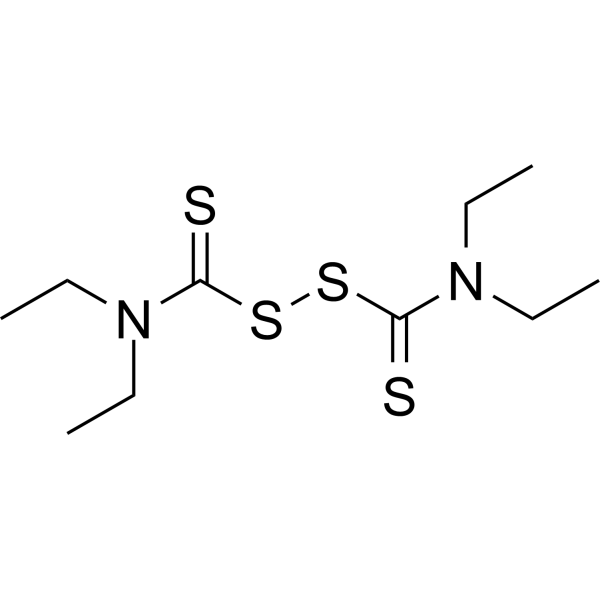
    Ditiocarb sodium (Standard) is the analytical standard of Ditiocarb sodium. This product is intended for research and analytical applications. Ditiocarb sodium (Sodium diethyldithiocarbamate) is a copper reagent. The reaction with Cu2+ solution resulted in the formation of a complex, which increased the copper displacement precipitation rate. Ditiocarb sodium can reduce HIV infection and can be used in adjuvant immune research of high-risk breast cancer [2] .
    Ditiocarb sodium (Standard)
  • HY-N7135R

    Tyrosinase Reference Standards Fungal Metabolic Disease Inflammation/Immunology Cancer
    Tropolone is a seven-membered non-benzenoid aromatic compound, which is the precursor of many Azulene derivatives. Tropolone is a potent mushroom tyrosinase inhibitor with an IC50 value of 0.4 μM. Its inhibitory effect can be achieved by dialysis or excess CU2+ Reversa. Tropolone exhibits broad anti-viral and anti-fungal activity and is synergistic upon co-treatment with nucleos(t)ide analog drugs. Tropolone is a promising candidate for research in osteosarcoma [2] .
    Tropolone (Standard)
  • HY-D1637

    Fluorescent Dye Others
    5-Nitro BAPTA tetramethyl ester is a calcium chelator. 5-Nitro BAPTA tetramethyl ester involves in the two-photon probe synthesis, and is used for real-time imaging of intracellular calcium ions, calcium waves monitoring at a depth of 100-300 μm in liver tissues for 1100-4000 s. 5-Nitro BAPTA tetramethyl ester, together with fluorescent compound 2-Me-substituted TM, can be used to form a red fluorescent probe (CaTM-2 AM) [2].
    5-Nitro BAPTA tetramethyl ester
  • HY-W747575

    Endogenous Metabolite Metabolic Disease
    (±)13-HODE cholesteryl ester is originally extracted from atherosclerotic lesions1 and shown to be produced by Cu2+-catalyzed oxidation of LDL. Later studies determined that 15-LO from rabbit reticulocytes and human monocytes were able to metabolize cholesteryl linoleate, a major component of LDL, to 13-HODE cholesteryl ester.
    (+/-)13-HODE cholesteryl ester
  • HY-123016A

    Endogenous Metabolite Metabolic Disease
    (±)9-HODE cholesteryl ester is originally extracted from atherosclerotic lesions1 and shown to be produced by Cu2+-catalyzed oxidation of LDL.2 Later studies determined that 15-LO from rabbit reticulocytes and human monocytes were able to metabolize cholesteryl linoleate, a major component of LDL, to 9-HODE cholesteryl ester.
    (±)9-HODE cholesteryl ester
  • HY-D1391

    PbS/CdSe QD

    Fluorescent Dye Others
    PbS/CdS QDs (PbS/CdSe QD) is a fluorescent probe that can be used for in vivo fluorescence imaging in the second near-infrared window [2].
    PbS/CdS QDs
  • HY-P6010

    Integrin Cancer
    αvβ6-BP is a selective αvβ6 binding peptide, and can be used for molecular imaging .
    αvβ6-BP
  • HY-P6010A

    Integrin Cancer
    αvβ6-BP TFA is a selective αvβ6 binding peptide, and can be used for research of molecular imaging .
    αvβ6-BP TFA
  • HY-D1701

    Fluorescent Dye Others
    Calcium is an important part of the human body, usually in the form of calcium, a large number of bones and teeth of the human body, a small amount of blood and tissues. MCE calcium ion detection probe can specifically identify intracellular calcium ions, with high sensitivity, low cytotoxicity, increased AM acetylmethyl ester can enter the cell well, after being sheared by the intracellular esterase stay in the cell to bind to calcium ions, produce strong fluorescence, in addition, Mag-indo-1/AM and Mag-Fluo-4 AM at a certain concentration (usually 5 mM) can effectively identify intracellular magnesium ions .
    Mag-Fura-2 AM
  • HY-E70238

    Nicotinamide 2-azidoadenine dinucleotide

    Glutamate Dehydrogenase (GLDH) Others
    2-Azido-NAD is a NAD + analog that can be used for visualization of intracellular Poly(ADP ribos)ylation (PARylation) processes .
    2-Azido-NAD
  • HY-W1049763

    MOFs Others
    [Cu2(bdc)2(bpy)]n is a metal-organic framework (MOF).
    [Cu2(bdc)2(bpy)]n
  • HY-W1049762

    MOFs Others
    [Cu2(bdc)2(bpe)]n is a metal-organic framework (MOF).
    [Cu2(bdc)2(bpe)]n
  • HY-D1239

    Fluorescent Dye Others
    BODIPY R6G NHS ester is a borondipyrromethene dye. BODIPY R6G NHS ester can be conjugated with proteins. BODIPY R6G NHS ester can be used for intracellular traces .
    BODIPY R6G NHS ester
  • HY-105238

    Cannabinoid Receptor Neurological Disease
    JHU-75528 is a novel ligand of the cannabinoid receptor (CB1). JHU-75528 can be used in the research of imaging CB1 receptor .
    JHU-75528
  • HY-D1615

    Fluorescent Dye Others
    BODIPY 530/550 NHS ester can be used for the stain of protein. BODIPY 530/550 NHS ester can be used for fluorescence OIM (oblique illumination microscopic) image .
    BODIPY 530/550 NHS ester
  • HY-145128

    Opioid Receptor Neurological Disease
    GR103545 is a potent and selective agonist of the κ-opioid receptor (κ-OR). 11GR103545 is a radiotracer for imaging κ-OR in vivo [1][2].
    GR103545 fumarate

Inquiry Online

Your information is safe with us. * Required Fields.

Salutation


Country or Region *

Applicant Name *


Organization Name *

Department *


Email Address *


Product Name *

Cat. No.


Requested quantity *

Phone Number *


Remarks

Inquiry Online

Inquiry Information

Product Name:
Cat. No.:
Quantity:
MCE Japan Authorized Agent:

