1. Search Result
Search Result
Results for "

lipid peroxyl radicals

" in MedChemExpress (MCE) Product Catalog:

8

Inhibitors & Agonists

1

Fluorescent Dyes

1

Natural
Products

Cat. No. Product Name Target Research Areas Chemical Structure
  • HY-Y0525
    AAPH
    2 Publications Verification

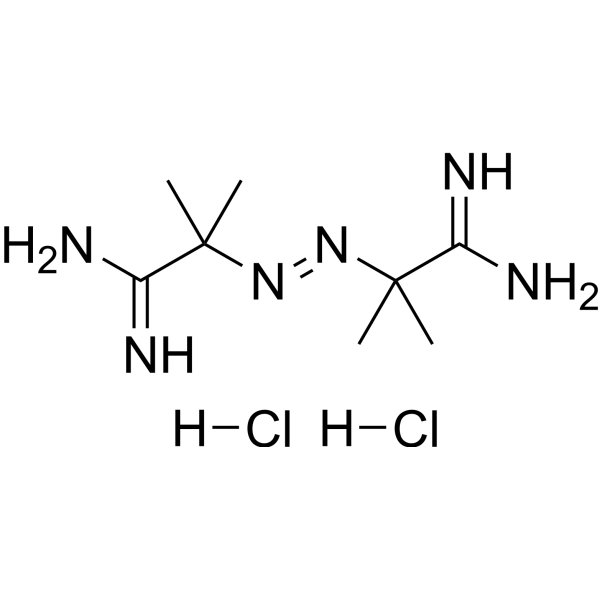
    2,2'-Azodiisobutyramidine dihydrochloride

    Reactive Oxygen Species (ROS) Inflammation/Immunology
    AAPH (2,2'-Azodiisobutyramidine dihydrochloride) has an effect of radical generation. AAPH induces oxidative stress and erythrocyte hemolysis . AAPH decomposes at 37°C to generate an alkyl radical, is used as an initiator. In the presence of oxygen, these alkyl radicals will be converted to peroxyl radicals that can cause lipid peroxidation and loss of erythrocyte membrane integrity, which could ultimately lead to hemolysis .
    AAPH
  • HY-117401

    Fluorescent Dye Others
    5-Dodecanoylaminofluorescein is an amphipathic (amphoteric) fluorescent probe (Ex/Em = 485 nm/515-535 nm), which consists of a hydrophilic fluorescein core and a hydrophobic dodecanoyl group (C12 fatty acid chain) linked by an amide bond. 5-Dodecanoylaminofluorescein is mainly used as an interface-localized radical trapping/indicator probe. Dodecanoylaminofluorescein can be used for the determination of the antioxidant properties of emulsions, or can serve as a lipophilic drug model for the study of passive skin penetration when encapsulated in tyrosine-derived nanospheres .
    5-Dodecanoylaminofluorescein
  • HY-W002942

    1,2,3,4-Tetrahydroquinolin-8-ol; 8-hydroxy-1,2,3,4-tetrahydroquinoline

    Ferroptosis Reactive Oxygen Species (ROS) Inflammation/Immunology
    Ferroptosis-IN-21 is a ferroptosis inhibitor that protects against renal I/R injury by suppressing ferroptosis and directly scavenging peroxyl radicals. Ferroptosis-IN-21 displays broad-spectrum anti-ferroptotic efficacy across multiple inducers in renal tubular epithelial cells, with nanomolar potency and robust suppression of lipid Reactive Oxygen Species (ROS). Ferroptosis-IN-21 significantly ameliorates renal I/R injury in mice, reducing histological damage, functional impairment, and inflammatory cytokine expression, while decreasing lipid peroxidation biomarkers such as 4-hydroxynonenal. Ferroptosis-IN-12 can be used for research in the field of ferroptosis-targeted drug development .
    Ferroptosis-IN-21
  • HY-132280

    U 74006F free base

    Reactive Oxygen Species (ROS) SARS-CoV Virus Protease Neurological Disease Inflammation/Immunology
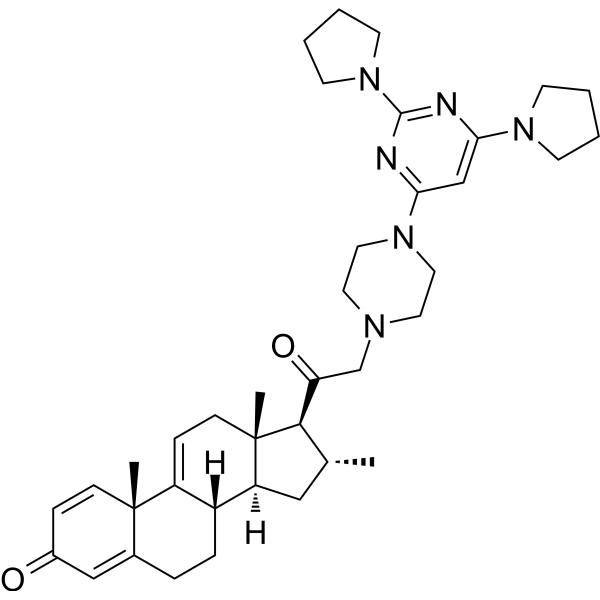
    Tirilazad (U 74006F free base) is a neuroprotective agent. Tirilazad can also bind tightly to the main protease of the COVID-19 virus and exert anti-SARS-CoV-2 activity. Tirilazad scavenges hydroxyl and lipid peroxyl free radicals and maintains the levels of endogenous antioxidants. Tirilazad reduces cerebral infarct volume and improves neurobehavioral scores in animal models of focal ischemia. Tirilazad can be used in research related to ischemic stroke and subarachnoid hemorrhage .
    Tirilazad
  • HY-132280R

    U 74006F free base (Standard)

    Reference Standards Reactive Oxygen Species (ROS) SARS-CoV Virus Protease Neurological Disease Inflammation/Immunology
    Tirilazad (U 74006F free base) Standard is the analytical standard of Tirilazad (HY-132280). This product is intended for research and analytical applications. Tirilazad (U 74006F free base) is a neuroprotective agent. Tirilazad can also bind tightly to the main protease of the COVID-19 virus and exert anti-SARS-CoV-2 activity. Tirilazad scavenges hydroxyl and lipid peroxyl free radicals and maintains the levels of endogenous antioxidants. Tirilazad reduces cerebral infarct volume and improves neurobehavioral scores in animal models of focal ischemia. Tirilazad can be used in research related to ischemic stroke and subarachnoid hemorrhage .
    Tirilazad (Standard)
  • HY-N11884

    Endogenous Metabolite Inflammation/Immunology
    Ubiquinone Q3 is an isoprenoid-chain ubiquinone homologue found in Saccharomyces cerevisiae, Escherichia coli, and Rhodospirillum rubrum. Ubiquinone Q3 has antioxidant activity and traps lipid peroxyl radicals .
    Ubiquinone Q3
  • HY-182603

    Drug Derivative Reactive Oxygen Species (ROS) HCV Infection Inflammation/Immunology
    BO-653 is an orally active anti-atherosclerotic antioxidant that exhibits high binding affinity for LDL. BO-653 scavenges linoleic acid peroxyl radicals, inhibits lipid peroxidation during the auto-oxidation of linoleic acid, and potently suppresses LDL oxidation. BO-653 inhibits Hepatitis C Virus (HCV) replication in a concentration-dependent manner, with an IC50 of 36.0 μM against the HCV subgenomic replicon in FLR3-1 cells. BO-653 demonstrates significant anti-atherosclerotic effects in various animal models, including the Watanabe heritable hyperlipidemic rabbit. BO-653 is suitable for use in research related to atherosclerosis and Hepatitis C Virus infection .
    BO-653
  • HY-160800

    BR-DT

    Drug Derivative Inflammation/Immunology
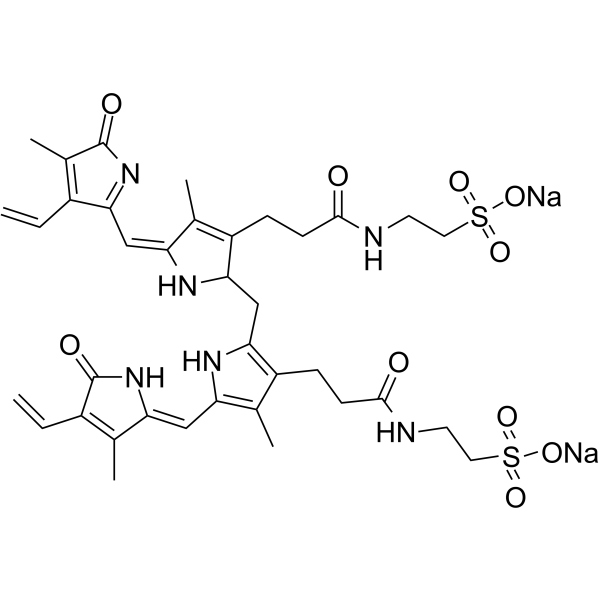
    Bilirubin ditaurine (BR-DT) is a mimetic compound of conjugated bilirubin. Bilirubin ditaurine can completely prevent the oxidation of phosphatidylcholine induced by reactive oxygen species in multilayer liposomes or micelles. Bilirubin ditaurine does not significantly decompose 18:2-OOH on its own, but it can greatly accelerate the decomposition of 18:2-OOH catalyzed by copper ions. Bilirubin ditaurine can be used to study the detoxification effect of conjugated bilirubin .
    Bilirubin ditaurine

Inquiry Online

Your information is safe with us. * Required Fields.

Salutation


Country or Region *

Applicant Name *


Organization Name *

Department *


Email Address *


Product Name *

Cat. No.


Requested quantity *

Phone Number *


Remarks

Inquiry Online

Inquiry Information

Product Name:
Cat. No.:
Quantity:
MCE Japan Authorized Agent:

