10 Results for "

luminescent probe

" in MedChemExpress (MCE) Product Catalog:
Products (10)

10 Results for "luminescent probe" in MCE Product Catalog:

6
6 Cited Publications
Cat. No.: HY-18743
CAS No.: 55779-48-1
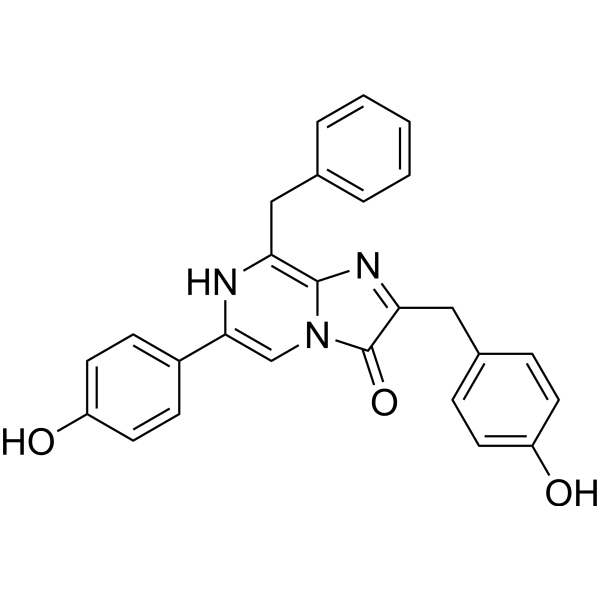
Coelenterazine is a luminescent enzyme substrate for apoaequorin and Renilla luciferase. Renilla luciferase and substrate coelenterazine has been used as the bioluminescence donor in bioluminescence resonance energy transfer (BRET) to detect protein-protein interactions. Coelenterazine is a superoxide anion-sensitive chemiluminescent probe and it can also be used in chemiluminescent detection of peroxynitrite (Ex/Em = 429/466 nm) .
loading...
    loading...
6
6 Cited Publications
Cat. No.: HY-18743A
Research Areas:  

Cancer

Coelenterazine TFA is a luminescent enzyme substrate for apoaequorin and Renilla luciferase. Renilla luciferase and substrate Coelenterazine TFA has been used as the bioluminescence donor in bioluminescence resonance energy transfer (BRET) to detect protein-protein interactions. Coelenterazine TFA is a superoxide anion-sensitive chemiluminescent probe and it can also be used in chemiluminescent detection of peroxynitrite (Ex/Em = 429/466 nm) .
loading...
    loading...
Cat. No.: HY-D0892
CAS No.: 194357-64-7
Research Areas:  

Cancer

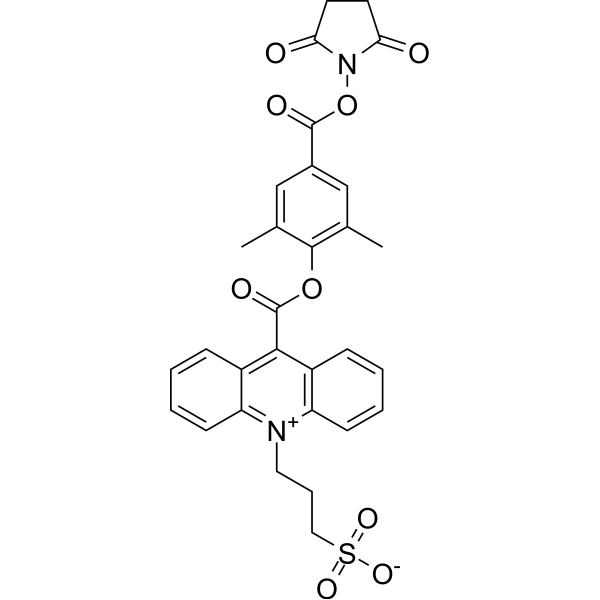
NSP-DMAE-NHS is an acridinium ester-based signal amplifier that can act as a luminescent probe to effectively improve the detection performance of biosensors. NSP-DMAE-NHS preserves the biochemical activity of biomolecules during the conjugation process. NSP-DMAE-NHS has been successfully applied to label mouse anti-human PI3 monoclonal antibodies for chemiluminescent immunoassays, as well as for pre-competitive chemiluminescent immunochromatographic detection of TP53 fusion proteins. NSP-DMAE-NHS can be used in detection studies of cancer and related biomarkers .
loading...
    loading...
Cat. No.: HY-W140535
CAS No.: 301206-84-8
Target:  

Fluorescent Dye MOFs

Research Areas:  

Others

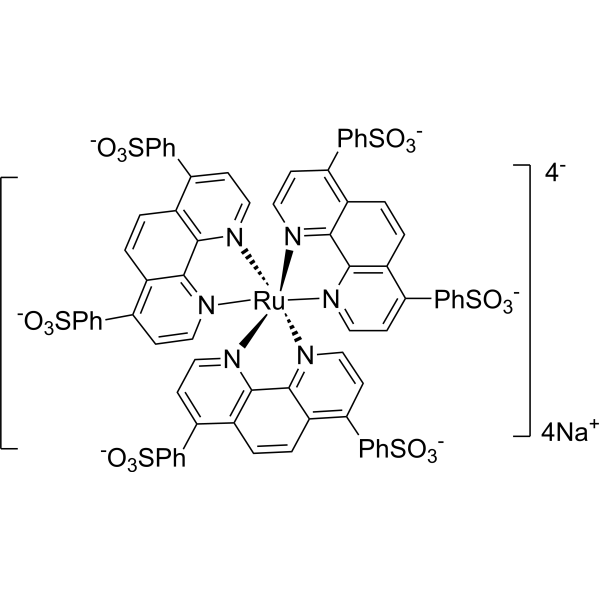
Tetrasodium, 4-(1,10-phenanthrolin-4-yl)benzenesulfonate,ruthenium((II)) is a luminescent ruthenium complex. Tetrasodium, 4-(1,10-phenanthrolin-4-yl)benzenesulfonate,ruthenium((II)) is used in biological and chemical fields as a fluorescent indicator dye and an electrochemiluminescent probe .
loading...
    loading...
Cat. No.: HY-177906
CAS No.: 1352477-26-9
Research Areas:  

Neurological Disease

h-FTAA is a luminescent conjugated oligothiophene (LCO) probe. h-FTAA can selectively bind to amyloid protein aggregates (such as Aβ plaques) and distinguish different conformations of the protein aggregates through changes in fluorescence signals. h-FTAA significantly reduces the neurotoxicity of Aβ1-42 and the Arctic mutant Aβ (AβArc), thereby protecting SH-SY5Y neuroblastoma cells. h-FTAA can be used to dynamically track the formation and maturation process of Aβ plaques .
loading...
    loading...
Cat. No.: HY-W034043
CAS No.: 1335047-34-1
[Ir(dF(Me)ppy)2(dtbbpy)]PF6 is a blue-green luminescent material. [Ir(dF(Me)ppy)2(dtbbpy)]PF6 exhibits irregular emission, with its emission peak maxima located at 498, 512, and 519 nM, respectively. [Ir(dF(Me)ppy)2(dtbbpy)]PF6 can serve as an electrochemiluminescence-based biological probe .
loading...
    loading...
Cat. No.: HY-W011577S1
Synonyms: 2,3-Benzotriphenylene-13C6
Dibenzo[a,c]anthracene- 13C6 (2,3-Benzotriphenylene- 13C6) is 13C labeled Benzo[f]tetraphene. Benzo[f]tetraphene (Dibenz[a,c]anthracene) is a polycyclic aromatic hydrocarbon with significant antitumor activity. Benzo[f]tetraphene is used as a luminescent probe in cell biology research and can effectively detect reactive oxygen species in biological systems. Benzo[f]tetraphene can also be used as a potential photosensitizer and shows good application prospects in photodynamic inhibition.
loading...
    loading...
Cat. No.: HY-W011577
CAS No.: 215-58-7
Synonyms: Dibenz[a,c]anthracene
Target:  

Photosensitizer

Benzo[f]tetraphene (Dibenz[a,c]anthracene) is a polycyclic aromatic hydrocarbon with significant antitumor activity. Benzo[f]tetraphene is used as a luminescent probe in cell biology research and can effectively detect reactive oxygen species in biological systems. Benzo[f]tetraphene can also be used as a potential photosensitizer and shows good application prospects in photodynamic inhibition.
loading...
    loading...
Cat. No.: HY-D3164
CAS No.: 1380316-56-2
Target:  

Fluorescent Dye

Research Areas:  

Others

TPE-Cy is a fluorescent probe with both aggregation-induced emission (AIE) property and pH-dependent luminescent behavior. TPE-Cy exhibits significant luminescent differences under different acidic and alkaline conditions: it shows moderate to strong red emission with linear variation with pH in acidic environments and within the pH range of 5-7, weak or even no emission within the pH range of 7-10, and switches to blue emission under alkaline conditions. TPE-Cy possesses excellent cell permeability and biocompatibility, enabling accurate ratiometric pH sensing and imaging monitoring in living cells via confocal microscopy, ratiometric analysis and flow cytometry .
loading...
    loading...
Cat. No.: HY-157293
CAS No.: 1374040-22-8
Research Areas:  

Others

PBI4600 is a quinone-trimethyl-locked coelenterazine-based proluminescent substrate and a probe for detecting the redox status and viability of metabolically active cells. PBI4600 releases the coelenterazine reporter group upon reduction by metabolically active cells, generating a luminescent signal through the bioluminescence system, with signal intensity correlating with cellular redox status and metabolic activity. PBI4600 can be used for research related to the redox status and viability of living cells .
loading...
    loading...

