1. Search Result
Search Result
Results for "

organic azo dye

" in MedChemExpress (MCE) Product Catalog:

11

Inhibitors & Agonists

5

Fluorescent Dyes

1

Biochemical Assay Reagents

1

Isotope-Labeled Compounds

Targets Recommended:
Cat. No. 상품명 Target 연구분야 Chemical Structure
  • HY-118907

    Fluorescent Dye Others
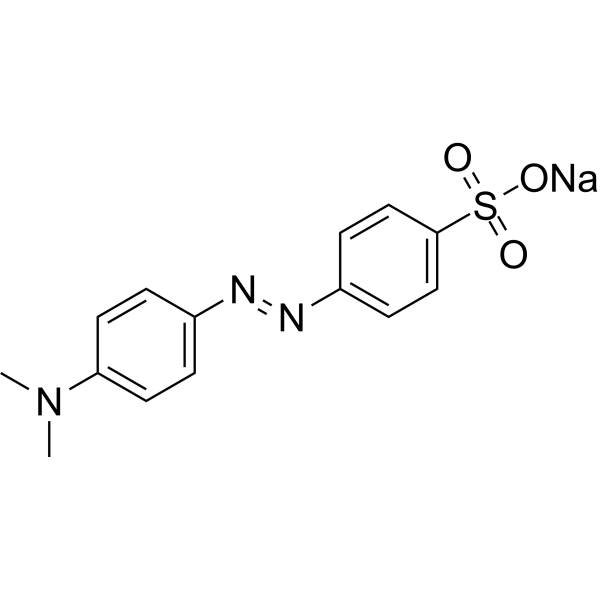
    Methyl Orange is a soluble azo dye commonly used as an acid-base indicator and for staining cells and tissue sections, as well as for dyeing textiles. Methyl Orange appears red at a pH of 3.1 and changes to bright yellow as the pH increases to 4.4. Methyl Orange (500 mg/L) exhibits cytotoxicity and can cause DNA damage .
    Methyl Orange
  • HY-D0307A

    Acid Red 27; azorubin S; FD & C Red dye No. 2

    Environmental Pollutants Biochemical Assay Reagents Inflammation/Immunology
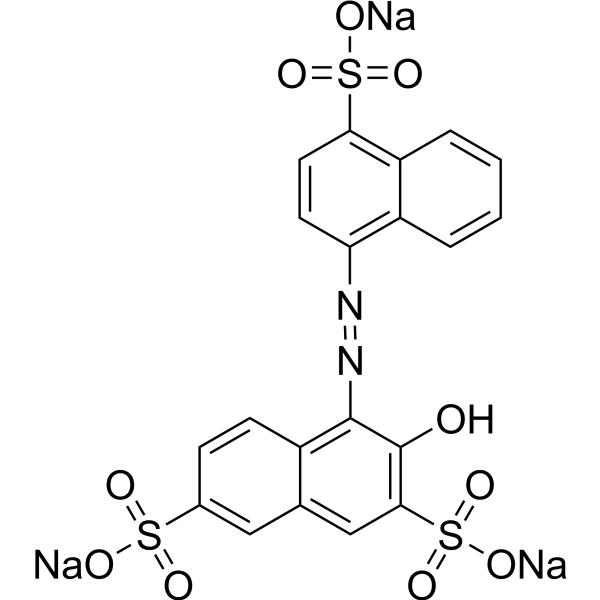
    Amaranth is an organic azo dye. Amaranth inhibits cellular immune response. Amaranth can be used as a food additive .
    Amaranth
  • HY-N1442

    Orange II; D&C Orange NO. 4

    Environmental Pollutants Biochemical Assay Reagents Others
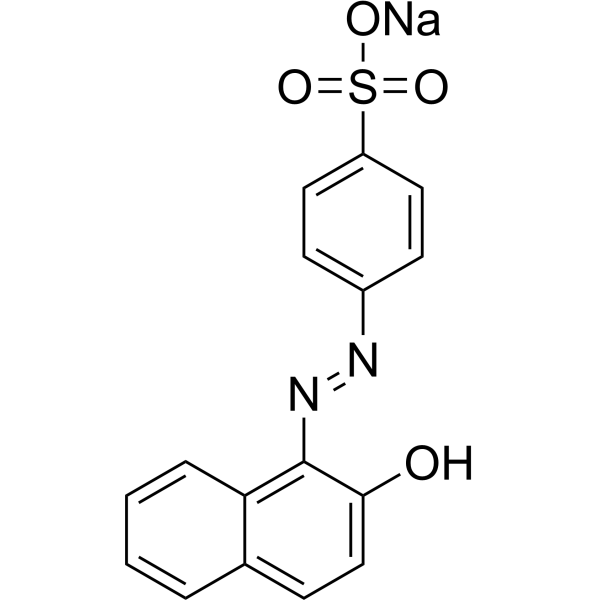
    Acid Orange 7 (Orange II; D&C Orange NO. 4) is an azo dye widely used in the textile, food and cosmetic industries. Acid Orange 7 is mainly used as a colorant by combining with fibers and other substances through azo bonds. Acid Orange 7 has a maximum absorption wavelength at 484-485 nm, and the concentration is measured using a UV-visible spectrophotometer. Acid Orange 7 is difficult to degrade and has a certain degree of toxicity. It is often used to study various sewage treatment technologies and photocatalytic degradation reactions, and to evaluate the removal effects of different treatment methods on organic pollutants .
    Acid orange 7
  • HY-135712

    Acid Orange GG

    Environmental Pollutants Biochemical Assay Reagents Others
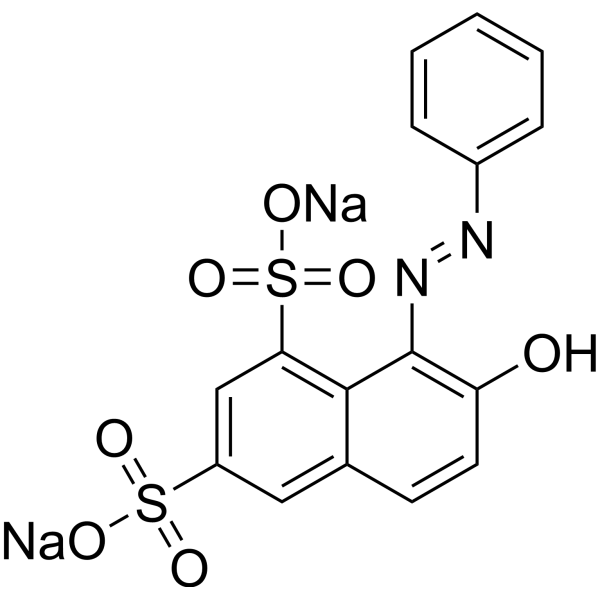
    Orange G is an azo dye commonly found in textile wastewater and is mainly used for textile dyeing. Orange G has a coloring function and can give textiles a specific color. The stability and potential hazards of Orange G in the environment are often used to study the removal effects of various wastewater treatment technologies on difficult-to-degrade organic pollutants, especially the degradation of azo dyes. Related research focuses on how to destroy the azo bond of Orange G through chemical, physical or biological methods to achieve harmless treatment to solve the problem of textile wastewater pollution .
    Orange G
  • HY-W115738

    Biochemical Assay Reagents Others
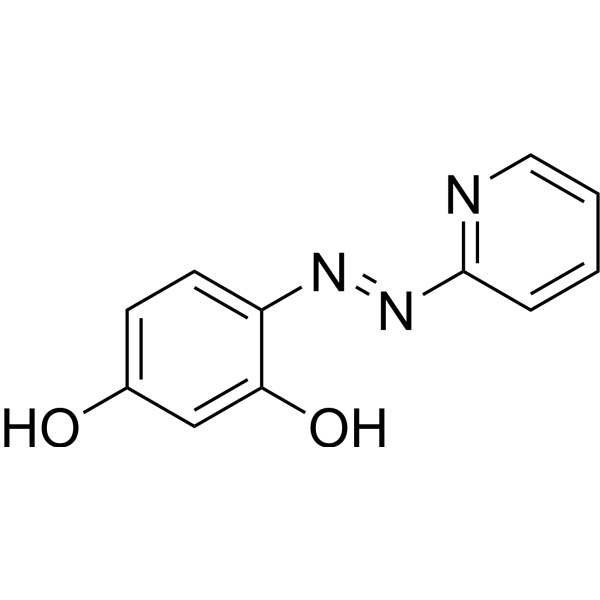
    PAR is an azo dye widely used as a colorimetric reagent for metal ions. PAR forms stable chelates with different metal ions. PAR can also complex with heavy metal ions in polar organic solvents, such as ethanol .
    PAR
  • HY-D0929

    α-Naphthol Orange

    Fluorescent Dye Others
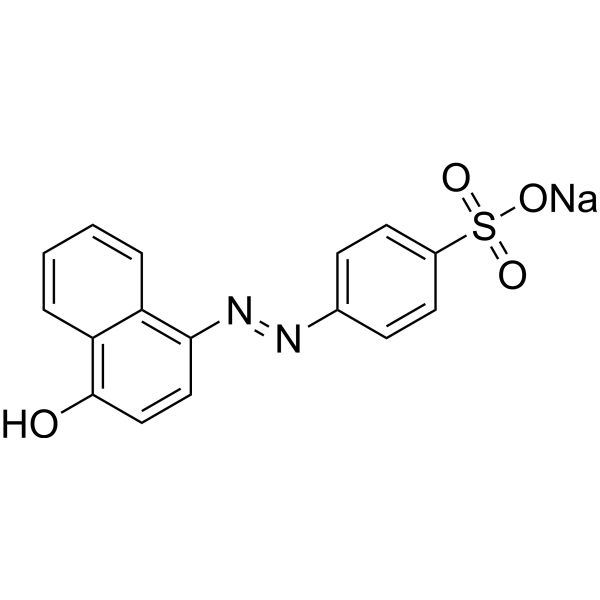
    Orange I (α-Naphthol Orange) is an anionic azo dye that can form a complex with Methylene blue (HY-14536) and cause fluorescence quenching. The equilibrium constant of the complex of Orange I and Methylene blue is 79900 mol -1·dm 3. Orange I can change the absorption spectrum of itself and Methylene blue .
    Orange I
  • HY-W250148

    Spirit nigrosine

    Biochemical Assay Reagents Others
    Solvent black 5 (Spirit nigrosine) is a synthetic dye belonging to the family of azo dyes. Also known as oil black or naphthol black, it is dark blue-black and has excellent solubility in organic solvents. Solvent black 5 is commonly used as a colorant in various industrial applications such as printing inks, coatings and plastics. It can also be used as an indicator dye to detect the presence of metals in solution. Furthermore, due to its high absorption and emission properties in the near-infrared region, it has been used in scientific research as a fluorescent biomarker for tissues and cells. However, Solvent black 5 has been reported to have potentially toxic effects on human health and the environment and its use is therefore regulated in some countries.
    Solvent black 5
  • HY-D0898

    Biochemical Assay Reagents Others
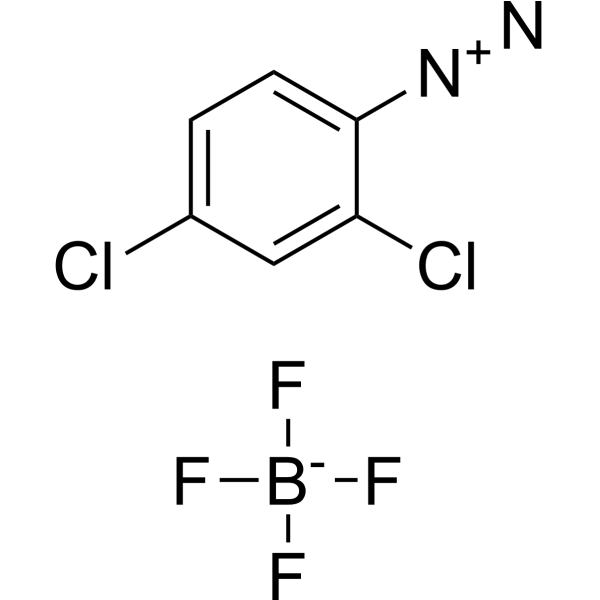
    2,4-Dichlorobenzenediazonium tetrafluoroborate is an organic compound commonly used in organic synthesis and dye preparation reactions. It can be used as an azotating agent to form azo dyes with other organic substances, and can be used in coatings, pigments and paints and other industries. In addition, the compound is widely used in certain chemical analysis and detection methods, such as in scientific instruments such as electron microscopes and mass spectrometers. Although the compound has no direct medical applications, it plays an important role in chemical research and laboratory studies.
    2,4-Dichlorobenzenediazonium tetrafluoroborate
  • HY-118907R

    Fluorescent Dye Reference Standards Others
    Methyl Orange (Standard) is the analytical standard of Methyl Orange. This product is intended for research and analytical applications. Methyl Orange is a soluble azo dye commonly used as an acid-base indicator and for staining cells and tissue sections, as well as for dyeing textiles. Methyl Orange appears red at a pH of 3.1 and changes to bright yellow as the pH increases to 4.4. Methyl Orange (500 mg/L) exhibits cytotoxicity and can cause DNA damage .
    Methyl Orange (Standard)
  • HY-W750212

    Orange II-13C6; D&C Orange NO. 4-13C6

    Isotope-Labeled Compounds Biochemical Assay Reagents Others
    Acid Orange 7- 13C6 (Orange II- 13C6) is the 13C-labeled Acid orange 7 (HY-N1442). Acid Orange 7 (Orange II; D&C Orange NO. 4) is an azo dye widely used in the textile, food and cosmetic industries. Acid Orange 7 is mainly used as a colorant by combining with fibers and other substances through azo bonds. Acid Orange 7 has a maximum absorption wavelength at 484-485 nm, and the concentration is measured using a UV-visible spectrophotometer. Acid Orange 7 is difficult to degrade and has a certain degree of toxicity. It is often used to study various sewage treatment technologies and photocatalytic degradation reactions, and to evaluate the removal effects of different treatment methods on organic pollutants .
    Acid Orange 7-13C6
  • HY-N1442R

    Orange II (Standard); D&C Orange NO. 4 (Standard)

    Biochemical Assay Reagents Reference Standards Others
    Acid orange 7 (Standard) is the analytical standard of Acid orange 7 (HY-1442). This product is intended for research and analytical applications. Acid Orange 7 (Orange II; D&C Orange NO. 4) is an azo dye widely used in the textile, food and cosmetic industries. Acid Orange 7 is mainly used as a colorant by combining with fibers and other substances through azo bonds. Acid Orange 7 has a maximum absorption wavelength at 484-485 nm, and the concentration is measured using a UV-visible spectrophotometer. Acid Orange 7 is difficult to degrade and has a certain degree of toxicity. Acid Orange 7 is often used to study various sewage treatment technologies and photocatalytic degradation reactions, and to evaluate the removal effects of different treatment methods on organic pollutants .
    Acid orange 7 (Standard)

온라인 문의

Your information is safe with us. * Required Fields.

호칭


Country or Region *

고객명 *


회사명 *

Department *


메일주소 *


상품명 *

Cat. No.


Requested quantity *

전화번호 *


비고

온라인 문의

Inquiry Information

상품명:
Cat. No.:
수량:
MCE Japan Authorized Agent:

