
36 Results for "

prothrombin

" in MedChemExpress (MCE) Product Catalog:
Products (36)

36 Results for "prothrombin" in MCE Product Catalog:

1
1 Cited Publications
Art. -Nr.: HY-P701216
Reinheit:  ≥ 95%, as determined by reducing SDS-PAGE.
Synonyms: F2; Coagulation Factor II (Thrombin); Coagulation Factor II, Thrombin; prothrombin B-Chain; prothrombin; F2 Protein; Prepro-Coagulation Factor II; RPRGL2; Coagulation Factor II; THPH1; Thrombin Factor II; PT
Species:  
Human
Source:  
HEK293
loading...
    loading...
Art. -Nr.: HY-E70544B
CAS. Nr.: 9001-29-0
Canine Factor X is a vitamin K-dependent plasma serine protease that is activated to generate Factor Xa. Canine Factor X mediates the common coagulation pathway and catalyzes the conversion of prothrombin to thrombin . Canine Factor X is the first enzyme to act in the common pathway of thrombosis in the coagulation cascade. Canine Factor X can be used in studies related to Factor X deficiency .
loading...
    loading...
Art. -Nr.: HY-W714524
CAS. Nr.: 321863-21-2
Synonyms: 16:0-18:1 PS (POPS)
1-Palmitoyl-2-oleoyl-sn-glycero-3-PS sodium (16:0-18:1 PS (POPS)) is an anionic phosphatidylserine phospholipid with 16:0 (palmitoyl) and 18:1 (oleoyl) acyl chains. It serves as a component of biomimetic inner plasma membrane models and membrane vesicles for hemostatic response studies. 1-Palmitoyl-2-oleoyl-sn-glycero-3-PS sodium regulates membrane electrical properties by forming tethered bilayer lipid membranes. It enhances the stability of sHDL particles without altering the cholesterol efflux capacity of sHDL. 1-Palmitoyl-2-oleoyl-sn-glycero-3-PS sodium acts synergistically with phosphatidylcholine to support prothrombin activation. It serves as a component of the 4:1 POPC/POPS binary lipid bilayer model. 1-Palmitoyl-2-oleoyl-sn-glycero-3-PS sodium is applicable to research related to atherosclerosis .
loading...
    loading...
Art. -Nr.: HY-P3009
CAS. Nr.: 9002-05-5
Bovine Factor Xa is a serine protease that plays a central role in blood coagulation, with prothrombin as its physiological substrate. Bovine Factor Xa catalyzes the conversion of prothrombin to thrombin, activates factor VIII, and hydrolyzes peptide, thioester, and amide substrates. Bovine Factor Xa cleaves protease-activated receptors 1 and 2 to activate intracellular signal transduction. Bovine Factor Xa regulates multiple cellular pathways, mediates various cellular activities, tissue remodeling and cancer cell migration, and inhibits apoptosis in some cancer cells. Bovine Factor Xa protects hippocampal neurons against glutamate-induced damage. Bovine Factor Xa participates in embryonic vascular development and regulates immune hematopoiesis; its activity is inhibited by soybean trypsin inhibitor, and cannot be enhanced by phospholipids. Bovine Factor Xa regulates immune responses and macrophage polarization, and participates in fibrosis, vascular remodeling and tumor progression through non-coagulant effects. Bovine Factor Xa can be used in research related to atherosclerosis, fibrosis, asthma, cancer, thromboinflammation, sepsis, etc .
loading...
    loading...
Art. -Nr.: HY-166257
CAS. Nr.: 38621-58-8
Synonyms: Psychosine 3′-O-sulfate; Psychosine 3′-sulfate
Forschungsgebiete:  

Metabolic Disease

Lyso-sulfatide (bovine) is a phospholipid component derived from sphingolipid catabolism and a potent factor Xa inhibitor and anticoagulant. Lyso-sulfatide (bovine) binds directly to factor Xa and inhibits prothrombin activation mediated by the prothrombinase complex, thereby prolonging factor Xa-induced plasma clotting time and suppressing thrombin generation. Lyso-sulfatide (bovine) serves as a reliable lipid membrane mimic for studying cell membrane structure, function, and molecular interactions .
loading...
    loading...
Art. -Nr.: HY-E70554A
CAS. Nr.: 9001-26-7
Forschungsgebiete:  

Cardiovascular Disease

Bovine Prothrombin is a glycoprotein with a molecular weight of 70 kDa and is composed of a single polypeptide chain. Prothrombin is activated by factors Va, Xa, and phospholipids to produce the serine protease thrombin .
loading...
    loading...
Art. -Nr.: HY-10769
CAS. Nr.: 229336-92-9
Target:  

Factor Xa

Forschungsgebiete:  

Cardiovascular Disease

ZK-813039 is a potent and orally active factor Xa inhibitor. ZK-813039 can prolong prothrombin time. ZK-813039 can be used for the research of cardiovascular disease .
loading...
    loading...
Art. -Nr.: HY-P991211
CAS. Nr.: 2766038-73-5
Synonyms: STSP-0601

Target:  

Factor XI

Forschungsgebiete:  

Cardiovascular Disease

Bemiltenase alfa is a hemostatic agent targeting coagulation factor X (FX). Bemiltenase alfa activates FX and promotes the conversion of prothrombin to thrombin, and thrombin can further transform fibrinogen into fibrin, forming a stable blood clot, thus exerting hemostatic activity. Bemiltenase alfa is promising for research of bleeding symptoms with hemophilia .
loading...
    loading...
Art. -Nr.: HY-P3009D
CAS. Nr.: 9002-05-5
Rat Factor Xa is a serine protease that plays a central role in blood coagulation, with prothrombin as its physiological substrate. Rat Factor Xa catalyzes the conversion of prothrombin to thrombin, activates factor VIII, and hydrolyzes peptide, thioester, and amide substrates. Rat Factor Xa cleaves protease-activated receptors 1 and 2 to activate intracellular signal transduction. Rat Factor Xa regulates multiple cellular pathways, mediates various cellular activities, tissue remodeling and cancer cell migration, and inhibits apoptosis in some cancer cells. Rat Factor Xa protects hippocampal neurons against glutamate-induced damage. Rat Factor Xa participates in embryonic vascular development and regulates immune hematopoiesis; its activity is inhibited by soybean trypsin inhibitor, and cannot be enhanced by phospholipids. Rat Factor Xa regulates immune responses and macrophage polarization, and participates in fibrosis, vascular remodeling and tumor progression through non-coagulant effects. Rat Factor Xa can be used in research related to atherosclerosis, fibrosis, asthma, cancer, thromboinflammation, sepsis, etc .
loading...
    loading...
Art. -Nr.: HY-P3009A
CAS. Nr.: 9002-05-5
Canine Factor Xa is a serine protease that plays a central role in blood coagulation, with prothrombin as its physiological substrate. Canine Factor Xa catalyzes the conversion of prothrombin to thrombin, activates factor VIII, and hydrolyzes peptide, thioester, and amide substrates. Canine Factor Xa cleaves protease-activated receptors 1 and 2 to activate intracellular signal transduction. Canine Factor Xa regulates multiple cellular pathways, mediates various cellular activities, tissue remodeling and cancer cell migration, and inhibits apoptosis in some cancer cells. Canine Factor Xa protects hippocampal neurons against glutamate-induced damage. Canine Factor Xa participates in embryonic vascular development and regulates immune hematopoiesis; its activity is inhibited by soybean trypsin inhibitor, and cannot be enhanced by phospholipids. Canine Factor Xa regulates immune responses and macrophage polarization, and participates in fibrosis, vascular remodeling and tumor progression through non-coagulant effects. Canine Factor Xa can be used in research related to atherosclerosis, fibrosis, asthma, cancer, thromboinflammation, sepsis, etc .
loading...
    loading...
Art. -Nr.: HY-P3009B
CAS. Nr.: 9002-05-5
Porcine Factor Xa is a serine protease that plays a central role in blood coagulation, with prothrombin as its physiological substrate. Porcine Factor Xa catalyzes the conversion of prothrombin to thrombin, activates factor VIII, and hydrolyzes peptide, thioester, and amide substrates. Porcine Factor Xa cleaves protease-activated receptors 1 and 2 to activate intracellular signal transduction. Porcine Factor Xa regulates multiple cellular pathways, mediates various cellular activities, tissue remodeling and cancer cell migration, and inhibits apoptosis in some cancer cells. Porcine Factor Xa protects hippocampal neurons against glutamate-induced damage. Porcine Factor Xa participates in embryonic vascular development and regulates immune hematopoiesis; its activity is inhibited by soybean trypsin inhibitor, and cannot be enhanced by phospholipids. Porcine Factor Xa regulates immune responses and macrophage polarization, and participates in fibrosis, vascular remodeling and tumor progression through non-coagulant effects. Porcine Factor Xa can be used in research related to atherosclerosis, fibrosis, asthma, cancer, thromboinflammation, sepsis, etc .
loading...
    loading...
Art. -Nr.: HY-P3009C
CAS. Nr.: 9002-05-5
Porcine Factor Xa is a serine protease that plays a central role in blood coagulation, with prothrombin as its physiological substrate. Porcine Factor Xa catalyzes the conversion of prothrombin to thrombin, activates factor VIII, and hydrolyzes peptide, thioester, and amide substrates. Porcine Factor Xa cleaves protease-activated receptors 1 and 2 to activate intracellular signal transduction. Porcine Factor Xa regulates multiple cellular pathways, mediates various cellular activities, tissue remodeling and cancer cell migration, and inhibits apoptosis in some cancer cells. Porcine Factor Xa protects hippocampal neurons against glutamate-induced damage. Porcine Factor Xa participates in embryonic vascular development and regulates immune hematopoiesis; its activity is inhibited by soybean trypsin inhibitor, and cannot be enhanced by phospholipids. Porcine Factor Xa regulates immune responses and macrophage polarization, and participates in fibrosis, vascular remodeling and tumor progression through non-coagulant effects. Porcine Factor Xa can be used in research related to atherosclerosis, fibrosis, asthma, cancer, thromboinflammation, sepsis, etc .
loading...
    loading...
Art. -Nr.: HY-172905
CAS. Nr.: 885684-79-7
Target:  

Others

Forschungsgebiete:  

Cardiovascular Disease

BCX-3607 is an orally active tissue factor/factor VIIa (TF-FVIIa) inhibitor (IC50: 4 nM). BCX-3607 blocks the extrinsic coagulation pathway by inhibiting the TF-FVIIa complex and significantly prolongs the prothrombin time (PT). BCX-3607 has a higher selectivity for TF-FVIIa than other serine proteases (such as thrombin, FXa, etc.). BCX-3607 can reduce thrombus weight and inflammatory response, and has both anti-thrombotic and anti-inflammatory effects. BCX-3607 can be used in the study of thrombosis-related diseases .
loading...
    loading...
Art. -Nr.: HY-170485
Target:  

Thrombin

Forschungsgebiete:  

Cardiovascular Disease

Thrombin inhibitor 13 (Compound 13a) is a covalent and reversible inhibitor for thrombin (FIIa) with an IC50 of 0.7 nM. Thrombin inhibitor 13 prolongs the activated partial thromboplastin time (aPTT) and prothrombin time (PT), exhibits antithrombotic and anticoagulant activities .
loading...
    loading...
Art. -Nr.: HY-10778
CAS. Nr.: 288077-60-1
Target:  

Factor Xa

Forschungsgebiete:  

Cardiovascular Disease

BMS-269223 is a potent, selective and orally active factor Xa inhibitor (Ki = 6.5 nM, EC2xPT = 32 μM). BMS-269223 can prolong prothrombin time and inhibit thrombosis formation. BMS-269223 can be used for the research of cardiovascular disease .
loading...
    loading...
Art. -Nr.: HY-E70544A
CAS. Nr.: 9001-29-0
Bovine Factor X is a vitamin K-dependent plasma serine protease that is activated to generate Factor Xa. Bovine Factor X mediates the common coagulation pathway and catalyzes the conversion of prothrombin to thrombin . Bovine Factor X is the first enzyme to act in the common pathway of thrombosis in the coagulation cascade. Bovine Factor X can be used in studies related to Factor X deficiency .
loading...
    loading...
Art. -Nr.: HY-106404
CAS. Nr.: 205054-36-0
Target:  

Factor Xa

Forschungsgebiete:  

Cardiovascular Disease

RPR 130737 is a selective, potent and competitive inhibitor for factor Xa with a Ki of 2.4 nM. RPR 130737 shows selectivity of more than 1000-fold over thrombin, activated protein C, plasmin, tissue-plasminogen activator and trypsin. RPR 130737 can prolong plasma activated partial thromboplastin time and prothrombin time. RPR 130737 shows no effect on platelet aggregation. RPR 130737 can be used for the research of cardiovascular disease, such as thrombosis .
loading...
    loading...
Art. -Nr.: HY-14854A
CAS. Nr.: 1004551-83-0
Synonyms: ATI-5923 sodium
Target:  

VKOR

Forschungsgebiete:  

Cardiovascular Disease

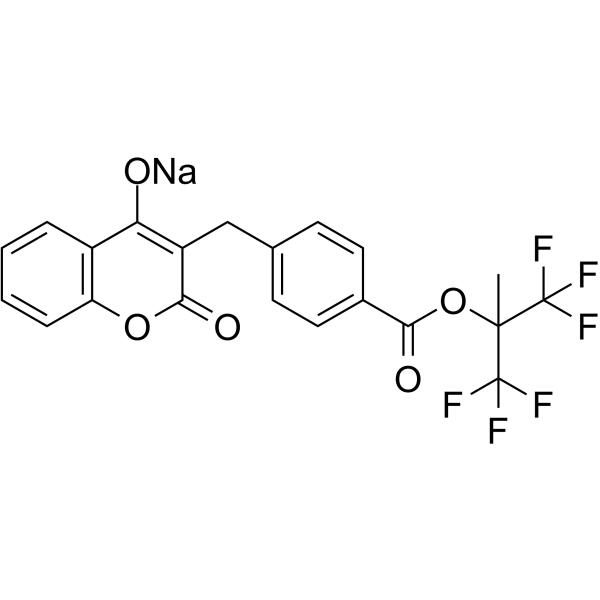
Tecarfarin (ATI-5923) sodium is an orally active VKOR inhibitor with an IC50 of 0.67 μM against VKORC1. Tecarfarin sodium blocks the post-translational modification of vitamin K-dependent coagulation factors II, VII, IX and X, reducing their levels and activities. Tecarfarin sodium prolongs prothrombin time, attenuates venous and arterial thrombosis, increases ear incision bleeding volume, and exerts reversible anticoagulant effects. Tecarfarin sodium is applicable to research related to arterial and venous thrombosis as well as other diseases requiring anticoagulation .
loading...
    loading...
Art. -Nr.: HY-14854R
CAS. Nr.: 867257-26-9
Synonyms: ATI-5923 (Standard)
Forschungsgebiete:  

Cardiovascular Disease

Tecarfarin (ATI-5923) (Standard) is the analytical standard of Tecarfarin. This product is intended for research and analytical applications. Tecarfarin is an orally active VKOR inhibitor with an IC50 of 0.67 μM against VKORC1. Tecarfarin blocks the post-translational modification of vitamin K-dependent coagulation factors II, VII, IX and X, reducing their levels and activities. Tecarfarin prolongs prothrombin time, attenuates venous and arterial thrombosis, increases ear incision bleeding volume, and exerts reversible anticoagulant effects. Tecarfarin is applicable to research related to arterial and venous thrombosis as well as other diseases requiring anticoagulation .
loading...
    loading...
Art. -Nr.: HY-14854S
Synonyms: ATI-5923-13C,d3
Tecarfarin- 13C,d3 (ATI-5923- 13C,d3) is 13C labeled Tecarfarin. Tecarfarin is an orally active VKOR inhibitor with an IC50 of 0.67 μM against VKORC1. Tecarfarin blocks the post-translational modification of vitamin K-dependent coagulation factors II, VII, IX and X, reducing their levels and activities. Tecarfarin prolongs prothrombin time, attenuates venous and arterial thrombosis, increases ear incision bleeding volume, and exerts reversible anticoagulant effects. Tecarfarin is applicable to research related to arterial and venous thrombosis as well as other diseases requiring anticoagulation .
loading...
    loading...

