9 Results for "

rabbit red blood cell

" in MedChemExpress (MCE) Product Catalog:
Products (9)

9 Results for "rabbit red blood cell" in MCE Product Catalog:

7
7 Cited Publications
Cat. No.: HY-110082
CAS No.: 130-89-2
Quinine hydrochloride is an alkaloid extracted from cinchona bark and exhibits oral activity, acting as a potassium channel inhibitor. Quinine hydrochloride modulates the tolerance of red blood cells and presents dose-dependent toxicity and embryonic effects. Quinine hydrochloride is a typical hemolysin that directly lyses red blood cells, with cellular components of red blood cell membranes as its action targets. Quinine hydrochloride disrupts red blood cell membranes and induces hemolysis at high concentrations, while merely weakening the anti-hemolytic capacity of red blood cells at low concentrations. Quinine hydrochloride continuously reduces red blood cell tolerance after in vivo administration, and high doses can also alter blood cell counts. Quinine hydrochloride can be applied to researches related to red blood cell hemolysis, cancer and malaria .
loading...
    loading...
3
3 Cited Publications
Cat. No.: HY-N4087
CAS No.: 66663-90-9
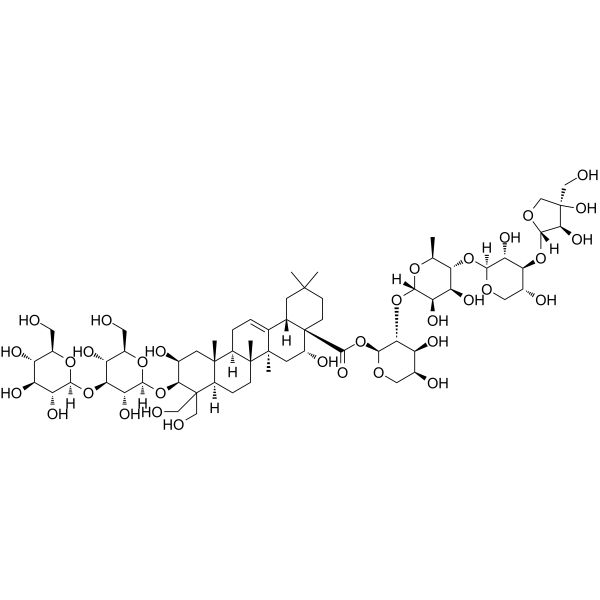
Platycodin D2 is an orally active triterpenoid saponin found in Platycodon grandiflorum. Platycodin D2 induces mitophagy in cancer cells through NIX, thereby activating the P21/CyclinA2 pathway and promoting cell senescence. Platycodin D2 induces mitochondrial dysfunction, enhances autophagy, inhibits hepatocellular carcinoma cell proliferation, and exhibits anti-tumor activity against multiple cancer cell types. Platycodin D2 promotes mRNA expression of T-bet, GATA-3, Th1 cytokines IL-2 and IFN-γ, and Th2 cytokines IL-4 and IL-10, enhances splenocyte proliferation, and acts as a vaccine adjuvant with low rabbit red blood cell hemolytic activity. Platycodin D2 induces mitochondrial ROS production, incomplete autophagy, and ferroptosis to inhibit breast cancer cell proliferation. Platycodin D2 can be used for the research of cancer, inflammation and immunology .
loading...
    loading...
Cat. No.: HY-164412
CAS No.: 85082-02-6
Target:  

Endogenous Metabolite

Research Areas:  

Neurological Disease

Phosphatidylcholine (C18:2,C20:4) is a phosphatidylcholine species containing linoleic acid (C18:2) and arachidonic acid (C20:4) as fatty acid components, that can be isolated from egg yolk, red blood cell membranes of rat, rabbit, human, and dog. Phosphatidylcholine (C18:2,C20:4) can be used as a biomarker for the research of Alzheimer's disease .
loading...
    loading...
Cat. No.: HY-177123
CAS No.: 2922808-66-8
Target:  

Complement System

Research Areas:  

Inflammation/Immunology

Refinicopan is a complement factor D inhibitor with an IC50 of 10 nM. Refinicopan inhibits hemolysis of rabbit red blood cells. Refinicopan can be used to study diseases mediated by complement factor D .
loading...
    loading...
Cat. No.: HY-W584165
CAS No.: 13983-17-0
Wollastonite is a white, chain-structured pyroxene silicate mineral with biocompatibility, biodegradability, osteogenicity and antibacterial properties. Wollastonite induces transient pulmonary inflammatory responses, reversible alveolar macrophage responses, early inflammatory/proliferative mesothelial cell responses, ROS production, and mild chronic pulmonary interstitial inflammation in rats. Wollastonite induces osteogenic differentiation, promotes bone growth, supports angiogenesis, and facilitates the formation of hydroxycarbonate apatite on its surface. Wollastonite enhances the strength, bioactivity and biodegradability of hydroxyapatite scaffolds, and is used to construct porous bone tissue engineering scaffolds. Wollastonite is applied in research related to diseases such as bronchitis, decreased lung function and bone defects .
loading...
    loading...
Cat. No.: HY-P2995C
Rabbit Hemoglobin is a hemoglobin derived from rabbit. Hemoglobin is a iron-containing protein in red blood cells with oxygen binding properties. Hemoglobin is an inducer of HO-1. Hemoglobin consits of heme, which binds to oxygen. Hemoglobin also transports other gases, such as carbon dioxide, nitric oxide, hydrogen sulfide and sulfide. Hemoglobin absorbs unneeded oxygen in tissues, as an antioxidant .
loading...
    loading...
Cat. No.: HY-162818
Research Areas:  

Infection

Antibacterial agent 237 (compound Ru-8) is a bacteriostatic agent for Staphylococcus aureus, with MIC of 0.78-1.56 μg/mL. Antibacterial agent 237 destroys bacterial cell membranes, changes their permeability, and induces bacteria to produce Reactive Oxygen Species, leading to bacterial death without causing drug resistance. Antibacterial agent 237 has low hemolytic toxicity to rabbit red blood cells and Raw 264.7 cells, and has significant antibacterial effects against Staphylococcus aureus in mouse skin wound infection models and Bacillus major larvae infection models .
loading...
    loading...
Cat. No.: HY-108031
CAS No.: 1163-37-7
Research Areas:  

Neurological Disease

Moxaverine hydrochloride is a phosphodiesterase (PDE) inhibitor. Moxaverine hydrochloride also interacts with calmodulin (calmodulin), thereby enhancing the inhibition of calmodulin-dependent PDE. Moxaverine hydrochloride can be used in studies related to microcirculation regulation and ocular tissue distribution .
loading...
    loading...
Cat. No.: HY-P11915
Research Areas:  

Inflammation/Immunology

GG13 is an anti-inflammatory peptide. GG13 reduces the expression of STAT1, NOS2, COX2, and CD40. GG13 decreases the expression and secretion of iNOS and TNF-α proteins. GG13 is applicable to the research of inflammatory diseases .
loading...
    loading...

