
1. Search Result
Search Result
Results for "

retinal lesions

" in MedChemExpress (MCE) Product Catalog:

12

Inhibitors & Agonists

2

Peptides

4

Natural
Products

2

Click Chemistry

1

Oligonucleotides

Targets Recommended:
Cat. No. 상품명 Target 연구분야 Chemical Structure
  • HY-B1745
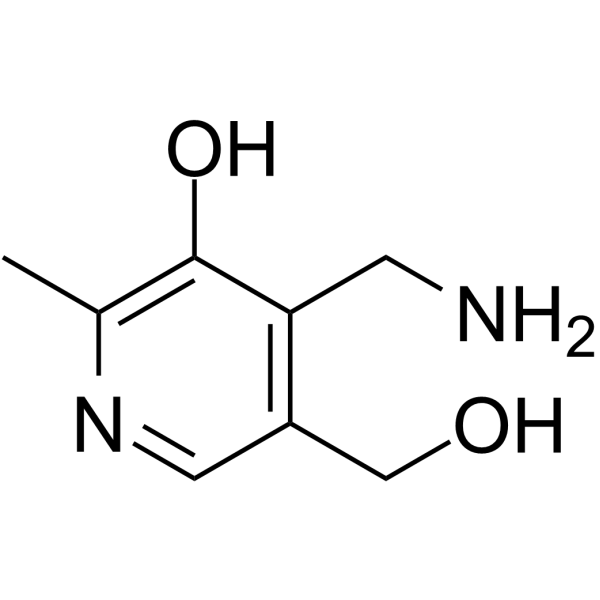
    Pyridoxylamine
    5+ Cited Publications

    Endogenous Metabolite Metabolic Disease
    Pyridoxylamine is an advanced glycation end production (AGEs) and lipoxidation end products (ALEs) inhibitor, to protect against diabetes-induced retinal vascular lesions.
    Pyridoxylamine
  • HY-P10936A

    Aquaporin Neurological Disease Inflammation/Immunology
    AQP4 (201-220) TFA is an encephalitogenic epitope of AQP-4. AQP4 (201-220) TFA can induce experimental autoimmune encephalomyelitis (EAE) (characterized by midline lesions in the brain, retinal pathology, and lesions at the grey matter/white matter border zone in the spinal cord). AQP-4 is a target antigen in neuromyelitis optica .
    AQP4 (201-220) TFA
  • HY-B1745A
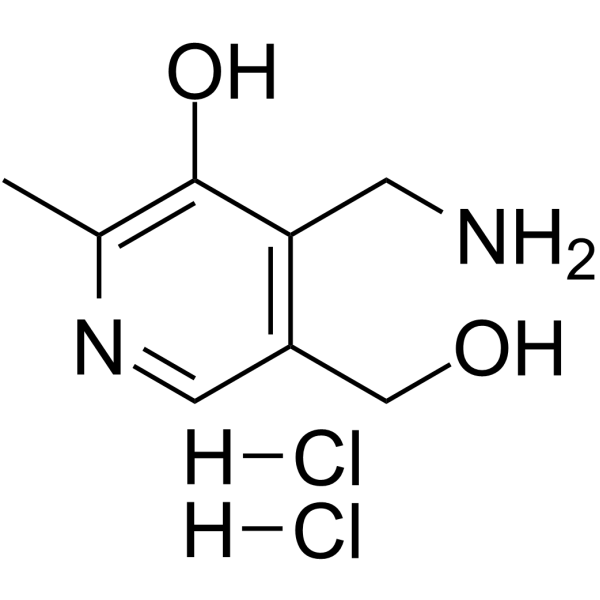
    Pyridoxylamine dihydrochloride
    5+ Cited Publications

    Endogenous Metabolite Metabolic Disease
    Pyridoxylamine dihydrochloride is an advanced glycation end production (AGEs) and lipoxidation end products (ALEs) inhibitor, to protect against diabetes-induced retinal vascular lesions .
    Pyridoxylamine dihydrochloride
  • HY-148457

    Izervay

    Complement System Infection Neurological Disease Inflammation/Immunology
    Avacincaptad pegol (Izervay) is a selective inhibitor targeting complement component C5, and is a pegylated ribonucleic acid aptamer. Avacincaptad pegol inhibits the cleavage of C5 into pro-inflammatory C5a and C5b, which forms the membrane attack complex (C5b-9), thereby reducing inflammatory cell recruitment and retinal cell damage. Avacincaptad pegol can slow the growth of geographic atrophy (GA) lesions and reduce the risk of persistent vision loss. Avacincaptad pegol can be used in research of geographic atrophy associated with age-related macular degeneration (AMD) and has been approved by the FDA .
    Avacincaptad pegol
  • HY-P10936

    Aquaporin Neurological Disease Inflammation/Immunology
    AQP4 (201-220) is an encephalitogenic epitope of AQP-4. AQP4 (201-220) can induce experimental autoimmune encephalomyelitis (EAE) (characterized by midline lesions in the brain, retinal pathology, and lesions at the grey matter/white matter border zone in the spinal cord). AQP-4 is a target antigen in neuromyelitis optica .
    AQP4 (201-220)
  • HY-B1745R

    Reference Standards Endogenous Metabolite Metabolic Disease
    Pyridoxylamine (Standard) is the analytical standard of Pyridoxylamine. This product is intended for research and analytical applications. Pyridoxylamine is an advanced glycation end production (AGEs) and lipoxidation end products (ALEs) inhibitor, to protect against diabetes-induced retinal vascular lesions.
    Pyridoxylamine (Standard)
  • HY-178919

    Formyl Peptide Receptor (FPR) Apoptosis Bacterial Inflammation/Immunology
    N-19004 is a FPR1 antagonist. N-19004 shows broad-spectrum antibacterial effects against a variety of pathogens. N-19004 exhibits significant retinal protective effects in the rd10 mouse model of retinitis pigmentosa (RP). N-19004 can attenuate retinal dysfunction, mitigate rod and cone degeneration, and reduce immune cell activation, gliosis, inflammation, oxidative stress, and apoptosis. N-19004 can reduce the size of laser-induced choroidal lesions and promote edema absorption through dual anti-inflammatory and anti-angiogenic effects. N-19004 can be used for the research of retinal degenerative diseases such as retinitis pigmentosa .
    N-19004
  • HY-111159

    Autophagy Neurological Disease
    CP-467688 is an orally active retinotoxic agent. CP-467688 induces increased lysosome volume, phagocytosis inhibition and autophagy inhibition in retinal cells. CP-467688 is applicable to the research of retinopathy .
    CP-467688
  • HY-B1745AR

    Reference Standards Endogenous Metabolite Metabolic Disease
    Pyridoxylamine (dihydrochloride) (Standard) is the analytical standard of Pyridoxylamine (dihydrochloride). This product is intended for research and analytical applications. Pyridoxylamine dihydrochloride is an advanced glycation end production (AGEs) and lipoxidation end products (ALEs) inhibitor, to protect against diabetes-induced retinal vascular lesions .
    Pyridoxylamine dihydrochloride (Standard)
  • HY-184141

    VEGFR Neurological Disease
    EYE1090 is an orally active VEGFR2 inhibitor with an IC50 of 3 nM. EYE1090 inhibits angiogenesis, endothelial migration, VEGFR2-induced retinal leakage, and reduces choroidal neovascularization lesion size in mice. EYE1090 can be used for the research of age-related macular degeneration, diabetic retinopathy, choroidal neovascularization .
    EYE1090
  • HY-182372

    Epoxide Hydrolase Neurological Disease
    SH-11037 is a potent inhibitor of soluble epoxide hydrolase (sEH) and docks to the substrate binding cleft in the sEH hydrolase domain. SH-11037 dose-dependently suppresses angiogenesis in the choroidal sprouting assay ex vivo and inhibited ocular developmental angiogenesis in zebrafish larvae. SH-11037 reduces choroidal neovascularisation lesion volume in the laser-induced CNV mouse model. SH-11037 synergises with anti-VEGF treatments in vitro and in vivo. SH-11037 induces G2/M phase blockade and retains retinal endothelial cell viability at active concentrations without overt toxicity. SH-11037 can be used for the research of retinal neovascularization and ocular neovascularization .
    SH-11037
  • HY-184142

    VEGFR Cardiovascular Disease Neurological Disease
    EYE1118 is an orally active, photoactivatable VEGFR2 inhibitor without acute hepatotoxicity. EYE1118 mediates light-enhanced inhibition via azide-functionalized receptor binding, and can utilize light-guided targeting to regulate its biodistribution in vivo. EYE1118 effectively inhibits angiogenesis, endothelial cell migration, VEGF-induced retinal leakage, and the size of choroidal neovascular lesions. EYE1118 has been applied in studies related to age-related macular degeneration, diabetic retinopathy, and choroidal neovascularization .
    EYE1118

온라인 문의

Your information is safe with us. * Required Fields.

호칭


Country or Region *

고객명 *


회사명 *

Department *


메일주소 *


상품명 *

Cat. No.


Requested quantity *

전화번호 *


비고

온라인 문의

Inquiry Information

상품명:
Cat. No.:
수량:
MCE Japan Authorized Agent:

