9 Results for "

root length

" in MedChemExpress (MCE) Product Catalog:
Products (9)

9 Results for "root length" in MCE Product Catalog:

Cat. No.: HY-W116336D
CAS No.: 1314-13-2
Zinc oxide, <100 nm particle size is a nitrate reductase modulator and growth promoter with plant stress resistance activity and oral toxicity. Zinc oxide, <100 nm particle size acts as a nutrient source for maize plants. By enhancing nitrate reductase activity and reducing free proline levels, it significantly improves plant height, root length and dry matter weight of maize, and its growth-promoting effect is comparable to that of traditional zinc sulfate fertilizer. Zinc oxide, <100 nm particle size induces anemia-related and persistent tissue inflammatory damage, leading to obvious histopathological adverse reactions in the stomach, pancreas, eyes and prostate of rats. Zinc oxide, <100 nm particle size acts as a non-toxic antibacterial agent and selective cytotoxin against multiple bacteria, fungi and spores .
loading...
    loading...
Cat. No.: HY-W015810
CAS No.: 617-94-7
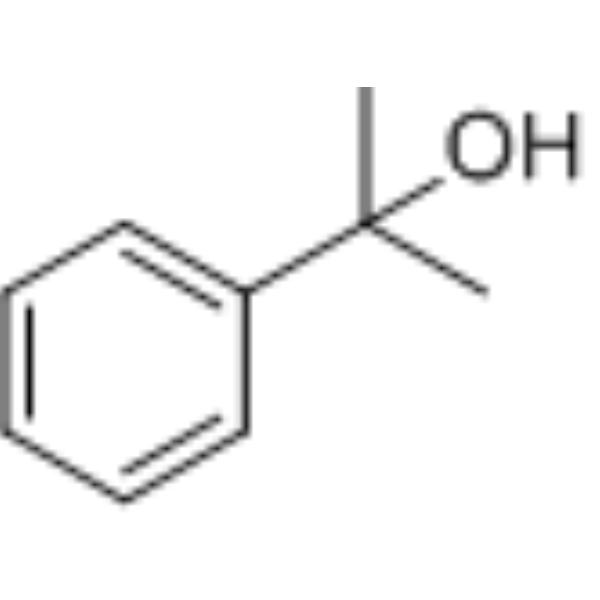
2-Phenyl-2-propanol is a volatile signaling compound released by rhizosphere microorganisms, and also a key product of the selective oxidation of cumene. 2-Phenyl-2-propanol alters primary root structure, regulates the expression of auxin and (±)-Jasmonic acid (HY-122464) responsive genes, and affects cell division. 2-Phenyl-2-propanol reduces the primary root length, lateral root number, lateral root density, and aboveground fresh weight of *Arabidopsis thaliana*. 2-Phenyl-2-propanol is commonly used in research related to cosmetics, pesticides, pharmaceuticals and other fields .
loading...
    loading...
Cat. No.: HY-34449
CAS No.: 13061-96-6
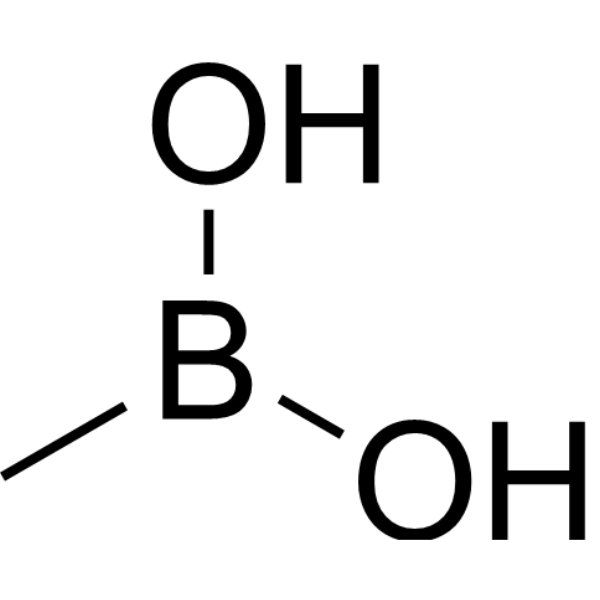
Methylboronic acid is a synthetic boric acid. Methylboronic acid alleviates boron deficiency symptoms in Arabidopsis thaliana and promotes the growth of taproots, lateral roots, root hairs and leaf surface area. Methylboronic acid is less toxic than boric acid at high concentrations, only causing a slight shortening of the taproot length in Arabidopsis thaliana without reducing the total chlorophyll content. Methylboronic acid can be used in studies related to boron deficiency in plants .
loading...
    loading...
Cat. No.: HY-34449S
CAS No.: 1332481-37-4
Methylboronic acid-d3 is the deuterated-labeled Methylboronic acid (HY-34449). Methylboronic acid is a synthetic boric acid. Methylboronic acid alleviates boron deficiency symptoms in Arabidopsis thaliana and promotes the growth of taproots, lateral roots, root hairs and leaf surface area. Methylboronic acid is less toxic than boric acid at high concentrations, only causing a slight shortening of the taproot length in Arabidopsis thaliana without reducing the total chlorophyll content. Methylboronic acid can be used in studies related to boron deficiency in plants .
loading...
    loading...
Cat. No.: HY-178358
CAS No.: 2352652-76-5
Target:  

Drug Derivative

Research Areas:  

Others

JAX-44 is a potent root architecture modulator. JAX-44 maintains primary root length while substantially increasing lateral root numbers, thereby optimizing the plant’s overall root system. JAX-44 is the metabolic precursor of JAX-77 (HY-178359) and can be converted to Indole-3-butyric acid (IBA) (HY-N0186). JAX-44 can be used for auxin biology and root development research .
loading...
    loading...
Cat. No.: HY-N11950
CAS No.: 58493-47-3
N-Vanillyloctanamide is a capsaicinoid that has the activity of inhibiting the root growth of plant seedlings. N-Vanillyloctanamide significantly reduces the root length of Lactuca sativa (seedling) in a dose-dependent manner .
loading...
    loading...
Cat. No.: HY-178359
CAS No.: 2228278-95-1
Target:  

Drug Derivative

Research Areas:  

Others

JAX-77 is a potent root architecture modulator. JAX-77 maintains primary root length while substantially increasing lateral root numbers, thereby optimizing the plant’s overall root system. JAX-77 is the key intermediate metabolite formed from the hydrolysis of JAX-44 (HY-178358) and can be converted to Indole-3-butyric acid (IBA) (HY-N0186). JAX-77 can be used for auxin biology and root development research .
loading...
    loading...
Cat. No.: HY-W015810R
CAS No.: 617-94-7
2-Phenyl-2-propanol (Standard) is the analytical standard of 2-Phenyl-2-propanol (HY-W015810). This product is intended for research and analytical applications. 2-Phenyl-2-propanol is a volatile signaling compound released by rhizosphere microorganisms, and also a key product of the selective oxidation of cumene. 2-Phenyl-2-propanol alters primary root structure, regulates the expression of auxin and (±)-Jasmonic acid (HY-122464) responsive genes, and affects cell division. 2-Phenyl-2-propanol reduces the primary root length, lateral root number, lateral root density, and aboveground fresh weight of *Arabidopsis thaliana*. 2-Phenyl-2-propanol is commonly used in research related to cosmetics, pesticides, pharmaceuticals and other fields .
loading...
    loading...
Cat. No.: HY-N9181
CAS No.: 26905-70-4
4'-Chloro-1'-(5-penta-1,3-diyn-1-yl-2-thienyl)-but-2'-yn-3'-ol is a phytotoxic polyacetylene compound. 4'-Chloro-1'-(5-penta-1,3-diyn-1-yl-2-thienyl)-but-2'-yn-3'-ol can be isolated from the roots and root exudates of Acroptilon repens. It exhibits phytotoxicity and reduces the root length of lettuce .
loading...
    loading...

