12 Results for "

specific fluorescence enhancement

" in MedChemExpress (MCE) Product Catalog:
Products (12)

12 Results for "specific fluorescence enhancement" in MCE Product Catalog:

Cat. No.: HY-D0006
CAS No.: 1662-01-7
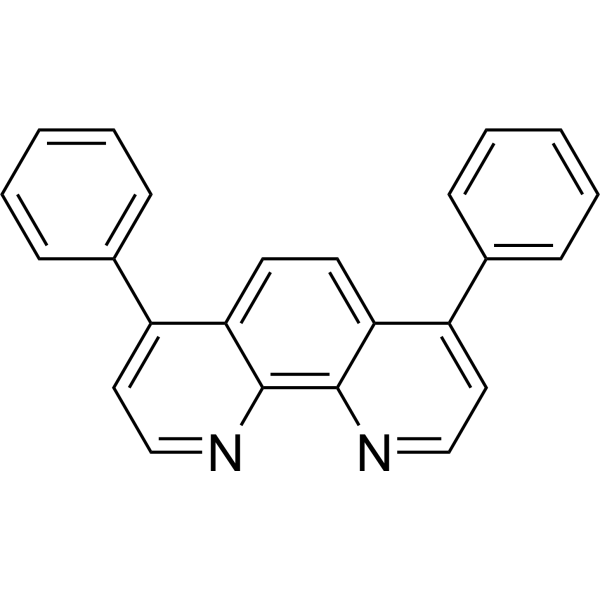
Bathophenanthroline is a nitrogen-containing organic ligand that can form stable complexes with transition metal ions such as Ru 2+. In proteomics, Bathophenanthroline is often used for in-gel protein staining. The negatively charged sulfonic acid groups of Bathophenanthroline interact electrostatically with the positively charged amino acid residues of proteins, thereby achieving specific binding to proteins and enhancing the fluorescent signal of detection. Bathophenanthroline can be used for protein separation and detection in SDS-PAGE gels in the field of proteomics, as well as other fluorescence studies[1]. Ex/Em=532 nm/610 nm[1].
loading...
    loading...
Cat. No.: HY-148796
CAS No.: 1311570-07-6
Synonyms: GE3126
Target:  

Fluorescent Dye

Research Areas:  

Others

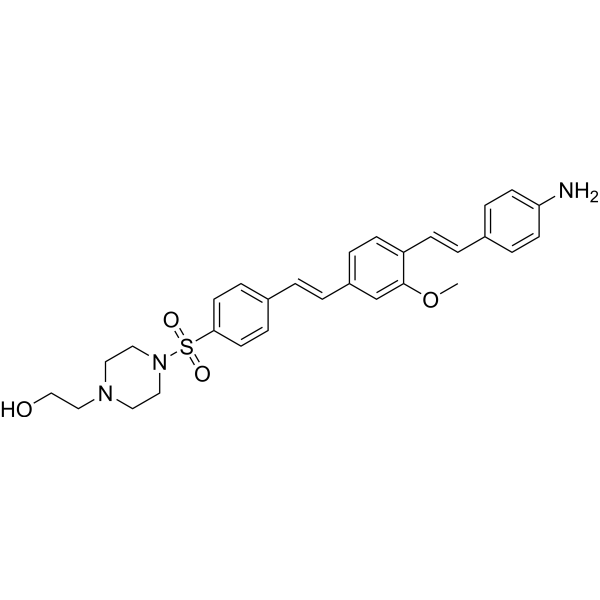
Rizedisben (GE3126) is a fluorophore that can be used in fluorescence image-guided surgery. Rizedisben reduces non-specific adipose tissue fluorescence intensity and enhances nerve visibility .
loading...
    loading...
Cat. No.: HY-D2964
CAS No.: 1612240-27-3
NBzF-BG is a novel H2O2-specific fluorescent probe. NBzF-BG shows visible absorption centered at 505 nm and weak fluorescence with an emission maximum at 525 nm. NBzF-BG is covalently and selectively conjugated with the SNAP-tag protein, leading to formation of the fluorophore-protein conjugate (SNAP-NBzF). SNAP-NBzF rapidly reacts with H2O2 and thereby shows an enhancement in fluorescence .
loading...
    loading...
Cat. No.: HY-P10073
CAS No.: 636566-40-0
Target:  

Fluorescent Dye

Research Areas:  

Others

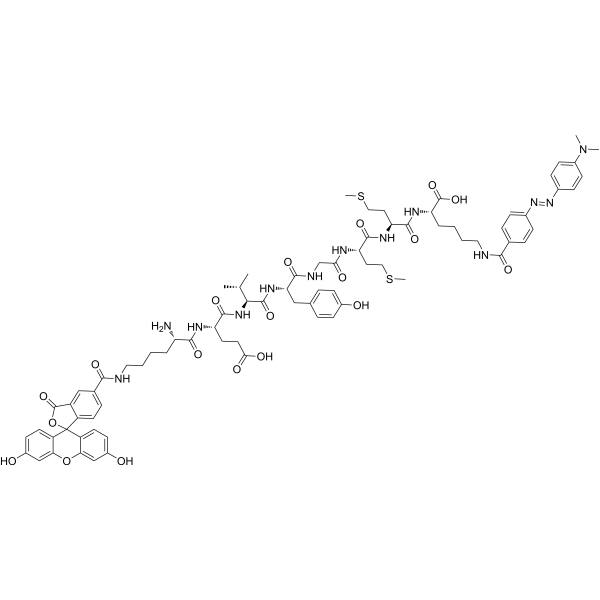
Calpain-1 substrate, fluorogenic serves as a sensitive and specific substrate for calpain-1 that cleaves Tyr-Gly bond and results in enhanced fluorescence .(Ex/Em = 490 nm/518 nm)
loading...
    loading...
Cat. No.: HY-D1549
CAS No.: 1181844-41-6
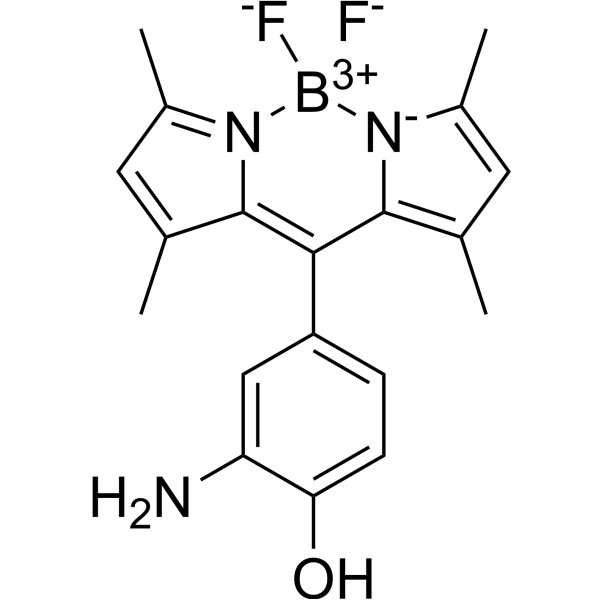
o-Pah is a BODIPY derivative with an -NH2 and -OH substituted meso-Ph group. o-Pah exhibits metal-induced J-aggregation in the presence of Cu 2+ and a specific fluorescence enhancement for Hg 2+ (Ex/Em=483/(495-600) nM) .
loading...
    loading...
Cat. No.: HY-D2639
CAS No.: 3032077-04-3
TPE-PY is a fluorescent dye targeting mitochondria, which has cationic and lipophilic characteristics, enabling specific targeting of mitochondria. TPE-PY functions through the aggregation-induced emission (AIE) mechanism. TPE-PY mechanism of action is based on the restriction of intramolecular rotation (RIR), which enhances fluorescence in the aggregated state. TPE-PY is mainly used in the field of biological imaging, especially for the specific staining of mitochondria in living cells, facilitating the observation of the location, morphology, and quantity of mitochondria .
loading...
    loading...
Cat. No.: HY-D3098
Target:  

Fluorescent Dye

Research Areas:  

Others

Mito‑VR2 is a mitochondria-targeted molecular rotor-type viscosity fluorescent probe with high responsiveness to microenvironmental viscosity, which is suitable for synchronous imaging of mitochondrial viscosity during autophagy in living cells. Mito-VR2 achieves specific targeting of mitochondria through its hydrophobic cationic structure, and its fluorescence intensity responds only to microenvironmental viscosity. Mito-VR2 emits almost no fluorescence in low-viscosity media, but its fluorescence emission is significantly enhanced in high-viscosity environments .
loading...
    loading...
Cat. No.: HY-D3361
Target:  

Fluorescent Dye

Research Areas:  

Others

JF639-HTL is a deep-red fluorescent dye belonging to the Janelia Fluor series and also a HaloTag ligand. JF639-HTL contains a methoxy group as the R substituent, which forms a specific covalent bond with HaloTag fusion proteins. JF639-HTL is fluorogenic, exhibiting low background fluorescence in solution and a significant fluorescence enhancement upon binding to proteins. It also possesses cell permeability and excellent photostability. JF639-HTL can be used in studies related to fluorescent labeling, localization tracking, and pulse-chase imaging of proteins in living cells .
loading...
    loading...
Cat. No.: HY-122802
CAS No.: 1838592-80-5
Research Areas:  

Cancer

TPP2a bromide is a thioredoxin reductase (TrxR) inhibitor with an IC50 value of 1.16 μM, and also acts as a TrxR-specific fluorescent probe with environment-sensitive fluorescence. TPP2a bromide selectively forms covalent interactions with subcellular mitochondrial TrxR, thereby modifying its Sec498 residue. TPP2a bromide can increase the level of reactive oxygen species (ROS) in cells and induce mitochondrial apoptosis in cancer cells. TPP2a bromide exhibits enhanced cytotoxicity against cancer cell lines. TPP2a bromide can be used in research related to cervical cancer, lung cancer, etc .
loading...
    loading...
Cat. No.: HY-D3119
CAS No.: 2246946-49-4
Research Areas:  

Others

MitoAIE1 is a Fluorescent probe for mitochondrial viscosity detection. MitoAIE1 contains a pyridinium structural unit, which endows it with mitochondria-targeting specificity. The detection mechanism of this probe is based on aggregation-induced emission (AIE): in low-viscosity media such as PBS buffer, intramolecular rotation leads to non-radiative energy dissipation, resulting in only weak fluorescence; however, in high-viscosity environments such as the mitochondrial matrix or the vicinity of the inner mitochondrial membrane, such intramolecular motion is restricted, thereby significantly enhancing its fluorescent signal; in addition, this probe is not interfered by changes in microenvironment polarity and pH. Its emission wavelength is 625 nm, with absorption peaks at 325 nm and 450 nm; when transferred from low-viscosity PBS to high-viscosity 99% glycerol, its fluorescence intensity at 625 nm can be increased by 38-fold. It can be used to monitor changes in mitochondrial viscosity during processes such as Stauroporine (HY-15141)-induced apoptosis and starvation-induced mitophagy in live cells, and has good biocompatibility .
loading...
    loading...
Cat. No.: HY-D3091
CAS No.: 2757681-99-3
Target:  

Fluorescent Dye

Research Areas:  

Others

NRLyso is a lysosome-targeted solvatochromic fluorescent probe derived from Nile Red (HY-D0718). It can localize to lysosomes and is applicable for imaging lysosomal lipid order and polarity. The excitation wavelength of NRLyso is 520 nm, and its emission maximum varies with the environment. NRLyso partitions well into lipid membranes: it exhibits fluorescence enhancement and emission blue-shift in low-polarity, tightly packed lipid environments, while shows emission red-shift in more polar, disordered lipid environments. NRLyso maintains organelle specificity under oxidative and hyperosmotic stress conditions, and can detect changes in lysosomal lipid order and polarity in response to these stresses, cholesterol extraction, and cholesterol enrichment .
loading...
    loading...
Cat. No.: HY-D3120
CAS No.: 2246946-53-0
Target:  

Fluorescent Dye

Research Areas:  

Others

LysoAIE2 is a Fluorescent probe for lysosomal viscosity detection and live-cell imaging. Its detection mechanism relies on the aggregation-induced emission effect: it exhibits only weak fluorescence in non-viscous media; in viscous environments, restricted intramolecular motion inhibits non-radiative energy dissipation pathways, thereby significantly enhancing fluorescence intensity. It achieves specific targeting of lysosomes through the proton acceptor property of its indole ring structure, while its hydroxyl group endows it with excellent water solubility. This probe is basically unaffected by microenvironmental polarity and pH within the range of pH 4.0 to pH 8.0, which avoids interference from these factors in viscosity measurement. LysoAIE2 has an emission wavelength of 570 nm. It can be used to monitor lysosomal viscosity changes during processes such as Dexamethasone (HY-14648)-induced lysosomal migration and starvation-induced mitophagy in live cells; at concentrations up to 40 μM, cell viability remains above 80%, demonstrating excellent biocompatibility .
loading...
    loading...
  • 1

