1. Search Result
Search Result
Results for "

stapled peptide

" in MedChemExpress (MCE) Product Catalog:

17

Inhibitors & Agonists

17

Peptides

Cat. No. Product Name Target Research Areas Chemical Structure
  • HY-P10925A

    (Z)-FOG-001; I-67

    β-catenin Cancer
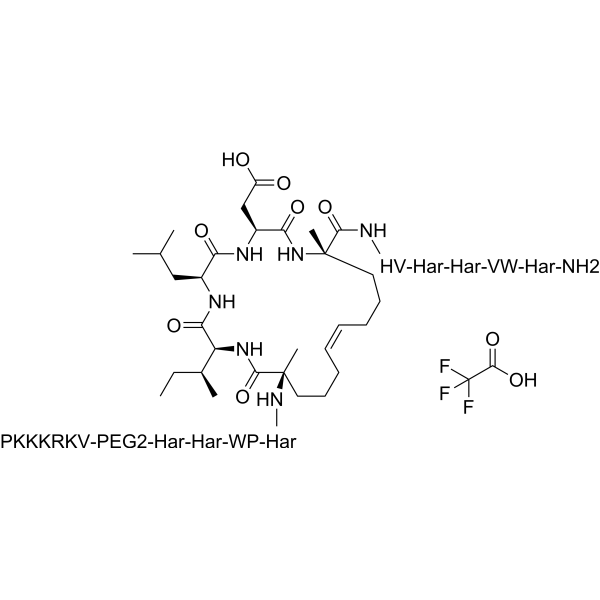
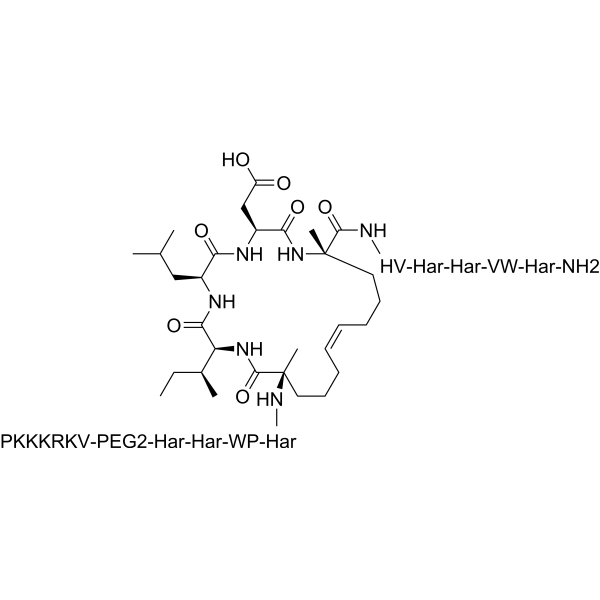
    (Z)-Zolucatetide (I-67) is a β-catenin inhibitor with IC50 ≤50 nM. (Z)-Zolucatetide's sequence is Ac-PL3-Asp-Npg-B5-Asp-3COOHF-Aib-Ala-Phe-Lys3-PyrS2-3Thi-BztA-GlnR3-Ala-NH2. (Z)-Zolucatetide can be used for cancer research .
    (Z)-Zolucatetide
  • HY-P5960

    PTBP1 α3-helix derived peptide P6 TFA

    DNA/RNA Synthesis Others
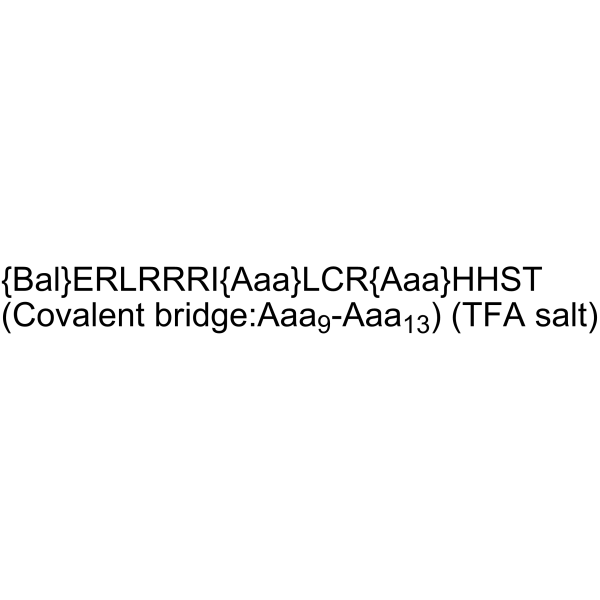
    PTBP1-RNA-binding inhibitor P6 (PTBP1 α3-helix derived peptide P6) TFA is a stapled peptide inhibitor of the splicing factor PTBP1, which inhibits alternative splicing events regulated by PTBP1. PTBP1 binds RNA through its RNA recognition motif .
    PTBP1-RNA-binding inhibitor P6 TFA
  • HY-W004864

    Amino Acid Derivatives Others
    Fmoc-(S)-2-(4-pentenyl) Ala-OH is an Fmoc-protected unnatural amino acid. Fmoc-(S)-2-(4-pentenyl) Ala-OH can be used for polypeptide synthesis, such as NYAD-13 (HY-P10834) .
    Fmoc-(S)-2-(4-pentenyl)Ala-OH
  • HY-P10392AF

    Wnt β-catenin Cancer
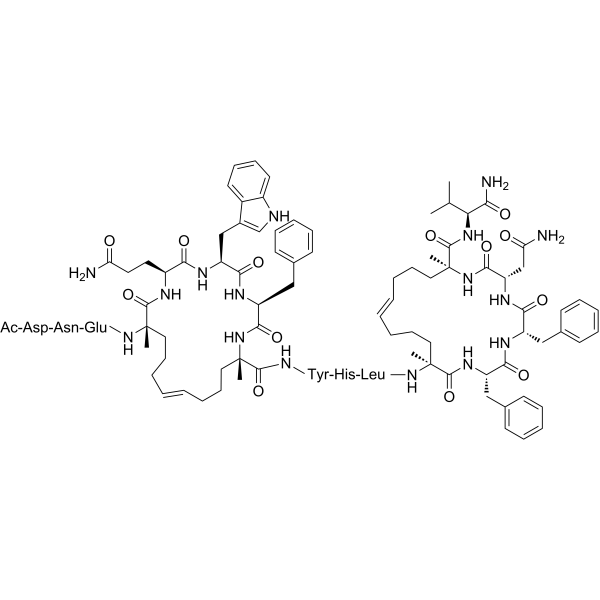
    fStAx-35R TFA is the hydrocarbon-stapled peptide. fStAx-35R TFA inhibits Wnt/β-catenin signaling pathway by disrupting the β-catenin-TCF interaction. fStAx-35R TFA can be used in cancer research .
    fStAx-35R TFA
  • HY-W006886

    Amino Acid Derivatives Others
    Fmoc-(R)-2-(7-octenyl) Ala-OH is an unnatural Fmoc-protected amino acid and modification module. Fmoc-(R)-2-(7-octenyl) Ala-OH serves as a key building block for all-hydrocarbon cross-linking modification of antimicrobial peptides, and facilitates the generation of stapled peptide derivatives. When introduced into specific sites of the parent peptide, Fmoc-(R)-2-(7-octenyl) Ala-OH effectively increases the α-helix content of the peptide chain, thereby significantly enhancing its antimicrobial activity and proteolytic stability. Fmoc-(R)-2-(7-octenyl) Ala-OH is widely used in research on bacterial infections and the development of related antimicrobial agents . Stapled peptide is a specially chemically modified polypeptide. It locks the peptide chain into a stable α-helical structure by introducing a "staple"-like chemical bridge (usually an all-carbon backbone) at specific positions of the peptide chain.
    Fmoc-(R)-2-(7-octenyl)Ala-OH
  • HY-P11288A

    PACAP Receptor Apoptosis Cancer
    ANT308 TFA is a vasoactive intestinal polypeptide (VIP receptor) antagonist. ANT308 TFA significantly enhances the activation and proliferation of T cells. ANT308 TFA inhibits the migration and metastasis, induces apoptosis of melanoma tumor cells by inhibiting VIP-VPAC2 signaling and reducing the expression of MCAM and N-cadherin. ANT308 TFA can be used for the study of acute myeloid leukemia (AML) and uveal melanoma (UVM) .
    ANT308 TFA
  • HY-P11288

    PACAP Receptor Apoptosis Cancer
    ANT308 is a vasoactive intestinal polypeptide (VIP receptor) antagonist. ANT308 significantly enhances the activation and proliferation of T cells. ANT308 inhibits the migration and metastasis, induces apoptosis of melanoma tumor cells by inhibiting VIP-VPAC2 signaling and reducing the expression of MCAM and N-cadherin. ANT308 can be used for the studies of acute myeloid leukemia (AML) and uveal melanoma (UVM) .
    ANT308
  • HY-P10392B

    β-catenin Wnt Cancer
    aStAx-35R TFA, a stapled peptide, antagonizes nuclear form of β-catenin and inhibits Wnt signaling. aStAx-35R TFA inhibits competitively the binding of β-catenin to TCF4. aStAx-35R TFA selectively induces growth inhibition of Wnt-dependent cancer cells .
    aStAx-35R TFA
  • HY-P2272

    Wnt β-catenin Cancer
    NLS-StAx-h is a selective, cell permeable, stapled peptide Wnt signaling inhibitor with an IC50 of 1.4 μM. NLS-StAx-h efficiently inhibits β-catenin-transcription factor interactions. NLS-StAx-h shows anti-proliferation of cancer cells .
    NLS-StAx-h
  • HY-P2272A
    NLS-StAx-h TFA
    1 Publications Verification

    Wnt β-catenin Cancer
    NLS-StAx-h TFA is a selective, cell permeable, stapled peptide Wnt signaling inhibitor with an IC50 of 1.4 μM. NLS-StAx-h TFA efficiently inhibits β-catenin-transcription factor interactions. NLS-StAx-h TFA shows anti-proliferation of cancer cells .
    NLS-StAx-h TFA
  • HY-P10392

    β-catenin Wnt Cancer
    aStAx-35R, a stapled peptide, antagonizes nuclear form of β-catenin and inhibits Wnt signaling. aStAx-35R inhibits competitively the binding of β-catenin to TCF4. aStAx-35R selectively induces growth inhibition of Wnt-dependent cancer cells .
    aStAx-35R
  • HY-P11255

    MDM-2/p53 Cancer
    SPDI-48-T1 is a lysine-stapled peptide. SPDI-48-T1 exhibits discernible binding affinities for MDM2 and MDMX, with Kd values of 396 nM and 456 nM, respectively. SPDI-48-T1 exhibits anticancer activity against breast cancer, colorectal cancer, non-small cell lung cancer, cervical cancer, and malignant melanoma .
    SPDI-48-T1
  • HY-P10556

    Bacterial Infection
    (KFF)3K is a cell penetrating peptide that can promote the absorption of other antibiotics by disrupting the outer membrane of bacteria. (KFF)3K can be introduced into a hydrocarbon scaffold to induce its antibacterial properties, making it an effective antimicrobial peptide. (KFF)3K can be used in the development of new antimicrobial agents .
    (KFF)3K
  • HY-P10386

    Bcl-2 Family Cancer
    155H1 (Compound 11) is a stapled peptide, that covalently binds hMcl1 (172-323) with IC50 of 18 nM .
    155H1
  • HY-136197

    Ras Cancer
    StRIP16, bioavailable StRIP3 analogue, is a double-stapled peptide which can bind to Rab8a GTPase, with a Kd of 12.7 μM .
    StRIP16
  • HY-P2203A

    Notch Cancer
    SAHM1 TFA is a Notch pathway inhibitor. SAHM1 TFA stabilizes hydrocarbon-stapled alpha helical peptide. SAHM1 TFA targets the protein-protein interface and prevents Notch complex assembly.
    SAHM1 TFA
  • HY-P10843

    Estrogen Receptor/ERR Cancer
    R4K1 is a cell-permeable stapled peptide. R4K1 binds to the estrogen receptor (ER) α with high affinity and inhibits its interaction with coactivators. R4K1 can enter breast cancer cells to regulate gene transcription and inhibit cell proliferation. R4K1 can be used in the study of cancer .
    R4K1

Inquiry Online

Your information is safe with us. * Required Fields.

Salutation


Country or Region *

Applicant Name *


Organization Name *

Department *


Email Address *


Product Name *

Cat. No.


Requested quantity *

Phone Number *


Remarks

Inquiry Online

Inquiry Information

Product Name:
Cat. No.:
Quantity:
MCE Japan Authorized Agent:

