

1. Search Result
Search Result
Results for "

titanium

" in MedChemExpress (MCE) Product Catalog:

13

Inhibitors & Agonists

3

Biochemical Assay Reagents

1

Peptides

2

Natural
Products

2

Isotope-Labeled Compounds

Cat. No. Product Name Target Research Areas Chemical Structure
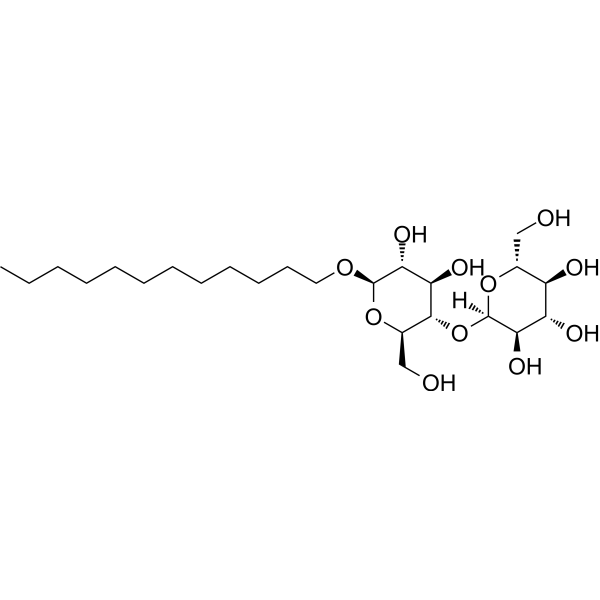
  • HY-128974
    N-Dodecyl-β-D-maltoside
    5 Publications Verification

    Lauryl Maltoside

    DNA/RNA Synthesis Others
    N-Dodecyl-β-D-maltoside (Lauryl Maltoside) is a non-ionic detergent. N-Dodecyl-β-D-maltoside has strong adsorption on alumina, titanium dioxide and hematite. N-Dodecyl-β-D-maltoside can promote the reactivation of various proteins. N-Dodecyl-β-D-maltoside can effectively stabilize photoactive reaction center complexes (RCs) and inhibit the degradation of Rhodopseudomonas spheroides R-26 reaction center in solution. N-Dodecyl-β-D-maltoside can be used for purification and stabilization of RNA polymerase and for detection of protein-lipid interactions .
    N-Dodecyl-β-D-maltoside
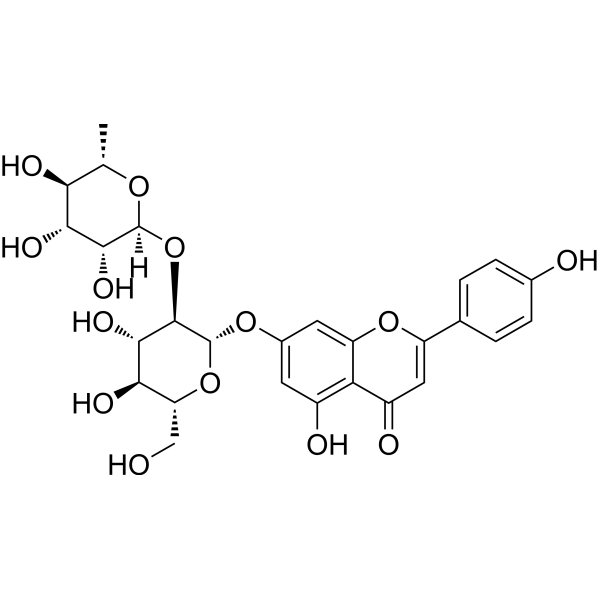
  • HY-N0755

    Insulin Receptor GLUT NF-κB p38 MAPK Autophagy Metabolic Disease Endocrinology Cancer
    Rhoifolin is a flavone glycoside can be isolated from Rhus succedanea. Rhoifolin has anti-diabetic effect acting through enhanced adiponectin secretion, tyrosine phosphorylation of insulin receptor-β and glucose transporter 4 (GLUT 4) translocation. Rhoifolin has an anti-inflammatory action via multi-level regulation of inflammatory mediators. Rhoifolin ameliorates titanium particle-stimulated osteolysis and attenuates osteoclastogenesis via RANKL-induced NF-κB and MAPK pathways. Rhoifolin also has cytotoxic activity against different cancer cell lines .
    Rhoifolin
  • HY-W051271

    titanium dioxide

    Environmental Pollutants Reactive Oxygen Species (ROS) Photosensitizer Others
    Titanium(IV) oxide is a photosensitizer and photocatalyst. Titanium(IV) oxide can be used as a pharmaceutical excipient such as a flow aid, coating agent, sunscreen, colorant, etc. Pharmaceutical excipients or pharmaceutical excipients refer to other chemical substances used in the pharmaceutical process other than the drug ingredients. Pharmaceutical excipients generally refer to inactive ingredients in pharmaceutical preparations that can improve the stability, solubility and processability of pharmaceutical preparations. Pharmaceutical excipients also affect the absorption, distribution, metabolism and elimination (ADME) process of co-administered drugs. Titanium(IV) oxide can use light energy to generate electron-hole pairs to degrade pollutants. Photons excite electrons in TiO2 to generate active oxygen species (such as ·OH and ·O2 -), thereby oxidizing and mineralizing pollutants such as organic compounds and heavy metals. TiO2 can be used in the research of environmental remediation fields such as water treatment, air purification and self-cleaning materials .
    Titanium(IV) oxide
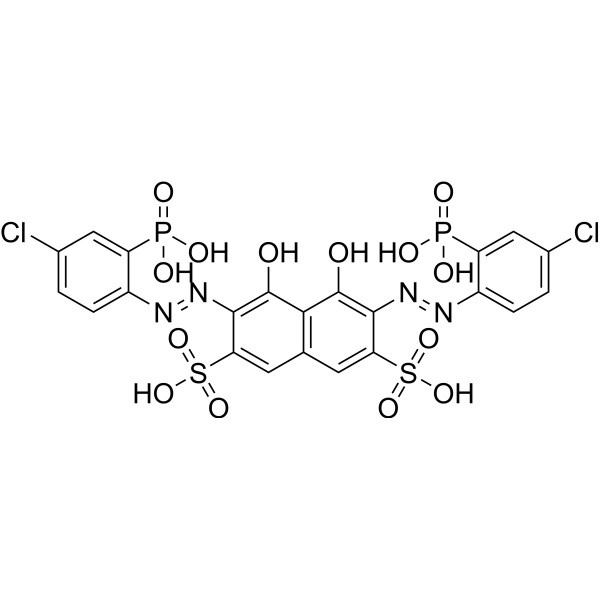
  • HY-W250149

    Biochemical Assay Reagents Cancer
    Chlorophosphonazo III is a cell membrane-permeable contrast agent and spectrophotometric reagent. Chlorophosphonazo III forms stable 1:1 complexes with intracellular calcium, magnesium, uranium, titanium, zirconium, thorium, scandium, equivalent actinides and protactinium. Chlorophosphonazo III generates photoacoustic signals correlated with Ca 2+ concentrations, which is applicable for imaging 3D tumor cell cultures and tumor spheroids. Chlorophosphonazo III exhibits no cytotoxicity, can be used for spectrophotometric detection of target ions, and the absorbance of its complexes remains stable for up to one week within the pH range of 2.2 to 7.0 .
    Chlorophosphonazo III
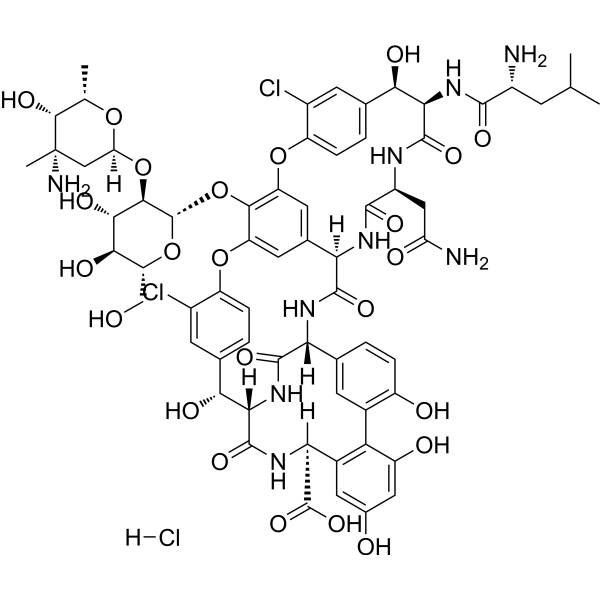
  • HY-B1924
    Norvancomycin monohydrochloride
    1 Publications Verification

    N-Demethylvancomycin monohydrochloride; NVCM monohydrochloride

    Bacterial Infection
    Norvancomycin hydrochloride is a cell wall synthesis inhibitor targeting peptidoglycan precursors of Gram-positive bacteria and cannot pass the blood-brain barrier. Norvancomycin hydrochloride can competitively bind to peptidoglycan precursors, irreversibly inhibit bacterial cell wall synthesis, and exert antibacterial activity. Norvancomycin hydrochloride is mainly used in the study of Gram-positive bacterial infections, especially infections caused by methicillin-resistant Staphylococcus aureus (MRSA) and methicillin-resistant Staphylococcus epidermidis (MRSE). Norvancomycin hydrochloride can also be incorporated into the bionic calcium phosphate coating of titanium implants to enhance antibacterial activity and inhibit postoperative orthopedic infections .
    Norvancomycin monohydrochloride
  • HY-Y0605S1

    Isotope-Labeled Compounds Biochemical Assay Reagents Phosphatase Metabolic Disease
    Potassium deuteroxide, 99.5%D, 40 wt. %in D2O is the deuterium labeled Potassium hydroxide (HY-Y0605C). 95% Potassium hydroxide is an alkaline reagent. 95% Potassium hydroxide can form an intermediate potassium titanate (K2Ti4O9) layer on a pure titanium substrate. 95% Potassium hydroxide can modify titanium substrates. Modification with 95% Potassium hydroxide increases Alkaline phosphatase expression. 95% Potassium hydroxide promotes the proliferation of mesenchymal stem cells cultured on titanium substrates. 95% Potassium hydroxide can be used in osteogenic differentiation research .
    Potassium deuteroxide, 99.5%D, 40 wt. %in D2O
  • HY-W004048

    Sodium p-toluenesulfonate

    Environmental Pollutants Drug Intermediate Others
    Sodium 4-methylbenzenesulfonate (Sodium p-toluenesulfonate) is a drug intermediate, capable of being used to synthesize xanthine oxidase inhibitors. Sodium 4-methylbenzenesulfonate can be used as a dopant to construct a polypyrrole (PPy) conductive film on the surface of titanium (Ti) implants .
    Sodium 4-methylbenzenesulfonate
  • HY-W688732

    Biochemical Assay Reagents Others
    2-Chloro-4,4,5,5-tetramethyl-1,3,2-dioxaphospholane is a biochemical reagent. 2-Chloro-4,4,5,5-tetramethyl-1,3,2-dioxaphospholane serves as a phosphorylation reagent for alcohols and heteroatoms, which is used in the synthesis of glycosyl donors and ligands, and also applied in the analytical research of derivatized lignin samples. 2-Chloro-4,4,5,5-tetramethyl-1,3,2-dioxaphospholane acts as a catalyst in copper oxide/titanium dioxide-catalyzed lignin oxidation studies .
    2-Chloro-4,4,5,5-tetramethyl-1,3,2-dioxaphospholane
  • HY-128974S

    Lauryl Maltoside-d25

    Isotope-Labeled Compounds DNA/RNA Synthesis Others
    N-Dodecyl-β-D-maltoside-d25 (Lauryl Maltoside-d25) is deuterium labeled N-Dodecyl-β-D-maltoside (HY-128974). N-Dodecyl-β-D-maltoside is a non-ionic detergent. N-Dodecyl-β-D-maltoside has strong adsorption on alumina, titanium dioxide and hematite. N-Dodecyl-β-D-maltoside can promote the reactivation of various proteins. N-Dodecyl-β-D-maltoside can effectively stabilize photoactive reaction center complexes (RCs) and inhibit the degradation of Rhodopseudomonas spheroides R-26 reaction center in solution. N-Dodecyl-β-D-maltoside can be used for purification and stabilization of RNA polymerase and for detection of protein-lipid interactions .
    N-Dodecyl-β-D-maltoside-d25
  • HY-121484

    titanium(4+) tetrafluoride

    Biochemical Assay Reagents Others
    Titanium tetrafluoride (Titanium(4+) tetrafluoride) shows protection against caries and tooth erosion. Titanium tetrafluoride reduces enamel solubility .
    Titanium tetrafluoride
  • HY-N0755R

    Reference Standards Insulin Receptor GLUT NF-κB p38 MAPK Autophagy Metabolic Disease Endocrinology Cancer
    Rhoifolin (Standard) is the analytical standard of Rhoifolin. This product is intended for research and analytical applications. Rhoifolin is a flavone glycoside can be isolated from Rhus succedanea. Rhoifolin has anti-diabetic effect acting through enhanced adiponectin secretion, tyrosine phosphorylation of insulin receptor-β and glucose transporter 4 (GLUT 4) translocation. Rhoifolin has an anti-inflammatory action via multi-level regulation of inflammatory mediators. Rhoifolin ameliorates titanium particle-stimulated osteolysis and attenuates osteoclastogenesis via RANKL-induced NF-κB and MAPK pathways. Rhoifolin also has cytotoxic activity against different cancer cell lines .
    Rhoifolin (Standard)
  • HY-P10306

    Bacterial Infection
    Cys-LL37 is a biomaterial with antimicrobial properties developed by covalently fixing to the surface of titanium. Cys-LL37 uses a flexible hydrophilic polyethylene glycol spacer and selective n-terminal coupling LL37, a surface peptide layer that kills bacteria on contact is formed. Cys-LL37 can be used in research to develop new antimicrobial biomaterials .
    Cys-LL37
  • HY-W110771

    titanium oxide phthalocyanine

    MOFs Others
    Titanyl Phthalocyanine(purifiedbysublimation) (Titanium oxide phthalocyanine) is a metal-organic framework (MOF).
    Titanyl Phthalocyanine(purifiedbysublimation)

Inquiry Online

Your information is safe with us. * Required Fields.

Salutation


Country or Region *

Applicant Name *


Organization Name *

Department *


Email Address *


Product Name *

Cat. No.


Requested quantity *

Phone Number *


Remarks

Inquiry Online

Inquiry Information

Product Name:
Cat. No.:
Quantity:
MCE Japan Authorized Agent:

