



STL1267
Based on 2 publication(s) in Google Scholar
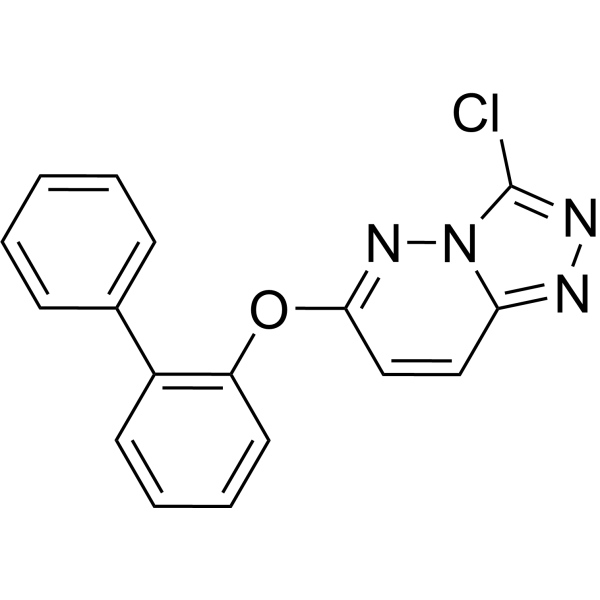
STL1267 is a potent and cross-the-blood-brain barrier REV-ERB agonist with a Ki value of 0.16 µM for REV-ERBα. STL1267 shows no cytotoxicity. STL1267 inhibits the gene expression of BMAL1.
For research use only. We do not sell to patients.
- Purity : 99.83%
- CAS No.: 1429024-58-7
- Formula: C17H11ClN4O
- Molecular Weight:322.75
-
Storage:Powder -20°C, 3 years , 4°C, 2 years ; In solvent -80°C, 6 months , -20°C, 1 month

To place orders, for customer services and technical support, please contact: MedChemExpress USA
Tel: 609-228-6898 E-mail: [email protected] [email protected]


-
 Biological Activity
-
Chemical Information
-
Solvent & Solubility
- Protocols
- Purity & Documentation
- References
-
 Help & FAQs



Publications Citing Use of MedChemExpress (MCE) STL1267
More

Biological Activity
Description
IC50 & Target
Ki: 0.16 µM (REV-ERBα)[1]
In Vitro
STL1267 (5 µM; 24 h) decreases the expression of BMAL1 and increases the gene expression of Mtnd1, Mtco1, Vicad, Lcad, Scad, Lkb1, Sirt1, Nampt, Ppargc1a in HepG2 cells[1].
MedChemExpress (MCE) has not independently confirmed the accuracy of these methods. They are for reference only. Further protocols information, click here.
-
Cell Line:HepG2, C2C12 cells
-
Concentration:0-20 µM
-
Incubation Time:24 h
-
Result:Showed no adverse effects on cell viability up to the maximum dose examined 20 µM.
-
Cell Line:HepG2 cells
-
Concentration:5 µM
-
Incubation Time:24 h
-
Result:Decreased the gene expression of BMAL1, increased the gene expression of Mtnd1, Mtco1, Vicad, Lcad, Scad, Lkb1, Sirt1, Nampt, Ppargc1a.
In Vivo
MedChemExpress (MCE) has not independently confirmed the accuracy of these methods. They are for reference only.
-
Animal Model:6-8 weeks, male C57Bl/6 J mice[1]
-
Dosage:50 mg/kg
-
Administration:I.p.; once
-
Result:Showed a plasma half-life of 1.6 h, effectively suppressed BMAL1 expression in the liver at 12 h post-administration.


Chemical Information
-
CAS No. 1429024-58-7
-
Appearance Solid
-
Molecular Weight 322.75
-
Formula C17H11ClN4O
-
Color White to off-white
-
SMILES
ClC1=NN=C2C=CC(OC3=C(C4=CC=CC=C4)C=CC=C3)=NN12
-
Shipping
Room temperature in continental US; may vary elsewhere.
-
Storage
Powder -20°C 3 years 4°C 2 years In solvent -80°C 6 months -20°C 1 month


Publications (2)
-
Journal Impact Factor
-
Most Recent
-
Adv Healthc Mater
Porous Microspheres Loading Small Molecule Targeting REV-ERBs Modulate Inflammatory Cytokines Fluctuations to Promote Periodontal Bone Regeneration. [Abstract]2025 Sep;14(23):e2500867. PMID: 40557559 -
Drug Des Devel Ther
ED-71 Ameliorates Bone Loss in Type 2 Diabetes Mellitus by Enhancing Osteogenesis Through Upregulation of the Circadian Rhythm Coregulator BMAL1. [Abstract]2024 Aug 29:18:3903-3919. PMID: 39224902


Solvent & Solubility
In Vitro:
DMSO : 25 mg/mL (77.46 mM; Need ultrasonic; Hygroscopic DMSO has a significant impact on the solubility of product, please use newly opened DMSO)
Please refer to the solubility information to select the appropriate solvent. Once prepared, please aliquot and store the solution to prevent product inactivation from repeated freeze-thaw cycles.
Storage method and period of stock solution: -80°C, 6 months; -20°C, 1 month. When stored at -80°C, please use it within 6 months. When stored at -20°C, please use it within 1 month.
Please refer to the solubility information to select the appropriate solvent. Once prepared, please aliquot and store the solution to prevent product inactivation from repeated freeze-thaw cycles.
Storage method and period of stock solution: -80°C, 6 months; -20°C, 1 month. When stored at -80°C, please use it within 6 months. When stored at -20°C, please use it within 1 month.
Concentration (start) × Volume (start) = Concentration (final) × Volume (final)

Protocols
-
RT-PCR
Reverse transcription technology uses RNA as a template to synthesize DNA. RT-PCR is simple, specific and sensitive, and can be used to detect gene expression levels and expression differences in cells; detect RNA virus content; clone cDNA sequences of specific genes.
-
RNA extraction experimental
By lysing cells, releasing RNA, and removing impurities such as proteins and DNA, high-purity RNA products are finally obtained. The commonly used traditional method is the guanidine isothiocyanate/phenol/chloroform method (Trizol), which is suitable for a variety of animal materials including animal tissues, microorganisms, cultured cells, etc., and most plant materials.
-
Cell Cytotoxicity Assay
Cytotoxicity assays are usually based on the assessment of cell membrane damage, which can also be indirectly detected by measuring cell viability. Detection methods include MTT assay, CKK-8 assay, LDH assay and ATP assay, etc.
-
Mammalian live/dead viability and cytotoxicity staining
Live/dead viability and cytotoxicity staining assays are based on the simultaneous detection of intracellular esterase activity in metabolically active (viable) cells and membrane integrity loss in non-viable cells. In commonly used dual-staining approaches, membrane-permeant fluorogenic substrates are converted by intracellular esterases into fluorescent products in live cells, while impermeant DNA-binding dyes selectively enter cells with compromised plasma membranes and label nucleic acids in dead or dying cells, enabling discrimination between viable and non-viable populations by fluorescence microscopy or flow cytometry.
-
Real Time qPCR (Q-PCR)
Real-time quantitative PCR (qPCR) quantifies an amplifiable nucleic-acid target by monitoring fluorescence during PCR cycling rather than measuring product only after amplification. The increase in fluorescence tracks accumulation of PCR product, and the quantification cycle (Cq; historically also Ct/CP) is related to the initial amount of target: samples containing more starting target generally reach the defined fluorescence threshold in fewer cycles.
-
Cell Viability Determination by MTT Colorimetric Assay
The following protocol uses the MTT colorimetric assay as a classic literature-established method for assessing cell viability/metabolic activity in cultured mammalian cells. MTT[3-(4,5-dimethylthiazol-2-yl)-2,5-diphenyltetrazolium bromide] is reduced by metabolically active cells to a colored formazan product; the amount of formazan is quantified spectrophotometrically and provides an indirect measure of metabolically active viable cells. Importantly, MTT reduction reflects cellular oxidoreductase/metabolic activity rather than an absolute direct count of living cells, so changes in cellular metabolism can alter the signal independently of cell number.


Purity & Documentation
-
Data Sheet (277 KB)
-
SDS (251 KB)
- English - EN (251 KB)
- Français - FR (251 KB)
- Deutsch - DE (251 KB)
- Norwegian - NO (251 KB)
- Español - ES (251 KB)
- Swedish - SV (251 KB)
- Italian - IT (251 KB)
- Korean - KR (251 KB)
- Portuguese - PT (251 KB)
-
Handling Instructions (2659 KB)
References


Complete Stock Solution Preparation Table
Please refer to the solubility information to select the appropriate solvent. Once prepared, please aliquot and store the solution to prevent product inactivation from repeated freeze-thaw cycles.
Storage method and period of stock solution: -80°C, 6 months; -20°C, 1 month. When stored at -80°C, please use it within 6 months. When stored at -20°C, please use it within 1 month.
| Optional Solvent | Concentration Solvent Mass | 1 mg | 5 mg | 10 mg | 25 mg |
|---|---|---|---|---|---|
| DMSO | 1 mM | 3.0984 mL | 15.4919 mL | 30.9837 mL | 77.4593 mL |
| 5 mM | 0.6197 mL | 3.0984 mL | 6.1967 mL | 15.4919 mL | |
| 10 mM | 0.3098 mL | 1.5492 mL | 3.0984 mL | 7.7459 mL | |
| 15 mM | 0.2066 mL | 1.0328 mL | 2.0656 mL | 5.1640 mL | |
| 20 mM | 0.1549 mL | 0.7746 mL | 1.5492 mL | 3.8730 mL | |
| 25 mM | 0.1239 mL | 0.6197 mL | 1.2393 mL | 3.0984 mL | |
| 30 mM | 0.1033 mL | 0.5164 mL | 1.0328 mL | 2.5820 mL | |
| 40 mM | 0.0775 mL | 0.3873 mL | 0.7746 mL | 1.9365 mL | |
| 50 mM | 0.0620 mL | 0.3098 mL | 0.6197 mL | 1.5492 mL | |
| 60 mM | 0.0516 mL | 0.2582 mL | 0.5164 mL | 1.2910 mL |


STL1267 Related Classifications
HY-148711 Related Classifications
 Powered by Bioz