



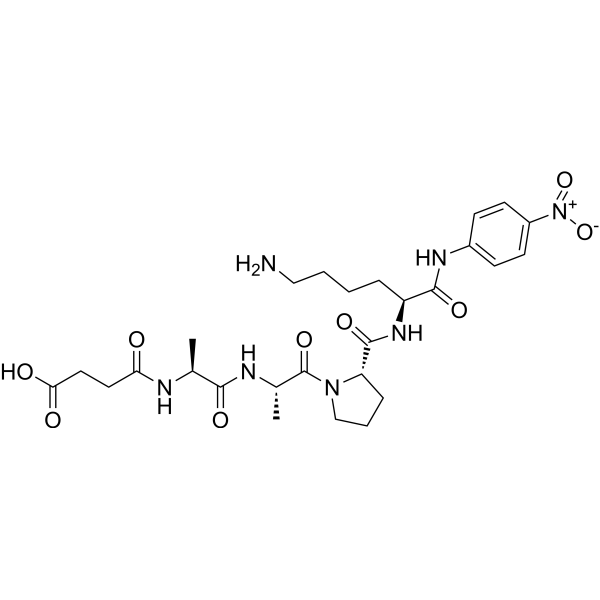
Suc-AAPK-pNA

Based on 1 Customer Validation
Suc-AAPK-pNA is a chromogenic substrate for the determination of serine/threonine kinase activity and enzyme kinetic parameters.
연구목적의 판매만을 진행합니다. 환자를 대상으로 한 판매는 하지 않습니다.
- Purity : 98.06%
- CAS No.: 108929-39-1
- 화학식: C27H39N7O9
- 분자량:605.64
-
보관:
Sealed storage, away from moisture and light, under nitrogen.
Powder -80°C, 2 years , -20°C, 1 year* In solvent : -80°C, 6 months; -20°C, 1 month (sealed storage, away from moisture and light, under nitrogen)

To place orders, for customer services and technical support, please contact: MedChemExpress USA
Tel: 609-228-6898 E-mail: [email protected] [email protected]


-
 Biological Activity
-
Chemical Information
-
용액&용해도
- Protocol
- 순도&문서
- References
-
 Help & FAQs




Biological Activity
제품 설명


Chemical Information
-
CAS No. 108929-39-1
-
Appearance Solid
-
분자량 605.64
-
화학식 C27H39N7O9
-
Color Off-white to light yellow
-
Sequence
{Suc}-Ala-Ala-Pro-Lys-{pNA}
-
Sequence Shortening
{Suc}-AAPK-{pNA}
-
선적
Room temperature in continental US; may vary elsewhere.
-
보관
Sealed storage, away from moisture and light, under nitrogen
Powder -80°C 2 years -20°C 1 year * In solvent : -80°C, 6 months; -20°C, 1 month (sealed storage, away from moisture and light, under nitrogen)


용액&용해도
In Vitro:
DMSO : 100 mg/mL (165.11 mM; Need ultrasonic; Hygroscopic DMSO has a significant impact on the solubility of product, please use newly opened DMSO)
Please refer to the solubility information to select the appropriate solvent. Once prepared, please aliquot and store the solution to prevent product inactivation from repeated freeze-thaw cycles.
Storage method and period of stock solution: -80°C, 6 months; -20°C, 1 month (sealed storage, away from moisture and light, under nitrogen). When stored at -80°C, please use it within 6 months. When stored at -20°C, please use it within 1 month.
Please refer to the solubility information to select the appropriate solvent. Once prepared, please aliquot and store the solution to prevent product inactivation from repeated freeze-thaw cycles.
Storage method and period of stock solution: -80°C, 6 months; -20°C, 1 month (sealed storage, away from moisture and light, under nitrogen). When stored at -80°C, please use it within 6 months. When stored at -20°C, please use it within 1 month.
Concentration (start) × Volume (start) = Concentration (final) × Volume (final)

Protocol
-
Kinase activity and phosphorylation assays
Kinase activity assays measure the ability of kinases to transfer phosphate groups from ATP to specific substrates, while phosphorylation assays detect the presence and levels of phosphorylated proteins. Common methods include radiolabeled ATP incorporation (e. g. ,), ADP release detection via bioluminescence (e. g. ,[3]), enzyme-linked immunosorbent assays (ELISA) for phospho-specific epitopes (e. g. ,[6]), and microtiter-based formats for high-throughput screening (e. g. ,[8]). The ADP-Glo assay quantifies kinase activity by measuring ADP produced during phosphorylation using a luciferase-based system. Radiometric assays involve autoradiography or scintillation counting after incorporation of 32P-labeled ATP into substrate proteins. ELISA-based approaches rely on phospho-specific antibodies to detect activated kinases in cell lysates or purified samples.
-
Protocol for Kinase activity and phosphorylation assays
Kinase activity assays measure transfer of phosphate from ATP to a protein or peptide substrate, generating phosphorylated substrate, ADP, or incorporated radiolabeled phosphate as the readout; phosphorylation assays measure site-specific phosphorylation in cells or tissues as a proxy for kinase-pathway activation, inhibition, or substrate regulation. Phosphorylation can be detected by phospho-specific Western blot, immunoprecipitation kinase assay, phospho-immunofluorescence, phospho-flow cytometry, luminescent ADP detection, radiolabeled ATP incorporation, or reporter-based pathway assays, and these readouts can be applied to cancer cells, primary neurons, mouse tumors, organoids, inflammatory macrophages, ferroptosis studies, and mitophagy studies when the kinase target is biologically relevant.


순도&문서
-
Data Sheet (271 KB)
-
SDS (252 KB)
- English - EN (252 KB)
- Français - FR (252 KB)
- Deutsch - DE (252 KB)
- Norwegian - NO (252 KB)
- Español - ES (252 KB)
- Swedish - SV (252 KB)
- Italian - IT (252 KB)
- Korean - KR (252 KB)
- Portuguese - PT (252 KB)
-
Handling Instructions (2659 KB)
References


Complete Stock Solution Preparation Table
Please refer to the solubility information to select the appropriate solvent. Once prepared, please aliquot and store the solution to prevent product inactivation from repeated freeze-thaw cycles.
Storage method and period of stock solution: -80°C, 6 months; -20°C, 1 month (sealed storage, away from moisture and light, under nitrogen). When stored at -80°C, please use it within 6 months. When stored at -20°C, please use it within 1 month.
| Optional Solvent | Concentration Solvent Mass | 1 mg | 5 mg | 10 mg | 25 mg |
|---|---|---|---|---|---|
| DMSO | 1 mM | 1.6511 mL | 8.2557 mL | 16.5115 mL | 41.2786 mL |
| 5 mM | 0.3302 mL | 1.6511 mL | 3.3023 mL | 8.2557 mL | |
| 10 mM | 0.1651 mL | 0.8256 mL | 1.6511 mL | 4.1279 mL | |
| 15 mM | 0.1101 mL | 0.5504 mL | 1.1008 mL | 2.7519 mL | |
| 20 mM | 0.0826 mL | 0.4128 mL | 0.8256 mL | 2.0639 mL | |
| 25 mM | 0.0660 mL | 0.3302 mL | 0.6605 mL | 1.6511 mL | |
| 30 mM | 0.0550 mL | 0.2752 mL | 0.5504 mL | 1.3760 mL | |
| 40 mM | 0.0413 mL | 0.2064 mL | 0.4128 mL | 1.0320 mL | |
| 50 mM | 0.0330 mL | 0.1651 mL | 0.3302 mL | 0.8256 mL | |
| 60 mM | 0.0275 mL | 0.1376 mL | 0.2752 mL | 0.6880 mL | |
| 80 mM | 0.0206 mL | 0.1032 mL | 0.2064 mL | 0.5160 mL | |
| 100 mM | 0.0165 mL | 0.0826 mL | 0.1651 mL | 0.4128 mL |


Suc-AAPK-pNA Related Classifications
HY-P4484 Related Classifications
 Powered by Bioz