



Yhhu-3792 hydrochloride
Based on 2 publication(s) in Google Scholar
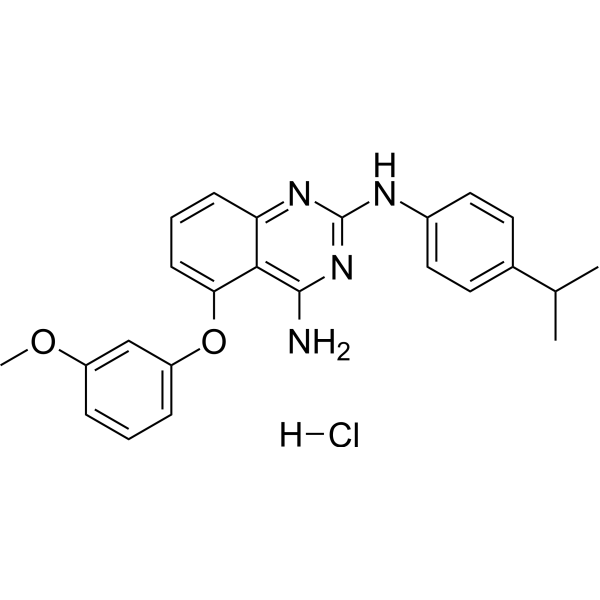
Yhhu-3792 hydrochloride is a Notch activator. Yhhu-3792 hydrochloride enhances the self-renewal capability of neural stem cells (NSCs). Yhhu-3792 hydrochloride promotes the expression of Hes3 and Hes5. Yhhu-3792 hydrochloride increases the spatial and episodic memory abilities of mice. Yhhu-3792 hydrochloride can be used for the study of neurodegenerative diseases (such as Alzheimer's disease) or for neural regeneration after brain injury .
For research use only. We do not sell to patients.
- CAS No.: 2624336-93-0
- Formula: C24H25ClN4O2
- Molecular Weight:436.93
-
Storage:
Please store the product under the recommended conditions in the Certificate of Analysis.

To place orders, for customer services and technical support, please contact: MedChemExpress USA
Tel: 609-228-6898 E-mail: [email protected] [email protected]


-
 Biological Activity
-
Chemical Information
- Protocols
- Purity & Documentation
- References
-
 Help & FAQs


Publications Citing Use of MedChemExpress (MCE) Yhhu-3792 hydrochloride
More

Biological Activity
Description
In Vitro
Yhhu-3792 (0.63-2.5 μM, 8 d) hydrochloride increases the number of embryonic hippocampal neural stem cells (NSCs)[1].
Yhhu-3792 (0.63-2.5 μM, 2 d) hydrochloride activates the Notch signaling pathway and promotes the expression of Hes5 and Hes3 in neuro-spheres[1].
Yhhu-3792 (2.5 μM, 7-14 d) hydrochloride fails to significantly increase the proportion or purity of natural killer (NK) cell[2].
MedChemExpress (MCE) has not independently confirmed the accuracy of these methods. They are for reference only. Further protocols information, click here.
-
Cell Line:Rats neuro-spheres
-
Concentration:0.63, 1.25, 2.5 μM
-
Incubation Time:2 d
-
Result:Increased the expression of Notch1 receptor, nuclear NICD, DLL1 and Jagged2.
Significantly increased the expression of Hes5 and Hes3 proteins.
-
Cell Line:Rats neuro-spheres
-
Concentration:0.63, 1.25, 2.5 μM
-
Incubation Time:2 d
-
Result:Increased the transcription levels of Hes5 and Hes3.
Significantly enhanced the binding of NICD to the promoters of Hes5 and Hes3.
In Vivo
MedChemExpress (MCE) has not independently confirmed the accuracy of these methods. They are for reference only.
-
Animal Model:Morris water maze (MWM) assay and fear conditioning (FC) assay established in eight-week-old male C57BL/6 mice[1]
-
Dosage:10 and 20 mg/kg
-
Administration:Intraperitoneal injection (i.p.), once daily for 3 weeks
-
Result:Expanded the NSCs pool and promoted endogenous neurogenesis in the hippocampal dentate gyrus.
Decreased the escape latency of C57BL/6 mice in the MWM test.
increased the freezing time of mice in the Fear conditioning test.


Chemical Information
-
CAS No. 2624336-93-0
-
Molecular Weight 436.93
-
Formula C24H25ClN4O2
-
SMILES
[H]Cl.NC1=C2C(OC3=CC=CC(OC)=C3)=CC=CC2=NC(NC4=CC=C(C(C)C)C=C4)=N1
-
Shipping
Room temperature in continental US; may vary elsewhere.
-
Storage
Please store the product under the recommended conditions in the Certificate of Analysis.


Publications (2)
-
Journal Impact Factor
-
Most Recent
-
MedComm (2020)
Nitrate Enhances Gastric Mucosa Defense and Repair Process in Ethanol-Induced Gastric Ulcer Rats via the Notch-Tff2 Pathway. [Abstract]2026 Feb 5;7(2):e70628. PMID: 41660303 -
Int J Mol Sci
Bmp16 Regulates Arterial Valve Morphogenesis Through Modulation of Notch Signaling in Zebrafish. [Abstract]2026 Feb 24;27(5):2111. PMID: 41828338

Protocols
-
RNA extraction experimental
By lysing cells, releasing RNA, and removing impurities such as proteins and DNA, high-purity RNA products are finally obtained. The commonly used traditional method is the guanidine isothiocyanate/phenol/chloroform method (Trizol), which is suitable for a variety of animal materials including animal tissues, microorganisms, cultured cells, etc., and most plant materials.
-
Notch Pathway Solutions
The Notch pathway is a contact-dependent signaling pathway that controls cell-fate decisions, differentiation, proliferation, and tissue patterning through interactions between membrane-bound Notch receptors and membrane-bound ligands on neighboring cells. Canonical Notch signaling is activated when ligand engagement triggers proteolytic release of the Notch intracellular domain, which enters the nucleus and regulates transcription together with DNA-binding transcriptional complexes. In the canonical mechanism, ligand-dependent Notch activation leads to release of the intracellular Notch domain, and presenilin-dependent γ-secretase activity is required for production of the active intracellular signaling fragment. The released intracellular domain functions as a nuclear signal that converts Notch receptor activation at the membrane into transcriptional regulation of target programs such as HES/HEY-family genes and other context-dependent downstream targets. The literature links Notch p
-
hPSC maintenance and expansion
This protocol maintains and expands human pluripotent stem cells under feeder-free, chemically defined conditions using E8 medium and vitronectin-coated culture surfaces; the readout is sustained adherent colony growth with undifferentiated morphology and retained pluripotency-marker expression during serial passaging. E8-based hPSC culture relies on defined soluble factors and matrix-dependent adhesion rather than feeder cells; vitronectin supports hPSC attachment through integrin-mediated interactions, and EDTA passaging dissociates colonies as small aggregates without enzymatic digestion, centrifugation, or routine ROCK-inhibitor treatment.
-
Alzheimer’s Disease Modeling
Alzheimer’s Disease (AD) is a neurodegenerative disorder characterized by a progressive decline in cognitive functions and loss of specific types of neurons and synapses. Alzheimer's symptoms can be simulated in mice by injecting drugs (such as Aβ) or genetically modified.


Purity & Documentation
References
[1]. Lu H, et al. A Novel 2-Phenylamino-Quinazoline-Based Compound Expands the Neural Stem Cell Pool and Promotes the Hippocampal Neurogenesis and the Cognitive Ability of Adult Mice. Stem Cells. 2018 Aug;36(8):1273-1285. [Content Brief]
[2]. Kunkanjanawan H, et al. Efficient large-scale expansion of cord blood-derived NK cells: leveraging lipopolysaccharide for enhanced NK cell production. Cytotherapy. 2025 Jun;27(6):782-789. [Content Brief]

Calculators
Concentration (start) × Volume (start) = Concentration (final) × Volume (final)


Yhhu-3792 hydrochloride Related Classifications
HY-120782A Related Classifications
 Powered by Bioz