



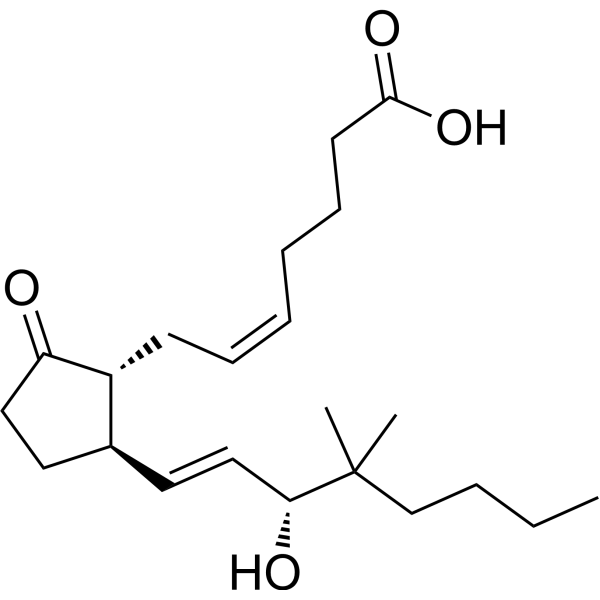
11-Deoxy-16,16-dimethyl-PGE2
11-Deoxy-16,16-dimethyl-PGE2, a Prostaglandin E2 analog, is a EP2 and EP3 receptors agonist. 11-Deoxy-16,16-dimethyl-PGE2 protects proximal renal tubular epithelial cells from potent nephrotoxicity-induced cell damage by exerting anti-oxidative stress.
For research use only. We do not sell to patients.
- CAS No.: 53658-98-3
- Formula: C22H36O4
- Molecular Weight:364.52
-
Storage:
Please store the product under the recommended conditions in the Certificate of Analysis.

To place orders, for customer services and technical support, please contact: MedChemExpress USA
Tel: 609-228-6898 E-mail: [email protected] [email protected]


-
 Biological Activity
-
Chemical Information
- Protocols
- Purity & Documentation
- References
-
 Help & FAQs




Biological Activity
Description
IC50 & Target
[1]|
EP2 |
EP3 |
In Vitro
11-Deoxy-16,16-dimethyl-PGE2, selectively stimulates the synthesis of several proteins in protect renal proximal tubular epithelial (LLC-PK1) cells, including endothelial actin binding protein, myosin, elongation factor 2 (EF-2), elongation factor 1alpha-1 (EF-1alpha), HSP90beta, GRP78, membrane-organizing extension spike protein, and actin[2].
MedChemExpress (MCE) has not independently confirmed the accuracy of these methods. They are for reference only. Further protocols information, click here.


Chemical Information
-
CAS No. 53658-98-3
-
Molecular Weight 364.52
-
Formula C22H36O4
-
SMILES
CCCCC(C)(C)[C@H](O)/C=C/[C@@H]1[C@H](C(CC1)=O)C/C=C\CCCC(O)=O
-
Shipping
Room temperature in continental US; may vary elsewhere.
-
Storage
Please store the product under the recommended conditions in the Certificate of Analysis.

Protocols
-
Nephrotoxicity Study
This protocol assesses nephrotoxicity by combining functional kidney injury readouts, urinary/tissue injury biomarkers, and renal histopathology. Serum creatinine and BUN reflect impaired kidney function, while KIM-1, NGAL, clusterin, osteopontin, IL-18, cystatin C, nephrin, Oat5, urinary protein, glucose, and alkaline phosphatase have been used to detect tubular injury in cisplatin-, gentamicin-, and acetaminophen-induced nephrotoxicity models.
-
ROS/oxidative-stress fluorescent staining
ROS/oxidative-stress fluorescent staining uses cell-permeant fluorogenic probes that become fluorescent after oxidation inside cells or tissues; commonly used examples include DCFH-DA/DCFDA for broad cellular oxidant detection, DHE for superoxide-related signal detection, MitoSOX for mitochondrial superoxide-related signal detection, and CellROX probes for oxidative-stress-associated fluorescence readouts. The assay detects probe oxidation rather than a single ROS species unless the probe and analysis method have been chemically validated for that species. DCFH-DA enters cells, is deacetylated by intracellular esterases to DCFH, and produces fluorescent DCF after oxidation, so the readout is used as an operational measure of total cellular oxidative stress rather than a species-specific ROS measurement. DHE and MitoSOX can report superoxide-related oxidation, but red fluorescence alone can include non-specific ethidium-like oxidation products; HPLC or optimized spectral approaches are


Purity & Documentation
References
[1]. R F Parrott, et al. Effects of centrally administered prostaglandin EP receptor agonists on febrile and adrenocortical responses in the prepubertal pig. Brain Res Bull. 1996;41(2):97-103. [Content Brief]
[2]. Kelly M Towndrow, et al. 11-Deoxy,16,16-dimethyl prostaglandin E2 induces specific proteins in association with its ability to protect against oxidative stress. Chem Res Toxicol. 2003 Mar;16(3):312-9. [Content Brief]

Calculators
Concentration (start) × Volume (start) = Concentration (final) × Volume (final)


11-Deoxy-16,16-dimethyl-PGE2 Related Classifications
HY-136696 Related Classifications
 Powered by Bioz