



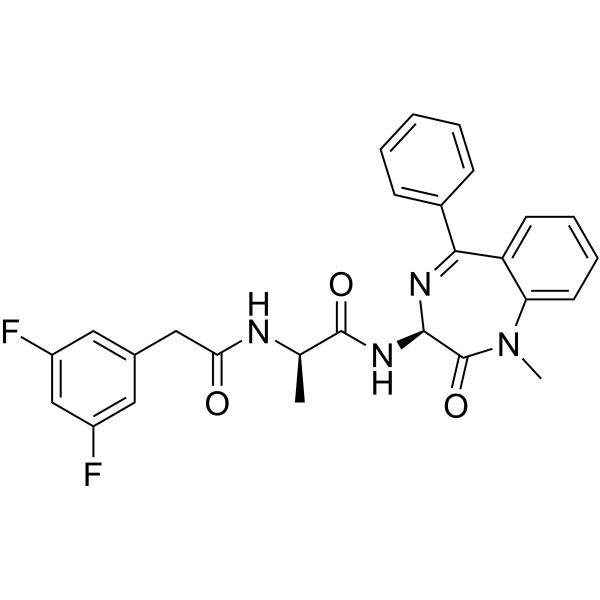
(1R,3S)-Compound E

Based on 1 Customer Validation
(1R,3S)-Compound E is the isomer of Compound E (HY-14176), and can be used as an experimental control. Compound E is a γ-secretase inhibitor. Compound E bloks β-amyloid(40), β-amyloid(42), and Notch γ-secretase cleavage with IC50s of 0.24, 0.37, 0.32 nM, respectively.
For research use only. We do not sell to patients.
- Purity : 99.61%
- CAS No.: 504428-17-5
- Formula: C27H24F2N4O3
- Molecular Weight:490.50
-
Storage:
-20°C, protect from light
* In solvent : -80°C, 6 months; -20°C, 1 month (protect from light)

To place orders, for customer services and technical support, please contact: MedChemExpress USA
Tel: 609-228-6898 E-mail: [email protected] [email protected]


-
 Biological Activity
-
Chemical Information
-
Solvent & Solubility
- Protocols
- Purity & Documentation
- References
-
 Help & FAQs




Biological Activity
Description


Chemical Information
-
CAS No. 504428-17-5
-
Appearance Solid
-
Molecular Weight 490.50
-
Formula C27H24F2N4O3
-
Color White to off-white
-
SMILES
FC1=CC(F)=CC(CC(N[C@H](C)C(N[C@H]2N=C(C3=CC=CC=C3)C4=CC=CC=C4N(C2=O)C)=O)=O)=C1
-
Shipping
Room temperature in continental US; may vary elsewhere.
-
Storage
-20°C, protect from light
* In solvent : -80°C, 6 months; -20°C, 1 month (protect from light)


Solvent & Solubility
In Vitro:
DMSO : ≥ 50 mg/mL (101.94 mM; Hygroscopic DMSO has a significant impact on the solubility of product, please use newly opened DMSO)
* "≥" means soluble, but saturation unknown.
Please refer to the solubility information to select the appropriate solvent. Once prepared, please aliquot and store the solution to prevent product inactivation from repeated freeze-thaw cycles.
Storage method and period of stock solution: -80°C, 6 months; -20°C, 1 month (protect from light). When stored at -80°C, please use it within 6 months. When stored at -20°C, please use it within 1 month.
Please refer to the solubility information to select the appropriate solvent. Once prepared, please aliquot and store the solution to prevent product inactivation from repeated freeze-thaw cycles.
Storage method and period of stock solution: -80°C, 6 months; -20°C, 1 month (protect from light). When stored at -80°C, please use it within 6 months. When stored at -20°C, please use it within 1 month.
Concentration (start) × Volume (start) = Concentration (final) × Volume (final)


Purity & Documentation
-
Data Sheet (273 KB)
-
SDS (393 KB)
- English - EN (393 KB)
- Français - FR (393 KB)
- Deutsch - DE (393 KB)
- Norwegian - NO (393 KB)
- Español - ES (393 KB)
- Swedish - SV (393 KB)
- Italian - IT (393 KB)
- Korean - KR (393 KB)
- Portuguese - PT (393 KB)
-
Handling Instructions (2659 KB)
References
[1]. Beher D, et al. Pharmacological knock-down of the presenilin 1 heterodimer by a novel gamma -secretase inhibitor: implications for presenilin biology. J Biol Chem. 2001 Nov 30;276(48):45394-402. [Content Brief]
[2]. Rasul S, et al. Inhibition of gamma-secretase induces G2/M arrest and triggers apoptosis in breast cancer cells. Br J Cancer. 2009 Jun 16;100(12):1879-88. [Content Brief]


Complete Stock Solution Preparation Table
Please refer to the solubility information to select the appropriate solvent. Once prepared, please aliquot and store the solution to prevent product inactivation from repeated freeze-thaw cycles.
Storage method and period of stock solution: -80°C, 6 months; -20°C, 1 month (protect from light). When stored at -80°C, please use it within 6 months. When stored at -20°C, please use it within 1 month.
| Optional Solvent | Concentration Solvent Mass | 1 mg | 5 mg | 10 mg | 25 mg |
|---|---|---|---|---|---|
| DMSO | 1 mM | 2.0387 mL | 10.1937 mL | 20.3874 mL | 50.9684 mL |
| 5 mM | 0.4077 mL | 2.0387 mL | 4.0775 mL | 10.1937 mL | |
| 10 mM | 0.2039 mL | 1.0194 mL | 2.0387 mL | 5.0968 mL | |
| 15 mM | 0.1359 mL | 0.6796 mL | 1.3592 mL | 3.3979 mL | |
| 20 mM | 0.1019 mL | 0.5097 mL | 1.0194 mL | 2.5484 mL | |
| 25 mM | 0.0815 mL | 0.4077 mL | 0.8155 mL | 2.0387 mL | |
| 30 mM | 0.0680 mL | 0.3398 mL | 0.6796 mL | 1.6989 mL | |
| 40 mM | 0.0510 mL | 0.2548 mL | 0.5097 mL | 1.2742 mL | |
| 50 mM | 0.0408 mL | 0.2039 mL | 0.4077 mL | 1.0194 mL | |
| 60 mM | 0.0340 mL | 0.1699 mL | 0.3398 mL | 0.8495 mL | |
| 80 mM | 0.0255 mL | 0.1274 mL | 0.2548 mL | 0.6371 mL | |
| 100 mM | 0.0204 mL | 0.1019 mL | 0.2039 mL | 0.5097 mL |


(1R,3S)-Compound E Related Classifications
HY-14176A Related Classifications
 Powered by Bioz