



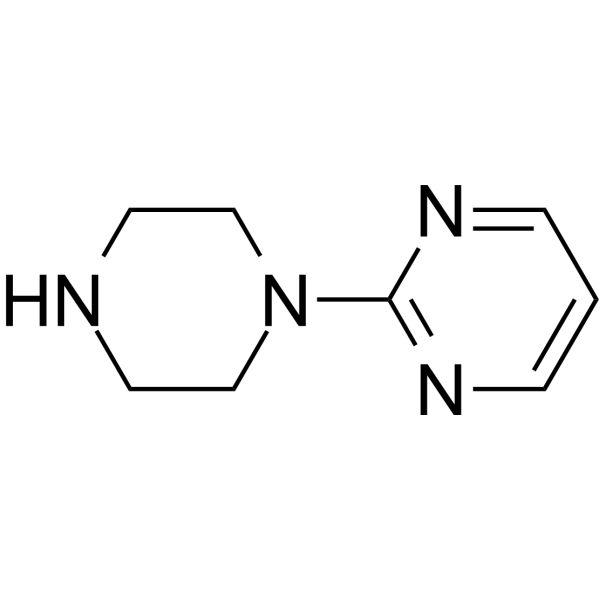
2-(1-Piperazinyl)pyrimidine

Based on 1 Customer Validation
2-(1-Piperazinyl)pyrimidine is an orally effective α2-adrenoceptor antagonist and 5-HT1A receptor agonist. 2-(1-Piperazinyl)pyrimidine is an in vivo metabolite related to buspirone. 2-(1-Piperazinyl)pyrimidine modulates excitatory synaptic transmission in the hippocampus and the release of monoamine transmitters such as norepinephrine and 5-HT by blocking α2-adrenoceptor and activating 5-HT1A Receptor. 2-(1-Piperazinyl)pyrimidine is used in research on psychiatric disorders such as anxiety and depression.
For research use only. We do not sell to patients.
- Purity : 99.94%
- CAS No.: 20980-22-7
- Formula: C8H12N4
- Molecular Weight:164.21
-
Storage:Powder -20°C, 3 years , 4°C, 2 years ; In solvent -80°C, 6 months , -20°C, 1 month

To place orders, for customer services and technical support, please contact: MedChemExpress USA
Tel: 609-228-6898 E-mail: [email protected] [email protected]


-
 Biological Activity
-
Chemical Information
-
Solvent & Solubility
- Purity & Documentation
- References
-
 Help & FAQs


-

HY-W004464R
2-(1-Piperazinyl)pyrimidine (Standard) -
HY-10029
Nutlin-3a -
HY-W016221
6-Hydroxy Chlorzoxazone -
HY-D0184
2'-Deoxycytidine -

HY-117605R
N-Desmethyl Sildenafil (Standard) -
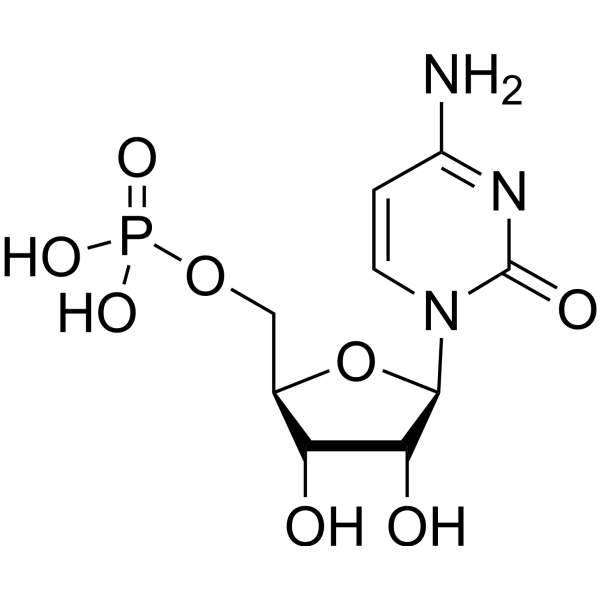
HY-W009162
Cytidine 5'-monophosphate -
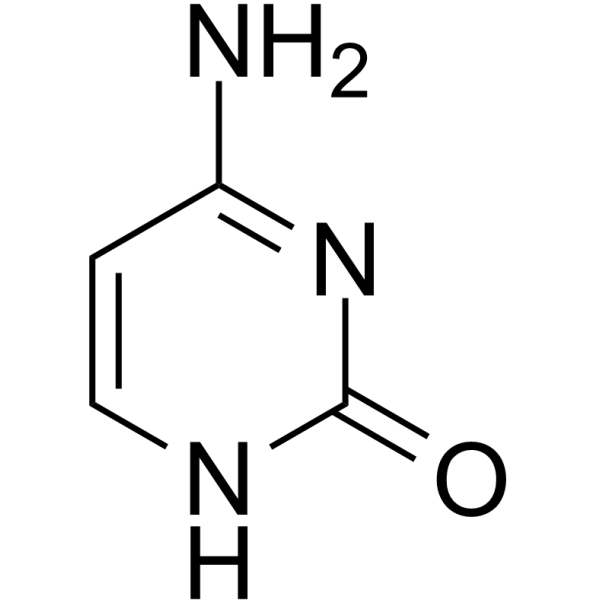
HY-I0626
Cytosine -

HY-W587530
6-Oxolithocholic acid -
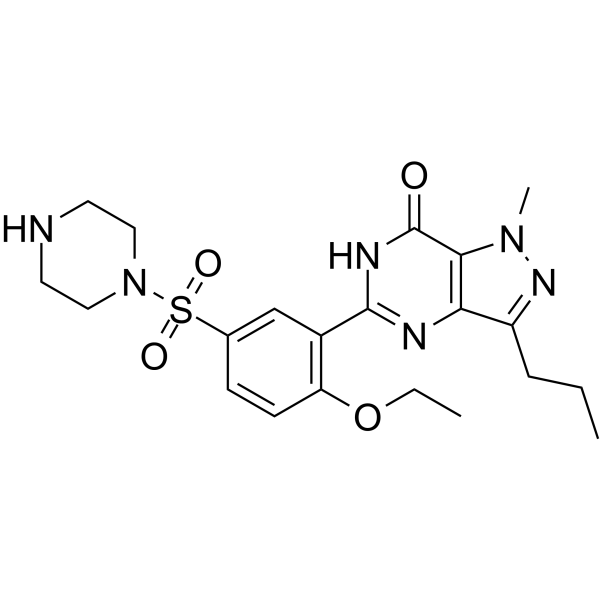
HY-117605
N-Desmethyl Sildenafil -

HY-D0184R
2'-Deoxycytidine (Standard) -

HY-109659
1-(3-Aminopropyl)-4-methylpiperazine -

HY-I0626R
Cytosine (Standard)


Biological Activity
Description
IC50 & Target
[1]|
α2-adrenergic receptor |
5-HT1A Receptor |
In Vitro
2-(1-Piperazinyl)pyrimidine (0.1-1 μM; 10 min) antagonizes the inhibition of [3H]NA (pA2 = 6.8) and [3H]5-HT (pA2 = 7.3) release by α2-adrenoceptors in rat cerebral cortex synaptosomes[1].
MedChemExpress (MCE) has not independently confirmed the accuracy of these methods. They are for reference only.
Parmacokinetics
| Species | Dose | Route | Cmax |
|---|---|---|---|
| Rat[2] | 2.5 mg/kg | p.o. | 3.80 nM/mL |
In Vivo
2-(1-Piperazinyl)pyrimidine (0.5-4.0 mg/kg; s.c.; single administration; tested 30 min after administration) exhibits significant anxiolytic effects in the rat drinking conflict test model[3].
2-(1-Piperazinyl)pyrimidine (0.25-4 mg/kg; s.c.; single administration; model-inducing drug injected 30 min after administration) antagonizes pupil dilation in the Clonidine (HY-12721)-induced rat mydriasis model[3].
2-(1-Piperazinyl)pyrimidine (0.063-0.5 mg/kg; s.c.; single administration; modeling drug injected 30 min after administration) reverses the decrease in locomotor activity in the Clonidine-induced hypokinesia model in rats[3].
2-(1-Piperazinyl)pyrimidine (0.25-1 mg/kg i.p.; single administration; continuous monitoring for 60 min) transiently reduces the amplitude of field excitatory postsynaptic potentials in the hippocampal CA1 region in a rat hippocampal electrophysiological recording model[5].
2-(1-Piperazinyl)pyrimidine (5 μg; intrahippocampal microinjection; single administration; continuous monitoring for 15-20 min) also exerts a transient inhibitory effect on excitatory synaptic transmission in the rat hippocampal electrophysiological recording model[5].
2-(1-Piperazinyl)pyrimidine (0.25 mg/kg; i.p.; once daily; for 9 consecutive days, with monitoring from day 1 to 14) persistently decreases basal excitatory synaptic transmission and produces tolerance to acute administration in a rat hippocampal electrophysiological recording model[5].
MedChemExpress (MCE) has not independently confirmed the accuracy of these methods. They are for reference only.
-
Animal Model:CD-COBS (Male, 200-250 g, overnight-fasted)[2]
-
Dosage:0.5 mg/kg, 0.8 mg/kg, 1.1 mg/kg, 2.0 mg/kg
-
Administration:p.o.; single dose; 10 min before Clonidine
-
Result:Antagonized clonidine-induced slowing of gastrointestinal transit in a dose-dependent manner.
Did not affect basal gastrointestinal transit when administered alone.
-
Animal Model:Sprague-Dawley (male, 240-300 g) were deprived of water for 48 h[3]
-
Dosage:0.5 mg/kg, 1.0 mg/kg, 2.0 mg/kg, 4.0 mg/kg
-
Administration:s.c.; single dose; 30 min before test
-
Result:Significantly increased the number of punished drinking licks, exhibiting an anticonflict effect.
-
Animal Model:Sprague-Dawley (male, 240-300 g)[3]
-
Dosage:0.25 mg/kg, 0.5 mg/kg, 1.0 mg/kg, 2.0 mg/kg, 4.0 mg/kg
-
Administration:s.c.; single dose; 30 min before Clonidine
-
Result:Dose-dependently inhibited clonidine-induced mydriasis.
-
Animal Model:Sprague-Dawley (male, 240-300 g)[3]
-
Dosage:0.063 mg/kg, 0.125 mg/kg, 0.25 mg/kg, 0.5 mg/kg
-
Administration:s.c.; single dose; 30 min before Clonidine
-
Result:Reversed the Clonidine-induced reduction in motor activity in a dose-dependent manner.
-
Animal Model:Wistar rats were implanted with electrodes via stereotaxic surgery and recorded in an alert state[5]
-
Dosage:0.25 mg/kg
-
Administration:i.p.; once daily; for 9 consecutive days, total 14 days
-
Result:Caused a gradual decrease in daily basal excitatory synaptic transmission levels during continuous administration.
Led to a blunted or tolerated acute electrophysiological inhibitory response.


Chemical Information
-
CAS No. 20980-22-7
-
Appearance Solid
-
Molecular Weight 164.21
-
Formula C8H12N4
-
Color Colorless to off-white
-
SMILES
N1(C2=NC=CC=N2)CCNCC1
-
Structure Classification
-
Initial Source
-
Shipping
Room temperature in continental US; may vary elsewhere.
-
Storage
Powder -20°C 3 years 4°C 2 years In solvent -80°C 6 months -20°C 1 month


Solvent & Solubility
In Vitro:
DMSO : 100 mg/mL (608.98 mM; Need ultrasonic; Hygroscopic DMSO has a significant impact on the solubility of product, please use newly opened DMSO)
Please refer to the solubility information to select the appropriate solvent. Once prepared, please aliquot and store the solution to prevent product inactivation from repeated freeze-thaw cycles.
Storage method and period of stock solution: -80°C, 6 months; -20°C, 1 month. When stored at -80°C, please use it within 6 months. When stored at -20°C, please use it within 1 month.
Please refer to the solubility information to select the appropriate solvent. Once prepared, please aliquot and store the solution to prevent product inactivation from repeated freeze-thaw cycles.
Storage method and period of stock solution: -80°C, 6 months; -20°C, 1 month. When stored at -80°C, please use it within 6 months. When stored at -20°C, please use it within 1 month.
Concentration (start) × Volume (start) = Concentration (final) × Volume (final)
In Vivo:
Select the appropriate dissolution method based on your experimental animal and administration route.
- For the following dissolution methods, please ensure to first prepare a clear stock solution using an In Vitro approach and then sequentially add co-solvents:
- To ensure reliable experimental results, the clarified stock solution can be appropriately stored based on storage conditions. As for the working solution for In Vivo experiments, it is recommended to prepare freshly and use it on the same day.
- The percentages shown for the solvents indicate their volumetric ratio in the final prepared solution. If precipitation or phase separation occurs during preparation, heat and/or sonication can be used to aid dissolution.
Add each solvent one by one: 10% DMSO 40% PEG300 5% Tween-80 45% Saline
Solubility: ≥ 2.5 mg/mL (15.22 mM); Clear solution
This protocol yields a clear solution of ≥ 2.5 mg/mL (saturation unknown).
Taking 1 mL working solution as an example, add 100 μL DMSO stock solution (25.0 mg/mL) to 400 μL PEG300, and mix evenly; then add 50 μL Tween-80 and mix evenly; then add 450 μL Saline to adjust the volume to 1 mL.
Preparation of Saline: Dissolve 0.9 g sodium chloride in ddH₂O and dilute to 100 mL to obtain a clear Saline solution.
Add each solvent one by one: 10% DMSO 90% (20% SBE-β-CD in Saline)
Solubility: ≥ 2.5 mg/mL (15.22 mM); Clear solution
This protocol yields a clear solution of ≥ 2.5 mg/mL (saturation unknown).
Taking 1 mL working solution as an example, add 100 μL DMSO stock solution (25.0 mg/mL) to 900 μL 20% SBE-β-CD in Saline, and mix evenly.
Preparation of 20% SBE-β-CD in Saline (4°C, storage for one week): 2 g SBE-β-CD powder is dissolved in 10 mL Saline, completely dissolve until clear.
In Vivo Dissolution Calculator
Please enter the basic information of animal experiments:
-
-
-
-
Recommended: Prepare an additional quantity of animals to account for potential losses during experiments.
Please enter your animal formula composition:
-
%DMSO +
Recommended: Keep the proportion of DMSO in working solution below 2% if your animal is weak.
-
%+
-
+%Tween-80 + +
-
%Saline +
The co-solvents required include: DMSO, . All of co-solvents are available by MedChemExpress (MCE). , Tween 80. All of co-solvents are available by MedChemExpress (MCE).
Working solution concentration: 0.22 mg/mL
Method for preparing stock solution: mg drug dissolved in μL DMSO. Stock solution concentration: mg/mL.
1. Take μL DMSO stock solution;
2. Add μL .
μL , mix evenly;
3. Then add μL Tween 80, mix evenly;
4. Then add μL
Please ensure that the stock solution in the first step is dissolved to a clear state, and add co-solvents in sequence. You can use ultrasonic heating (ultrasonic cleaner, recommended frequency 20-40 kHz), vortexing, etc. to assist dissolution.


Purity & Documentation
-
Data Sheet (295 KB)
-
SDS (393 KB)
- English - EN (393 KB)
- Français - FR (393 KB)
- Deutsch - DE (393 KB)
- Norwegian - NO (393 KB)
- Español - ES (393 KB)
- Swedish - SV (393 KB)
- Italian - IT (393 KB)
- Korean - KR (393 KB)
- Portuguese - PT (393 KB)
-
Handling Instructions (2659 KB)
References


Complete Stock Solution Preparation Table
Please refer to the solubility information to select the appropriate solvent. Once prepared, please aliquot and store the solution to prevent product inactivation from repeated freeze-thaw cycles.
Storage method and period of stock solution: -80°C, 6 months; -20°C, 1 month. When stored at -80°C, please use it within 6 months. When stored at -20°C, please use it within 1 month.
| Optional Solvent | Concentration Solvent Mass | 1 mg | 5 mg | 10 mg | 25 mg |
|---|---|---|---|---|---|
| DMSO | 1 mM | 6.0898 mL | 30.4488 mL | 60.8976 mL | 152.2441 mL |
| 5 mM | 1.2180 mL | 6.0898 mL | 12.1795 mL | 30.4488 mL | |
| 10 mM | 0.6090 mL | 3.0449 mL | 6.0898 mL | 15.2244 mL | |
| 15 mM | 0.4060 mL | 2.0299 mL | 4.0598 mL | 10.1496 mL | |
| 20 mM | 0.3045 mL | 1.5224 mL | 3.0449 mL | 7.6122 mL | |
| 25 mM | 0.2436 mL | 1.2180 mL | 2.4359 mL | 6.0898 mL | |
| 30 mM | 0.2030 mL | 1.0150 mL | 2.0299 mL | 5.0748 mL | |
| 40 mM | 0.1522 mL | 0.7612 mL | 1.5224 mL | 3.8061 mL | |
| 50 mM | 0.1218 mL | 0.6090 mL | 1.2180 mL | 3.0449 mL | |
| 60 mM | 0.1015 mL | 0.5075 mL | 1.0150 mL | 2.5374 mL | |
| 80 mM | 0.0761 mL | 0.3806 mL | 0.7612 mL | 1.9031 mL | |
| 100 mM | 0.0609 mL | 0.3045 mL | 0.6090 mL | 1.5224 mL |


2-(1-Piperazinyl)pyrimidine Related Classifications
HY-W004464 Related Classifications
 Powered by Bioz
Keywords
- 2-(1-Piperazinyl)pyrimidine
- 20980-22-7
- Adrenergic Receptor
- 5-HT Receptor
- Drug Metabolite
- 5-HT1A receptors
- hippocampal excitatory synaptic transmission
- gastrointestinal transit
- ETD-MS
- rat cerebral cortex synaptosomes
- TiO2 enrichment
- presynaptic α2-adrenoceptors
- α2-adrenoceptor antagonist
- phosphopeptide
- anticonflict
- Inhibitor
- inhibitor
- inhibit