



2,5-DMBQ

Based on 1 Customer Validation
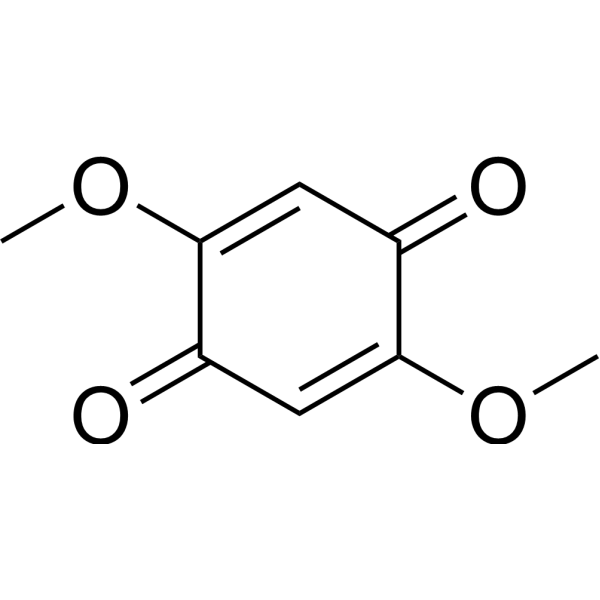
2,5-DMBQ (2,5-Dimethoxybenzoquinone) serves as an extracellular reductant. 2,5-DMBQ is involved in a crucial redox cycle, namely the extracellular hydroquinone-quinone redox cycle. In this cycle, 2,5-DMBQ is capable of reducing extracellular Fe³⁺ and generating H2O2. 2,5-DMBQ plays a pivotal role in the biodegradation mechanism of brown rot fungal, assisting the fungi in decomposing and utilizing organic matter.
Nur für Forschungszwecke. Wir verkaufen nicht an Patienten.
- Reinheit : 99.99%
- CAS. Nr.: 3117-03-1
- Formel: C8H8O4
- Molecular Weight:168.15
-
Speicherung:Powder -20°C, 3 years , 4°C, 2 years ; In solvent -80°C, 6 months , -20°C, 1 month

To place orders, for customer services and technical support, please contact: MedChemExpress USA
Tel: 609-228-6898 E-mail: [email protected] [email protected]


-
 Biologische Aktivität
-
Chemical Information
- Protokoll
- Reinheit & Dokumentation
- Verweise
-
 Help & FAQs


-

HY-W112021R
2,5-DMBQ (Standard)Reductant -
HY-W010516
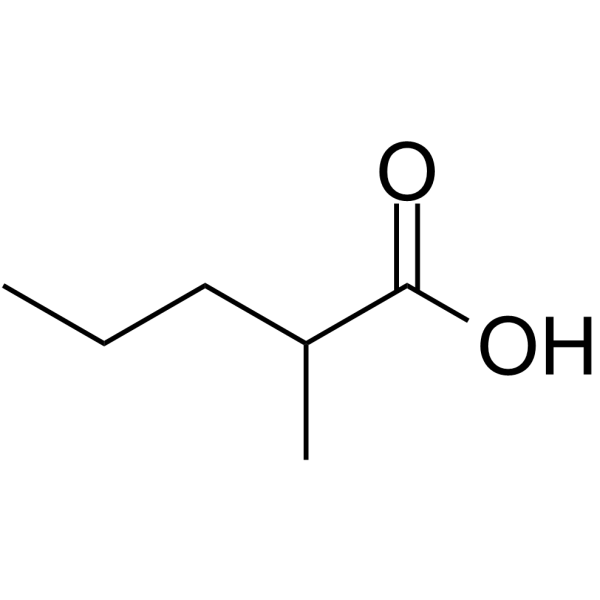
2-Methylvaleric acidShort-chain Fatty acid -

HY-W002255
2,4-Dimethylthiazole-5-carboxylic acidBuilding Block -
![3,3',5,5'-Tetra-tert-butyl-[1,1'-bi(cyclohexylidene)]-2,2',5,5'-tetraene-4,4'-dione (Standard)](https://file.medchemexpress.com/product_pic/hy-w035905r.gif)
HY-W035905R
3,3',5,5'-Tetra-tert-butyl-[1,1'-bi(cyclohexylidene)]-2,2',5,5'-tetraene-4,4'-dione (Standard) -

HY-W010516R
2-Methylvaleric acid (Standard)


Biologische Aktivität
Beschreibung
Cellular Effect
|
Cell Line

|
Type | Value | Description | References |
|---|---|---|---|---|
| Cancer cell lines | ED50 |
1.3 μg/mL
Compound: 4
|
Cytotoxicity against human lung cancer cells
Cytotoxicity against human lung cancer cells
|
[PMID: 1965200] |
| Cancer cell lines | ED50 |
1.4 μg/mL
Compound: 4
|
Cytotoxicity against human colon cancer cells
Cytotoxicity against human colon cancer cells
|
[PMID: 1965200] |
| Cancer cell lines | ED50 |
5.2 μg/mL
Compound: 4
|
Cytotoxicity against human breast cancer cells
Cytotoxicity against human breast cancer cells
|
[PMID: 1965200] |
| HT-1080 | ED50 |
3.4 μg/mL
Compound: 4
|
Cytotoxicity against human HT1080 cells
Cytotoxicity against human HT1080 cells
|
[PMID: 1965200] |
| KB | ED50 |
3.8 μg/mL
Compound: 4
|
Cytotoxicity against human KB cells
Cytotoxicity against human KB cells
|
[PMID: 1965200] |
| Melanoma cell | ED50 |
2.7 μg/mL
Compound: 4
|
Cytotoxicity against human melanoma cells
Cytotoxicity against human melanoma cells
|
[PMID: 1965200] |
| P388 | ED50 |
2.5 μg/mL
Compound: 4
|
Cytotoxicity against mouse P388 cells
Cytotoxicity against mouse P388 cells
|
[PMID: 1965200] |


Chemical Information
-
CAS. Nr. 3117-03-1
-
Appearance Solid
-
Molecular Weight 168.15
-
Formel C8H8O4
-
Color Light yellow to yellow
-
SMILES
O=C1C(OC)=CC(C(OC)=C1)=O
-
Synonyms
2,5-Dimethoxybenzoquinone
-
Versand
Room temperature in continental US; may vary elsewhere.
-
Speicherung
Powder -20°C 3 years 4°C 2 years In solvent -80°C 6 months -20°C 1 month


Reinheit & Dokumentation
-
Data Sheet (269 KB)
-
SDS (393 KB)
- English - EN (393 KB)
- Français - FR (393 KB)
- Deutsch - DE (393 KB)
- Norwegian - NO (393 KB)
- Español - ES (393 KB)
- Swedish - SV (393 KB)
- Italian - IT (393 KB)
- Korean - KR (393 KB)
- Portuguese - PT (393 KB)
-
Handling Instructions (2659 KB)
Verweise
[1]. Varela E, et al. Effect of pH and oxalate on hydroquinone-derived hydroxyl radical formation during brown rot wood degradation. Appl Environ Microbiol. 2003;69(10):6025-6031. [Content Brief]
[2]. Jensen KA Jr, et al. Pathways for extracellular Fenton chemistry in the brown rot basidiomycete Gloeophyllum trabeum. Appl Environ Microbiol. 2001 Jun;67(6):2705-11. [Content Brief]

Calculators
Konzentration (Stammlösung) × Volumen (Stammlösung) = Konzentration (Ziellösung) × Volumen (Ziellösung)


2,5-DMBQ Related Classifications
HY-W112021 Related Classifications
 Powered by Bioz