



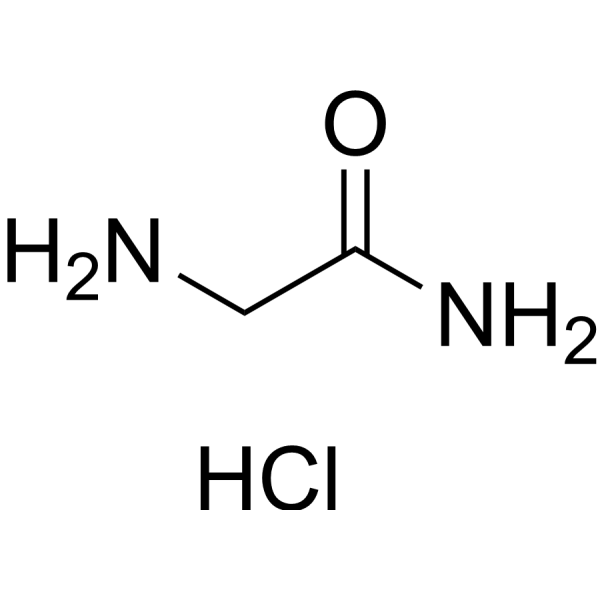
2-Aminoacetamide hydrochloride

Based on 1 Customer Validation
2-Aminoacetamide hydrochloride (Glycinamide hydrochloride) is a derivative of Glycine (HY-Y0966). 2-Aminoacetamide hydrochloride forms cell-absorbable nanocomplexes with proteins (such as bovine serum albumin) through strong electrostatic interactions, promoting cellular uptake of related proteins. 2-Aminoacetamide hydrochloride synergizes with BMP2 to upregulate the expression of osteogenic marker genes (such as Col1a1, Alp, Runx2) and proteins (such as COL1, BSP), enhancing collagen synthesis. 2-Aminoacetamide hydrochloride synergizes with BMP2 to promote osteoblast differentiation in vitro and bone regeneration in vivo.
For research use only. We do not sell to patients.
- Purity : 99.83%
- CAS No.: 1668-10-6
- Formula: C2H7ClN2O
- Molecular Weight:110.54
-
Storage:
4°C, sealed storage, away from moisture
* In solvent : -80°C, 6 months; -20°C, 1 month (sealed storage, away from moisture)

To place orders, for customer services and technical support, please contact: MedChemExpress USA
Tel: 609-228-6898 E-mail: [email protected] [email protected]


-
 Biological Activity
-
Chemical Information
-
Solvent & Solubility
- Protocols
- Purity & Documentation
- References
-
 Help & FAQs




Biological Activity
Description
In Vitro
2-Aminoacetamide (1 mM; 4 days for osteogenesis markers) hydrochloride significantly enhances collagen synthesis, alkaline phosphatase (ALP) activity, and the expression of osteoblast differentiation marker genes (Col1a1, Alp, Osx, Runx2, Bsp, Ocn) in MC3T3-E1 cells under osteogenic medium (OSM) or with bone morphogenetic protein 2 (BMP2)[1].
2-Aminoacetamide (3 mg/mL; 4 h) hydrochloride readily forms submicron-sized nanocomplexes with proteins (e.g., bovine serum albumin, BSA) through strong electrostatic interactions[1].
2-Aminoacetamide (0.5-5 mM; 24-72 h) hydrochloride partially retards the proliferation of MC3T3-E1 cells and human BMSCs on day 3 but does not induce cytotoxicity in either cell line on day 1[1].
MedChemExpress (MCE) has not independently confirmed the accuracy of these methods. They are for reference only. Further protocols information, click here.
In Vivo
MedChemExpress (MCE) has not independently confirmed the accuracy of these methods. They are for reference only.
-
Animal Model:Six-week-old male ICR mice with calvarial defect[1]
-
Dosage:1 M Glycinamide
-
Administration:Administration via transplantation of Glycinamide-soaked absorbable collagen sponge into the calvarial defect
-
Result:Showed that the group treated with 1 M Glycinamide plus 0.25 μg BMP2 had a 65% increase in bone volume (BV) and a 64% increase in bone volume/tissue volume ratio (BV/TV) compared with the BMP2 alone group, and a 1.6-fold increase in trabecular number (Tb.N) compared with the BMP2 alone group.
Revealed that the bone area percentage of the Glycinamide plus BMP2 group was 84.7% higher than that of the BMP2 alone group.
Showed that the mature bone area percentage of this group (Glycinamide plus BMP2) was 35.2%, which was significantly higher than that of the BMP2 alone group (18.9%) and the glycine plus BMP2 group (15.5%).


Chemical Information
-
CAS No. 1668-10-6
-
Appearance Solid
-
Molecular Weight 110.54
-
Formula C2H7ClN2O
-
Color White to off-white
-
SMILES
O=C(N)CN.Cl
-
Synonyms
Glycinamide hydrochloride
-
Shipping
Room temperature in continental US; may vary elsewhere.
-
Storage
4°C, sealed storage, away from moisture
* In solvent : -80°C, 6 months; -20°C, 1 month (sealed storage, away from moisture)


Solvent & Solubility
In Vitro:
DMSO : 100 mg/mL (904.65 mM; Need ultrasonic; Hygroscopic DMSO has a significant impact on the solubility of product, please use newly opened DMSO)
Please refer to the solubility information to select the appropriate solvent. Once prepared, please aliquot and store the solution to prevent product inactivation from repeated freeze-thaw cycles.
Storage method and period of stock solution: -80°C, 6 months; -20°C, 1 month (sealed storage, away from moisture). When stored at -80°C, please use it within 6 months. When stored at -20°C, please use it within 1 month.
Please refer to the solubility information to select the appropriate solvent. Once prepared, please aliquot and store the solution to prevent product inactivation from repeated freeze-thaw cycles.
Storage method and period of stock solution: -80°C, 6 months; -20°C, 1 month (sealed storage, away from moisture). When stored at -80°C, please use it within 6 months. When stored at -20°C, please use it within 1 month.
Concentration (start) × Volume (start) = Concentration (final) × Volume (final)
In Vivo:
Select the appropriate dissolution method based on your experimental animal and administration route.
- For the following dissolution methods, please ensure to first prepare a clear stock solution using an In Vitro approach and then sequentially add co-solvents:
- To ensure reliable experimental results, the clarified stock solution can be appropriately stored based on storage conditions. As for the working solution for In Vivo experiments, it is recommended to prepare freshly and use it on the same day.
- The percentages shown for the solvents indicate their volumetric ratio in the final prepared solution. If precipitation or phase separation occurs during preparation, heat and/or sonication can be used to aid dissolution.
Add each solvent one by one: 10% DMSO 40% PEG300 5% Tween-80 45% Saline
Solubility: ≥ 2.5 mg/mL (22.62 mM); Clear solution
This protocol yields a clear solution of ≥ 2.5 mg/mL (saturation unknown).
Taking 1 mL working solution as an example, add 100 μL DMSO stock solution (25.0 mg/mL) to 400 μL PEG300, and mix evenly; then add 50 μL Tween-80 and mix evenly; then add 450 μL Saline to adjust the volume to 1 mL.
Preparation of Saline: Dissolve 0.9 g sodium chloride in ddH₂O and dilute to 100 mL to obtain a clear Saline solution.
Add each solvent one by one: 10% DMSO 90% (20% SBE-β-CD in Saline)
Solubility: ≥ 2.5 mg/mL (22.62 mM); Clear solution
This protocol yields a clear solution of ≥ 2.5 mg/mL (saturation unknown).
Taking 1 mL working solution as an example, add 100 μL DMSO stock solution (25.0 mg/mL) to 900 μL 20% SBE-β-CD in Saline, and mix evenly.
Preparation of 20% SBE-β-CD in Saline (4°C, storage for one week): 2 g SBE-β-CD powder is dissolved in 10 mL Saline, completely dissolve until clear.
In Vivo Dissolution Calculator
Please enter the basic information of animal experiments:
-
-
-
-
Recommended: Prepare an additional quantity of animals to account for potential losses during experiments.
Please enter your animal formula composition:
-
%DMSO +
Recommended: Keep the proportion of DMSO in working solution below 2% if your animal is weak.
-
%+
-
+%Tween-80 + +
-
%Saline +
The co-solvents required include: DMSO, . All of co-solvents are available by MedChemExpress (MCE). , Tween 80. All of co-solvents are available by MedChemExpress (MCE).
Working solution concentration: 0.22 mg/mL
Method for preparing stock solution: mg drug dissolved in μL DMSO. Stock solution concentration: mg/mL. * In solvent : -80°C, 6 months; -20°C, 1 month (sealed storage, away from moisture)
1. Take μL DMSO stock solution;
2. Add μL .
μL , mix evenly;
3. Then add μL Tween 80, mix evenly;
4. Then add μL
Please ensure that the stock solution in the first step is dissolved to a clear state, and add co-solvents in sequence. You can use ultrasonic heating (ultrasonic cleaner, recommended frequency 20-40 kHz), vortexing, etc. to assist dissolution.

Protocols
-
RNA extraction experimental
By lysing cells, releasing RNA, and removing impurities such as proteins and DNA, high-purity RNA products are finally obtained. The commonly used traditional method is the guanidine isothiocyanate/phenol/chloroform method (Trizol), which is suitable for a variety of animal materials including animal tissues, microorganisms, cultured cells, etc., and most plant materials.
-
Mesenchymal stromal/stem cell osteogenic differentiation
Mesenchymal stromal/stem cells can be induced toward an osteoblast-like lineage in vitro by culture in osteogenic medium containing dexamethasone, ascorbic acid or ascorbate-2-phosphate, and β-glycerophosphate; the differentiation process is commonly evaluated by alkaline phosphatase activity, osteogenic marker expression, collagenous matrix formation, and calcium-rich matrix mineralization. The main readouts are alkaline phosphatase activity as an early osteogenic marker and Alizarin Red S staining as a calcium-deposit readout for mineralized extracellular matrix; Alizarin Red S can be inspected microscopically or extracted and measured colorimetrically at 405 nm.


Purity & Documentation
-
Data Sheet (272 KB)
-
SDS (394 KB)
- English - EN (394 KB)
- Français - FR (394 KB)
- Deutsch - DE (394 KB)
- Norwegian - NO (394 KB)
- Español - ES (394 KB)
- Swedish - SV (394 KB)
- Italian - IT (394 KB)
- Korean - KR (394 KB)
- Portuguese - PT (394 KB)
-
Handling Instructions (2659 KB)
References


Complete Stock Solution Preparation Table
Please refer to the solubility information to select the appropriate solvent. Once prepared, please aliquot and store the solution to prevent product inactivation from repeated freeze-thaw cycles.
Storage method and period of stock solution: -80°C, 6 months; -20°C, 1 month (sealed storage, away from moisture). When stored at -80°C, please use it within 6 months. When stored at -20°C, please use it within 1 month.
| Optional Solvent | Concentration Solvent Mass | 1 mg | 5 mg | 10 mg | 25 mg |
|---|---|---|---|---|---|
| DMSO | 1 mM | 9.0465 mL | 45.2325 mL | 90.4650 mL | 226.1625 mL |
| 5 mM | 1.8093 mL | 9.0465 mL | 18.0930 mL | 45.2325 mL | |
| 10 mM | 0.9046 mL | 4.5232 mL | 9.0465 mL | 22.6162 mL | |
| 15 mM | 0.6031 mL | 3.0155 mL | 6.0310 mL | 15.0775 mL | |
| 20 mM | 0.4523 mL | 2.2616 mL | 4.5232 mL | 11.3081 mL | |
| 25 mM | 0.3619 mL | 1.8093 mL | 3.6186 mL | 9.0465 mL | |
| 30 mM | 0.3015 mL | 1.5077 mL | 3.0155 mL | 7.5387 mL | |
| 40 mM | 0.2262 mL | 1.1308 mL | 2.2616 mL | 5.6541 mL | |
| 50 mM | 0.1809 mL | 0.9046 mL | 1.8093 mL | 4.5232 mL | |
| 60 mM | 0.1508 mL | 0.7539 mL | 1.5077 mL | 3.7694 mL | |
| 80 mM | 0.1131 mL | 0.5654 mL | 1.1308 mL | 2.8270 mL | |
| 100 mM | 0.0905 mL | 0.4523 mL | 0.9046 mL | 2.2616 mL |


2-Aminoacetamide hydrochloride Related Classifications
HY-Y1123 Related Classifications
 Powered by Bioz