



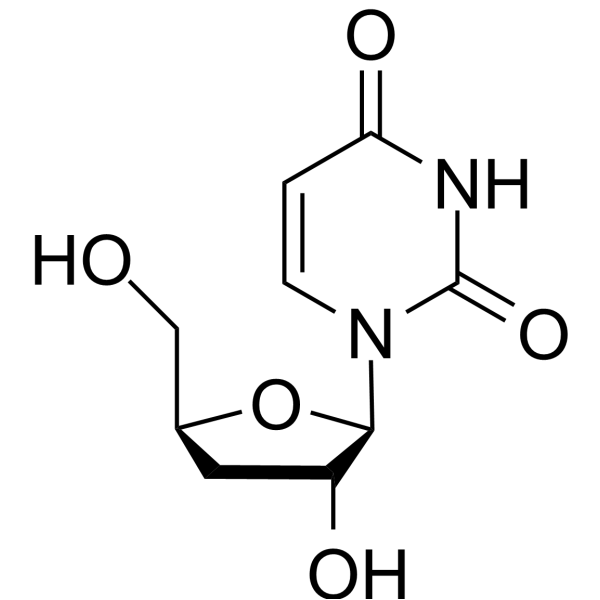
3′-Deoxyuridine

Based on 1 Customer Validation
3′-Deoxyuridine is a 3'-deoxynucleoside analog and a 2',3'-dideoxynucleoside. 3′-Deoxyuridine does not inhibit the replication of HCV-like RNA templates or luciferase levels in human cells at the tested concentrations. 3′-Deoxyuridine serves as a substrate for microbial dideoxyribosylation reactions to generate various 2',3'-dideoxynucleosides, but cannot be converted into 2',3'-dideoxycytidine by resting E. coli AJ 2595 cells. 3′-Deoxyuridine can be formed by the deamination of 3'-deoxycytidine by E. coli BM-11 cytidine deaminase, and can also undergo phosphorolytic cleavage to produce uracil and the corresponding pentose phosphate. 3′-Deoxyuridine has been used in research related to HCV and other relevant fields.
Para uso exclusivo en investigación. No vendemos a pacientes.
- Pureza : 98.87%
- No. CAS: 7057-27-4
- Fòrmula: C9H12N2O5
- Peso molecular:228.20
-
Almacenamiento:
4°C, protect from light
* In solvent : -80°C, 6 months; -20°C, 1 month (protect from light)

To place orders, for customer services and technical support, please contact: MedChemExpress USA
Tel: 609-228-6898 E-mail: [email protected] [email protected]


-
 Actividad biológica
-
Chemical Information
-
Solvente y solubilidad
- Pureza y Documentación
- Referencias
-
 Help & FAQs




Actividad biológica
Descripciòn
Cellular Effect
|
Cell Line

|
Type | Value | Description | References |
|---|---|---|---|---|
| CCRF S-180 | ED50 |
>100 μM
Compound: 26
|
Effective dose to inhibit the replication of S180 cell line in vitro.
Effective dose to inhibit the replication of S180 cell line in vitro.
|
[PMID: 1995894] |
| CCRF-CEM | ED50 |
>100 μM
Compound: 26
|
Inhibit the replication of CCRF-CEM cell line in vitro.
Inhibit the replication of CCRF-CEM cell line in vitro.
|
[PMID: 1995894] |
| L1210 | ED50 |
50 μM
Compound: 26
|
Effective dose to inhibit the replication of L1210 cell line in vitro.
Effective dose to inhibit the replication of L1210 cell line in vitro.
|
[PMID: 1995894] |
| P388 | ED50 |
25 μM
Compound: 26
|
Effective dose to inhibit the replication of P388 cell line in vitro.
Effective dose to inhibit the replication of P388 cell line in vitro.
|
[PMID: 1995894] |
In Vitro
Resting cells of Escherichia coli AJ 2595 (50-200 mM DDU with corresponding base; 24-48 h) catalyze the transdideoxyribosylation of 2',3'-Dideoxyuridine (HY-W014306) (DDU, not the target reagent 3′-Deoxyuridine) to produce up to 52 mM 2′,3′-dideoxyadenosine, 49.1 mM 2′,3′-dideoxyadenosine, 43.1 mM 2′,3′-dideoxyadenosine, 16.6 mM 2′,3′-dideoxyadenosine, 32 mM 2′,3′-dideoxyinosine, 5.8 mM 2′,3′-dideoxythymidine, and 1.2 mM 2′,3′-dideoxyguanosine, but not 2′,3′-dideoxycytidine, when paired with the corresponding purine or pyrimidine bases under optimized conditions[1].
3′-Deoxyuridine (0.5-150 μM; 48 h) does not inhibit HCV-like RNA replication in 293B4α cells or exhibit cytotoxicity in 293SVLuc cells[2].
MedChemExpress (MCE) has not independently confirmed the accuracy of these methods. They are for reference only. .


Chemical Information
-
No. CAS 7057-27-4
-
Appearance Solid
-
Peso molecular 228.20
-
Fòrmula C9H12N2O5
-
Color White to light yellow
-
SMILES
O=C(N1)N([C@H]2[C@H](O)C[C@@H](CO)O2)C=CC1=O
-
Envío
Room temperature in continental US; may vary elsewhere.
-
Almacenamiento
4°C, protect from light
* In solvent : -80°C, 6 months; -20°C, 1 month (protect from light)


Solvente y solubilidad
In Vitro:
DMSO : 50 mg/mL (219.11 mM; Need ultrasonic; Hygroscopic DMSO has a significant impact on the solubility of product, please use newly opened DMSO)
Please refer to the solubility information to select the appropriate solvent. Once prepared, please aliquot and store the solution to prevent product inactivation from repeated freeze-thaw cycles.
Storage method and period of stock solution: -80°C, 6 months; -20°C, 1 month (protect from light). When stored at -80°C, please use it within 6 months. When stored at -20°C, please use it within 1 month.
Please refer to the solubility information to select the appropriate solvent. Once prepared, please aliquot and store the solution to prevent product inactivation from repeated freeze-thaw cycles.
Storage method and period of stock solution: -80°C, 6 months; -20°C, 1 month (protect from light). When stored at -80°C, please use it within 6 months. When stored at -20°C, please use it within 1 month.
Concentration (start) × Volume (start) = Concentration (final) × Volume (final)
In Vivo:
Select the appropriate dissolution method based on your experimental animal and administration route.
- For the following dissolution methods, please ensure to first prepare a clear stock solution using an In Vitro approach and then sequentially add co-solvents:
- To ensure reliable experimental results, the clarified stock solution can be appropriately stored based on storage conditions. As for the working solution for In Vivo experiments, it is recommended to prepare freshly and use it on the same day.
- The percentages shown for the solvents indicate their volumetric ratio in the final prepared solution. If precipitation or phase separation occurs during preparation, heat and/or sonication can be used to aid dissolution.
Add each solvent one by one: 10% DMSO 40% PEG300 5% Tween-80 45% Saline
Solubility: ≥ 2.5 mg/mL (10.96 mM); Clear solution
This protocol yields a clear solution of ≥ 2.5 mg/mL (saturation unknown).
Taking 1 mL working solution as an example, add 100 μL DMSO stock solution (25.0 mg/mL) to 400 μL PEG300, and mix evenly; then add 50 μL Tween-80 and mix evenly; then add 450 μL Saline to adjust the volume to 1 mL.
Preparation of Saline: Dissolve 0.9 g sodium chloride in ddH₂O and dilute to 100 mL to obtain a clear Saline solution.
Add each solvent one by one: 10% DMSO 90% (20% SBE-β-CD in Saline)
Solubility: ≥ 2.5 mg/mL (10.96 mM); Clear solution
This protocol yields a clear solution of ≥ 2.5 mg/mL (saturation unknown).
Taking 1 mL working solution as an example, add 100 μL DMSO stock solution (25.0 mg/mL) to 900 μL 20% SBE-β-CD in Saline, and mix evenly.
Preparation of 20% SBE-β-CD in Saline (4°C, storage for one week): 2 g SBE-β-CD powder is dissolved in 10 mL Saline, completely dissolve until clear.
In Vivo Dissolution Calculator
Please enter the basic information of animal experiments:
-
-
-
-
Recommended: Prepare an additional quantity of animals to account for potential losses during experiments.
Please enter your animal formula composition:
-
%DMSO +
Recommended: Keep the proportion of DMSO in working solution below 2% if your animal is weak.
-
%+
-
+%Tween-80 + +
-
%Saline +
The co-solvents required include: DMSO, . All of co-solvents are available by MedChemExpress (MCE). , Tween 80. All of co-solvents are available by MedChemExpress (MCE).
Working solution concentration: 0.22 mg/mL
Method for preparing stock solution: mg drug dissolved in μL DMSO. Stock solution concentration: mg/mL. * In solvent : -80°C, 6 months; -20°C, 1 month (protect from light)
1. Take μL DMSO stock solution;
2. Add μL .
μL , mix evenly;
3. Then add μL Tween 80, mix evenly;
4. Then add μL
Please ensure that the stock solution in the first step is dissolved to a clear state, and add co-solvents in sequence. You can use ultrasonic heating (ultrasonic cleaner, recommended frequency 20-40 kHz), vortexing, etc. to assist dissolution.


Pureza y Documentación
-
Ficha de datos (277 KB)
-
SDS (394 KB)
- English - EN (394 KB)
- Français - FR (394 KB)
- Deutsch - DE (394 KB)
- Norwegian - NO (394 KB)
- Español - ES (394 KB)
- Swedish - SV (394 KB)
- Italian - IT (394 KB)
- Korean - KR (394 KB)
- Portuguese - PT (394 KB)
-
Instrucciones de manejo (2659 KB)
Referencias
[1]. Shirae H, et al. Production of 2',3'-dideoxyadenosine and 2',3'-dideoxyinosine from 2',3'-dideoxyuridine and the corresponding purine bases by resting cells of Escherichia coli AJ 2595. Appl Environ Microbiol. 1989;55(2):419-424. [Content Brief]
[2]. King RW, et al. Inhibition of the replication of a hepatitis C virus-like RNA template by interferon and 3'-deoxycytidine. Antivir Chem Chemother. 2002;13(6):363-370. [Content Brief]


Complete Stock Solution Preparation Table
Please refer to the solubility information to select the appropriate solvent. Once prepared, please aliquot and store the solution to prevent product inactivation from repeated freeze-thaw cycles.
Storage method and period of stock solution: -80°C, 6 months; -20°C, 1 month (protect from light). When stored at -80°C, please use it within 6 months. When stored at -20°C, please use it within 1 month.
| Optional Solvent | Concentration Solvent Mass | 1 mg | 5 mg | 10 mg | 25 mg |
|---|---|---|---|---|---|
| DMSO | 1 mM | 4.3821 mL | 21.9106 mL | 43.8212 mL | 109.5530 mL |
| 5 mM | 0.8764 mL | 4.3821 mL | 8.7642 mL | 21.9106 mL | |
| 10 mM | 0.4382 mL | 2.1911 mL | 4.3821 mL | 10.9553 mL | |
| 15 mM | 0.2921 mL | 1.4607 mL | 2.9214 mL | 7.3035 mL | |
| 20 mM | 0.2191 mL | 1.0955 mL | 2.1911 mL | 5.4777 mL | |
| 25 mM | 0.1753 mL | 0.8764 mL | 1.7528 mL | 4.3821 mL | |
| 30 mM | 0.1461 mL | 0.7304 mL | 1.4607 mL | 3.6518 mL | |
| 40 mM | 0.1096 mL | 0.5478 mL | 1.0955 mL | 2.7388 mL | |
| 50 mM | 0.0876 mL | 0.4382 mL | 0.8764 mL | 2.1911 mL | |
| 60 mM | 0.0730 mL | 0.3652 mL | 0.7304 mL | 1.8259 mL | |
| 80 mM | 0.0548 mL | 0.2739 mL | 0.5478 mL | 1.3694 mL | |
| 100 mM | 0.0438 mL | 0.2191 mL | 0.4382 mL | 1.0955 mL |


3′-Deoxyuridine Related Classifications
HY-W012282 Related Classifications
 Powered by Bioz