



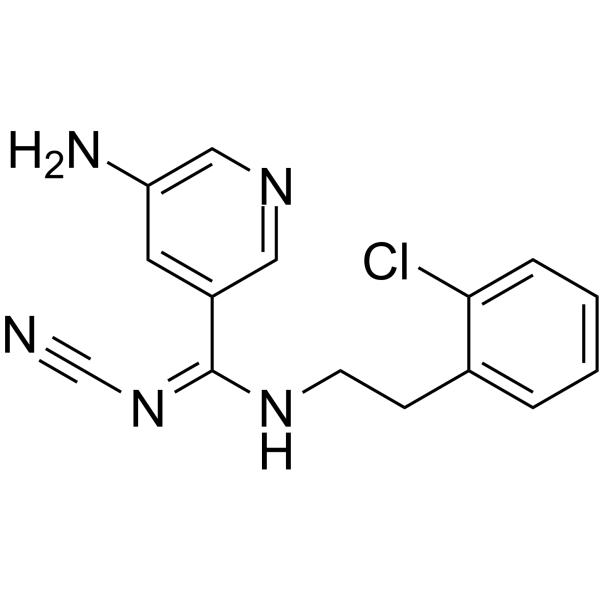
KRN4884
KRN4884 is a K+ channel opener. In the presence of intracellular ATP (1 mM), KRN4884 (0.1-3 μM) activates KATP channels in a concentration-dependent manner (EC50=0.55 μM).
Nos produits utilisent uniquement pour la recherche. Nous ne vendons pas aux patients.
- CAS No.: 152802-84-1
- Formule: C15H14ClN5
- Masse moléculaire:299.76
-
Stockage:
Please store the product under the recommended conditions in the Certificate of Analysis.

To place orders, for customer services and technical support, please contact: MedChemExpress USA
Tel: 609-228-6898 E-mail: [email protected] [email protected]


-
 Activité biologique
-
Chemical Information
- Pureté et documentation
- Références
-
 Help & FAQs




Activité biologique
Description
IC50 & Target
EC50: 0.55 μM (KATP channel)[1]
In Vitro
KRN4884 (0.3 μM) shifts the concentration-response relationship for ATP-induced KATP channel inhibition to the right and slightly upward direction without altering the slope. After either the spontaneous or Ca2+-induced channel rundown, KRN4884 (1 and 3 μM) partially restores the KATP channel activity. Furthermore, the effect of KRN4884 is augmented by the presence of uridine 5′-diphosphate (3 mM). KRN4884 activates cardiac KATP channels through not only decreasing the sensitivity of the channel to ATP but also directly stimulating the opening of the channel. KRN4884 (0.3 and 3 μM) increases the outward current in a concentration-dependent manner, and the unitary current amplitudes are similar to that of KATP channels in the ATP-free solution[1].
MedChemExpress (MCE) has not independently confirmed the accuracy of these methods. They are for reference only. .
In Vivo
MedChemExpress (MCE) has not independently confirmed the accuracy of these methods. They are for reference only.


Chemical Information
-
CAS No. 152802-84-1
-
Masse moléculaire 299.76
-
Formule C15H14ClN5
-
SMILES
N#C/N=C(C1=CC(N)=CN=C1)/NCCC2=CC=CC=C2Cl
-
Livraison
Room temperature in continental US; may vary elsewhere.
-
Stockage
Please store the product under the recommended conditions in the Certificate of Analysis.


Pureté et documentation
Références
[1]. Shinbo A, et al. Activation of cardiac ATP-sensitive K+ channels by KRN4884, a novel K+ channel opener. J Pharmacol Exp Ther. 1997 Nov;283(2):770-7. [Content Brief]
[2]. Yokoyama T, et al. Effects of KRN4884, a novel pyridinecarboxamidine type KATP channel opener, on serum triglyceride levels in rats. Br J Pharmacol. 1997 Apr;120(8):1471-6. [Content Brief]

Calculators
Concentration (start) × Volume (start) = Concentration (final) × Volume (final)


KRN4884 Related Classifications
HY-U00201 Related Classifications
 Powered by Bioz