



LY 303511 hydrochloride
Based on 5 publication(s) in Google Scholar
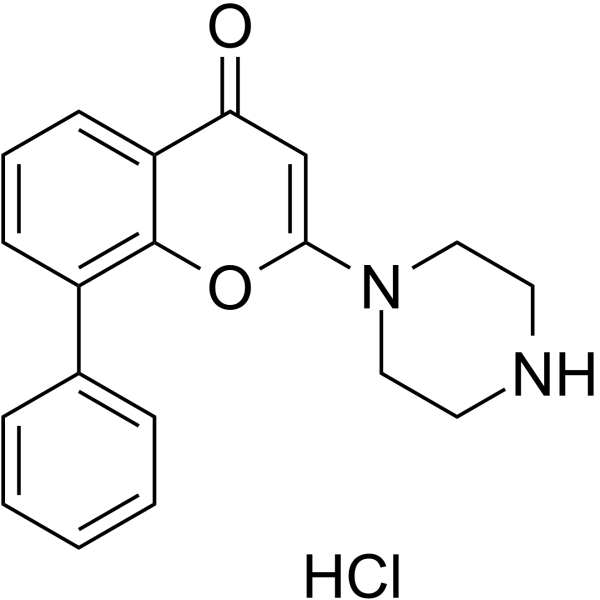
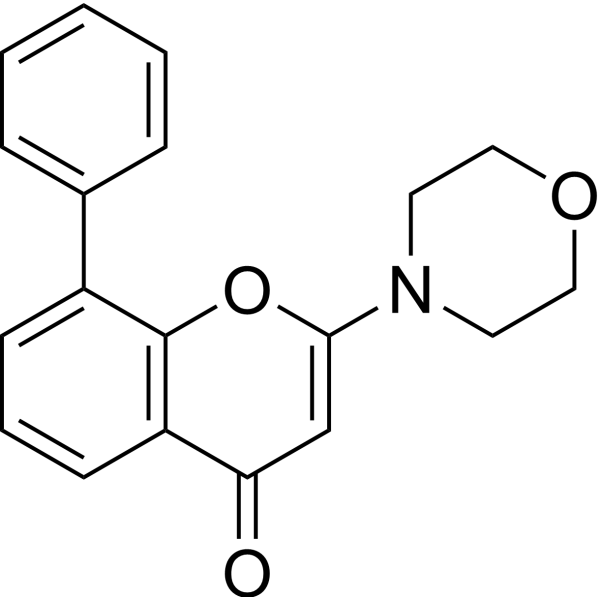
LY 303511 hydrochloride is a structural analogue of LY294002. LY303511 does not inhibit PI3K. LY303511 enhances TRAIL sensitivity of SHEP-1 neuroblastoma cells. LY303511 reversibly blocks K+ currents (IC50=64.6±9.1 μM) in MIN6 insulinoma cells.
For research use only. We do not sell to patients.
- Purity : 98.87%
- CAS No.: 2070014-90-1
- Formula: C19H19ClN2O2
- Molecular Weight:342.82
-
Storage:
4°C, sealed storage, away from moisture
* In solvent : -80°C, 6 months; -20°C, 1 month (sealed storage, away from moisture)

To place orders, for customer services and technical support, please contact: MedChemExpress USA
Tel: 609-228-6898 E-mail: [email protected] [email protected]


-
 Biological Activity
-
Chemical Information
-
Solvent & Solubility
- Protocol
- Purity & Documentation
- References
-
 Help & FAQs


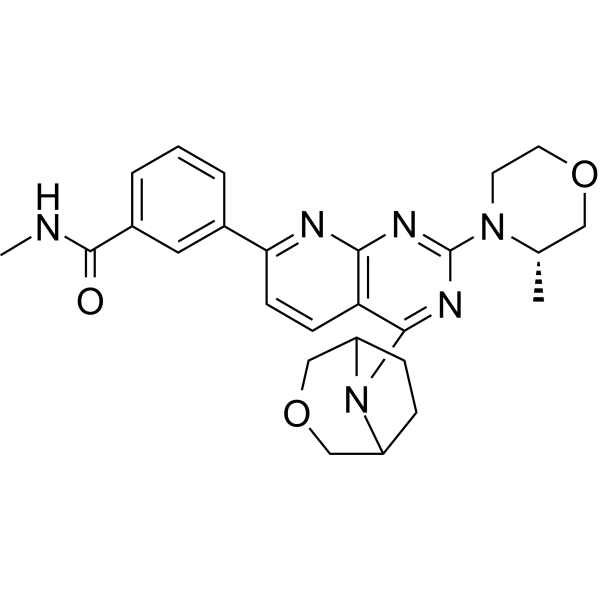
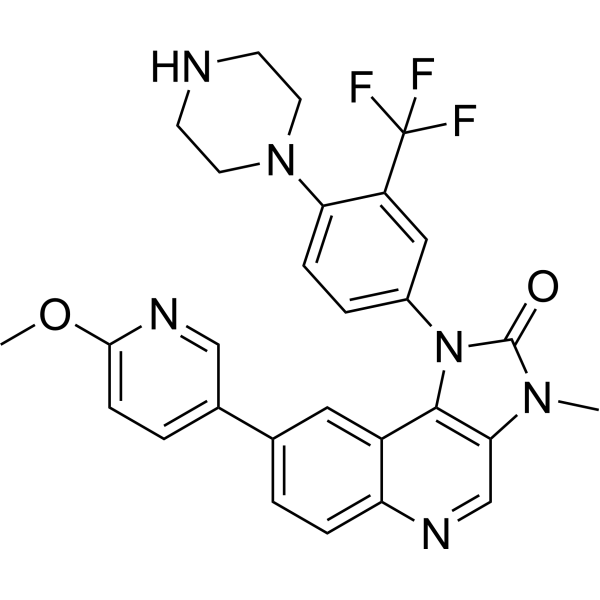
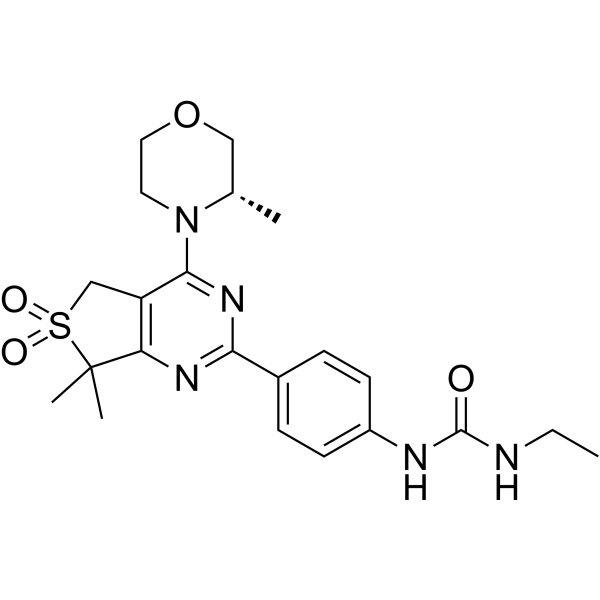
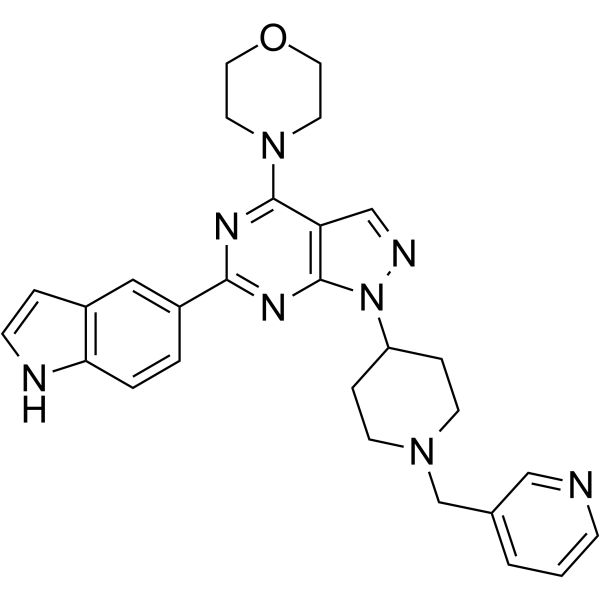
Publications Citing Use of MedChemExpress (MCE) LY 303511 hydrochloride
More

Biological Activity
Description
IC50 & Target
TRAIL[2]
IC50: 64.6±9.1 µM (K+ currents, in MIN6 insulinoma cells)[3]
In Vitro
LY303511 is structurally identical to LY294002 except for a substitution of -O for -NH in the morpholine ring, and does not potently inhibit PI3K. Treatment of cells with LY303511 causes an increase in calcein spread similar to levels of LY294002. The ability of LY303511 to increase gap junctional intercellular communication (GJIC) does not occur concomitant with inhibition of phosphorylation of AKT as measured by immunoblotting[1]. LY303511 enhances TRAIL sensitivity of SHEP-1 neuroblastoma cells via H2O2-MAPK activation and up-regulation of death receptors. SHEP-1 cells are exposed to varying concentrations of LY303511 (LY30), TRAIL, and a combination of the two (1 h preincubation with LY303511 followed by TRAIL for 4 hours). SHEP-1 cells are responsive to TRAIL (~10%, ~15%, and ~30% reduction in the surviving fraction at 25, 50, and 100 ng/mL, respectively); however, treatment with LY303511 (12.5, 25, or 50 μM) has no effect on cell viability. However, incubation of cells with LY303511 (25 μM) for 1 hour followed by 4 hours exposure to 50 ng/mL of TRAIL has a strong synergistic effect (~40% reduction in viable cells with LY303511+TRAIL versus ~15% with TRAIL alone)[2]. LY303511 is a negative control compound with respect to PI3K activity. In MIN6 insulinoma cells, Wortmannin (100 nM) has no effect on whole-cell outward K+ currents, but LY294002 and LY303511 reversibly block currents in a dose-dependent manner (IC50=9.0±0.7 μM and 64.6±9.1 μM, respectively). Kv2.1 and Kv1.4 are highly expressed in beta-cells, and in Kv2.1-transfected tsA201 cells, 50 μM LY294002 and 100 μM LY303511 reversibly inhibit currents by 99% and 41%, respectively. LY303511 blocks currents with an IC50 of 64.6±9.1 µM, with a maximal inhibition of ~90% at 500 µM (n≥5 cells at each concentration)[3].
MedChemExpress (MCE) has not independently confirmed the accuracy of these methods. They are for reference only.
In Vivo
MedChemExpress (MCE) has not independently confirmed the accuracy of these methods. They are for reference only.


Chemical Information
-
CAS No. 2070014-90-1
-
Appearance Solid
-
Molecular Weight 342.82
-
Formula C19H19ClN2O2
-
Color White to light yellow
-
SMILES
O=C1C=C(N2CCNCC2)OC3=C(C4=CC=CC=C4)C=CC=C13.Cl
-
Shipping
Room temperature in continental US; may vary elsewhere.
-
Storage
4°C, sealed storage, away from moisture
* In solvent : -80°C, 6 months; -20°C, 1 month (sealed storage, away from moisture)


Publications (5)
-
Journal Impact Factor
-
Most Recent
-
Proc Natl Acad Sci U S A
2024 Nov 19;121(47):e2405534121. PMID: 39536084 -
Cancer Cell Int
Construction of a prognostic model with histone modification-related genes and identification of potential drugs in pancreatic cancer. [Abstract]2021 Jun 5;21(1):291. PMID: 34090418 -
Int J Mol Sci
A Functional Pipeline of Genome-Wide Association Data Leads to Midostaurin as a Repurposed Drug for Alzheimer's Disease. [Abstract]2023 Jul 28;24(15):12079. PMID: 37569459 -
J Leukoc Biol
2026 Jun 27:qiag090. PMID: 42364103 -


Solvent & Solubility
In Vitro:
DMSO : 25 mg/mL (72.92 mM; Need ultrasonic; Hygroscopic DMSO has a significant impact on the solubility of product, please use newly opened DMSO)
H2O : 1 mg/mL (2.92 mM; Need ultrasonic)
Please refer to the solubility information to select the appropriate solvent. Once prepared, please aliquot and store the solution to prevent product inactivation from repeated freeze-thaw cycles.
Storage method and period of stock solution: -80°C, 6 months; -20°C, 1 month (sealed storage, away from moisture). When stored at -80°C, please use it within 6 months. When stored at -20°C, please use it within 1 month.
* Note: If you choose water as the stock solution, please dilute it to the working solution, then filter and sterilize it with a 0.22 μm filter before use.
Please refer to the solubility information to select the appropriate solvent. Once prepared, please aliquot and store the solution to prevent product inactivation from repeated freeze-thaw cycles.
Storage method and period of stock solution: -80°C, 6 months; -20°C, 1 month (sealed storage, away from moisture). When stored at -80°C, please use it within 6 months. When stored at -20°C, please use it within 1 month.
* Note: If you choose water as the stock solution, please dilute it to the working solution, then filter and sterilize it with a 0.22 μm filter before use.
Concentration (start) × Volume (start) = Concentration (final) × Volume (final)
In Vivo:
Select the appropriate dissolution method based on your experimental animal and administration route.
- For the following dissolution methods, please ensure to first prepare a clear stock solution using an In Vitro approach and then sequentially add co-solvents:
- To ensure reliable experimental results, the clarified stock solution can be appropriately stored based on storage conditions. As for the working solution for In Vivo experiments, it is recommended to prepare freshly and use it on the same day.
- The percentages shown for the solvents indicate their volumetric ratio in the final prepared solution. If precipitation or phase separation occurs during preparation, heat and/or sonication can be used to aid dissolution.
Add each solvent one by one: 10% DMSO 40% PEG300 5% Tween-80 45% Saline
Solubility: ≥ 2.5 mg/mL (7.29 mM); Clear solution
This protocol yields a clear solution of ≥ 2.5 mg/mL (saturation unknown).
Taking 1 mL working solution as an example, add 100 μL DMSO stock solution (25.0 mg/mL) to 400 μL PEG300, and mix evenly; then add 50 μL Tween-80 and mix evenly; then add 450 μL Saline to adjust the volume to 1 mL.
Preparation of Saline: Dissolve 0.9 g sodium chloride in ddH₂O and dilute to 100 mL to obtain a clear Saline solution.
Add each solvent one by one: 10% DMSO 90% (20% SBE-β-CD in Saline)
Solubility: ≥ 2.5 mg/mL (7.29 mM); Clear solution
This protocol yields a clear solution of ≥ 2.5 mg/mL (saturation unknown).
Taking 1 mL working solution as an example, add 100 μL DMSO stock solution (25.0 mg/mL) to 900 μL 20% SBE-β-CD in Saline, and mix evenly.
Preparation of 20% SBE-β-CD in Saline (4°C, storage for one week): 2 g SBE-β-CD powder is dissolved in 10 mL Saline, completely dissolve until clear.
In Vivo Dissolution Calculator
Please enter the basic information of animal experiments:
-
-
-
-
Recommended: Prepare an additional quantity of animals to account for potential losses during experiments.
Please enter your animal formula composition:
-
%DMSO +
Recommended: Keep the proportion of DMSO in working solution below 2% if your animal is weak.
-
%+
-
+%Tween-80 + +
-
%Saline +
The co-solvents required include: DMSO, . All of co-solvents are available by MedChemExpress (MCE). , Tween 80. All of co-solvents are available by MedChemExpress (MCE).
Working solution concentration: 0.22 mg/mL
Method for preparing stock solution: mg drug dissolved in μL DMSO. Stock solution concentration: mg/mL. * In solvent : -80°C, 6 months; -20°C, 1 month (sealed storage, away from moisture)
1. Take μL DMSO stock solution;
2. Add μL .
μL , mix evenly;
3. Then add μL Tween 80, mix evenly;
4. Then add μL
Please ensure that the stock solution in the first step is dissolved to a clear state, and add co-solvents in sequence. You can use ultrasonic heating (ultrasonic cleaner, recommended frequency 20-40 kHz), vortexing, etc. to assist dissolution.

Protocol
Cell Assay[2]
Human neuroblastoma SHEP-1 cells are maintained in DMEM supplemented with 10% fetal bovine serum and 1% Penicillin. In a typical survival assay, SHEP-1 cells (8×10⁴ per well) plated in 24-well plates for 24 h are exposed to LY303511 (12.5, 25, and 50 μM), TRAIL (25, 50, and 100 ng/mL), and a combination of the two (1 h preincubation with LY303511 followed by TRAIL for 4 h). Cytotoxicity is determined by the crystal violet assay. After drug exposure, cells are washed with PBS and incubated for 20 min with crystal violet solution (200 μL). The excess crystal violet solution is washed away with distilled water, and the remaining crystals are dissolved with 20% acetic acid. Viability is determined by absorbance at 595 nm wavelength using an automated ELISA reader. Cell viability experiments are performed similarly with 2,000 units/mL of catalase, 4 μM JNK inhibitor SP600125, 10 μM p38 inhibitor SB202190, 20 μM MAPK/ERK kinase (MEK) inhibitor PD98059, 50 μM of caspase-8 inhibitor Z-IETD-FMK or pan-caspase inhibitor Z-VAD-FMK, or death receptor blocking antibodies (4 μg/mL anti-DR4 or 1 μg/mL anti-DR5), or in cells transfected with small interfering RNA (siRNA) for silencing JNK and ERK expression, respectively. Cells are preincubated for 1 h with LY303511 and the respective inhibitor or catalase before the addition of TRAIL. Similar sensitizing effect of LY303511 on TRAIL-induced apoptosis is carried out with SY5Y neuroblastoma, T98G glioblastoma, Jurkat leukemia, CEM myelogenous leukemia, HeLa ovarian carcinoma, and HT29 colorectal carcinoma cell lines[2].
MedChemExpress (MCE) has not independently confirmed the accuracy of these methods. They are for reference only.
Animal Administration[4]
Mice[4]
Human prostate adenocarcinoma (PC-3) cells (ATCC CRL-1435) are cultured in vitro before harvesting and implantation of 1×10⁶ cells in 20% Matrigel per athymic NCR nude mouse by subcutaneous injection at the flank. Inoculated mice are subdivided into four groups of 10. Administration of vehicle or LY303511, 10 mg/kg/day, is begun (day 1) when tumors reach ~150 mm3 (n=35), and tumor volumes are measured for 30 days at the indicated time points.
MedChemExpress (MCE) has not independently confirmed the accuracy of these methods. They are for reference only.


Purity & Documentation
-
Data Sheet (286 KB)
-
SDS (393 KB)
- English - EN (393 KB)
- Français - FR (393 KB)
- Deutsch - DE (393 KB)
- Norwegian - NO (393 KB)
- Español - ES (393 KB)
- Swedish - SV (393 KB)
- Italian - IT (393 KB)
- Korean - KR (393 KB)
- Portuguese - PT (393 KB)
-
Handling Instructions (2659 KB)
References
[1]. Bodenstine TM, et al. Homotypic gap junctional communication associated with metastasis suppression increases with PKA activity and is unaffected by PI3K inhibition. Cancer Res. 2010 Dec 1;70(23):10002-11. [Content Brief]
[2]. El-Kholy W, Macdonald PE, Lin JH, The phosphatidylinositol 3-kinase inhibitor LY294002 potently blocks K(V) currents via a direct mechanism. FASEB J. 2003 Apr;17(6):720-2. [Content Brief]
[3]. Shenoy K, et al. LY303511 enhances TRAIL sensitivity of SHEP-1 neuroblastoma cells via hydrogen peroxide-mediated mitogen-activated protein kinase activation and up-regulation of death receptors. Cancer Res. 2009 Mar 1;69(5):1941-50. [Content Brief]
[4]. Kristof AS, et al. LY303511 (2-piperazinyl-8-phenyl-4H-1-benzopyran-4-one) acts via phosphatidylinositol 3-kinase-independent pathways to inhibit cell proliferation via mammalian target of rapamycin (mTOR)- and non-mTOR-dependent mechanisms. J Pharmacol E [Content Brief]


Complete Stock Solution Preparation Table
Please refer to the solubility information to select the appropriate solvent. Once prepared, please aliquot and store the solution to prevent product inactivation from repeated freeze-thaw cycles.
Storage method and period of stock solution: -80°C, 6 months; -20°C, 1 month (sealed storage, away from moisture). When stored at -80°C, please use it within 6 months. When stored at -20°C, please use it within 1 month.
| Optional Solvent | Concentration Solvent Mass | 1 mg | 5 mg | 10 mg | 25 mg |
|---|---|---|---|---|---|
| H2O / DMSO | 1 mM | 2.9170 mL | 14.5849 mL | 29.1698 mL | 72.9246 mL |
| DMSO | 5 mM | 0.5834 mL | 2.9170 mL | 5.8340 mL | 14.5849 mL |
| 10 mM | 0.2917 mL | 1.4585 mL | 2.9170 mL | 7.2925 mL | |
| 15 mM | 0.1945 mL | 0.9723 mL | 1.9447 mL | 4.8616 mL | |
| 20 mM | 0.1458 mL | 0.7292 mL | 1.4585 mL | 3.6462 mL | |
| 25 mM | 0.1167 mL | 0.5834 mL | 1.1668 mL | 2.9170 mL | |
| 30 mM | 0.0972 mL | 0.4862 mL | 0.9723 mL | 2.4308 mL | |
| 40 mM | 0.0729 mL | 0.3646 mL | 0.7292 mL | 1.8231 mL | |
| 50 mM | 0.0583 mL | 0.2917 mL | 0.5834 mL | 1.4585 mL | |
| 60 mM | 0.0486 mL | 0.2431 mL | 0.4862 mL | 1.2154 mL |
* Note: If you choose water as the stock solution, please dilute it to the working solution, then filter and sterilize it with a 0.22 μm filter before use.


LY 303511 hydrochloride Related Classifications
HY-15643A Related Classifications
 Powered by Bioz