



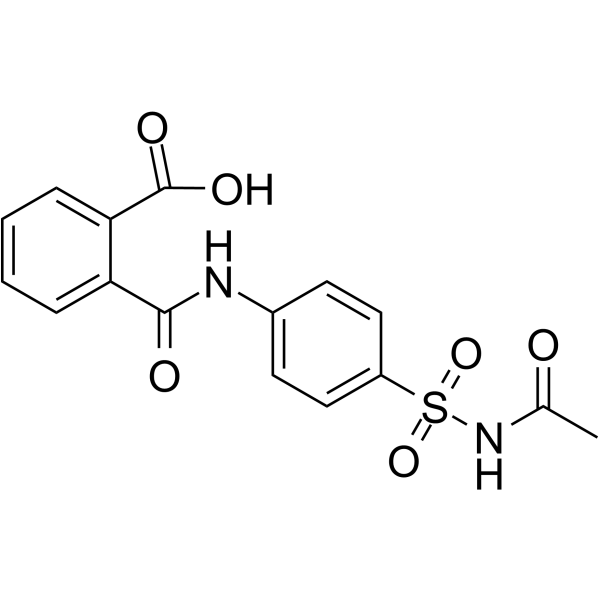
Phthalylsulfacetamide

Based on 1 Customer Validation
Phthalylsulfacetamide is an orally active sulfonamide antibiotic and New Delhi metallo-β-lactamase-1 (NDM-1) inhibitor with an IC50 of 15.4 μM. Phthalylsulfacetamide stably binds to the active hydrolysis center of NDM-1, interacts with Zn2+, and interacts with key amino acid residues Val73 and His122 to inhibit enzyme activity. Phthalylsulfacetamide can be used for the research of Escherichia coli infection.
For research use only. We do not sell to patients.
- Purity : 98.0%
- CAS No.: 131-69-1
- Formula: C16H14N2O6S
- Molecular Weight:362.36
-
Storage:Powder -20°C, 3 years , 4°C, 2 years ; In solvent -80°C, 2 years , -20°C, 1 year

To place orders, for customer services and technical support, please contact: MedChemExpress USA
Tel: 609-228-6898 E-mail: [email protected] [email protected]


-
 Biological Activity
-
Chemical Information
-
Solvent & Solubility
- Protocols
- Purity & Documentation
- References
-
 Help & FAQs


All Antibiotic Isoforms
More

Biological Activity
Description
In Vitro
Phthalylsulfacetamide (4-128 μM) potently inhibits purified recombinant NDM-1 enzyme activity with an IC50 of 15.4 μM[1].
Phthalylsulfacetamide (16 h) alone exhibits negligible intrinsic antibacterial activity against NDM-1-positive Escherichia coli with an MIC of 512 μg/mL[1].
Phthalylsulfacetamide (16 h) acts synergistically with Meropenem (HY-13678) against NDM-1-positive Escherichia coli, reducing Meropenem's MIC by 32-fold with an FICI of 0.156[1].
Phthalylsulfacetamide (64 μg/mL), when combined with Meropenem, rapidly eliminates NDM-1-positive Escherichia coli within 3 h, with no regrowth observed[1].
Phthalylsulfacetamide (1-8 mg/mL; 24 h) exhibits no significant cytotoxicity toward mouse small intestinal mucosal epithelial cells[1].
MedChemExpress (MCE) has not independently confirmed the accuracy of these methods. They are for reference only.
-
Cell Line:mouse small intestinal mucosal epithelial cells
-
Concentration:1 mg/mL; 2 mg/mL; 4 mg/mL; 8 mg/mL
-
Incubation Time:24 h
-
Result:Resulted in a cell survival rate exceeding 95% at concentrations up to 8 mg/mL, with no significant reduction in cell viability (P > 0.05).
In Vivo
Phthalylsulfacetamide (20 mg/kg; i.g.; every 12 hours; 6 doses), when combined with Meropenem, increases survival rate to 70% in mice with lethal systemic NDM-1-positive E. coli infection[1].
Phthalylsulfacetamide (20 mg/kg; i.g.; every 12 hours; 6 doses), when combined with Meropenem, reduces bacterial load, white blood cell counts, and proinflammatory cytokine levels, and alleviates histopathological damage in mice with sublethal systemic NDM-1-positive E. coli infection, while monotherapy only reduces small intestine bacterial load[1].
MedChemExpress (MCE) has not independently confirmed the accuracy of these methods. They are for reference only.
-
Animal Model:BALB/c (female, 6-8 weeks old, 18-20 g, intraperitoneal inoculation with NDM-1-positive *E. coli*)[1]
-
Dosage:5 mg/kg; 10 mg/kg; 20 mg/kg
-
Administration:i.g.; every 12 hours; 6 doses
-
Result:Produced the most significant reduction in white blood cell counts, bacterial loads in liver, spleen, and small intestine tissues, and serum levels of proinflammatory cytokines TNF-α, IL-1β, and IFN-γ at 20 mg/kg when combined with Meropenem (P < 0.05).
-
Animal Model:SPF BALB/c (6-8 weeks old, intraperitoneal inoculation with lethal dose of NDM-1-positive *E. coli*)[1]
-
Dosage:20 mg/kg
-
Administration:i.g.; every 12 hours; 6 doses
-
Result:Resulted in a 70% survival rate at 120 hours post-infection when combined with Meropenem, which was significantly higher than the 20% survival rate of infection controls (P < 0.01).
Did not significantly improve survival as monotherapy compared to infection controls.
-
Animal Model:SPF BALB/c (6-8 weeks old, intraperitoneal inoculation with sublethal dose of NDM-1-positive *E. coli*)[1]
-
Dosage:20 mg/kg
-
Administration:i.g.; every 12 hours; 6 doses
-
Result:Significantly reduced bacterial load in the small intestine as monotherapy (P < 0.05).
Significantly reduced white blood cell counts, bacterial loads in liver, spleen, and small intestine tissues, and serum levels of proinflammatory cytokines TNF-α, IL-1β, and IFN-γ when combined with Meropenem (P < 0.05).
Significantly ameliorated histopathological damage to liver, spleen, and small intestine tissues, restoring tissue architecture to near-normal levels, and restored the integrity of small intestine villus ultrastructure with neatly arranged brush borders when combined with Meropenem.


Chemical Information
-
CAS No. 131-69-1
-
Appearance Solid
-
Molecular Weight 362.36
-
Formula C16H14N2O6S
-
Color White to off-white
-
SMILES
O=C(O)C1=CC=CC=C1C(NC2=CC=C(S(=O)(NC(C)=O)=O)C=C2)=O
-
Shipping
Room temperature in continental US; may vary elsewhere.
-
Storage
Powder -20°C 3 years 4°C 2 years In solvent -80°C 2 years -20°C 1 year


Solvent & Solubility
In Vitro:
DMSO : 25 mg/mL (68.99 mM; Need ultrasonic; Hygroscopic DMSO has a significant impact on the solubility of product, please use newly opened DMSO)
H2O : 1 mg/mL (2.76 mM; ultrasonic and warming and heat to 80°C)
Please refer to the solubility information to select the appropriate solvent. Once prepared, please aliquot and store the solution to prevent product inactivation from repeated freeze-thaw cycles.
Storage method and period of stock solution: -80°C, 2 years; -20°C, 1 year. When stored at -80°C, please use it within 2 years. When stored at -20°C, please use it within 1 year.
* Note: If you choose water as the stock solution, please dilute it to the working solution, then filter and sterilize it with a 0.22 μm filter before use.
Please refer to the solubility information to select the appropriate solvent. Once prepared, please aliquot and store the solution to prevent product inactivation from repeated freeze-thaw cycles.
Storage method and period of stock solution: -80°C, 2 years; -20°C, 1 year. When stored at -80°C, please use it within 2 years. When stored at -20°C, please use it within 1 year.
* Note: If you choose water as the stock solution, please dilute it to the working solution, then filter and sterilize it with a 0.22 μm filter before use.
Concentration (start) × Volume (start) = Concentration (final) × Volume (final)
In Vivo:
Select the appropriate dissolution method based on your experimental animal and administration route.
- For the following dissolution methods, please ensure to first prepare a clear stock solution using an In Vitro approach and then sequentially add co-solvents:
- To ensure reliable experimental results, the clarified stock solution can be appropriately stored based on storage conditions. As for the working solution for In Vivo experiments, it is recommended to prepare freshly and use it on the same day.
- The percentages shown for the solvents indicate their volumetric ratio in the final prepared solution. If precipitation or phase separation occurs during preparation, heat and/or sonication can be used to aid dissolution.
Add each solvent one by one: 10% DMSO 40% PEG300 5% Tween-80 45% Saline
Solubility: ≥ 2.5 mg/mL (6.90 mM); Clear solution
This protocol yields a clear solution of ≥ 2.5 mg/mL (saturation unknown).
Taking 1 mL working solution as an example, add 100 μL DMSO stock solution (25.0 mg/mL) to 400 μL PEG300, and mix evenly; then add 50 μL Tween-80 and mix evenly; then add 450 μL Saline to adjust the volume to 1 mL.
Preparation of Saline: Dissolve 0.9 g sodium chloride in ddH₂O and dilute to 100 mL to obtain a clear Saline solution.
Add each solvent one by one: 10% DMSO 90% (20% SBE-β-CD in Saline)
Solubility: ≥ 2.5 mg/mL (6.90 mM); Clear solution
This protocol yields a clear solution of ≥ 2.5 mg/mL (saturation unknown).
Taking 1 mL working solution as an example, add 100 μL DMSO stock solution (25.0 mg/mL) to 900 μL 20% SBE-β-CD in Saline, and mix evenly.
Preparation of 20% SBE-β-CD in Saline (4°C, storage for one week): 2 g SBE-β-CD powder is dissolved in 10 mL Saline, completely dissolve until clear.
In Vivo Dissolution Calculator
Please enter the basic information of animal experiments:
-
-
-
-
Recommended: Prepare an additional quantity of animals to account for potential losses during experiments.
Please enter your animal formula composition:
-
%DMSO +
Recommended: Keep the proportion of DMSO in working solution below 2% if your animal is weak.
-
%+
-
+%Tween-80 + +
-
%Saline +
The co-solvents required include: DMSO, . All of co-solvents are available by MedChemExpress (MCE). , Tween 80. All of co-solvents are available by MedChemExpress (MCE).
Working solution concentration: 0.22 mg/mL
Method for preparing stock solution: mg drug dissolved in μL DMSO. Stock solution concentration: mg/mL.
1. Take μL DMSO stock solution;
2. Add μL .
μL , mix evenly;
3. Then add μL Tween 80, mix evenly;
4. Then add μL
Please ensure that the stock solution in the first step is dissolved to a clear state, and add co-solvents in sequence. You can use ultrasonic heating (ultrasonic cleaner, recommended frequency 20-40 kHz), vortexing, etc. to assist dissolution.


Purity & Documentation
-
Data Sheet (280 KB)
-
SDS (254 KB)
- English - EN (254 KB)
- Français - FR (254 KB)
- Deutsch - DE (254 KB)
- Norwegian - NO (254 KB)
- Español - ES (254 KB)
- Swedish - SV (254 KB)
- Italian - IT (254 KB)
- Korean - KR (254 KB)
- Portuguese - PT (254 KB)
-
Handling Instructions (2659 KB)
References


Complete Stock Solution Preparation Table
Please refer to the solubility information to select the appropriate solvent. Once prepared, please aliquot and store the solution to prevent product inactivation from repeated freeze-thaw cycles.
Storage method and period of stock solution: -80°C, 2 years; -20°C, 1 year. When stored at -80°C, please use it within 2 years. When stored at -20°C, please use it within 1 year.
| Optional Solvent | Concentration Solvent Mass | 1 mg | 5 mg | 10 mg | 25 mg |
|---|---|---|---|---|---|
| H2O / DMSO | 1 mM | 2.7597 mL | 13.7984 mL | 27.5969 mL | 68.9922 mL |
| DMSO | 5 mM | 0.5519 mL | 2.7597 mL | 5.5194 mL | 13.7984 mL |
| 10 mM | 0.2760 mL | 1.3798 mL | 2.7597 mL | 6.8992 mL | |
| 15 mM | 0.1840 mL | 0.9199 mL | 1.8398 mL | 4.5995 mL | |
| 20 mM | 0.1380 mL | 0.6899 mL | 1.3798 mL | 3.4496 mL | |
| 25 mM | 0.1104 mL | 0.5519 mL | 1.1039 mL | 2.7597 mL | |
| 30 mM | 0.0920 mL | 0.4599 mL | 0.9199 mL | 2.2997 mL | |
| 40 mM | 0.0690 mL | 0.3450 mL | 0.6899 mL | 1.7248 mL | |
| 50 mM | 0.0552 mL | 0.2760 mL | 0.5519 mL | 1.3798 mL | |
| 60 mM | 0.0460 mL | 0.2300 mL | 0.4599 mL | 1.1499 mL |
* Note: If you choose water as the stock solution, please dilute it to the working solution, then filter and sterilize it with a 0.22 μm filter before use.


Phthalylsulfacetamide Related Classifications
HY-B0967 Related Classifications
 Powered by Bioz