



Autophagy
Autophagy is a conserved cellular degradation and recycling process in the lysosome. In mammalian cells, there are three primary types of autophagy: microautophagy, macroautophagy, and chaperone-mediated autophagy (CMA). Microphagy captures cargoes by means of invaginations or protrusions of the lysosomal membrane directly, CMA uses chaperones to identify cargo proteins and then unfolds and transfers them into the lysosomal, while macroautophagy sequesters cargo by autophagosomes-de novo synthesized of double-membrane vesicles-and subsequently transport it to the lysosome.
Macroautophagy is the best studied and it occurs at a low level constitutively and can also be further induced under stress conditions, such as nutrient or energy starvation with a salient feature of autophagy protein degradation. Stress-induced macrophagy plays an important role in protein catabolism with another key protein degradation pathway, the ubiquitin–proteasome system (UPS).
As the study progressed, autophagy gains its importance under basal, nutrient-rich conditions, and is now recognized as a critical housekeeping pathway in catabolism of diverse cellular constituents, such as protein aggregates (aggrephagy), lipid droplets (lipophagy), iron complex (Ferritinophagy) and carbohydrate. Except for macromolecules, autophagy can also target several organelles and structures, such as mitochondria (mitophagy), peroxisome (pexophagy), endoplasmic reticulum (reticulophagy or ER-phagy), ribosome (ribophagy), spermatozoon-inherited organelles following fertilization (allophagy), secretory granules within pancreatic cells (zymophagy) and intracellular pathogens (xenophagy).
Autophagy and its dysfunction are associated with a variety of human pathologies, including ageing, cancer, neurodegenerative disease, heart disease and metabolic diseases, such as diabetes. Plenty of drugs and natural products are involved in autophagy modulation through multiple signaling pathways. Small molecules that can regulate autophagy seem to have great potential to intervene such diseases in animal models or clinical courses.
All Product Categories
-
Autophagy Inhibitors
(468)
View all products
-
Autophagy Agonists
(6)
View all products
-
Autophagy Activators
(123)
View all products
-
Autophagy Modulators
(59)
View all products
-
Autophagy Chemicals
(2)
View all products
-
Autophagy Inducers
(2175)
View all products
-
Autophagy Controls
(5)
View all products
-
Autophagy Ligand
(1)
View all products
-
Autophagy Related Products (3367)
Related Products (3367)

-
Antibodies (31)
-
Autophagy Signaling Pathway
-
Imiquimod-d7
 0 ImagesCat. No.: HY-B0180S2Synonyms: R 837-d7Imiquimod-d7 (R 837-d7) is deuterium labeled Imiquimod. Imiquimod (R 837), an immune response modifier, is a selective toll like receptor 7 (TLR7) agonist. Imiquimod exhibits antiviral and antitumor effects in vivo. Imiquimod can be used for the research of external genital, perianal warts, cancer and COVID-19.
-
Omeprazole-d3 sodium
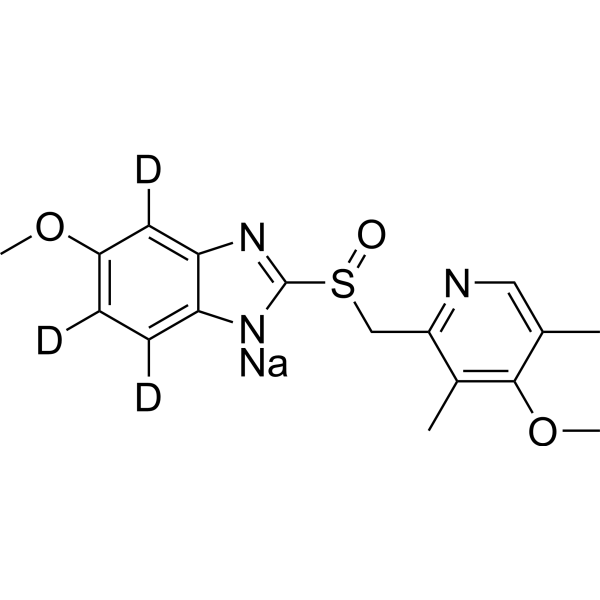 0 ImagesCat. No.: HY-B0113S4Synonyms: H 16868-d3 sodiumOmeprazole-d3 sodium is deuterated labeled Omeprazole (HY-B0113). Omeprazole sodium (H 16868) is an orally active H+,K+-ATPase inhibitor and a proton pump inhibitor. Omeprazole sodium competitively inhibits CYP2C19, CYP3A4, and CYP2C9 activity. Omeprazole sodium inhibits gastric acid secretion and can be used for acid-related gastrointestinal disorders. Omeprazole sodium inhibits pancreatic cancer cell proliferation, induces apoptosis, autophagosome accumulation (elevated LC3-I and LC3-II levels), oxidative stress, and cytogenetic imbalance, modulates lysosomal transport, reduces inflammatory cytokines. Omeprazole sodium alters small intestinal morphology and magnesium absorption, and induces gastric mucosa morphologic changes. Omeprazole sodium aslo has neuroprotective and antibacterial effects.
-
Desethyl chloroquine diphosphate (Standard)
 0 ImagesDesethyl chloroquine (diphosphate) (Standard) is the analytical standard of Desethyl chloroquine (diphosphate). This product is intended for research and analytical applications. Desethyl chloroquine diphosphate is a major desethyl metabolite of Chloroquine. Chloroquine diphosphate is an inhibitor of autophagy and toll-like receptors (TLRs). Desethyl chloroquine diphosphate possesses antiplasmodic activity.
-
SR-18292 (Standard)
 0 ImagesSR-18292 (Standard) is the analytical standard of SR-18292 (HY-101491). This product is intended for research and analytical applications. SR-18292 is a PPAR gamma coactivator-1α (PGC-1α) inhibitor, which increases PGC-1α acetylation, suppresses gluconeogenic gene expression and reduces glucose production in hepatocytes.
-
Temozolomide (Standard)
 0 ImagesSynonyms: NSC 362856 (Standard); CCRG 81045 (Standard); TMZ (Standard)Temozolomide (Standard) is the analytical standard of Temozolomide. This product is intended for research and analytical applications. Temozolomide (NSC 362856) is an oral active DNA alkylating agent that crosses the blood-brain barrier. Temozolomide is also a proautophagic and proapoptotic agent. Temozolomide is effective against tumor cells that are characterized by low levels of O6-alkylguanine DNA alkyltransferase (OGAT) and a functional mismatch repair system. Temozolomide has antitumor and antiangiogenic effects.
-
8-Nitro-cGMP
 0 ImagesCat. No.: HY-134314CAS No.: 913645-39-38-Nitro-cGMP is an electrophilic second messenger of redox signaling that can form a protein-S-cGMP adduct in s-guanylation process. 8-Nitro-cGMP is an autophagy inducer. 8-Nitro-cGMP promotes RANKL-induced osteoclast differentiation from macrophages. 8-Nitro-cGMP has vasodilator effect, and ameliorates the vascular endothelial dysfunction in diabetic mice.
-
Sildenafil-d5
 0 ImagesCat. No.: HY-15025S3CAS No.: 951385-70-9Synonyms: UK-92480-d5Sildenafil-d5 (UK-92480-d5) is deuterium labeled Sildenafil. Sildenafil (UK-92480) is a potent phosphodiesterase type 5 (PDE5) inhibitor with an IC50 of 5.22 nM.
-
Saracatinib (Standard)
 0 ImagesSynonyms: AZD0530 (Standard)Saracatinib (Standard) is the analytical standard of Saracatinib. This product is intended for research and analytical applications. Saracatinib (AZD0530) is a potent Src family inhibitor with IC50s of 2.7 to 11 nM for c-Src, Lck, c-YES, Lyn, Fyn, Fgr, and Blk. Saracatinib shows high selectivity over other tyrosine kinases.
-
Lys01
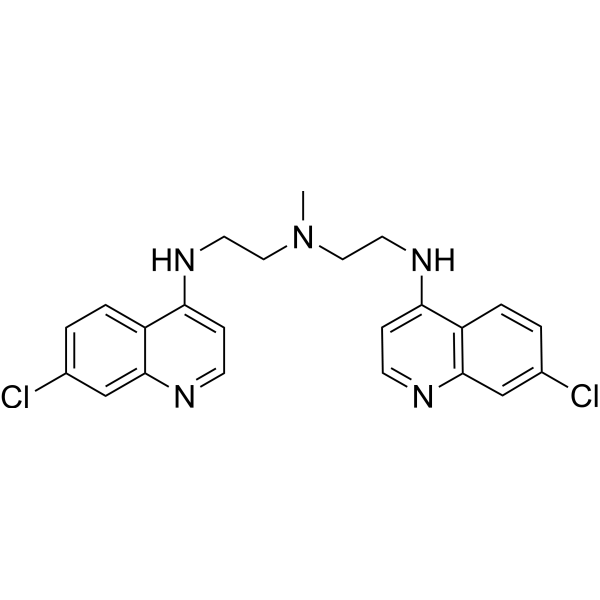 0 ImagesCat. No.: HY-12855CAS No.: 1391426-22-4Lys01, a dimeric form of Chloroquine (HY-17589A), is an autophagy inhibitor. Lys01 inhibits cell viability of 1205Lu, c8161, LN229, HT-29 cells with IC50s of 3.6, 3.8, 7.9, 6.0 μM. Lys01 can be used for anticancer research.
-
[Cu2Cl2(4'-(4-Methoxy-1-naphthyl)-terpy)2](PF6)2
2](https://file.medchemexpress.com/product_pic/hy-158117.gif "Click to View [Cu2Cl2(4'-(4-Methoxy-1-naphthyl)-terpy)2](PF6)2 Product Detail") 0 ImagesCat. No.: HY-158117[Cu2Cl2(4'-(4-Methoxy-1-naphthyl)-terpy)2](PF6)2 (Compound 3) is a copper complex, which inhibits cell viability of HCT116, HCT116DoxR, A2780 and fibroblasts, with IC50s of 0.13, 0.15, 0.66 and 6.24 μM, respectively. [Cu2Cl2(4'-(4-Methoxy-1-naphthyl)-terpy)2](PF6)2 induces apoptosis and autophagy, and arrests cell cycle at G0/G1 phase in HCT116DoxR. [Cu2Cl2(4'-(4-Methoxy-1-naphthyl)-terpy)2](PF6)2 exhibits antimetastatic efficacy.
0 ImagesCat. No.: HY-158117[Cu2Cl2(4'-(4-Methoxy-1-naphthyl)-terpy)2](PF6)2 (Compound 3) is a copper complex, which inhibits cell viability of HCT116, HCT116DoxR, A2780 and fibroblasts, with IC50s of 0.13, 0.15, 0.66 and 6.24 μM, respectively. [Cu2Cl2(4'-(4-Methoxy-1-naphthyl)-terpy)2](PF6)2 induces apoptosis and autophagy, and arrests cell cycle at G0/G1 phase in HCT116DoxR. [Cu2Cl2(4'-(4-Methoxy-1-naphthyl)-terpy)2](PF6)2 exhibits antimetastatic efficacy.
-
Aliskiren hemifumarate (Standard)
 0 ImagesSynonyms: CGP 60536 hemifumarate (Standard); CGP60536B hemifumarate (Standard); SPP 100 hemifumarate (Standard)Aliskiren (hemifumarate) (Standard) is the analytical standard of Aliskiren (hemifumarate). This product is intended for research and analytical applications. Aliskiren (CGP 60536; CGP60536B; SPP 100) hemifumarate is an orally active and selective renin inhibitor, with IC50 of 1.5 nM. Aliskiren hemifumarate can be used for the research of hypertension, cardiovascular diseases and cancer cachexia.
-
FAAH-IN-2 (Standard)
 0 ImagesCat. No.: HY-79511RCAS No.: 184475-71-6Synonyms: O-Desmorpholinopropyl Gefitinib (Standard)
-
TA-02 (Standard)
 0 ImagesTA-02 (Standard) is the analytical standard of TA-02 (HY-100115). This product is intended for research and analytical applications. TA-02, an analog of SB 203580 (HY-10256), is a p38 MAPK inhibitor with an IC50 of 20 nM. TA-02 especially inhibits TGFBR-2. TA-02 exhibits similar cardiogenic properties as SB 203580 and SB 202190 (HY-10295).
-
Isoliquiritigenin (Standard)
 0 ImagesSynonyms: GU17 (Standard); ISL (Standard); Isoliquiritigen (Standard); SJ000286237 (Standard)Isoliquiritigenin (Standard) is the analytical standard of Isoliquiritigenin. This product is intended for research and analytical applications. Isoliquiritigenin is an anti-tumor flavonoid from the root of Glycyrrhiza uralensis Fisch., which inhibits aldose reductase with an IC50 of 320 nM. Isoliquiritigenin is a potent inhibitor of influenza virus replication with an EC50 of 24.7 μM.
-
Tazarotene-13C6
 0 ImagesCat. No.: HY-15388S2Synonyms: AGN 190168-13C6Tazarotene-13C6 (AGN 190168-13C6) is 13C labeled Tazarotene. Tazarotene (AGN 190168) is a selective retinoic acid receptor (RAR) agonist for the treatment of plaque psoriasis and acne vulgaris. Tazarotene is a click chemistry reagent, it contains an Alkyne group and can undergo copper-catalyzed azide-alkyne cycloaddition (CuAAc) with molecules containing Azide groups.
-
NAcM-OPT hydrochloride
 0 ImagesCat. No.: HY-111505ACAS No.: 2416146-10-4NAcM-OPT (hydrochloride) is a protein interaction inhibitor. NAcM-OPT (hydrochloride) can disrupt the interaction between DCN1 and UBC12, with an IC50 value of 80 nM. NAcM-OPT (hydrochloride) can protect keratinocytes from H2O2-induced cell damage by promoting autophagy.
-
Silmitasertib (Standard)
 0 ImagesSynonyms: CX-4945 (Standard)Silmitasertib (Standard) is the analytical standard of Silmitasertib. This product is intended for research and analytical applications. Silmitasertib (CX-4945) is an orally bioavailable, highly selective and potent CK2 inhibitor, with IC50 values of 1 nM against CK2α and CK2α'.
-
10074-G5 (Standard)
 0 ImagesCat. No.: HY-100996RCAS No.: 413611-93-5
-
SD 0006 (Standard)
 0 ImagesCat. No.: HY-11087RCAS No.: 271576-80-8Synonyms: SD-06 (Standard)
-
Nesolicaftor (Standard)
 0 ImagesCat. No.: HY-111680RCAS No.: 1953130-87-4Synonyms: PTI-428 (Standard)Nesolicaftor (Standard) is the analytical standard of Nesolicaftor (HY-111680). This product is intended for research and analytical applications. Nesolicaftor (PTI-428) is a specific cystic fibrosis transmembrane conductance regulator (CFTR) amplifier.




