



Bacterial
Anything that destroys bacteria or suppresses their growth or their ability to reproduce. Heat, chemicals such as chlorine, and antibiotic drugs all have antibacterial properties. Many antibacterial products for cleaning and handwashing are sold today. Such products do not reduce the risk for symptoms of viral infectious diseases in otherwise healthy persons. This does not preclude the potential contribution of antibacterial products to reducing symptoms of bacterial diseases in the home.
All Product Categories
-
Bacterial Inhibitors
(7521)
View all products
-
Bacterial Agonists
(3)
View all products
-
Bacterial Antagonists
(9)
View all products
-
Bacterial Activators
(24)
View all products
-
Bacterial Modulators
(27)
View all products
-
Bacterial Chemicals
(2)
View all products
-
Bacterial Inducers
(7)
View all products
-
Bacterial Controls
(14)
View all products
-
Bacterial Substrates
(2)
View all products
-
Bacterial Ligand
(1)
View all products
-
Bacterial Related Products (8852)
Related Products (8852)

-
Antibodies (14)
-
Related Compound Screening Libraries (1)
-
Ochracenomicin C
 0 ImagesCat. No.: HY-N14347CAS No.: 164177-47-3Ochracenomicin C is found in the strain of Amicolatopsis sp. MJ 950-891. Ochracenomicin C has a weak antibacterial effect.
-
Ilicicolin B
 0 ImagesCat. No.: HY-114708CAS No.: 22581-07-3Synonyms: LL-Z 1272βIlicicolin B (LL-Z 1272β) inhibits Bacillus carbonifera with the concentration of 6 μg/mL and its toxic concentration to Hela cells is 0.3 μg/mL.
-
LysRs-IN-4
 0 ImagesCat. No.: HY-175503CAS No.: 2973324-63-7LysRS-IN-4 (Compound 49) is an orally active Mycobacterium tuberculosis LysRS (lysyl-tRNA synthetase) inhibitor. LysRS-IN-4 is promising for research of tuberculosis.
-
Antibacterial agent 282
 0 ImagesCat. No.: HY-174326Antibacterial agent 282 (Compound CP7), a seleno-Ciprofloxacin (HY-B0356) derivative, is an Antibacterial agent. Antibacterial agent 282 has significant antibacterial activity against gram-positive bacterium and gram-negative bacterium with MICs of 0.1-1.56 and 0.1-3.13 μg/mL, respectively (MBCs of 0.2-1.56 and 0.39-12.5 μg/mL). Antibacterial agent 282 potently disrupts and prevents biofilms formation of P. aeruginosa. Antibacterial agent 282 shows significant inhibitory activity towards the DNA gyrase from E. coli.
-
NSC10010 hydrochloride
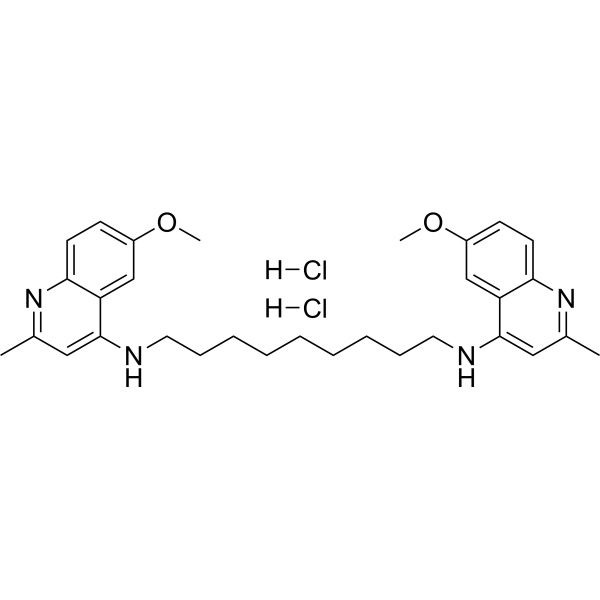 0 ImagesNSC10010 hydrochloride inhibits gammaherpesvirus associated B-lymphomas growth through activation of NF-kB and c-Myc-mediated signaling pathways. NSC10010 hydrochloride induces necrotic cell death in gammaherpesvirus infected B-cells. NSC10010 hydrochloride is also an inhibitor of Mtb ClpC1 ATPase.
-
Antimycobacterial agent-14
 0 ImagesCat. No.: HY-179532Antimycobacterial agent-14 (compound 20s) is an antimycobacterial agent with potent activity against Mycobacterium tuberculosis (M.tb) H37Ra strain with a MIC of 11.37 μM. Antimycobacterial agent-14 can be used for tuberculosis (TB) research.
-
Cinnatriacetin B
 0 ImagesCat. No.: HY-N14137CAS No.: 244277-15-4Cinnatriacetin B is found in the strain of Fistulina hepatica. Cinnatriacetin B has only anti-Gram-positive bacterial activitys.
-
Dactylocycline E
 0 ImagesCat. No.: HY-126579CAS No.: 146064-01-9Dactylocycline E has anti-Gram-positive bacteria activity.
-
(±)-Menthyl acetate
 0 Images(±)-Menthyl acetate is a menthol acyl derivative (monoterpene ester) and antibacterial agent found in the essential oil of Mentha arvensis L.. (±)-Menthyl acetate inhibits growth of Gram-positive bacterial strains including Streptococcus mutans, Mycobacterium smegmatis, Enterococcus faecalis, Staphylococcus aureus, and Bacillus subtilis. (±)-Menthyl acetate is inactive against tested fungal strains. (±)-Menthyl acetate can be used in the research of Gram-positive bacterial infections.
-
Phenylmercuriurea
 0 ImagesPhenylmercuriurea is an organomercurial fungicide. Phenylmercuriurea exerts antifungal and antibacterial effects by inhibiting the activity of key enzymes via the binding of mercury ions to sulfhydryl groups of microbial proteins. Phenylmercuriurea can be used in studies related to infections caused by phytopathogenic fungi and bacteria.
-
Enamidonin
 0 ImagesCat. No.: HY-N5190CAS No.: 2271109-33-0Enamidonin is a lipopeptide antibiotic. Enamidonin inhibits EGF-dependent [3H] thymidine involvement in Balb/MK cells (IC50 is 10 μg/mL), and it can restore the deformed SRCTS-NRK form to the normal flat form (ED50 is 10 μg/mL). No antimicrobial activity.
-
Fenbenicillin potassium
 0 ImagesSynonyms: Phenbenicillin potassium; α-Phenoxybenzylpenicillin potassiumFenbenicillin (Phenbenicillin) potassium is semi-synthetic penicillin with antibacterial effecst.
-
IMB-XMA0038
 0 ImagesCat. No.: HY-W026339CAS No.: 921812-26-2IMB-XMA0038 is a MtASADH inhibitor with an IC50 value of 0.59 μg/mL. IMB-XMA0038 inhibits various agent-resistant Mycobacteria tuberculosis potently with MICs of 0.25-0.5 μg/mL. IMB-XMA0038 shows anti-tuberculosis activity.
-
Dalfopristin mesylate
 0 ImagesCat. No.: HY-A0241ASynonyms: RP54476 mesylateDalfopristin (RP54476) mesylate is a semisynthetic sulfone antibiotic. Dalfopristin mesylate alone has limited antibacterial activity, but synergistically with Quinupristin it has significant bactericidal activity against many pathogenic Gram-positive cocci.

-
Coriolin B
 0 ImagesCat. No.: HY-N14029CAS No.: 33400-89-4Coriolin B has anti-Gram-positive bacteria, negative bacteria (weak), yeast and vaginal trichomoniasis activities. Coriolin B of 5 μg/mL can inhibit the growth of yoshida sarcoma 61.6%. Coriolin B has no inhibitory effect on Ehrlich ascites carcinoma in animals.
-
Rifamycin dibenzylamide
 0 ImagesCat. No.: HY-187549CAS No.: 17607-39-5Rifamycin dibenzylamide is an orally active Antibiotic. Rifamycin dibenzylamide inhibits the growth of Gram-positive bacteria, Gram-negative bacteria, and Mycobacterium tuberculosis. Rifamycin dibenzylamide exhibits protective activity against experimental Staphylococcal infections in mice. It can be used in studies related to Staphylococcal infections and Mycobacterium tuberculosis infections.
-
Albonoursin
 0 ImagesAlbonoursin, a microbial secondary metabolite, is an antibacterial peptide. Albonoursin displays antibacterial and antitumor activities.
-
Clindamycin palmitate hydrochloride (Standard)
 0 ImagesCat. No.: HY-B1454RCAS No.: 25507-04-4Clindamycin palmitate (hydrochloride) (Standard) is the analytical standard of Clindamycin palmitate (hydrochloride). This product is intended for research and analytical applications. Clindamycin palmitate hydrochloride is a hydrochloride salt of the ester of clindamycin and palmitic acid and it is an antibacterial agent. Clindamycin palmitate hydrochloride is inactive in vitro, rapid in vivo hydrolysis converts this compound to the antibacterially active clindamycin.
-
MAC-0040599
 0 ImagesCat. No.: HY-187233CAS No.: 28783-31-5MAC-0040599 is a synthetic antibacterial compound that exhibits inhibitory effects against various strains including Burkholderia cenocepacia K56-2 and Pseudomonas aeruginosa. MAC-0040599 can be used in studies related to bacterial infections.




